~Why do we need "local money" now?~
Indeed, the yen that we use every day is an extremely convenient tool that has the same value whether in Tokyo, Okinawa, or on Amazon's website.However, on the other hand, the convenience of being able to use it anywhere also means that it can easily be carried away anywhere.
For this reason, the biggest challenge facing local economies is often explained by the "leaky bucket" theory. For example, no matter how much water (money) is poured into a local bucket through tourism or subsidies, if there is a hole at the bottom in the form of "payments to foreign capital" or "online shopping," the water will continue to flow out without accumulating.
In other words, community currency is a device that plugs the hole in this bucket and forces money to circulate within the community.This is not simply an alternative means of payment. Rather, it is an attempt to restore the "blood circulation of the community" that has become diluted in the midst of global capitalism.
In this article, we first look back at the legendary experiment of the 1930s, then take a bird's-eye view of the latest digital technology and a new initiative in Toyako Town, Hokkaido, and finally unravel the true potential of community currencies.
Chapter 1: History proves the power of "money circulation"
In fact, the history of community currencies is long and dramatic. They originated as a prescription for the recession and inequality we face today.
1. The "Wörgl Miracle" - A town saved by rotten money
When talking about community currencies, it is impossible to avoid the example of the small Austrian town of Wörgl, which was in the midst of the Great Depression in 1932. At the time, unemployment was rising and the town was on the verge of bankruptcy."Stamp currency (money that depreciates 1% every month)"He came up with a clever idea:
structure
People could not hoard it because the value of the money would decrease if they kept it, so they used it as soon as they received their paycheck to pay taxes or buy things.
result
While legal tender was hoarded in banks, local currencies were circulated at a ferocious pace. As a result, the velocity of circulation was higher than that of legal tender.Approximately 14 timeshas been reached.
results
As a result, delinquent taxes were paid off, infrastructure was improved, and unemployment dramatically improved—a phenomenon that would later be called a "miracle."
2. Lessons from Japan's Failure
On the other hand, Japan also experienced a boom in the 2000s, but many of them were forced to cease operations. The main reasons for their failure are as follows:
| Relying on volunteers | The management of paper tickets and the process of exchanging them for cash were complicated, and as a result, the administrative burden on the operators exceeded their limits. |
|---|---|
| Lack of use | It could be used for mutual aid activities such as "shoulder patting," but it could not be used for daily grocery purchases (commercial use), so it did not have any economic potential. |
| temporary | It was operated as a kind of "premium gift certificate" that relied on subsidies, and as a result, the sense of value disappeared and use of the system ceased. |
Chapter 2: How digital technology has changed the ecosystem of local currencies
However, in the latter half of the 2010s, a "black ship" arrived that completely changed this situation: the spread of smartphones. Digitalization dramatically improved cost structures and convenience.
Gifu "Sarubobo Coin"
First, a local credit union took the lead in securing the exchange rate of 1 coin = 1 yen. Furthermore, they established a system that allowed for remittances between participating stores (B2B) and enabled stores to use the coins they received for purchasing.
German "Chiemgauer"
On the other hand, in Germany, a fee of 5% is charged when cashing. To avoid this fee, stores do not convert the currency into cash but instead reuse it for payments to wholesalers. As a result, the currency has a circulation speed approximately three times faster than that of the euro.
Chapter 3: Case Study: Toyako Town's "Toya Coin"
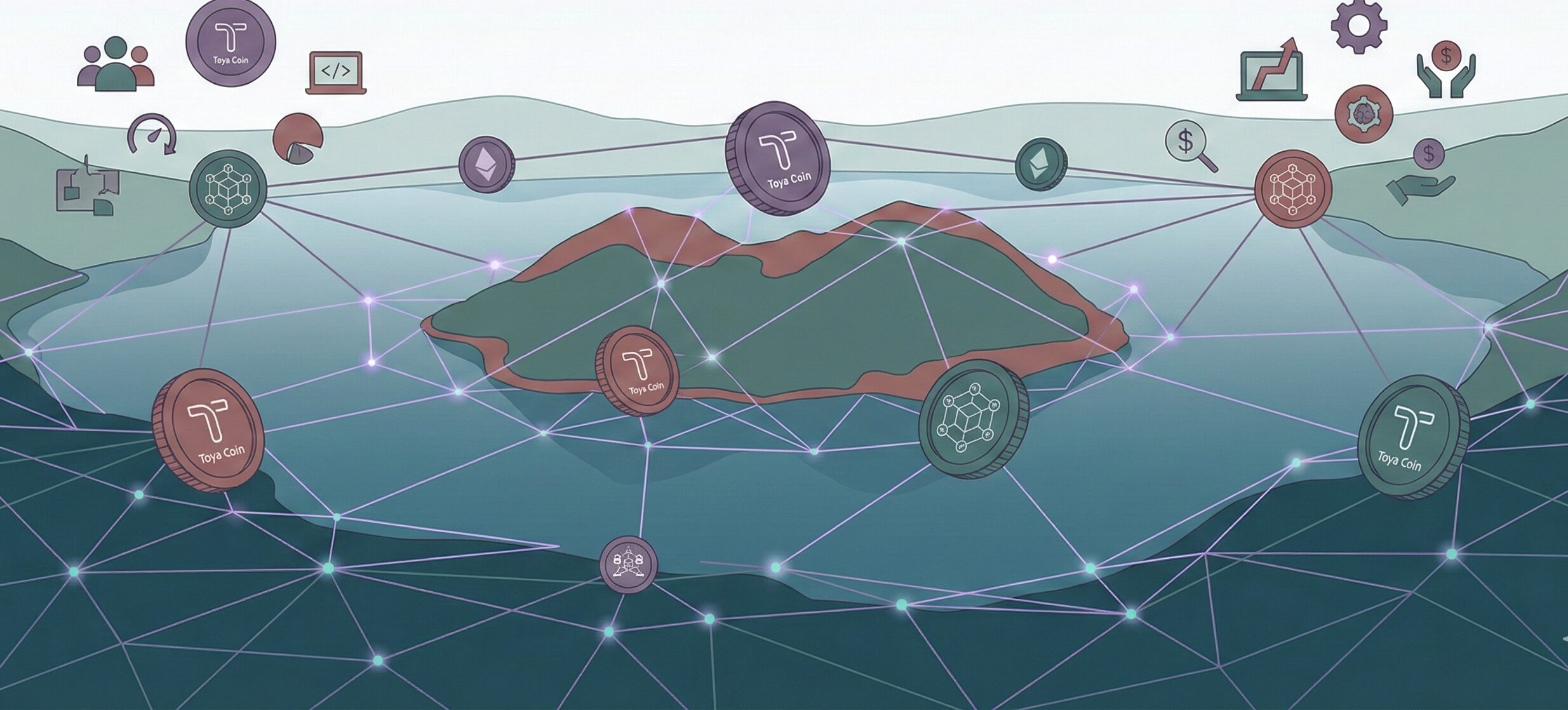
Against this backdrop, Toyako Town in Hokkaido, a tourist destination with a population of approximately 8,400, will launch a digital local currency in 2025."Touya Coin"has started.
Currently, basic functions such as payment via smartphone app, equivalent exchange of 1 point = 1 yen, and awarding of government points have already been implemented.However, government-led projects always carry the risk that "when the budget runs out, so does the relationship."
For example, will users abandon the service when the tax money that provides the premium runs out? Also, who will continue to cover the operating costs? Therefore, we need a key to break through this barrier of "sustainability," and that is the idea behind DAO (Decentralized Autonomous Organization), which will be explained in the next chapter.
Chapter 4: Leaping into the future - The "Toya DAO" concept and digital villagers
Now, here is the new development that is the core of this article. Rather than ending up with a simple "means of payment with benefits," we will evolve the local currency into a tool for "governance" by all people involved in the community. In other words,Community Currency DAOThis is a possibility.
1. What is a DAO? —A "Digital Neighborhood Association"
A DAO is an organization that uses blockchain technology to operate autonomously through consensus among participants without a designated leader.In short, when applied to local currency, this can be described as a system in which people who hold the currency can vote to decide the management policies and budget usage of the local area.
2. Turning tourists into "shareholders" – Token economy
Toyako Town's greatest asset is the tens of thousands of tourists it receives each year, so by introducing the DAO system, we will transform them from mere "customers" into "regional managers."
Issuance of Digital Villager Rights (NFT)
First, we will sell membership rights in the form of NFTs and governance tokens (coins with voting rights) to Toyako fans, allowing them to become "digital villagers" even if they do not physically live there.
Decide how to spend the budget by voting
Next, a portion of the transaction fees is deposited into a "community vault." Coin holders then vote on a project in the app, such as "stocking the lake with young fish" or "making the fireworks festival more spectacular."
"Automated Contribution" through Smart Contracts
Furthermore, if the "litter picking" is verified via GPS, coins will be awarded immediately. This is to provide incentives transparently on the blockchain without human intervention.
As a result, tourists will return to see the fireworks they voted for. In other words, they will transform from being merely a source of spending money into stakeholders who work together to improve the local area.
Chapter 5: The merits and demerits of local currencies and challenges facing DAOs
Of course, a DAO is an ideal scenario, but there are high hurdles to implementing it. Here we will summarize the benefits and challenges.
| Benefits (Advanced Version) | Disadvantages and challenges |
|---|---|
|
Elimination of the feeling of being forced to do something It wasn't something that was decided by the government. It's a project that was decided by people themselves, and that's why the enthusiasm is maintained. |
Legal grey area There are still some areas of legislation in the works regarding the legal status of DAOs and the tax treatment of tokens, so careful design is required. |
|
Obtaining external funding Investors from all over the world will purchase tokens in anticipation of the region's future prospects, making it possible to raise funds without relying on local government finances. |
Technology barriers Concepts such as "wallet" are difficult for the general public to understand, so it is essential to design a UI that does not distract from the underlying technology. |
Conclusion: From currency to the revitalization of the "commons"
The people of Völgur once survived the Depression with a depreciating currency, and now Toyako Town has a new weapon: blockchain and DAO.
Ultimately, the goal of "Touya Coin" is not just a cashless app. It is a platform for local residents and fans from around the world to cooperate in protecting, nurturing, and sharing the value of the local commons, such as beautiful lakes and hot springs."Digital Square"is.
Tourists will leave saying "I'm home" instead of "I'll come again." Then they'll open an app and vote on "How do we allocate the budget for next month's festival?" This sci-fi-like future is certainly beginning to emerge as an extension of local currencies.
In conclusion, changing the form of money is a challenge to update the form of community and the form of democracy itself.
Related Links
- Toyako Town, Hokkaido Official Website
- Research Institute of Economy, Trade and Industry (RIETI) – Research on local currencies and economic circulation
- Yamakoshi Village (Nishikigoi NFT) – A pioneering example of regional revitalization through DAO
Inquiries and requests
We help solve local issues.
Please feel free to contact us even if it is a small matter.