〜Could the government's "Digital Garden City-State Initiative" be a trump card for rural areas facing declining populations?〜
*This article is based on published materials and historical documents as of December 2025.
"The marriage of city and country. From this joyous union come new hopes, new lives, and new civilizations."
These are famous words written by Ebenezer Howard, a British thinker known as the father of modern urban planning, in his 1898 book Tomorrow: A Peaceful Path to True Reform. The Industrial Revolution had caused overcrowding in London, which was covered in soot, and poverty-stricken rural areas to be devastated. Howard proposed the concept of the "Garden City" as a "third way" to resolve these polarized social issues.
Now, more than a century later, these words have once again found themselves at the heart of Japan's national strategy: the "Digital Garden City-State Concept." However, we must calmly reexamine the question: Why has the "dream new town," which was once aimed at through the development of physical infrastructure, now transformed into an "old town" where aging and loneliness are rampant?
This article returns to Howard's original meaning and examines the distortions in Japan's reception historically. Furthermore, it uses the perspective of specific fieldwork in Toyako Town, Hokkaido, to unravel, based on detailed data and facts, how digital technology is rewriting the future of rural areas by nullifying the "constraints of distance."
1. The Origin of the Ideal: Howard's "Three Magnets" and the Economic System
First, we need to clarify the original definition of "garden city," which many people misunderstand. In modern Japan, the term is often used to conjure up the image of a quiet, luxurious residential area lush with greenery. However, what Howard envisioned was not simply a plan to develop a commuter town. It was an extremely radical "social reform program" that even included changes to land ownership and the redistribution of wealth.
"Three Magnets" for Diagnosing Society
Howard used a diagram called "Three Magnets" to analyze British society at the time, which explained the gravitational forces that people were drawn to.
Who receives the "land benefits"?
Even more important is its economic mechanism. The greatest innovation in Howard's vision was the "public ownership (or sharing) of land."
In conventional urban development, as a city develops and land prices rise, the profits (capital gains) go into the pockets of the landowners and developers. However, in Garden City, the land continues to be owned by a trust organization, and residents live on rent. Any increase in land prices due to the city's development is collected as "rent," which is reinvested in the city's infrastructure, social welfare, and the maintenance of green spaces.
In other words, the "local circulation of profits system" is the heart of a garden city; without it, it would be nothing more than a suburban residential area. Letchworth, the world's first garden city, built in 1903, has continued to maintain its rich financial base and green spaces even now, more than 100 years later, thanks to this system.
2. Acceptance and transformation in Japan: The light and shadow of new towns
On the other hand, when we look back at the history of the garden city concept in Japan, we can see a clear ``distortion in acceptance.''
The fatal choice of "separating work and residence"
From the end of the Meiji period through the Taisho period, Denen Toshi Co., Ltd., founded by Eiichi Shibusawa and others, developed what are now Tokyo's Ota and Meguro wards (including Denenchofu). While these were certainly groundbreaking developments with well-equipped water and sewerage systems and street trees, they were essentially "bedroom towns" for the wealthy who commuted to the megalopolis of Tokyo. The aspects Howard placed the greatest importance on, such as "living close to work" and "self-sustaining cities," had already receded at this point.
This trend accelerated further during the postwar period of rapid economic growth. Large-scale developments such as Tama New Town and Senri New Town were carried out, primarily by the Japan Housing Corporation (now the Urban Renaissance Agency). These were designed as gigantic "bedrooms" without any urban functions (places to work), with the top priority being to "ensure quantity" in order to alleviate the national housing crisis of a housing shortage.
The reality of "old townization" as seen through data
More than half a century has passed since the development of these "new towns," and they are now at a serious turning point. The same generation that moved in en masse is now aging all at once, causing the towns to lose their vitality rapidly.
[Visualization: Transition from New Town to Old Town]
(maturity stage)
(Outflow period)
(the current)
According to a survey of new town areas in Tama City (research conducted by Tama University and others), areas that saw a rapid increase in residents early on have seen extremely high rates of aging, with neighborhood centers (shopping streets) becoming deserted and elementary and junior high schools being merged and closed one after another. An urban structure that specializes only in "living" and does not provide "jobs" has revealed the vulnerability of losing its economic base as residents retire.
3. Digital Garden City-State Concept: Challenging Physical Constraints
With physical urban development reaching a deadlock, the "Digital Garden City-State Concept" was launched by the Kishida administration in 2021 and has been continued by the Ishiba administration. This is not simply an IT policy. It is a renewed attempt using technology to solve the difficult problem of "combining urban convenience with rural prosperity," a problem that has remained unsolved for the past 100 years.
A paradigm shift that rewrites the concept of "distance"
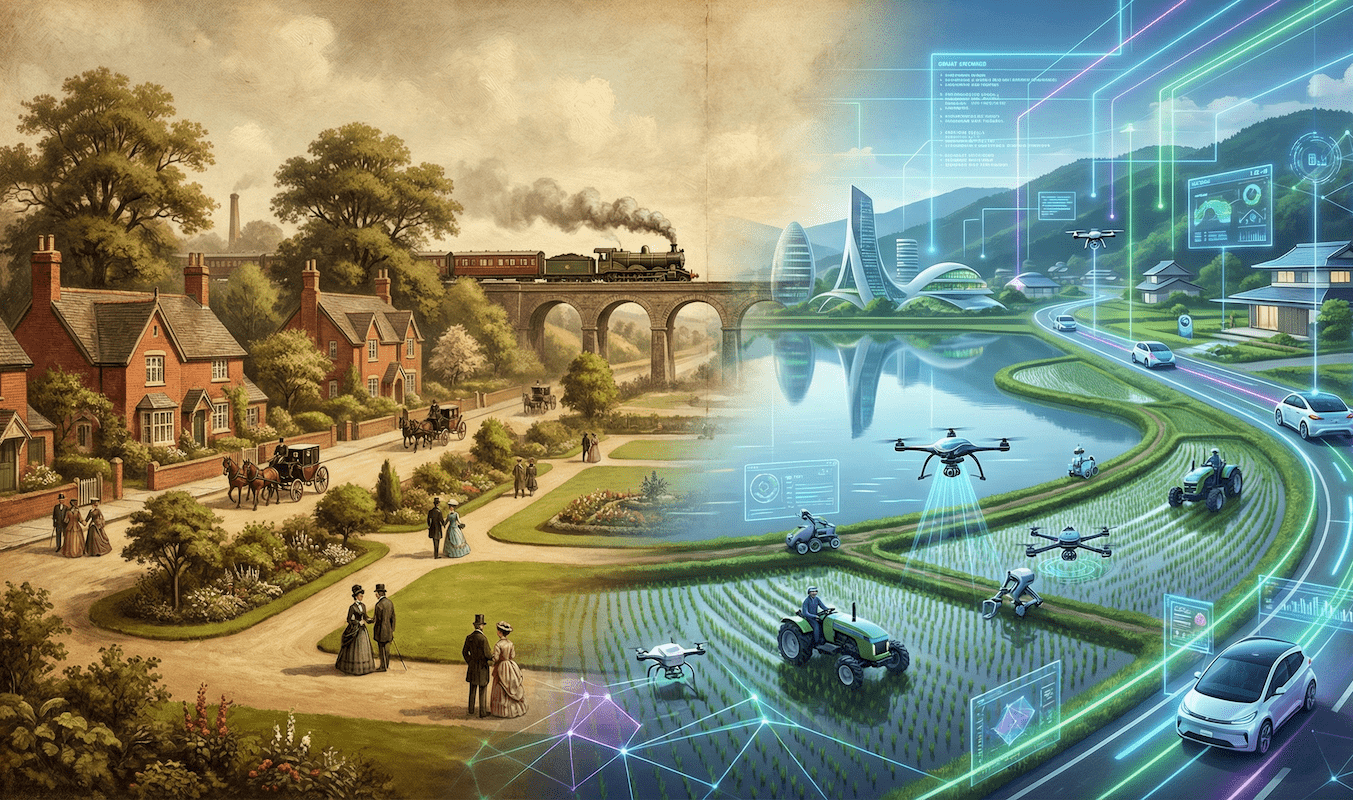
While traditional garden cities emphasized physical connections through railways and roads, modern concepts emphasize connections in cyberspace through "high-speed communication networks (optical fiber, 5G)" and "data sharing platforms."
For example, until now, the equation "living in rural areas = no jobs and inconvenient medical care" held true. However, technologies such as remote work, telemedicine, drone delivery, and autonomous driving make it possible to enjoy the same services as in cities without having to travel physically. This means that digital technology will fill the "lack of opportunity," which was the greatest disadvantage of rural areas in Howard's "three magnets" diagram.
Comparative analysis: British model vs. Japanese model
So, what are the characteristics of this new Japanese concept compared to the original garden city concept? We have summarized them in the comparison table below.
| Comparison items | [UK] Letchworth (Howard's model) |
[Japan] Digital Garden City (Modern policy model) |
|---|---|---|
| Means of connection | Physical railways and roads (Physical Connectivity) |
Fiber optics, 5G, and data (Digital Connectivity) |
| economic resources | Land rental income. Run and reinvested by an independent foundation. |
Government grants and subsidies. The challenge is to break away from dependence on tax revenue. |
| Key challenges | Residents oppose new development. The difficulty of managing urban growth. |
The digital divide. Secure maintenance costs after system implementation. |
| Our goal | Work and home proximity A self-sustaining medium-sized city. |
No matter where you live, you won't have any inconveniences. A decentralized network society. |
*You can scroll left and right to view tables and graphs.
4. Report from the Field: The Challenge of Toyako Town, Hokkaido
Talking only about theory tends to be empty. Let's take a look at the example of Toyako Town in Hokkaido to see how the Digital Garden City concept is being implemented in an actual local government.
Toyako Town, located in the Iburi region of Hokkaido, is one of Japan's leading tourist destinations, boasting a beautiful caldera lake and hot springs. However, behind this lies the reality of a serious population decline. According to estimates by the National Institute of Population and Social Security Research, the population in 2040 will be 1.2 times that of 2015.Reduced to about 60% of the original levelThis is predicted to happen, and the shortage of workers in the tourism and agricultural industries is at a critical level.
In response to this issue, Toyako Town has formulated a "DX Promotion Plan" and, despite the difficulty of rapidly increasing the physical population (migration), has begun creating a system that will increase the satisfaction of the visiting population and enable the community to function even with a small number of people.
[Challenges: Concerns about overtourism and labor shortages]
There is a risk of lower satisfaction due to tourists concentrating in certain times and places, while accommodation facilities and restaurants are experiencing opportunity losses due to chronic staff shortages.
[Solution: Data-driven tourism destination management and workation]
Optimize marketing by analyzing people flow data and attribute dataWe aim to allocate staff efficiently according to demand.By developing a communications environment and satellite offices as a mecca for "workation" and increasing the number of long-term guests, the hotel will increase weekday occupancy rates and average customer spending.
What is noteworthy is that this is not just about "introducing a convenient tool." Just as Howard once disliked overcrowding in cities, Toyako Town is using digital technology toThe resort proposes a new style of stay (Workation) that allows people to "enjoy a vacation while working," and aims to provide tourists with "quiet lakeside time" and residents with "a stable local economy."This could be said to be a modern version of garden city management, aiming to shift from "quantity (simple number of tourists)" to "quality (average spending and satisfaction)."
The challenge of moving away from subsidy dependency
However, challenges remain. DX projects in many local governments, including Toyako Town, are primarily funded by the national government's "Digital Garden City Nation Initiative Grant" and "Regional Revitalization Special Grant." While Letchworth is self-sustaining through revenue from its land, the Japanese model remains dependent on financial transfers from the central government.
Even if the initial costs of introducing the system can be covered by subsidies, how will the renewal and maintenance costs (running costs) be covered in the years to come? Unless the "profit-making power" that uses data to generate unique revenue for the region can be implemented, the Digital Garden City will also face the same obstacles to sustainability as the new towns of the past.
"Digital" is a means, and the goal is to "restore humanity"
Looking back at the rise and fall of the garden city concept over the past 100 years, one truth emerges: many of the failures in urban planning have occurred when economic rationality has been prioritized too much, while "human life" and "community" have been neglected.
Japan's new towns functioned as a means to efficiently send labor to large cities, but they were not designed to ensure the happiness of the people who would spend their retirement years there.
The aim of the Digital Garden City-State initiative today is not simply to provide Wi-Fi to rural areas or to enable people to carry out work from Tokyo in rural areas. It is to use digital technology to eliminate the noise of "inconvenience" and "loneliness" and to restore the "joy of living with nature" and "face-to-face relationships" that are innate to humans.
Just as Toyako Town aims to become a smart resort, when digital technology plays a supporting role in supporting analog happiness, perhaps Howard's dream of a "marriage between urban and rural areas" will finally come true in modern Japan. We are now in the midst of a social experiment that will take more than 100 years.
Related Links
- Cabinet Secretariat: Digital Garden City-State Vision Realization Council
- Letchworth Garden City Heritage Foundation
- Ministry of Land, Infrastructure, Transport and Tourism: Regeneration of suburban housing estates, etc.
Inquiries and requests
We help solve local issues.
Please feel free to contact us even if it is a small matter.