〜Through a dialogue between classical ideals and the harsh reality of snowy and volcanic regions, we unravel the philosophy of "coexistence" that modern cities should strive for.〜
*This article is based on information as of December 2025.
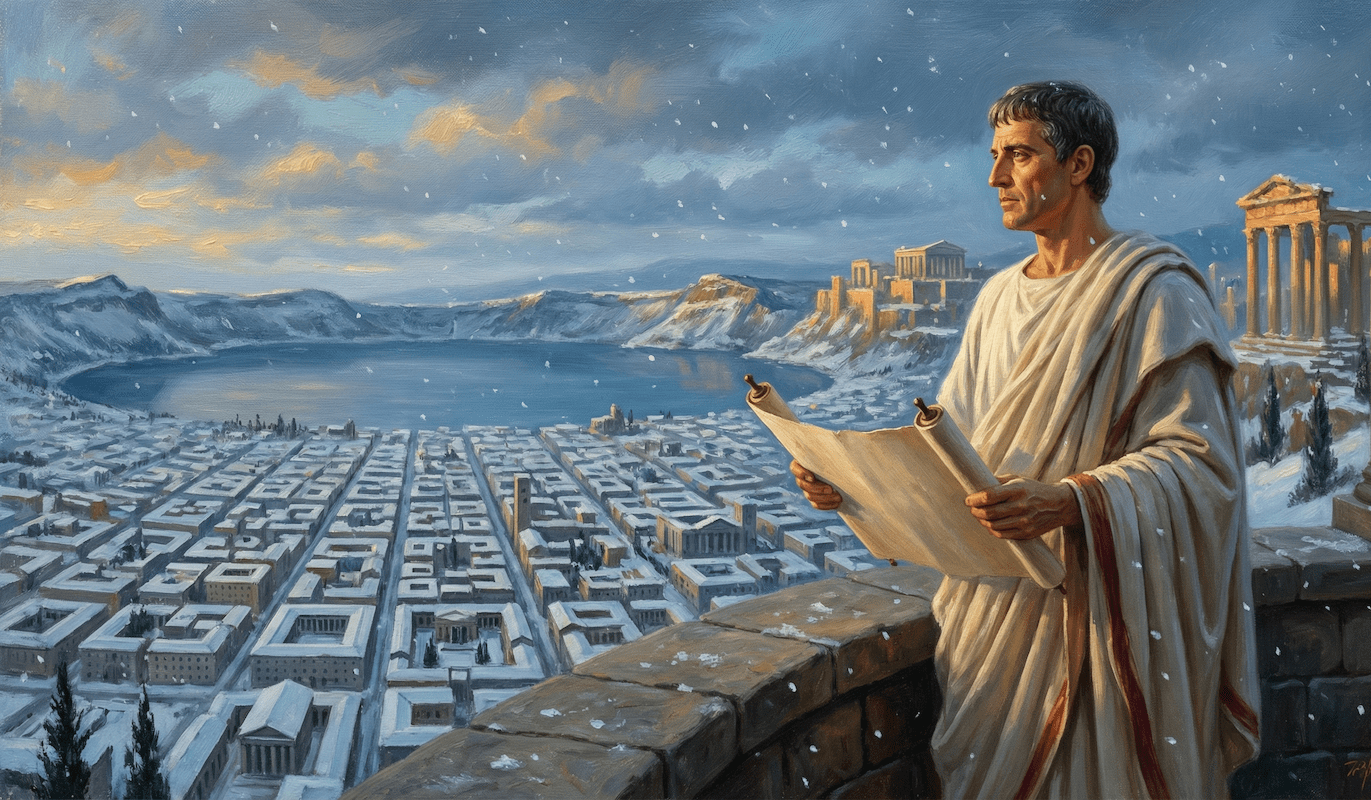
If an architect who lived in the Roman Empire 2,000 years ago were to travel through time and space and land in Hokkaido in the winter, what would he say about the sight that unfolded before his eyes?
He would probably look at Sapporo's cityscape and exclaim in admiration at its geometric beauty: the orderly grid pattern, the straight line of Odori Park, because it seems to him the very embodiment of reason, so beloved by the Romans.
But moments later, as a fierce seasonal wind blows in from the northwest, he will no doubt grimacing and exclaim:
"Why bother building a wind passage? The city itself is like a giant wind tunnel."and.
His name was Marcus Vitruvius Pollio, author of De Architectura, the oldest surviving architectural theory book in the Western world. This book, which he dedicated to Emperor Augustus in the 1st century BC, has remained a holy text on urban planning and a bible for architects throughout the Renaissance and up to the present day. In particular, the three principles he advocated - "Strength (Firmitas), Use (Utilitas), and Beauty (Venustas)" - have become universal evaluation criteria for all designs.
However, theories are always destined to collide with the harsh environment of reality and be forced to change. How is Vitruvius's ideal, which was based on the warm climate of the Italian peninsula, being applied to the field of Toyako Town in Hokkaido, where people must coexist with extreme cold, heavy snow, and active volcanoes? How has it evolved through "creative misinterpretation"?
In this article, we compare and examine modern town development in northern Japan from various angles, drawing on ancient Roman wisdom. What emerges is not simply a historical comparison, but a grand drama of "environmental adaptation" that shows how humans have interacted with nature and expanded their realm of survival.
1. The Geometry of Wind and Streets: Rome in Flee, Hokkaido in Opposition
When planning a city, what should be considered first? Is it the price of land or the accessibility of transportation? Vitruvius' answer was something more fundamental: the wind.
Vitruvius' warning: "Don't invite the wind in"
In the sixth chapter of Book 1 of his Ten Books on Architecture, "On the Direction of the Streets and the Winds," Vitruvius writes that the first step in urban planning is to divide the streets within the city walls."You can't have the streets facing the wind."He strongly asserts that:
According to his theory, wind is a "flowing wave of air," and although its movement is invisible, it is a physical force that determines the sanitary environment of a city. What would happen if a street were designed to face the direction of the prevailing wind (the wind that blows most frequently) in the area? The street itself would become what physics calls a "wind tunnel."
The wind, blowing through the straight, unobstructed roads, penetrates deep into the city without slowing down. Vitruvius warned:
- "Cold winds are uncomfortable and make life difficult."
- "Hot winds weaken people."
- "Damp wind is bad for your health."
He therefore recommended orienting streets "in the middle" of the main wind direction, i.e., orienting them so that the wind hits the corners of buildings (block corners), thereby breaking up and diffusing the force of the wind and preventing it from blowing directly into alleys and houses. This can be said to be a precursor to what is called "passive design" in modern environmental engineering.
He actually cited the city of Mytilene on the island of Lesbos as an example, criticizing it for lacking "prudentia" (care) in its layout planning, no matter how beautifully and magnificently constructed it may have been. His description of how "when the south wind blew, people fell ill; when the northwest wind blew, they coughed; when the north wind blew, they recovered, but the bitter cold made it impossible for them to even stand in the streets and alleys" seems to predict the scene of a modern-day winter in Sapporo.
Hokkaido's fight against snow and the trade-offs it has made
Now, let's look at the major cities of Hokkaido that were built after the Meiji period, particularly Sapporo. Planned by the Hokkaido Development Commission, this city is a typical grid city (goban-style) that is precisely based on the cardinal directions of north, south, east, and west.
From a Vitruvian perspective, this is an extremely "risky" layout because the long, straight streets face directly or at an angle to the northwesterly monsoons that prevail in Hokkaido in winter, maintaining the wind speed and drawing cold air into the city.
So why did the pioneers of Hokkaido choose this structure? There was a variable unique to northern regions that Vitruvius had not anticipated: snow accumulation.
In Hokkaido's urban planning, the top priority in winter is not "wind control" but "maintaining traffic functions," i.e."Snow removal efficiency"Let's check the comparison in the table below.
| Comparative Perspective | [Vitruvius's Theory] | [The reality in Sapporo, Hokkaido] |
|---|---|---|
| Street direction | Off-axis The emphasis is on breaking the wind at the corners of the building and diffusing its momentum. |
Directly facing north, south, east and west (Cardinal) The grid was emphasized as a symbol of modernization and ease of land surveying. |
| Priority | Health and livability (shelter function) The top priority is to protect citizens walking outdoors from the wind. |
Function and efficiency (logistics and snow removal space) The top priority is to prevent the paralysis of urban functions during the snowy season. |
| solution | The city's very "layout" protects it from the wind. | This makes it possible to perform mechanical snow removal on straight roads. Wind is prevented by using underground spaces and highly insulated buildings. |
What would have happened if roads had been constructed in complex, winding patterns to protect from the wind, as Vitruvius taught? Huge modern snowplows and snow removal trucks would not have been able to operate smoothly, and managing snow dumps (snow belts) would have been extremely difficult. Straight, clear roads were an essential requirement for maintaining lifelines in snowy regions.
Instead, modern cities have achieved Vitruvian "shelters" in other ways. These include the development of "underground walking spaces (chi-ka-ho)" that completely block winds above ground, and "architectural defenses" that improve the insulation performance of individual buildings. Instead of blocking the wind with urban structures, they protect people with a membrane of technology. This was Hokkaido's answer.
Figure: Comparison of priority parameters in urban planning
2. Managing Beauty (Venustas): From Order to Munsell Values
Next, we will consider one of Vitruvius' three principles, "beauty (Venustas)." In modern times, "beauty" tends to be perceived as subjective, but in ancient Rome, it was based on strict mathematical rules.
For Vitruvius, "beauty" is not a matter of personal sensibility, but an objective"Ratio (Eurythmy)"と"Symmetry"It was.
The thickness and height of temple columns, the distance between them, the extent of the cornice's overhang... all of these had strict mathematical definitions for each order, such as Doric, Ionic, and Corinthian. Adherence to these rules was considered to be the dignity of a city and the "order" that gave citizens a sense of security.
In modern Toyako Town, this "rule of beauty" has taken on a new form."Munsell value"This functions as a numerical management system.
In this town, which is home to Shikotsu-Toya National Park, painting buildings in vibrant colors based on personal preference is not permitted, as there is a clear aesthetic here that says the natural landscape should take center stage and man-made structures should remain in the background.
The dignity of the landscape protected by "10YR 2/1"
Let's take a look at Toyako Town's "Landscape Guidelines" in detail. These specify the colors that can be used on the exterior walls of buildings in great detail using Munsell values, which indicate hue, value, and saturation.
For example, low-saturation (reduced vividness) colors such as "10YR 2/1" are recommended, and conversely, highly saturated primary colors such as red and yellow are generally discouraged. This is a system that puts a stop to commercial signs and architecture that aim to "stand out" within a public framework.
At first glance, this may seem like an excessive restriction on freedom of expression, but just as Vitruvius emphasized the importance of order in public spaces, saying that "temples must have the dignity to be looked up to from anywhere in the town," in Toyako Town, Mt. Yotei, Nakajima Island, and the lake surface itself serve as modern-day temples.
By limiting the height of buildings and unifying the colors to earth tones, the man-made city will blend into the magnificent natural scenery. This is a modern redefinition of "beauty (Venustas)" and the implementation of a highly intellectual design code.
3. Utilitas and Firmitas: Urban Theory of Circulation and Regeneration
Finally, we will explore the surprising similarities and differences between Rome and Toyako Town in terms of urban functionality (Utilitas) and structural strength (Firmitas).
Modern Aqueduct: Centralized Hot Spring Management System
Roman civilization is also known as the "civilization of water." Vitruvius devoted the entirety of Book 8 to water, detailing methods for discovering water sources, testing water quality, and supply systems using long aqueducts. His perspective was even medical, as he even mentioned the potential health hazards of lead pipes (lead poisoning) and recommended the use of ceramic pipes. This is because the fair distribution of water infrastructure is the foundation of a city's functionality (Utilitas).
This spirit continues to be felt in modern Toyako Onsen."Hot spring centralized management hot water distribution system"During the tourism boom of the high economic growth period, hotels competed to drill their own hot springs, which led to a drop in water level and the risk of resource depletion. To prevent this "tragedy of the commons," the town took control of the hot springs and built a system to distribute the hot water to each facility through a huge pipeline.
Furthermore, modern technology has surpassed the Roman ideal. According to documents such as the Toyako Town Waterworks Management Strategy, a system has been introduced to recover and reuse thermal energy from used hot spring wastewater using a heat pump. Resources are not used once and then thrown away, but are thoroughly recycled. This can be said to be an update of ancient wisdom with modern environmental ethics (sustainability).
Strength isn't about not breaking, it's about being able to bounce back
And here in Toyako Town, there is a crucial difference in the concept of "strength (Firmitas)."
Vitruvius aimed to build an "eternal city" that would remain unchanged for hundreds of years by placing the foundations of the building on solid ground and using permanent stone and brick. For him, unstable land (swamps and soft ground) was merely a risk to be avoided.
However, Toyako Town is located at the foot of Mount Usu, an active volcano. Eruptions occur here every few decades (in the 20th century alone, in 1910, 1944, 1977, and 2000), causing the earth itself to rise and change shape. No matter how strong the stonework, it is powerless against the overwhelming power of magma.
The answer that Toyako Town gave to this inevitable fate was something that was unique in the world."Preservation of disaster remains"is.
- The demolished public housing will remain as it is.
- The raised roads and curved railway tracks will be developed into walking paths.
- Plants sprouting from the ruins are shown as a "symbol of rebirth."
This is a dramatic shift from Roman values that sought to conquer and control nature. Based on the premise that "disasters cannot be prevented," even memories of destruction are incorporated as part of the city's identity (assets). The Toyako-Usuzan Geopark's philosophy of "coexistence with the ever-changing earth" teaches us that true "strength" in the modern world lies not in robustness, but in resilience.
Conclusion: Urban Planning as a Dialogue
It has been 2,000 years since Vitruvius wrote "Ten Books on Architecture." While the appearance of cities has changed dramatically thanks to concrete, steel frames, and digital technology, the essence of the challenges we face remains surprisingly unchanged.
it is,"How can humans cope with the overwhelming power of nature?"This is a fundamental question.
The Romans chose to bend their roads to avoid the wind, while the citizens of Sapporo chose to make their roads at right angles to clear the snow. The ancient people piled up stones in search of eternity, while the Toyako townspeople accepted the cycle and chose to live with the ravages of volcanic activity. Their approaches may seem polar opposites, but at their core is the sincere intelligence unique to humans, of listening to the "voices" of the land they live on (wind, snow, heat, crustal movement) and trying to derive optimal solutions within those constraints.
When we talk about "sustainability" in modern business and life, it is not just a slogan; rather, it is the delicate balance between "reverence for nature" and "engineering rationality," as demonstrated by the urban development of Toyako Town, that offers us great insight.
If Vitruvius were to visit Lake Toya today, he might nod in approval at this new interpretation of "strength, utility, and beauty."
Related Links
- Toyako Town Landscape Plan and Landscape Ordinance (Toyako Town Official)
- Lake Toya and Mount Usu Geopark Official Website
- Ministry of Land, Infrastructure, Transport and Tourism: Overview of the City Planning System
Inquiries and requests
We help solve local issues.
Please feel free to contact us even if it is a small matter.