〜Unraveling past failures and successes to create the next generation of "fortresses as systems"〜
*This article is based on statistical data and historical materials as of January 2026.
"Where is Utopia?" This was a never-ending question that people of the Renaissance, a time of both chaos and rebirth, pursued throughout their lives.
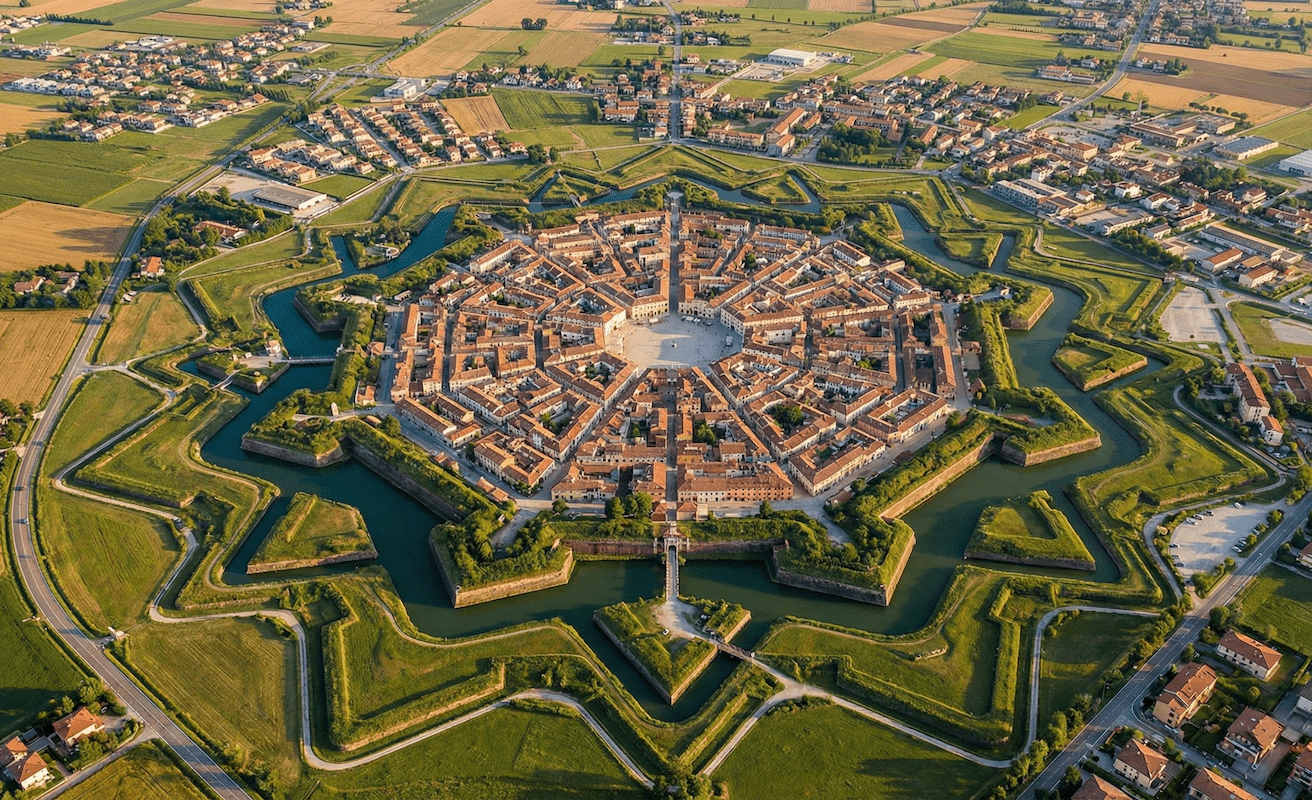
On October 7, 1593, in the Friuli Plain in northeastern Italy, a physical "answer" to this metaphysical question was constructed. The name of the city was Palmanova. It was a perfectly nine-pointed star-shaped fortified city built by the Republic of Venice, known as the Queen of the Adriatic, to counter the threat of the Ottoman Empire approaching from the east.
When viewed from above, the city forms a beautiful star shape that looks like it came straight out of a geometry textbook. It was the pinnacle of military theory (Italian fortification) at the time, and at the same time, it was a grand experimental field for the pursuit of perfect harmony in human society. However, this too-perfect structure paradoxically led to the tragedy of an "uninhabited city."
In modern times, we face new threats such as population decline, overtourism, and natural disasters. This article examines the history and structure of Palmanova in detail, comparing it with Japan's greatest treasure, Goryokaku, and thoroughly examining what suggestions the ideal city of 400 years ago can provide for the type of "sustainable city" that modern-day Toyako Town in Hokkaido and other areas should strive for.
1. Renaissance Dreams and Military Necessities Embodied in Geometry
Painting God's Order on Earth: Combining Beauty and Function
Palmanova's most distinctive feature is its uncompromising geometric structure. At its heart is the hexagonal Piazza Grande, from which six main roads radiate, connecting to the nine bastions on the city's periphery. The city's design was the work of some of the finest architects and military engineers of the time, including Vincenzo Scamozzi and Giulio Savorgnan.
As Thomas More wrote in his 1516 book, Utopia, the humanists of the time firmly believed that "a harmony in the physical environment is the foundation of social tranquility." In Palmanova, all major streets were designed to be the same width (14 meters), and buildings were required to be of uniform height and style. This was based on social engineering intent to eliminate jealousy among citizens and promote equality. It was nothing less than the embodiment of the Renaissance spirit, which sought to recreate the beauty of God's creations on earth.
However, this beautiful star shape is not simply the result of aesthetic pursuit. Its backbone is based on cold, military rationality, namely, "complete elimination of blind spots."
[Diagram: Defensive mechanism of a star fort (bastion style)]
Directly below the wall"Blind spot"becomes
(Cannot attack from above)
From the protruding bastion
"Flanking fire (crossfire)"is possible
Being "invisible" is the strongest shield
While medieval castles competed for height to demonstrate their authority, Palmanova chose to remain underground. From the 15th century onwards, high stone walls, which were easy targets, were too vulnerable to the destructive power of firearms (cannons), which had rapidly developed.
Palmanova was built by digging the entire city into the plain and surrounding it with thick earthworks and moats. This gave it a high level of stealth, making it appear from a distance like a simple forest or rolling hills. Cannonballs were absorbed by the soft earth of the earthworks, greatly reducing their power.
This concept of an "invisible city" is not only a defense against enemies, but also a remarkable visionary concept that is reminiscent of modern environmentally conscious architecture and landscape-focused resort development.
| Comparison items | Medieval castle (vertical stone wall) |
star fortress (Bastion-style castle) |
|---|---|---|
| defensive structure | Tall, vertical stone walls | Low, thick earthworks and bastions |
| Anti-battery capabilities | vulnerable (Easily collapsed by horizontal fire) |
tough (The soil absorbs and disperses the impact) |
| Presence or absence of blind spots | can be (If an enemy lands directly under the wall, they cannot attack.) |
none (flank attack from adjacent bastion) |
| Visibility and symbolism | Showing off one's majesty (Make it tall as a symbol of power) |
Concealment and camouflage (Blends into the landscape to prevent targeting) |
2. A timeless dialogue with Japan's star-shaped fortress, Goryokaku
Approximately 250 years after the completion of Palmanova in Italy, a fortress based on a similar concept appeared in Japan, an island nation in the Far East. This fortress is Goryokaku in Hakodate, Hokkaido. Comparing these two fortresses reveals the spread of technology and the ingenuity of adaptation to the conditions of each country.
Construction start:1593
shape:Nonagon (triple wall)
the purpose:Defense against the Ottoman Empire
Features:This project, funded by the national budget and representing the prestige of the Republic of Venice, was a "complete city" that fully encompassed urban functions, plazas, churches, and other living spaces.
Construction completed:1864
shape:Pentagon (single wall)
the purpose:Relocation and defense of the Hakodate Magistrate's Office
Features:The building was designed by Dutch scholar Takeda Fusaburo, who used European military books of the time, such as "Castle Construction Books," to help him optimize costs and maximize the effectiveness of his limited budget.
The notable difference in "cost performance"
The most praiseworthy aspect of Goryokaku's design is its economic rationality. During the turbulent times of the late Edo period, the shogunate's finances were tight. Comparing the construction costs of Goryokaku with those of the maritime fortress "Shinagawa Battery," which was built in Edo (Tokyo) around the same time, the high level of Takeda Fusaburo's management skills becomes clear.
[Comparison of fortress construction costs at the end of the Edo period (estimated values)]
*Although Goryokaku has a site area about four times larger than that of the battery, costs were dramatically reduced by using a construction method that repurposed excavated soil from the site into earthworks.
*Although the value of one car fluctuates greatly, it is equivalent to a difference in modern value of tens of millions to hundreds of millions of yen.
Takeda Fusaburo avoided costly construction methods such as transporting earth and sand from Mount Hakodate and filling it in, instead opting for the "digging method," which involved digging down the local soil to create a moat and then piling up the soil to create an earthwork. Furthermore, by limiting the use of expensive stone walls to key locations and using earthworks made mostly from hardened grass, he was able to complete a world-class fortress with a site area larger than that of the battery, on a budget about half the cost of the battery.
Meanwhile, another star-shaped fortress, Tatsuoka Castle, located in Saku City, Nagano Prefecture, faced financial difficulties as a small domain with only 16,000 koku of rice. Due to this, the castle's moat was narrow and it was left unfinished at the time of the Meiji Restoration. History has shown, with brutal clarity, how important it is to have the capital and resource allocation necessary to implement the technology, even if the blueprints are in place.
3. Miscalculation and lessons of the "uninhabited utopia"
The decisive gap between hardware and software
Despite Palmanova being a city of such militarily and aesthetically perfection, when it was first built, very few people wanted to live there.
Why? There lies a serious problem, relevant even today, in the mismatch between the "hardware (infrastructure)" and "software (the will of the residents)" of urban planning. The Republic of Venice forced its citizens to live in a geometrically disciplined environment and live on the military front line with a sense of tension. No matter how beautiful the plazas and orderly the roads, if there is a lack of "warmth of life" and "freedom," people will not settle there.
The Venetian government took the situation seriously and in 1622 implemented a drastic policy of forced relocation, amnestying criminals and providing land and materials free of charge. Ironically, the fact that a place designed as an ideal city welcomed prisoners as its first residents points to the limitations of top-down urban development.
Even with today's "smart city" concept, if technology and efficiency take precedence over building a community among the people who live there, we risk repeating the same mistakes.
4. Modern Application: The "Invisible Fortress" in Toyako Town, Hokkaido
So how should we apply the knowledge gained from Palmanova and Goryokaku to urban development in modern-day Hokkaido, particularly in areas like Toyako Town? Two key words emerge: "geometry" and "defense."
A "modern castle wall" called the landscape
While Palmanova protected the city with "physical walls," modern tourist destinations must protect their value with "legal walls (landscape regulations)."
Toyako Town has a topography that can be described as a natural fortress, located within the "natural circle" of a huge caldera lake. To protect this beauty, the Toyako Town Landscape Plan restricts the height of buildings to 10m (or 13m) or less as a general rule, and strictly stipulates that the color of exterior walls must blend in with the surrounding nature based on Munsell values.
This perfectly resonates in a contemporary context with the logic behind Palmanova's earlier decision to keep its buildings low to avoid being seen by its enemies: it defends the territory of its local identity against the modern invasion of uncontrolled development with the invisible wall of legal height restrictions.
Circles and Stars in Action: Geometry Tourism
This geometric characteristic is also a powerful tool in tourism strategies.
- ● Lake Toya:A huge creation of nature"Circle"
- ● Goryokaku:A sophisticated product created by humans"Star"
Hokkaido is home to a gigantic geometric formation of "circles and stars" that is rare even on a global scale. By creating a "Hokkaido Geometry Tour" that combines these formations, and proposing it as an intellectual sightseeing route that goes beyond simply appreciating the scenery, and teaches the functional beauty and historical background hidden in the formations, it will be a powerful hook for intellectually inquisitive travelers such as wealthy Westerners.
Systemic funding and reinvestment
Maintaining historical assets like Palmanova incurs enormous costs. Similarly, maintaining beautiful landscapes also incurs costs. This is where strategic use of "extra-statutory taxes" such as bathing taxes and accommodation taxes becomes important.
In fiscal year 2022, Toyako Town's bathing tax revenue reached approximately 124.35 million yen. By reinvesting this revenue not just in repairing tourist facilities, but also intensively in developing "walkable cities" like Palmanova, for example by burying power lines underground and installing consistent street furniture, the city's brand value will be dramatically improved.
Conclusion: The next generation of fortresses is a "system"
In the past, people built star-shaped walls out of stone and earth to physically protect themselves from invading enemies. However, physical walls cannot protect against the enemies we face in the 21st century, such as population decline, climate change, and the decline of local economies.
The history of Palmanova and the wisdom of Goryokaku teach us the importance of a "design philosophy" that adapts to the environment. A fortress that protects a region today is nothing other than the sum of the following "invisible systems."
- Preventing uncontrolled development, strict but beautiful"Landscape Regulations (Ordinances)"
- Converting external revenues into local capital"Tax Circulation System"
- Proximity of work and home to improve energy efficiency"Compact city structure"
While making the most of the visible castle walls and Goryokaku as tourist resources, we must reinterpret the ideas behind them in a modern way and build the invisible "walls of institutions" as robustly as possible. This will be the only way for regional cities to survive and move closer to becoming ideal cities.
Related Links
- UNESCO World Heritage Center – Venetian Works of Defense
- Hakodate City Official Tourism Information – History of Goryokaku
- Toyako Town Landscape Plan
Inquiries and requests
We help solve local issues.
Please feel free to contact us even if it is a small matter.