〜A real-life model community that proves that high welfare and high profits can coexist〜
*This article is based on information as of January 2026.
When you hear the word "utopia," what kind of scenery comes to mind?
An unrealistic dreamland, or an impossible utopia. Indeed, the word "autopos" comes from the Greek word meaning "nowhere." However, if we look back at history, there are rare examples of people actually building such "nowheres" and even turning them into "business models that generate enormous profits."
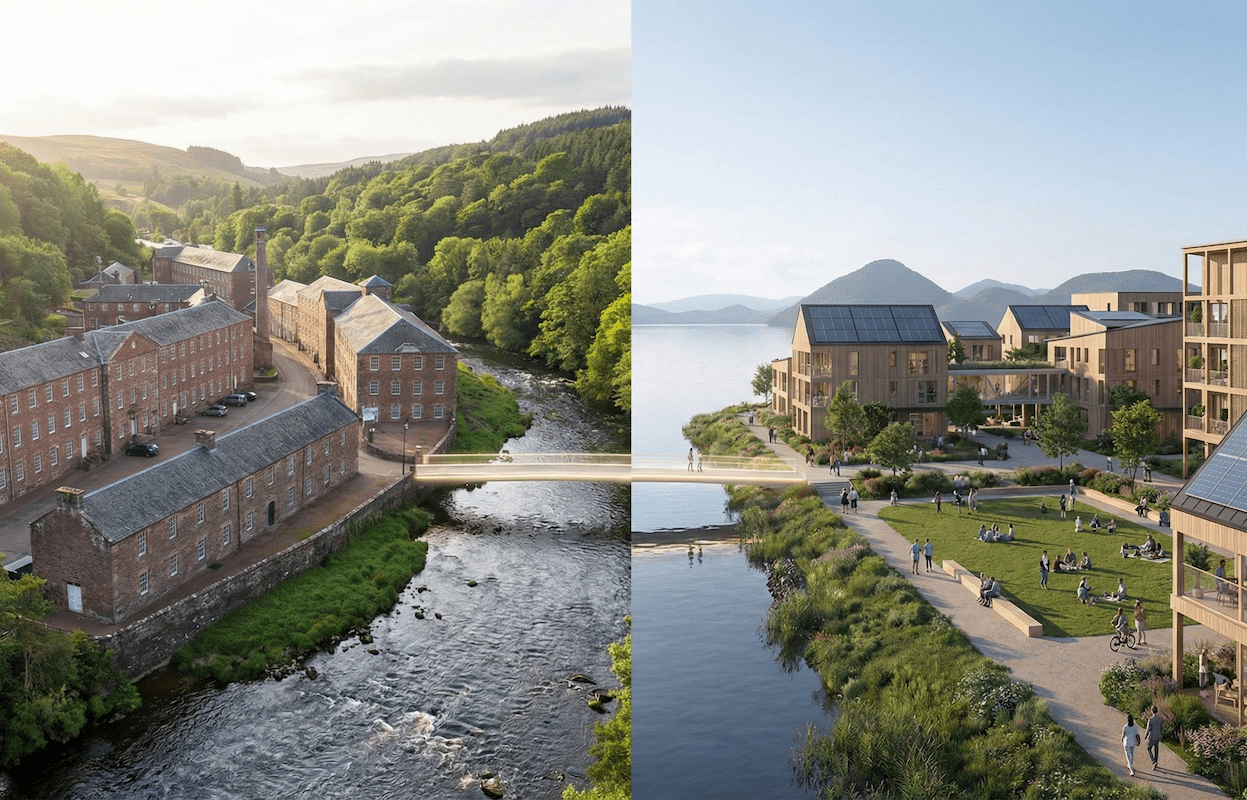
This is New Lanark, built by Robert Owen in the early 19th century in Britain, in the midst of the Industrial Revolution.
This spinning mill village, located in a Scottish valley, was more than just a production base. At a time when harsh child labor was commonplace, it was the world's first large-scale social experiment, thoroughly designing education, living environments, and employee benefits based on the hypothesis that "the happiness of workers is the greatest profit for a company."
Why dig deeper into the story of a spinning mill that is over 200 years old now?
This is because Owen's practice is surprisingly vivid and full of practical suggestions when considering the future of modern Japan, a country facing a declining population, a shift in industrial structure, and the need to redefine the meaning of work, and particularly the town of Toyako in Hokkaido where we live.
This paper provides a detailed analysis of Robert Owen's ideas and the New Lanark system, proposing community design as "social common capital" that can be applied to modern urban development.
1. Building a "utopia" as a business strategy: the full picture of New Lanark
Robert Owen is often labeled a "utopian socialist" in textbooks, but in reality he was an extremely cool-headed and rational businessman. The reforms he carried out at New Lanark should be seen as a precursor to what we now call "human capital management" and "Creating Shared Value (CSV)," rather than as a charitable endeavor based on philanthropy.
Geographical background and current location of World Heritage Sites
First, let's look at the geography of New Lanark, the setting of the story. It is located about 40km southeast of Glasgow, Scotland, in a valley ideal for water-powered spinning, taking advantage of the rapids of the River Clyde.
Founded by David Dale in 1785 and taken over by Owen in 1800, the village is now a UNESCO World Heritage Site. What's particularly noteworthy is that it's not just a "ruin," but a "living museum" where people still live, a hotel operates, and the hydroelectric power plant is still in operation. This clearly demonstrates how sustainable Owen's design was.
Radical reform based on "environmental determinism"
The British industrial world at the time was a miserable one: workers were treated like "living tools," forced into filthy slums, and many turned to alcohol. However, Owen had one strong belief.
"A man's character is formed not by himself, but by his environment"
In other words, his theory of "environmental determinism" is that workers' bad behavior is not due to their personalities, but to the poor working conditions they live in. Based on this theory, he made dramatic improvements to the working environment, as can be seen in the comparison table below.
| Comparison items | A typical factory at the time (Early 19th century, England) |
New Lanark (Owen's reform period) |
|---|---|---|
| Working hours | 13-16 hours Long working hours that almost lead to death from overwork have become the norm, and the only rest is sleep. |
10.5 hours The ideal slogan he advocated was the "8-hour workday." |
| Child labor | Use from age 5-6 He was taken in from an orphanage as an "apprentice" and was overworked without any training. |
Children under 10 are prohibited He made schooling more compulsory than work, and was a pioneer in child welfare. |
| Cost of living | Expensive, low-quality goods They are forced to buy at high prices from company-designated stores (truck system) and are exploited. |
Approximately 25% cheaper than market price We purchase high-quality products together and offer them at low prices. Profits are returned to educational expenses. |
| maintaining discipline | Corporal punishment, fines, dismissal Rule through fear and violence. |
Silent Monitor The "silent evaluation" using colored pieces of wood appeals to the workers' self-esteem. |
An important fact to glean from this table is that Owen did not simply "spread the wages."
He focused resources on "reducing the cost of living (cheap purchasing departments)" and "investing in the future (education)." As a result, New Lanark generated exceptionally high profits for the time, and by 1813 the asset value had nearly doubled (to 114,000 pounds) at the time of purchase. He demonstrated, not through emotional arguments, but through accounting records, that "ethical management can also be the right answer economically."
2. "Goodwill" as a System: Silent Monitoring and Education
New Lanark's success was underpinned by specific, and sometimes modern, management systems. Here we will take a closer look at two particularly emblematic systems.
1. Silent Monitor: Visual Nudge
Owen disliked corporal punishment and instead introduced the "silent monitor."
This was a piece of wood with four colored faces that hung next to each spinning machine and changed color each day depending on the work attitude and productivity of the previous day.
Illustrated: Silent Monitor Evaluation Criteria
*These pieces of wood were hung in a place where everyone in the factory could see them, making workers constantly aware of their color. This can be seen as a precursor to gamification and nudges in modern behavioral economics.
"Yesterday it was black, today let's make it blue."
Workers improved their behavior independently, not because they were being yelled at by their bosses, but because they were conscious of their own pride and the gaze of their peers. This was a far more advanced and sustainable system of discipline than rule by fear.
② Character Development Academy: The world's earliest early childhood education
The highlight of Owen's reforms was the Institute for the Formation of Character, which opened in 1816.
He believed that "children's personalities can be improved in any way if they are given the right educational environment," and he founded what is said to be one of the world's earliest infant schools.
There was no cramming here. Instead, emphasis was placed on music, dance, nature appreciation, and "being kind to one another." Happy, well-behaved children made workers feel secure, which in turn contributed to the stability and productivity of the entire community.
"Investing in education is the capital investment with the highest return." After 200 years, Owen's philosophy is once again in the spotlight in the modern context of SDGs and ESG investment.
3. The Light and Shadow of Paternalism: Similarities with Hokkaido's Industrial History
However, New Lanark cannot be praised unconditionally, as it had a dark side known as "intense paternalism."
Benevolent Dictatorship
Owen's management was thorough. In addition to the silent monitors mentioned above, sanitation inspectors known as "bug patrols" visited each home at night to check that things were being cleaned properly.
In addition, drinking alcohol in the village was strictly regulated, and church attendance (although Owen himself was critical of religion) and lifestyle were closely monitored.
This "benevolent dictatorship" eradicated drunkenness, fighting, and filthy conditions from the village, creating an extremely efficient and clean production base.
Vulnerability of dependency
On the other hand, from a modern perspective, this can also be seen as an "excessive surveillance society."
All rules were decided top-down by Owen, the absolute leader, and there was little democratic decision-making process by the residents.
In fact, after Owen left, the purer community he attempted to build in America, "New Harmony," collapsed within just a few years. Dependence on leaders, combined with a lack of democratic consensus-building, meant the organization could not withstand internal conflict. This illustrates the fragility of "dependent happiness."
This structure in which companies take care of everything in our lives is very familiar to us Hokkaido residents.
The coal mining towns of the Sorachi region and the paper industry in Tomakomai were also a kind of "Japanese version of New Lanark," with companies building infrastructure, housing, hospitals, schools, and even recreational facilities in undeveloped wilderness.
In times of rapid industrial growth, company towns function as the strongest communities, providing residents with the highest standard of living. However, the moment the industrial structure changes and the protection of companies is lost, towns that lack the ability to recover autonomously will easily collapse.
As the financial collapse of Yubari City shows, the greatest challenge we must overcome today is to move away from paternalism and move towards an "autonomous civil society."
4. Implications for Toyako Town: Modern implementation of the Owen model
So how can we apply Owen's lessons to the modern-day town of Toyako in Hokkaido?
In this town of approximately 8,000 people, where tourism and agriculture are the main industries, I believe it is entirely possible to create a regional design that could be called a "second New Lanark." Specific strategies include the following three points:
① Qualitative transformation of tourism centered on "education"
Owen placed the greatest importance on the aforementioned "Character Formation Institute," and he generously invested the profits from his factory in education.
Currently, in our town, which is home to the Lake Toya and Mount Usu Geopark, tourism should not be simply "consumption" (viewing the scenery and taking a bath in the hot springs). Just as New Lanark has become a place of learning that attracts over 300,000 visitors a year, we too should place "learning" at the center of our activities.
Specifically, the goal is to actively attract school trips, corporate SDG training, and workcations, and establish a brand that says, "If you come here, you can gain knowledge about coexistence with the Earth (disaster reduction, renewable energy, urban development)." This will compensate for the weakness of the tourism industry, which is easily affected by seasonal fluctuations, and lead to the creation of a stable "related population."
② A "modern village store" as a means of circulating the local economy
New Lanark's "Village Store" effectively redistributed wealth by funneling profits into running the school.
In modern urban development, this can be applied to "local currencies" and "local new power companies (local energy companies)."
- structure:A digital infrastructure will be built that automatically allocates a portion of the hot spring tax, accommodation tax, or the purchase price of local products paid by tourists to "local child-rearing support and education expenses" and "measures to deal with vacant houses."
- effect:It visualizes a clear circular structure in which "the more tourists there are, the lower the cost of living for residents (school lunches and electricity bills)."
This will ease the local residents' resentment towards "tourist pollution (overtourism)" that is unique to tourist destinations, and will allow us to design a happy, win-win relationship between residents and visitors.
3) Satellite office strategy to accommodate "modern immigrants"
Just as workers once flocked to New Lanark in search of work, today companies and individuals move in search of a better environment.
As climate change intensifies, Hokkaido, with its cool climate, abundant water resources, and advanced disaster risk control (geopark knowledge), has the potential to become a global "Climate Haven."
It is not simply about renting out land or vacant houses. Like Owen, it is about providing a package that includes a high-quality living environment, healthy local ingredients, and rich natural experiences (well-being). Attracting a "modern company town (satellite office cluster)" has a lower environmental impact than attracting large-scale factories, and can be a sustainable development model that attracts people with high intellectual productivity.
Conclusion: The ability to turn ideals into blueprints
Robert Owen's greatest achievement was that he not only dreamed of an ideal (utopia), but also designed, implemented, and profited from the "economic system" that supported it.
In urban development, kindness and compassion are important starting points, but to ensure that it continues for decades or even centuries, cold-hearted calculation, system design, and adherence to facts, as Owen showed, are essential.
This is exactly what KAMENOAYUMI aims for.
Building on solid knowledge of civil engineering and architecture, we aim to become a bridge that connects local emotions with the economy. We hope to carry on the flame of the "experimental spirit" that was once lit in the Scottish valleys here in Toyako and continue to implement it in concrete terms so that it will become a model for the next generation.
Utopia is not somewhere far away; it is something we can design and build right here, with our own hands.
Related Links
- New Lanark (UNESCO World Heritage Centre)
- Lake Toya and Mount Usu Geopark
- Hokkaido's Industrial Heritage (Hokkaido Heritage Council)
Inquiries and requests
We help solve local issues.
Please feel free to contact us even if it is a small matter.