〜The fusion of "functionality" and "art" and new possibilities for placemaking〜
*This article is based on statistics and publicly available information as of January 2026.
The space we walk through every day, known as a "city," is one that we call "town." Did you know that its shape and the nature of its plazas were heavily influenced by a certain debate that took place over 100 years ago?
Is a city simply a "living machine," a functional device for efficient movement and living? Or should it also be a "giant work of art" that weaves people's memories and stirs their emotions? In Vienna at the end of the 19th century, there was a man who, alone, challenged this fundamental question and spoke out against the trend of modern rationalism. His name was Camillo Sitte.
His book, "Urban Planning Based on Artistic Principles," is considered a bible in modern urban design as a "manifesto for the restoration of humanity" against the inorganic urban planning that was done with ruler and compass. However, in modern Japan, and particularly in Hokkaido, a cold region with heavy snowfall, his ideal of "irregular and intricate plazas" seems powerless in the face of the absolute justice of "snow removal efficiency."
This article deliberately pits Sitte's theory of art against the harsh reality of Hokkaido. By examining data on Sapporo's enormous snow countermeasure budget and the actual state of tourism investment in Toyako Town, it delves deeply into the possibility of moving away from solely efficiency-oriented urban development and achieving a happy marriage of beauty and function in snowy regions.
1. Resisting Functionalism: Rediscovering Camilo Sitte and its Historical Context
Let's begin by turning back the clock to Vienna at the end of the 19th century. Why did Sitte feel such intense anger and a sense of crisis about the cutting-edge urban planning of the time? Understanding the background to this is key to understanding the problems of "uniform urban development" that we face today.
Rebellion against "ruler and compass" and the Ringstraße
In 1889, Europe was in the midst of the maturation of the Industrial Revolution, and large-scale urban redevelopment was being carried out across the country to accommodate the explosive growth in urban population. Symbolic of this was the Ringstrasse, a ring road constructed by demolishing Vienna's city walls.
The engineers and politicians of the time aimed for "sanitation," "ventilation," and "smooth traffic." They used rulers and compasses on giant drawing boards to draw geometrically perfect, symmetrical squares and endless, straight boulevards. While there was an overwhelming sense of "order" and "authority," there was no consideration for human physical sensations or psychological comfort.
Gitte was sharp in his criticism of the situation.
"Modern plazas are not salons where residents can gather, but merely empty spaces with no buildings on them. We have succeeded in drawing lines with a ruler, but we have forgotten how to create comfortable spaces. People feel uneasy about spaces that are too large."
— Free translation from Camilo Sitte's "The Formation of the Square"
In later urban planning studies, Sitte's observations were also discussed in the context of agoraphobia.
The map below shows the center of Vienna, where Sitte was active. You can see how the Ringstrasse (ring road) opened up the city and created a vast space. Sitte contrasted this modern sense of scale with the human scale of the Middle Ages.
Vienna: The area around Ringstrasse, which was the subject of Sitte's criticism and analysis
The metaphor of a "room without a roof"
The alternative that Sitte proposed was the "irregular beauty" found in the ancient Italian cities of the Middle Ages and the Renaissance. The patterns he discovered while walking around Venice and Siena and making numerous sketches still offer a fresh surprise to us today.
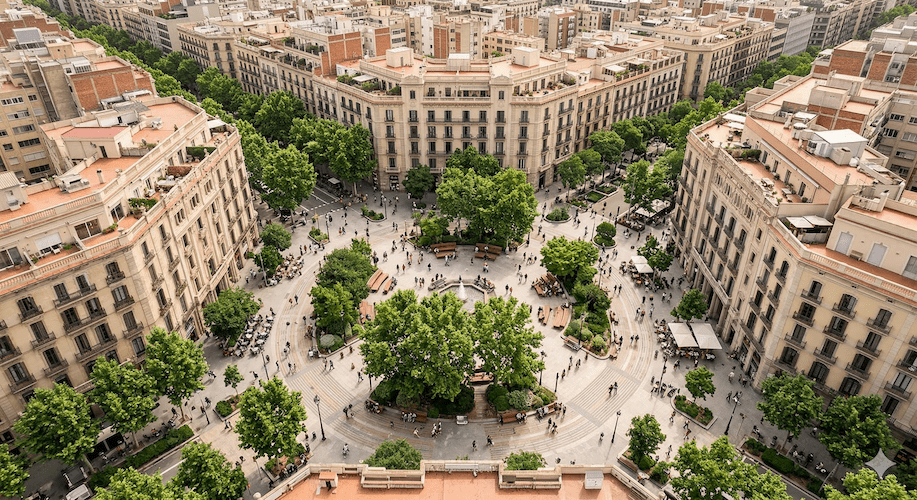
He likened the square to a furnished room,"Roofless Room"He argued that just as walls are important indoors, "enclosure" is also paramount in a plaza. Only when a plaza is properly surrounded by buildings on all four sides, blocking out views to the outside, do people develop a psychological "sense of protection" and want to stay there.
The table below compares in detail the differences between the Sitte model and the functionalist model common in modern Japan. Looking at this comparison, we can see why Japanese station squares tend to become "places where people just pass through."
| Comparison items | [A] Sitte model (Principles of the Artistic Medieval City) |
[B] Functionalist model (Modern, typical Japanese city) |
|---|---|---|
| Defining space | "Roofless Room" A stagnant space that serves as a stage for life and interaction. Emphasis is placed on enclosing areas with walls (buildings). |
"Transportation node/vacant land" Station rotary and disaster prevention park. It has a strong character as a passing traffic route. |
| Street Shape | Irregular/T-junction It controls the gaze and creates a pictorial sequence. Avoid infinite perspective. |
Grid (grid pattern) and straight lines Good visibility and efficient land readjustment. Maintaining the speed of automobile traffic is the top priority. |
| Monument placement | Off-center arrangement Placed in the corners of the plaza or along the walls. The center is left open for activity. |
geometric center For example, the central island of a roundabout. Place it as a symbol in a place where people cannot get close. |
| Closed space | High (Enclosed) The buildings are continuous and there are no gaps. It creates a feeling of being protected. |
Low (Open/Leaky) There are many roads and the buildings are independent. Space is scattered and "leaking." |
*The table can be scrolled horizontally.
2. Hokkaido's Dilemma: Snow and Cost
Sitte's theory is very appealing, as "irregular alleys" and "open-centered squares" have the effect of making tourists curious about what lies ahead and lengthening their stay. However, the moment we move the setting from Europe to Hokkaido, we are faced with a huge physical obstacle: snow.
The cruel trade-off between "beauty" and "snow removal"
There is a more compelling reason than aesthetics why Hokkaido's urban planning, especially Sapporo and the city blocks developed after the pioneering period, have stubbornly maintained a grid layout: straight roads are the only shape that allows large snow removal equipment (graders and rotary vehicles) to operate most efficiently and quickly.
What would happen if, as Sitte recommends, roads were intentionally curved and obstacles (sculptures, plants, benches) were placed in the plaza? Snow removal operators would be forced to reverse frequently, dramatically reducing their work efficiency. This would mean higher maintenance costs and disruption to civic life.
Let's graph the data from Sapporo City to see just how enormous this "cost of maintaining functionality" is.
[Graph] Trends in total snow countermeasure expenses in Sapporo City (total)
Source: Created from Sapporo City's "Snow Countermeasures Budget" materials
The graph can be scrolled horizontally.
Sapporo alone spends approximately 28.5 billion yen annually (FY2025 proposal). This is the total amount of "snow countermeasure costs" including road snow removal, road heating, and other maintenance. Even with more efficient straight roads, this much budget is still invested. Pursuing a "beauty of irregularity" like that of Zitte could be a factor in pushing up these costs even further.
On the other hand, in a tourist destination like Toyako Town, efficiency alone is not enough to survive. The town continues to invest heavily in landscape improvements such as plaza development and illuminations. This is proof that investment in the visible scenery, not just the invisible infrastructure, is the engine that drives the economy.
3. Practice in Toyako Town: "Snow Country Translation" of Sitte's Theory
So, is Sitte's theory useless in Hokkaido? No, not at all. In fact, Toyako Town, where a "harsh natural environment" and "the necessity of being a tourist destination" intersect, is the perfect testing ground for "translating" and applying Sitte's theory to a modern, local context.
The challenge Toyako Town faces is how to resolve the dilemma between "open views of the vast lake" and the "protected enclosure" that Sitte desires.
▼Toyako Onsen Town: A linear town block that stretches along the lakeside. The challenge here is how to create a sense of "staying."
Solution 1: Virtual enclosure with "light"
Surrounding the square with physical buildings would not only hinder snow removal, but would also obscure the beautiful lake view. An effective solution is to use an approach similar to the "illumination tunnel" that is also being implemented in Toyako Onsen Town.
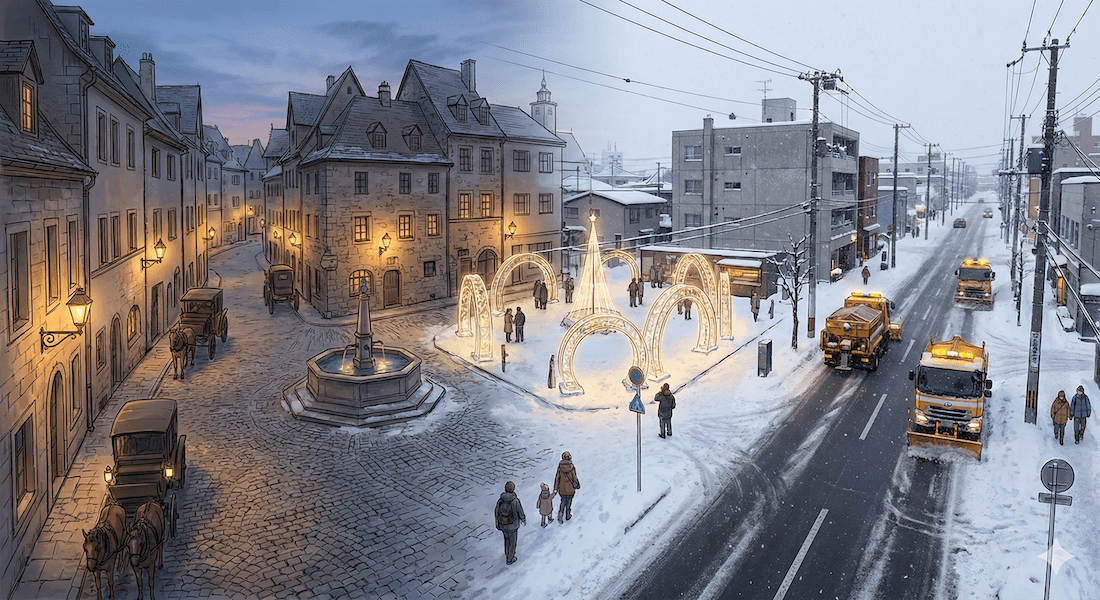
This is what Sitte calls a "roofless room.""Ceiling of Light"On winter nights, the snow wall and illuminated arches moderately block the view, creating an intimate space that suddenly appears in the midst of a vast outdoor space. This is an extremely clever solution, unique to snowy regions, that does not obstruct the flow of snow removal traffic and creates a psychological "plaza."
Solution 2: A "variable plaza" that takes advantage of snow removal
Sitte preached that "the center of the square should be left empty" (meaning that no monument should be placed in the center). This teaching has a different functional rationality in the Hokkaido winter.
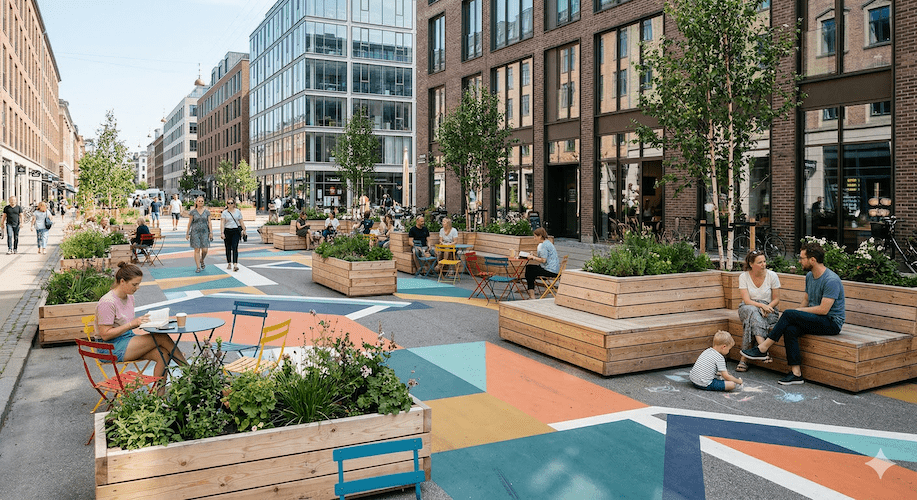
If you leave the center of the square open, you can use it in winter."Snow storage area" and "snow park"In the summer, it can be used as a beautiful, irregular square, reminiscent of Jette, for beer gardens and events, and in the winter, the entire square is filled with snow and snow huts and slides are made. This "modifiability," which allows "summer art (Jette-style landscape)" and "winter function (snow dumping site)" to coexist in the same space, is the most powerful weapon in Hokkaido's urban development.
4. Outlook for the Future: Technology Complements "Medieval Beauty"
Finally, let us touch on how future urban development technologies will revive Sitte's ideals. Advances in digital technology are making the "inconvenient but beautiful city" that was once rejected by functionalism into something that can once again be realized.
Autonomous driving and the return of pedestrianism
The spread of autonomous driving technology (MaaS) has the potential to dramatically reduce the amount of space available for cars on roads. If lane widths become narrower, the resulting space can be used for pedestrian waiting spaces or planting areas. Paradoxically, cutting-edge technology could bring back the human-scale road widths that Sitte once loved, where people and horse-drawn carriages could coexist.
Complementing the landscape with AR/VR
Even without physically rebuilding buildings, it will be possible to make "virtual walls" or "historical monuments" appear in missing parts of a plaza by looking through augmented reality (AR) glasses. Looking through AR, an empty parking lot at Lake Toya could appear as a bustling plaza reminiscent of medieval Italy, with people socializing around a virtual bonfire. The creation of such a "Sitte-esque plaza in digital space" is already a technological possibility in the future.
Conclusion: "Handwritten Fluctuations" Painted on Functionalism
The question posed by Camilo Sitte in 1889 has taken on new meaning in modern-day Hokkaido, more than 100 years later.
For a long time, we have been led to believe that optimizing the "function" of a city and satisfying human "emotions" are a trade-off. Sapporo's 28.5 billion yen snow countermeasure budget is certainly an essential foundation for supporting the city's survival. However, that alone will not attract people, nor will it foster a sense of attachment to the city (civic pride).
Toyako Town should not aim to completely reject functionalism. It must maintain the sturdy infrastructure needed for survival, such as snow removal and transportation, while also layering on top of it a Sitte-esque skin that stirs people's emotions.
"Restoring the fluidity of handwriting to the lines drawn with a ruler"
This is the most strategic approach to designing relationships, the next generation of capital.
Related Links
- Ministry of Land, Infrastructure, Transport and Tourism: Creating comfortable and walkable urban areas (walkability promotion measures)
- Toyako Town Official Website: Toyako Town Landscape Plan and Guidelines
- City Planning Institute of Japan: Research Papers on the Qualitative Evaluation of Urban Space
Inquiries and requests
We help solve local issues.
Please feel free to contact us even if it is a small matter.