〜A modern reinterpretation of Tony Garnier's ideas〜
*This article is based on information as of January 2026.
In the urban spaces of Japan where we live every day, you will notice that the places to live, work, and play are arranged according to certain rules. Why aren't huge chemical plants suddenly built in the middle of residential areas? Or why are commercial facilities concentrated in front of train stations?
This has become as commonplace as air for modern people.ZoningThis is the concept of urban planning. One of the pioneers who presented this concept to the world in a systematic and visually clear way in the early days of modern urban planning was the French architectTony Garnier (1869-1948)is.
His 1917 culmination of his work, Une Cité Industrielle (The Industrial City), was more than just a collection of architectural drawings. It was a grand prescription for rescuing cities that had become smothered in soot and noise after the Industrial Revolution. His attempt to simultaneously achieve both human health and industrial efficiency by spatially dividing "functions" led to subsequent international discussions (CIAM, etc.), and has influenced the foundations of modern-day Japanese city planning law.
However, times have changed dramatically, and we are now facing new challenges different from those of Garnier's time, such as the "harmful effects of functional separation" and "population decline." In this article, we will once again delve deeper into Garnier's ideological background and its innovativeness, and, using the specific example of Toyako Town in Hokkaido, we will unravel from multiple perspectives the future vision of "reinterpretation of zoning" and "sustainable urban development" that will be required in the coming era.
1. The Dawn of Modern Urban Planning: The Background to the Birth of "Industrial Cities"
"Chaos" and "Pollution" in Lyon at the End of the 19th Century
First, we need to understand the historical context in which Garnier's concept was born. At the end of the 19th century, Europe was in the midst of the Second Industrial Revolution. In particular, Lyon, France, Garnier's hometown and base of operations, was in a transitional period in which its industrial structure was shifting from silk weaving to heavy chemical industries, and the city was undergoing rapid urbanization.
The urban environment at that time was far worse than we can imagine today. Factories and workers' housing were scattered throughout the city, and the sky was constantly gray with the soot spewing from factory chimneys. Water and sewage systems were not keeping up with the demands of the city, and infectious diseases such as tuberculosis and typhus were rampant in the overcrowded slums, significantly shortening the average life expectancy of workers.
Lyon, France, where Garnier was based and left behind many of his works
Rebellion against academia and the birth of "functionalism"
In 1899, at the age of 30, Garnier won the Prix de Rome, a gateway to success in the architectural world, earning him the right to study at the Villa Medici in Rome. Prize winners were usually required to survey and study ancient Roman or Greek ruins and create plans for their restoration in the classical style.
However, Garnier, who held socialist ideology and came from a working-class background, objected to nostalgia for the heritage of the past. Believing that "architects should contribute to society's future, not its past," he defied the rules of the Academy and began designing his own ideal city. He presented his first concept in 1901, and after repeated refinements, published "The Industrial City" in 1917, it was the culmination of his rebellion against academia and his hopes for the future.
2. The full picture of the "industrial city": its innovative specifications
Garnier's "industrial city" was not just a sketch. It was a blueprint that could be implemented, with detailed calculations for everything from population size to infrastructure and building materials. We will explain its main features in three points.
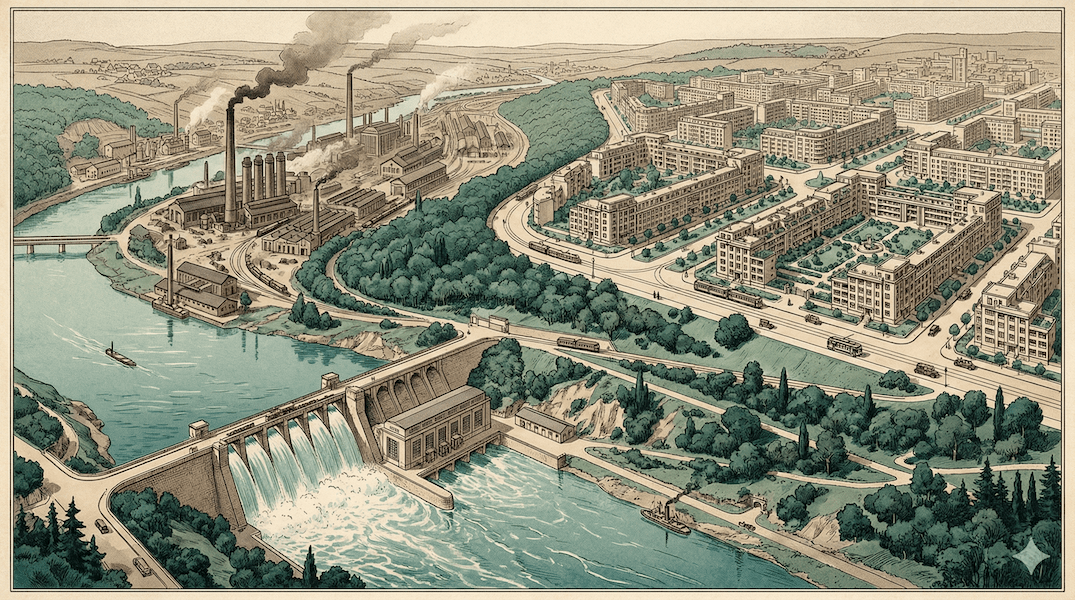
The city was divided into four functions: residence, work, leisure, and transportation, and these were physically separated using the terrain.
・Living area:It is located on high ground upwind to ensure fresh air and sunlight.
・Industrial zone:Because it is a source of pollution, it is located in the plains downwind from the residential area, separated by a green belt.
・Medical District:Located on a quiet mountainside, the facility prioritizes a therapeutic environment.
Reinforced concrete construction, which was revolutionary at the time, was fully adopted not only for factories but also for housing and public facilities.
This resulted in a simple and hygienic design free from ornamentation, reduced construction costs through standardization, and ensuring sufficient light through large windows, making it a pioneering example of modernist architecture.
Comparative verification with competing ideal city models
To further highlight the uniqueness of Garnier's plan, we will compare it with the "Garden City" proposed by the contemporary British social reformer Ebenezer Howard, and the "Shining City" proposed by Le Corbusier in his later years.
| Comparison items | [T. Garnier] Industrial City (1917) |
[E. Howard] Garden City (1898) |
[Le Corbusier] The Shining City (1930) |
|---|---|---|---|
| Stance towards industry | affirmation/promotion We view industrial production capacity as the foundation for urban development and pursue efficiency. |
restraint/harmony The aim is to move away from the drawbacks of big cities and integrate with rural areas. |
Centralization/management Maximize business efficiency with ultra-high density skyscrapers. |
| Estimated population size | Approximately 35,000 people A medium-sized regional core city is assumed. |
Approximately 32,000 people Upper limit of autonomous community size. |
3 million people Reconstruction of a huge metropolis. |
| social system | Socialist utopia. (Police, courts and barracks were not established as they were deemed unnecessary.) |
Public land ownership (trust) and cooperative self-governance. | Rational management by technocrats. |
| Modern influences | ZoningThe concept was drawn up on a large scale. | This developed into new town development and the garden city movement. | Directly linked to redevelopment methods involving high-rise buildings and public open spaces. |
*The table above compares the conceptual features of each plan. There are regional differences in how they are applied to actual urban planning.
*The table can be viewed by scrolling horizontally.
3. The Pros and Cons of Zoning: Its Acceptance and Transformation in Japan
Garnier's idea of functional separation was discussed at the CIAM (International Congress of Modern Architecture) in 1933, and was formulated as the "functional city" by Le Corbusier in the "Charter of Athens" published in 1943. This had a major impact on urban planning in various countries during the post-war reconstruction period. However, the way in which this idea was accepted varied greatly from country to country.
The "exclusive" United States vs. the "accumulator" Japan
There are two main types of zoning: "Euclidean Zoning," which is common in Europe and the United States, especially the United States, and "Cumulative Zoning," which is used in Japan.
[Illustration] Zoning strictness
*You can view the entire graph by scrolling horizontally.
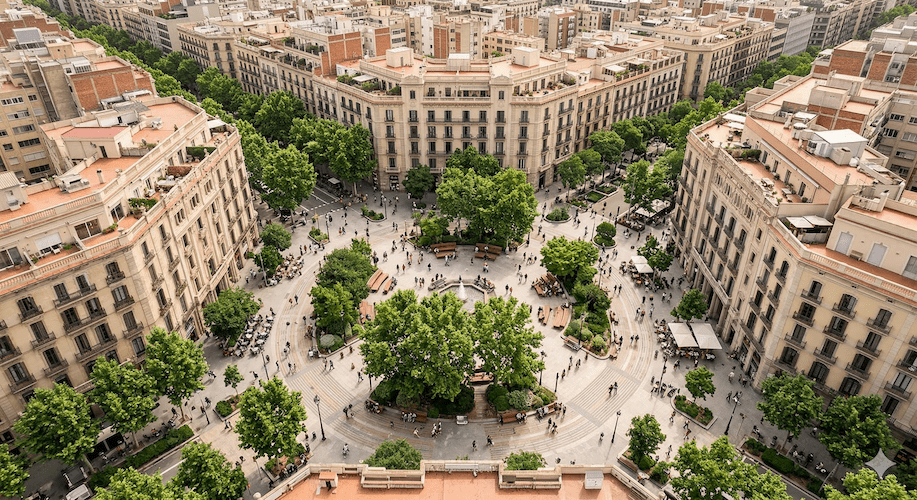
Japan's zoning system (use district system) has maintained a level of leniency rarely seen anywhere in the world since the enactment of the New City Planning Act in 1968. By adopting the "accumulation method," which allows higher-level uses (e.g., residential) to be built in lower-level areas (e.g., semi-industrial areas), it has become possible to create "mixed-use" areas where convenience stores, cafes, and clinics coexist naturally within residential areas.
While this has enabled Japan to avoid to some extent the "inner city problem" (hollowing out of urban centers) seen in Europe and the United States, it has also created other issues, such as urban sprawl, where urban areas expand uncontrollably, and the difficulty of controlling the landscape. The balance between convenience and environmental conservation remains a major point of contention in Japanese urban planning.
4. Practical Simulation: "Next Generation Zoning" in Toyako Town, Hokkaido
So, what happens if Garnier's idea of an "industrial city" is applied to solving the problems of modern Japan? Here, we look at Hokkaido, a major tourist destination that is facing the serious problem of population decline."Toyako Town"will be taken as a model case.
Data analysis of regional issues: The dilemma between tourism and settlement
Toyako Town is one of Japan's leading tourist destinations, with its scenic caldera lake and hot springs. However, the town is facing the following structural challenges.
- Accelerating population decline:Garnier's current population is less than 10,000, far below its projected population of 35,000. In a settlement where people are increasingly dispersed, the cost of maintaining infrastructure (snow removal, water supply, road repairs) is putting a strain on finances.
- Concerns about overtourism:In hot spring resort areas, an increase in tourists will cause noise and traffic congestion, posing a risk of friction with residents seeking a quieter living environment.
Proposal: Compact Tourism City Concept
We will conduct a simulation to translate Garnier's approach of separating the functions of factory and residential into a modern one and apply it to Toyako Town.
The lakeside area"Tourism and Exchange Specialized Zone", high ground and inland areas"Settlement and administrative guidance zone"The functions are clearly divided as follows.
Instead of the previous "isolation" system, by concentrating residents in residentially-inducing areas, we aim to improve the efficiency of administrative services (reducing snow removal costs, etc.). At the same time, we will strengthen landscape regulations in the lakeside area, increasing its added value as a world-class resort space.
Garnier planned to generate all of the city's energy from hydroelectric power.
In Toyako Town, there are many"Hot spring heat (geothermal)"and winter"Snow and Ice Fever"By building a district heating system and preventing energy costs from leaving the town, we aim to become an "energy independent city" that creates an economic cycle.
Comparative example: Comparison with Tomakomai West Industrial Park
There is an example in Hokkaido that embodies Garnier's "industrial city" on a massive scale: Tomakomai City. The city has an industrial park covering a total of approximately 13,000 hectares, and its core, the Tomakomai Western Industrial Base (approximately 2,400 hectares), is the pinnacle of functionalist urban planning, with the port, railway, and factories completely separated from residential areas.
However, this kind of "hard separation" is not what is needed in tourist destinations like Toyako Town.
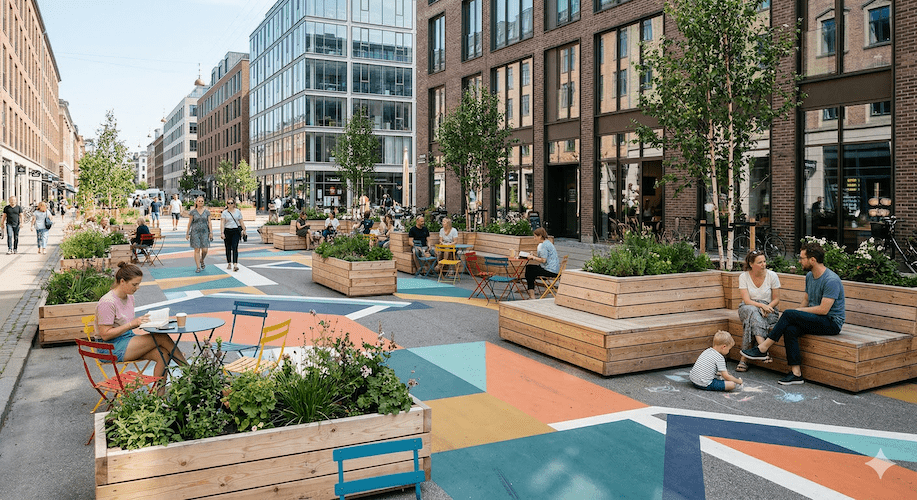
Balancing the bustle of tourists with the serenity of local residents"Soft zoning"For example, modern "industrial cities" require dynamic and flexible management methods, such as changing the use of roads depending on the time of day (cafe terraces during the day, logistics roads at night) or using ICT technology to disperse congestion.
Conclusion: Redesign from Separation to Integration
"Only the truth is beautiful." These words express the spirit espoused by rationalist architects of the time, including Tony Garnier. For them, truth meant facing the realities of industrial society squarely and resolving them with the power of architecture.
100 years ago, he separated functions to protect people from soot. Now, we are reuniting those functions with advanced technology and design to protect communities from isolation and decline."Integration"We are currently in the process of
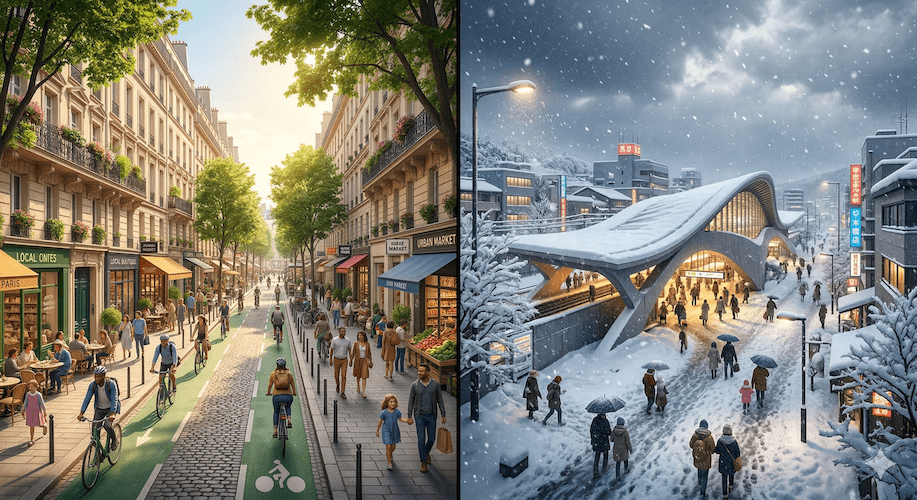
Thanks to advances in digital technology and clean energy, factories are no longer nuisances. Workshops equipped with 3D printers and server farms can blend into residential areas, creating a new form of "living close to work."
What Toyako Town, and indeed Japan's regional cities, should aim for is to boldly redraw the boundaries of existing zoning, without being bound by them, by working backwards from the ideal of "how happy will people be living in this town in 2060?" It can be said that Garnier's imagination and courage are the greatest legacy he has left to us today.
Related Links
- Ministry of Land, Infrastructure, Transport and Tourism: Overview of the City Planning System (Use Zones)
- Toyako Town, Hokkaido: Comprehensive Strategy for Revitalizing Towns, People, and Jobs
- Architectural Institute of Japan: Considerations on Tony Garnier's "Industrial City"
Inquiries and requests
We help solve local issues.
Please feel free to contact us even if it is a small matter.