〜How can we maintain the quality and asset value of residential areas in an era of population decline and connect them to the future?〜
*This article is based on information as of January 2026.
How can the personal act of "building a house" be elevated into "public beauty that will last for 100 years"? At the end of the 19th century, London faced a dramatic deterioration of its urban environment as a result of the Industrial Revolution. Overcrowded slums were enveloped in soot and smoke. In response to this "urban crisis," the "Garden Suburb" model was developed by refining the "Garden City" concept proposed by Ebenezer Howard into a more realistic living space.
In particular, Hampstead Garden Suburb (HGS) in London, which is said to be his masterpiece, is now known as one of the residential areas with the highest real estate values in the world. This paper thoroughly analyzes the essence of HGS by examining its strict management mechanisms and comparing it with examples in Japan. How can this "100-year-lasting value" be transplanted and redefined in Toyako Town, Hokkaido, which is facing the difficult challenges of population decline and the problem of vacant houses? We present a strategic perspective on this issue.
1. The phase of "garden suburbs" in urban planning history and its contemporary significance
1.1 The "ideal home" born from the chaos of the Industrial Revolution
In the late 19th century, rapid industrialization in London was causing a collapse in public health and living conditions. The intellectual class, alarmed by this situation, saw the emergence of social reformer Henrietta Barnett. She dreamed of a community where people of all classes could live together in a lush green environment, regardless of their income level. This vision was crystallized into a specific residential form known as the "Garden Suburb" through the design skills of architect Raymond Unwin.
1.2 Structural differences between "garden cities" and "garden suburbs"
The two concepts are often confused, but there is a crucial difference in the requirements for their establishment. Whereas the "garden city" proposed by Howard aimed to be a "self-sustaining city" that incorporated industry, agriculture, and residence and returned profits from rising land prices to the community, the "garden suburb" was a "residential-focused" planned area that was premised on dependence on the economic sphere (jobs) of a large city.
| Comparison items | Garden City | Garden Suburb |
|---|---|---|
| Main Objective | Independence of cities through the integration of work, housing and agriculture | High-quality living environments in metropolitan areas |
| Economic foundation | Industry and agriculture within the community | A life based on commuting to the city center |
| Landscape Features | Greenbelt urban isolation | Parks, hedges, and low-density housing |
2. Hampstead Garden Suburb (HGS): Utopia Dissected
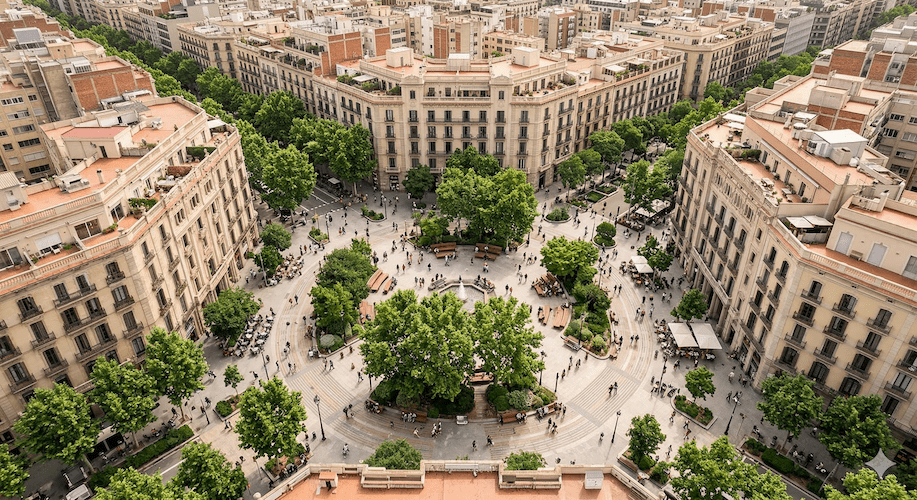
HGS is located in northwest London, with a streetscape that spreads organically and radially from the central square.
2.1 Unwin's spatial design: cul-de-sac and hedgerow
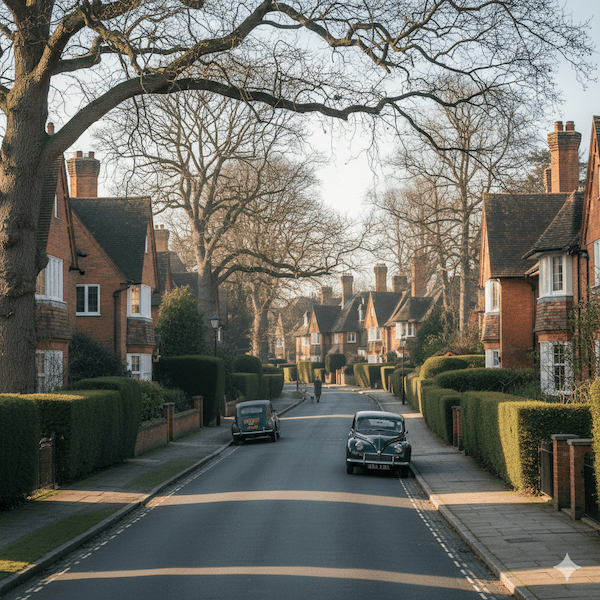
The greatest innovation that Unwin adopted at HGS was the use of the "cul-de-sac" system. By eliminating through traffic, he created a close community and tranquility among residents. He also recommended "hedges, not walls" as a founding principle. Even today, the removal of hedges or trees requires the consent of the Trust, and this thorough "continuity of greenery" has transformed the entire town into a landscape resembling a giant park.
2.2 Source of Value Preservation: Scheme of Management
The biggest reason why the asset value of HGS remains unshakable is its legally enforceable management system. In the early stages of development, a special law in 1906 relaxed the restrictions of building regulations, allowing for freer design, but the basis for modern landscape control is the "Scheme of Management," which was established by High Court order in 1974 based on the 1967 law.
As a result, even if the land is freehold, consent from the Hampstead Garden Suburb Trust is required for any exterior changes, re-roofing, removal of hedges, cutting or pruning of trees, etc. Agreeing to this "inconvenience" eliminates the risk of future environmental degradation and adds a significant premium to the property price.
[Comparison of home values based on data (average for detached homes)]
(*Average for detached houses based on sales. London/Barnet figures are from November 2025, HGS is Rightmove sales data from the past year)
3. The Acceptance and Challenges of "Garden Suburbs" in Japan
This is the embodiment of the garden city concept promoted by Eiichi Shibusawa and others. It was heavily influenced by the British garden city movement and maintains a unique aesthetic, such as radial streets. Management relies on the government's "district plan," and efforts are ongoing to prevent land subdivision. However, compared to strong, centralized management based on private law and special orders like HGS, preserving the landscape as generations change is more difficult.
Located in Tobetsu Town, this district maintains a unified streetscape thanks to a "building agreement" by residents' organizations and a unique "landscape guidebook." The agreement governs the color of exterior walls, the specifications of window frames, and the maintenance of open exteriors, making it a modern, successful model of "landscape assetization" in Hokkaido.
4. "21st Century Rural Village" Concept in Toyako Town, Hokkaido
4.1 Strategic shift from "quantity" to "quality"
The lessons learned from HGS offer hints for "Shrinking Smart," a way to address the vacant house problem Toyako Town faces. Rather than simply clearing the land, vacant houses are being integrated with neighboring lots to "expand the lot" and promote low density. This reorganization, which places the focus on the garden and view rather than the building itself, will create a rare, quiet, high-quality residential area that stands out from the overheated Niseko area.
The caldera landscape of Lake Toya is the greatest "public asset" and the core part that should be managed.
4.2 Proposal for the public-private partnership "Toya Landscape Trust"
It is desirable to establish a "trust" with specialized review authority that goes beyond the uniform rules of the government. Similar to HGS, designing a unique scheme to maintain the beauty of the entire area, regardless of the form of land ownership (rental or ownership), will stabilize the long-term tax revenue base and attract high-quality relocation and investment.
5. Comparative Summary: Source of Value that Will Last for 100 Years
| analysis axis | HGS (UK) | Sweden Hills (Hokkaido) | Toyako Town (view) |
|---|---|---|---|
| Legal basis for management | Scheme of Management (1974) | Building agreement and guidebook management | Landscape Ordinance and Public-Private Trust (draft) |
| The core of the landscape | Hedges, Arts & Crafts architecture, and trees | Scandinavian architecture, unified color scheme, open exterior | Lakeside scenery, earth tones, low density |
| Future sustainability | Very high (100 years of experience) | High (unique brand value) | High potential (by capitalizing on the landscape) |
Conclusion: The economics of managing landscapes by will
Hampstead Garden Suburb proves that"Limiting individual freedom creates the greatest community benefit (asset value)"This is the pinnacle of democratic urban planning.
William Morris, a pioneer of the Arts and Crafts movement, preached in a lecture in 1880, "Have nothing in your houses that you do not know to be useful, or believe to be beautiful." The Garden Suburb is an extension of this ethos to the entire city.
The urban development challenge in Toyako Town, Hokkaido, will go beyond mere real estate development; it will be a quiet but decisive revolution that will help rural Japan break free from the illusion of "quantity" and regain pride in "quality."
-- If we don't protect the landscape, it will disappear. But if we manage it, it will become a timeless asset.
Related Links
- Hampstead Garden Suburb Trust (Official)
- Tobetsu Town Sweden Hills (official website)
- Denenchofu Association General Incorporated Association
Inquiries and requests
We help solve local issues.
Please feel free to contact us even if it is a small matter.