〜"A modern city for 3 million people" proposed by the architectural master Le Corbusier 100 years ago〜
*This article is based on data as of January 2026.
"A house is a machine for living in."
This famous aphorism, left behind by Le Corbusier (1887-1965), one of the most representative architects of the 20th century, symbolizes the spirit of modernist architecture, which pursued functionality and rationality to the utmost. However, the objects that he devoted his life to designing were not limited to individual "houses." He attempted to reorganize "cities" themselves, which had grown disorderly and reached the height of chaos since the Industrial Revolution, as if they were precision machines, in an attempt to free the human mind and body from the shackles of outdated conventions.
Let's turn back the clock to 1922. Presented at the Salon d'Automne in Paris, "Ville Contemporaine pour 3 millions d'habitants" (Contemporary City for 3 Million People) was a radical manifesto that represented the pinnacle of his thinking. Skyscrapers soaring into the clouds, vast green spaces at their feet, and a transportation network that completely separated pedestrians and automobiles. This century-old vision has continued to be passed down through the generations, even as it has taken on new forms and sometimes been criticized, in modern-day redevelopment projects in Tokyo's Minato Ward, skyscrapers in Manhattan, and even resort developments nestled in the majestic natural surroundings of Hokkaido.
Why are we so fascinated by "heights" and at the same time crave "the hustle and bustle of the ground"?
This article thoroughly examines the ideals and reality of Le Corbusier's "vertical urbanism" based on a vast amount of material and data. We will delve into the merits and demerits of high-rise buildings for cities, his ideological conflict with Jane Jacobs, and new ways of managing cities in an era of declining population, from multiple perspectives.
1. "A Modern City for 3 Million People": A Radical Manifesto from 100 Years Ago
"Vertical" liberation from unsanitary, overcrowded cities
Contrary to the image we have today of Paris as the "City of Flowers," the city of 1920s was plagued by serious urban problems. The development of urban infrastructure was unable to keep up with the explosive population influx brought about by the Industrial Revolution. Narrow, winding alleyways dating back to the Middle Ages, unsanitary courtyard houses that blocked light and ventilation, and the rampant spread of infectious diseases such as tuberculosis. Corbusier viewed this chaotic urban environment as a "crisis," and believed that the only solution was to fundamentally reject and rebuild the existing urban structure, rather than simply repair it.
The answer he came up with was a paradoxical one that overturned the conventional wisdom of the time: "We should deliberately increase density to alleviate congestion in the city center."
By stretching and consolidating low-rise, densely packed buildings vertically, he created vast spaces on the ground. This was the core of his "vertical urbanism." He redefined the city not as a flat expanse, but as a vertical vector.
Geometric Order and the Four Fundamental Principles
Le Corbusier's plans were based on the following four cool, rational basic principles, which rejected emotion and tradition (*1).
[Le Corbusier's four principles of urban planning]
- 1. Decongestion in the centers of cities
To prevent sprawl (uncontrolled suburbanization), we will maximize the efficiency of land use in urban areas. - 2. Increase in density
Condensing urban functions into a compact area and shortening the distance between business and residential areas. - 3. Enlargement of the means of circulation
It completely separates pedestrians and vehicles (pedestrian-vehicle separation), allowing for high-speed movement. - 4. Enlargement of the landscaped areas
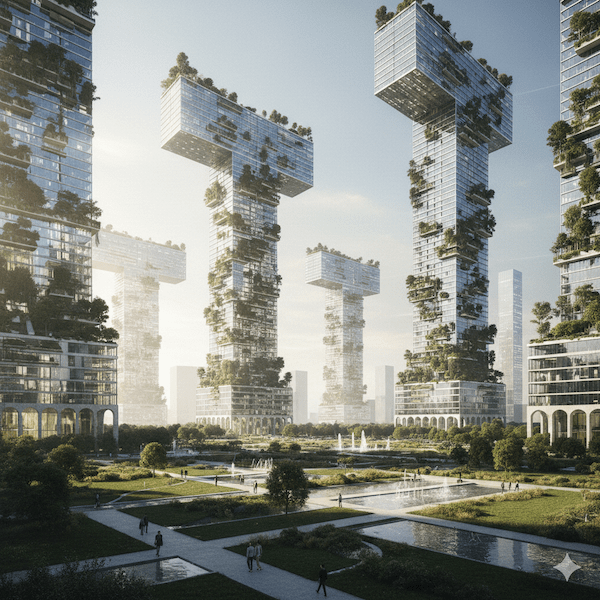
The entire area around the base of the building will be open to green space, creating a "tower in the park."
Of particular note is the specificity of its physical specifications. 24 skyscrapers were planned for the city's core, with the business district envisioned as 60 stories high. While sources vary in height, they are often described as roughly 200-220 meters, a scale that seemed like science fiction at the time.
These skyscrapers had a cruciform plan and were widely spaced apart to allow sunlight and greenery through every window. The table below shows how innovative or disruptive Le Corbusier's plans were compared to existing urban data from the time he presented them.
| Comparison items | Le Corbusier's "Contemporary City" (Skyscraper district) |
Paris average at the time (Corbusier's proposed value) |
|---|---|---|
| Population density (person/ha) | Approximately 3,000 people | Approximately 360 people |
| Open Space | Most of the earth's surface Reserved as gardens and parks |
Extremely low (Road and courtyard only) |
| architectural form | vertical concentration (60-story cross-shaped skyscraper) |
horizontal crowding (Courtyard-type block) |
*The figures are estimates based on the plans of the time, and definitions may differ from modern standards.
*The table can be scrolled horizontally.
The facts revealed by this data are shocking. Le Corbusier attempted to open up most of the ground surface as green space and pedestrian space, while achieving an ultra-high density (3,000 people/ha), roughly eight times the average density in Paris at the time. Concentrating the densely packed low-rise buildings vertically and freeing up the ground surface - this was an idea that could be said to be the origin of the concepts of "public open space" and "floor area ratio bonus" in modern high-rise developments.
Destroy Paris: The Impact of Plan Voisin
Le Corbusier's ideas were not merely theoretical, but were further radicalized in the form of the "Plan Voisin" in 1925. This was a violent proposal that would be completely unacceptable to modern sensibilities, calling for the demolition of the entire historic city center, including the Marais district on Paris's right bank, and for it to be replaced with 18 gigantic glass skyscrapers.
▲ If the Voisin Plan had been realized, the current historic Marais district (map) would have disappeared and been replaced by a cluster of huge buildings.
2. "Tower in the Park" vs. "Eyes on the Street": Conflict in Urban Planning
Le Corbusier's ideal model of the "shining city" was adopted as a template for housing complex planning and urban redevelopment around the world after World War II. In Japan, many new towns built during the period of rapid economic growth were influenced by this idea. However, in the 1960s, strong objections were raised against this "overly orderly aesthetic." At the forefront of this movement was Jane Jacobs, a New York journalist and urban activist.
"Order and Hygiene"
"A city can only function through order"
Le Corbusier despised disorderly streets, calling them "donkey paths." For him, control through straight lines and geometry was proof of reason. Vast green spaces (open spaces) were sanctuaries providing people with sunlight and fresh air, and the bird's-eye view from buildings overlooking the streets was a symbol of a new civilization. He believed that urban efficiency could be maximized through "zoning," which clearly separates places to live, work, and play.
"Diversity and Chaos"
"It's not the police who keep the city safe, it's the eyes on the streets."
In her classic work, The Death and Life of Great American Cities, Jacobs sharply criticized Corbusier-style green spaces, saying they could become "dangerous, empty spaces." She argued that the essence of a city lies in the diverse "streets" where an unspecified number of people come and go, and that the natural surveillance (eyes on the street) by shopkeepers and residents maintains the safety and vitality of the community. She declared that the functionally purified planned city was a "deadly disease" that destroyed the city's complex ecosystem.
Lessons for the modern day from the controversy
These two opposing ideas continue to raise the most important question in modern urban planning: how to balance efficient high-rise construction with lively ground-level spaces.
The failure of "cities where no one walks," which was seen in past new town developments and resulted from overly large lawns and impersonal high-rise housing complexes, has historically proven Jacobs's point to be correct.However, in today's megacities, which are troubled by population explosions and land shortages and are being forced to improve energy efficiency as a measure against climate change, the demand for "high density and intensification" as exemplified by Le Corbusier is also a realistic solution that cannot be ignored.
3. Modern Megacities in Practice: The Challenges of Tokyo and New York
So, how are megacities of the 21st century responding to this dilemma between density and humanity? We will examine the actual situation using the examples of two of the world's leading cities: Minato Ward, Tokyo, and Manhattan, New York.
Minato Ward, Tokyo: A modern interpretation of the "Upright Green City"
The "Vertical Garden City" concept, which Mori Building Co., Ltd. and others have been promoting in Minato Ward for half a century, can be seen as an example of translating Le Corbusier's ideas into a modern, Japanese style adapted to Japan's disaster prevention and local conditions.
The project involves integrating fragmented, densely populated wooden areas through consensus building with landowners and consolidating them into skyscrapers. This creates vast green spaces at the base of the buildings, while at the same time updating aging infrastructure. Azabudai Hills, which opened in 2023, can be considered the culmination of this approach.
■ Trends in green coverage in major projects
The graph below (estimated) shows how major projects in Minato Ward have created above-ground green space. Considering that the average green coverage rate for the entire ward is approximately 22.6%(*2), it is clear that these redevelopments have created outstanding open spaces.
*The values for each facility are based on publicly available data (Mori Hills REIT, etc.). The graph can be scrolled horizontally.
What's important is that these open spaces are not the passive, ornamental green spaces that Le Corbusier once envisioned. Markets, art events, winter illuminations—these are "managed liveliness," but they are attempting to realize the "people retention" and "interaction" that Jacobs sought, through private area management methods. This could be thought of as an attempt to install Jacobs' software onto Le Corbusier's hardware.
New York: POPs and securing public spaces
Manhattan, on the other hand, has developed not through Le Corbusier-style "towers in parks," but through high-density development that fills grid-like city blocks. However, even here, since the 1961 zoning ordinance amendment, an incentive zoning system has been introduced that provides publicly usable open space (POPS) in exchange for floor area bonuses, and foot space has been secured in exchange for high-rise buildings.
The case of the southern tip of Manhattan (Community District 1: CD1), which has undergone a dramatic transformation from a former financial district to a work-life balance area, is particularly interesting. This area has seen rapid population growth as a result of the conversion of land into residential use, including the post-9/11 reconstruction effort. While open space metrics in CD1 vary depending on their definition, one example is the "City Parks" goal of 1.8 acres per 1,000 residents (NY4P data). With the exception of planned development areas like Battery Park City, creating new "meaningful open spaces" in existing, overcrowded city blocks is an extremely difficult task.
The challenge in New York is shifting from ensuring "quantity" to improving "quality." In response to criticism that many POPs are "dead spaces" that function only as building corridors or smoking areas, the current focus of urban design is on how to renovate them into "places to sit" and "places where activities can be generated."
4. Resorts and Regional Cities: The Pros and Cons of Height in Hokkaido
If we shift our perspective to rural Japan, particularly Hokkaido, which is rich in nature, the meaning of high-rise buildings changes dramatically from "efficiency" to "landscape" and "survival." Here, we will look at three case studies that clearly illustrate the tension between development and conservation.
Lake Toya: The merits and demerits of the "Solitary Tower" The Windsor Hotel
The Windsor Hotel Toya Resort & Spa, located on the summit of Mount Poromoi (625m above sea level) overlooking Lake Toya, is in a sense the embodiment of Le Corbusier's idea of a "giant tower standing isolated in nature."
Planned and constructed during the bubble economy, it was later rebuilt after going bankrupt and gained global recognition when it was used as the venue for the 2008 Toyako Summit in Hokkaido. The building offers guests an overwhelmingly extraordinary experience of a spectacular view from the sky. However, when viewed from the lakeside or the opposite shore, it has become the subject of controversy over its landscape as a huge man-made structure that divides the gently sloping ridgeline.
This is a conflict between "privileged views" and "landscape as a public good." Le Corbusier objectified nature as an "object to be viewed," but in modern resort areas, architecture itself is expected to blend in with the landscape.
Niseko: A drive for horizontality through height restrictions in each scenic district
In contrast, the Niseko area (Kutchan Town and Niseko Town), which is rapidly growing as an international ski resort, has some of the strictest landscape regulations in Japan in order to curb unregulated high-rise development.
In areas such as Kutchan Town's Hirafu District, detailed height limits (e.g., 16m, 22m depending on conditions) are set for each type of scenic district, and complex transitional measures are in place for existing buildings, such as how they should be handled when rebuilding. Furthermore, Niseko Town requires prior consultation for any buildings over 10m in height, and is thorough in ensuring views (vistas) of Mt. Yotei and Niseko Annupuri.
Niseko's strategy clearly rejects Le Corbusier's "vertical protrusion" and instead chooses harmony with nature (low-rise, low-density, gabled roofs) that spreads horizontally. This strategy demonstrates a strong political will. Niseko has thus prevented the loss of value due to overdevelopment and has succeeded in maintaining its brand as a luxury resort.
Yubari City: "Urbanism of Retreat" as a Survival Strategy
On the other hand, the "consolidation" in Yubari City, which has experienced financial collapse, has an entirely different and urgent meaning. The consolidation here is not for the sake of growth, but rather a "retreat" to reduce infrastructure maintenance costs and somehow maintain urban functions.
The "compact city" policy concentrates scattered public housing and public facilities in a central location, limiting the scope of snow removal and water maintenance. While this policy is similar in form to Le Corbusier's "condensation," its motivation is rooted in the instinct for survival in a society with a declining population. There are examples, such as Toyama City, which has successfully created a compact city centered around the LRT (light rail transit), resulting in a return to the city center and increased tax revenue. Even in regional cities in Hokkaido, densification to stop indiscriminate sprawl and achieve "smart shrinkage" is an unavoidable path.
5. Outlook beyond 2025: Towards a sustainable vertical city
As climate change becomes more serious in the second half of the 21st century, the role of high-rise buildings is also being redefined from a "symbol of authority" to a "tool for environmental solutions."
"Vertical Forest" and Embodied Carbon
Designs such as Milan's "Bosco Verticale (Vertical Forest)," in which the balconies and exterior walls of buildings are covered with trees to absorb CO2, regulate the microclimate, and serve as a base for biodiversity, are being referenced around the world as iconic examples, and similar concepts are on the rise. While Le Corbusier limited green spaces to the "ground," contemporary architects are extending greenery into the "sky," trying to make the building itself part of the ecosystem.
Additionally, plans are underway for "wooden high-rise buildings" that use wood (CLT panels, etc.) instead of steel and concrete in order to reduce CO2 emissions (embodied carbon) during construction. This trend, which is also linked to the revitalization of Japan's forestry industry, has the potential to reduce environmental impact depending on the design conditions, and could be seen as a new form of modernism that aims to combine technology and nature.
Conclusion: Towards the integration of technological liberation and human activity
The "modern city for 3 million people" that Le Corbusier dreamed of in 1922 was never realized in its purest form. However, his fundamental question of "creating open space through high density and increasing urban sustainability" remains as vivid as ever after 100 years.
In megacities like Tokyo, creating open spaces through high-rise buildings functions as a countermeasure against the heat island effect and as a disaster prevention base, while in regional cities, compactness is the key to maintaining infrastructure.The key is how to incorporate the "human activity as software" that Jacobs sought to protect into the "efficiency as hardware" proposed by Le Corbusier.
What is required of urban development from 2025 onwards is not to simply pursue economic rationality in vertical expansion, but to breathe life into it with the spirit of "bustling streets" and "coexistence with the environment". Cities that once aspired to be "machines" are now once again trying to return to being "organisms" for humans and nature.
(*1) Le Corbusier, “Urbanisme”, 1925.
(※2) From Minato Ward's "Minato Ward Green Survey Report (10th Edition)."
Related Links
- UNESCO World Heritage Center – The Architectural Work of Le Corbusier
- Tokyo Metropolitan Government Bureau of Urban Development: Creating open spaces through redevelopment, etc.
- Mori Memorial Foundation Urban Strategy Institute: Global City Power Rankings
Inquiries and requests
We help solve local issues.
Please feel free to contact us even if it is a small matter.