〜Unraveling the next generation of community design (rebuilding relationships)〜
*This article is based on publicly available data as of February 2026.
Elementary schools are not just educational institutions. For a long time, they have played the role of the nucleus of the city in which we live.
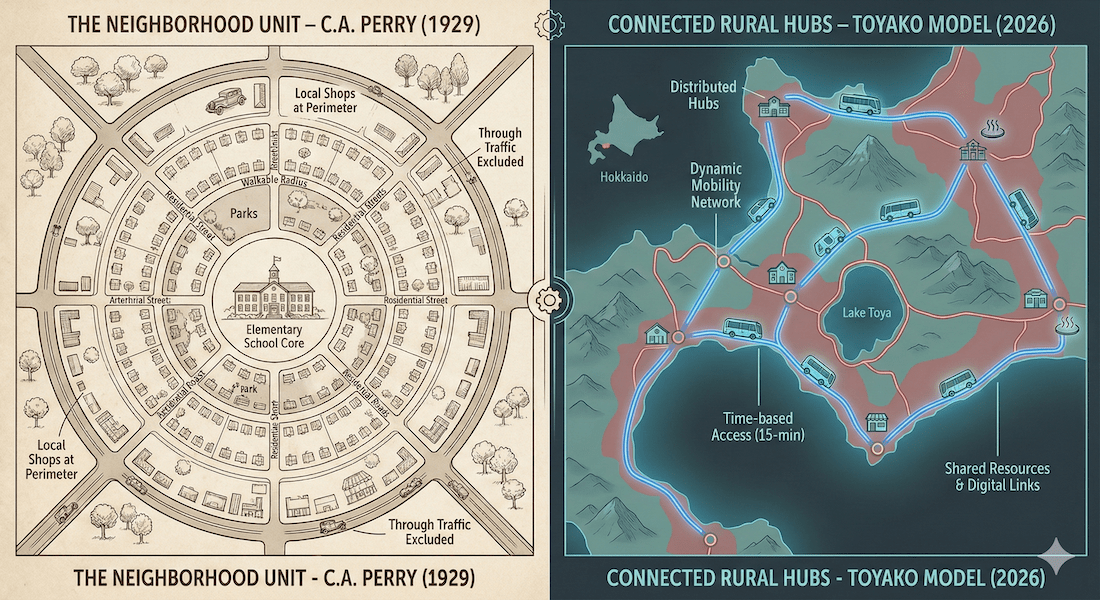
In the 1920s, American urban planner Clarence Arthur Perry proposed a revolutionary concept to protect local communities that were being torn apart by the rapid rise of the automobile society (motorization)."Neighborhood Unit Theory"is.
In other words, the idea is to design "towns of the right size" that allow people to complete their daily lives within walking distance of an elementary school. This philosophy was faithfully adopted as the "bible" for new town development in Japan after the war, and has shaped the foundation (OS) of our living environment to the present day.
However, the irreversible waves of population decline and an aging society with a declining birthrate are currently destroying these "cells" from within. Elementary school consolidation and closures, shopping streets becoming deserted, and the problem of "old new towns" are occurring. The once ideal "community with an elementary school about 400 meters away (residential area with a diameter of about 800 meters)" is clearly suffering from institutional fatigue.
This article delves deeply into the concept of neighborhood districts, a classic in urban planning, and compares it with the latest global trends such as Paris's "15-minute city" and Barcelona's "superblocks."Furthermore, it focuses on the specific local field of Toyako Town in Hokkaido and considers the shape of the "New Neighborhood" that will be needed in the coming era.
1. The True Nature of Neighborhood Theory: Six Principles for Protecting Cities
"Sanctuary" design as a countermeasure against automobiles
Why did Perry need the concept of a "neighborhood" in the first place?
The story takes place in New York City in the 1920s. Suddenly, a large number of automobiles began to flow into roads that had previously been dominated by horse-drawn carriages and pedestrians. Through traffic speeding through residential areas threatened the lives of children, and noise disrupted neighborhood relationships. Neighborhood theory was a "social engineering defense" against this crisis.
In Volume 7 of his Plan of the New York Neighborhoods, published in 1929, Perry clearly defined the following:
"A population large enough to support one elementary school (approximately 5,000 to 9,000 people, some sources say 10,000) is considered a single living unit, and its interior is made into a sanctuary protected from the threat of automobiles."
Six spatial devices that make up the residential area
Specifically, Perry established the following "six principles" as requirements for urban design. These are the very blueprints for Japan's new towns (Senri, Tama, etc.), and are structures that can still be seen in many residential areas today.
| Principle items | Design intent and functionality |
|---|---|
| 1. Size | Population required for one elementary school (approximately 5,000 to 9,000 people, maximum 10,000). The area will be approximately 160 acres (approximately 65 ha), adjusted depending on density. |
| 2. Boundaries | The area will be surrounded on all sides by sufficiently wide "main roads" to physically prevent through traffic from entering the residential area. |
| 3. Parks (Open Spaces) | Small parks and recreational spaces will be strategically placed to ensure an area equivalent to approximately 10% for all residents. |
| 4. Public Institutions | Elementary schools, community centers, churches, etc. will be placed at the "center" of the neighborhood, making it the spiritual core. |
| 5. Local Shops | Daily shopping facilities will be located "near intersections on the periphery" rather than in the center of the residential area, to maintain tranquility within the area. |
| 6. Internal Streets | Within the residential area, designs that include morphology (dead ends, curves, etc.) will reduce through traffic and ensure pedestrian safety. |
Source: Created by the author based on CA Perry (1929) “Regional Survey of New York and Its Environments”
2. Divergence from the modern city: The crumbling “fixed circle”
This theory was a brilliant success in 20th century urban planning, but it was a system that was based on the assumptions that the population would continue to grow and that the nuclear family was the norm.
In modern times, this premise has completely collapsed. Let's compare Perry's theory with modern challenges visually.
The gap between "plans" and "reality" as seen through data
The graph below conceptualizes the discrepancy between the "walking area" idealized by neighborhood theory and the "actual living area" in modern regional cities.
[Illustration] Theoretical living space vs. actual living space
*Due to consolidation and closure of schools, the distance to the elementary school has increased. For daily shopping, go to roadside stores.
In this way, a lifestyle that was once entirely walkable has become physically dispersed due to the consolidation and closure of facilities and the increasing popularity of motorization. Perry's ideal of "building a community around an elementary school" is hindered in rural areas by the barrier of physical distance.
3. Global Trends: 15-Minute Cities and Superblocks
Let's now turn our attention overseas. Efforts to update Perry's "neighborhoods" into modern versions are gaining momentum, particularly in Europe.
The decisive difference between Paris and the "15-minute city"
The "15-minute city" (La ville du quart d'heure) proposed by Paris Mayor Anne Hidalgo is similar to, but not identical to, Perry's theory. The biggest difference is the concept of "mixed use."
| Comparison axis | Neighborhood theory (20th century) | 15 minute city (21st century model) |
|---|---|---|
| land use | Purification of use (Zoning) Commercial and business functions will be separated to protect residential areas. |
Mixed Use Work, housing, leisure and commerce are mixed together in a mosaic. |
| central nucleus | Elementary schools and public facilities The focus is on fixed structures. |
Consumer (me) A circle of "time distance" centered on your location. |
| Transportation | Walking only Travel outside the residential area requires a car. |
Walking + Bicycle Incorporating micromobility to expand your range of activities. |
In other words, while Perry separated functions out of fear of "mixing," modern urban planning considers "mixing" to be the source of innovation and vitality. This paradigm shift also contains important implications for regional cities like Toyako Town, which will be discussed in the next section.
4. Field Report: The Challenge of Toyako Town, Hokkaido
Now that we have organized the theory, let's apply it to a specific field: Toyako Town in Hokkaido, where the population is declining and aging.
The "one school, one neighborhood" model is difficult to maintain
Toyako Town is a tourist destination with the beautiful caldera lake of Lake Toya and Mount Usu, but it also faces serious challenges as a residential area. In particular, the "optimal placement of schools" is an urgent issue.
In the townAbuta Elementary School, Toyako Onsen Elementary School, Toya Elementary SchoolHowever, due to the declining number of students, the model advocated by Perry of "elementary schools with a population of several thousand students" has already collapsed. While small schools have the advantage of providing a more attentive education, they also face challenges in areas such as "friendly competition within a group," "maintaining club activities," and "the cost of maintaining and managing facilities."
- ● Distributed residence: Residents are scattered over a wide area, and the number of children in each area is decreasing.
- ● Increased maintenance costs: Maintenance costs for small facilities are putting a strain on finances.
- ● Moving Wall: The expansion of areas where it is difficult to commute to school without a school bus.
- ● Network type: Transcending physical distance, connecting bases through mobility.
- ● Composite: Schools are being opened up from being "places for children only" to "community exchange hubs."
- ● Integrated elementary and junior high school: Reexamining the community over a nine-year span.
From "physical proximity" to "temporal proximity"
Toyako Town is considering integrated elementary and junior high school education.Report of the Council for Educational Administration (January 2025)It has been confirmed that the town is proceeding with its deliberations taking into account the above (as stated in the town's published materials).
The important thing here is not to think that "farther away elementary schools = the death of the community." There is technology that did not exist in Perry's time. For example, by utilizing AI on-demand transportation (demand buses), elderly people and children can have their main functions within a 15-minute time range, even if they are physically separated by several kilometers.
As in the case of Shiwa Town in Iwate Prefecture, reorganizing public transportation and connecting small hubs that aggregate urban functions through a network is a new form of urban development that reinterprets Perry's "neighborhood districts" as a modern Hokkaido version.
Conclusion: The courage to "re-edit" our neighborhoods
Nearly 100 years have passed since CA Perry proposed his neighborhood theory. The "sanctuary centered on an elementary school," which was designed to protect people from automobiles, is finding it increasingly difficult to maintain its physical form (dependence on the elementary school as a building) in today's world of declining population.
However, there should be no misunderstanding. Perry's essential objective was"Concentrate the functions necessary for daily life at the core and protect the community on a human scale"This idea itself is by no means outdated. In fact, its importance is increasing now, as we face the need to combat loneliness and isolation and to provide mutual assistance in times of disaster.
What we need is not to preserve the "form" of theory, but to change the way it is implemented while preserving its "essence." Turn school classrooms into local co-working spaces. Open school buses to local residents. Turn vacant stores in shopping districts into after-school learning spaces.
This flexible "re-editing" of existing stock and designing new connections that transcend physical constraints is the right answer for modern neighborhoods, maximizing capital and building sustainable relationships.
Related Links
- Ministry of Land, Infrastructure, Transport and Tourism: Urban planning for sustainable urban development
- Official website of the City of Paris: La ville du quart d'heure (15-minute city concept)
- Toyako Town Board of Education: Integrated elementary and junior high school education
Inquiries and requests
We help solve local issues.
Please feel free to contact us even if it is a small matter.