〜Why a century-old German housing complex became a World Heritage Site and still has a waiting list for vacancies〜
*This article is based on research information and historical documents as of February 2026.
It is said that "cities are mirrors that reflect what a society values."
Can you imagine that the residential areas in Japan where we live every day were registered as World Heritage Sites 100 years from now, becoming places of pilgrimage for architects and tourists from all over the world?
Unfortunately, modern Japanese housing has long been based on the premise of "scrap and build." The average lifespan of a wooden house is said to be about 30 years (the period before it is demolished), and as the population declines, the number of "vacant houses" is increasing, transforming what were once new towns into old towns. However, if we shift our perspective to Berlin, Germany, after World War I, we notice that the exact opposite phenomenon exists.
The "Siedlung" housing complexes for workers were built in the 1920s amid the devastating economic conditions of defeat in the war and hyperinflation. Six of these housing complexes in Berlin, in particular, have retained their original appearance even after 100 years since their construction and are protected as UNESCO World Heritage Sites. And they are not merely preserved as museums; they continue to function as highly popular homes where Berliners actually live.
How was Germany able to create "assets that will last 100 years" 100 years ago under conditions far more severe than those of modern-day Japan? This article delves into the unique funding system behind this success, known as the "Hauszinssteuer (housing interest tax)," the "color magic" practiced by Bruno Taut and others, and the philosophy of the "existential minimum." Furthermore, it connects these findings to contemporary urban development in Toyako Town, Hokkaido, proposing specific strategies for transforming vacant houses into "community assets" rather than liabilities.
1. Historical background: the "housing revolution" from the crisis and political will
First, we need to properly understand the historical background behind the birth of the Siedlung. It was not just a trend in architecture, but a political response to a crisis facing the nation's survival.
The tragedy of "rented barracks" and the public health crisis
During the Imperial period (before World War I), rapid industrialization in Berlin led to an influx of workers, resulting in the creation of a forest of squalid, overcrowded housing known as "rented barracks" (Mietskaserne).These apartments had extremely narrow courtyards (Hinterhof), preventing sunlight from reaching the ground and preventing wind from passing through.The humidity and stagnant air were a breeding ground for tuberculosis, a deadly disease at the time, and severely damaged the health of the working class.
Furthermore, due to the influx of returning soldiers and refugees following the defeat in the war, Germany was facing a housing shortage of hundreds of thousands of homes in the early 1920s. With people without homes, social unrest reached an extreme level.
Article 155 of the Weimar Constitution: Declaration of the "Right to Live"
In response to this crisis, the new Weimar Republic enacted groundbreaking legislation: Article 155 of the Weimar Constitution, enacted in 1919, stated that land allocation and use should be subject to state supervision in order to ensure "decent housing."
"The allocation and use of land will be subject to state supervision with the aim of ensuring healthy and cultured housing for all German citizens." (Summary of the purpose)
In other words, housing was redefined not as a "commodity" that should be left solely to market principles, but as a public good that the state should guarantee to its citizens. This strong legal and ethical backing made later large-scale public intervention possible.
2. Realization mechanism: financial resources and architectural innovation
However, housing cannot be built simply by proposing ideals. What made Weimar Germany truly innovative was that it simultaneously invented the economic system and construction techniques necessary to realize those ideals.
Funding mechanism: "Hauszinssteuer (housing interest tax)"
The biggest challenge was securing the funds for construction, which led to the introduction of a special tax system called "Hauszinssteuer" (also translated as housing interest tax or rent tax) in 1924.
Due to the hyperinflation that followed World War I, the mortgage debts of property owners who had borrowed money to build apartment buildings before the war were essentially wiped out. Meanwhile, rental income continued to flow in, creating huge inflationary gains (unearned income) for the owners. To adjust for this, the government imposed heavy taxes on existing property.
An important point is that the collected taxes were used as a source of loans to non-profit housing companies (such as GEHAG) that built the Siedlung. In other words, a circulation system was created that "corrected the imbalance in wealth caused by inflation and converted it into quality housing capital for workers."
Architectural Revolution: "Neues Bauen" (New Architecture)
With financial backing, architects declared a break with past styles, and under the overall direction of Martin Wagner, then head of urban planning for the city of Berlin, they appointed masters of modernism such as Bruno Taut and Walter Gropius.
Their slogan was "Light, Air, Sun" (Licht, Luft, Sonne). They thoroughly implemented a design that prioritized public health and functionality, such as eliminating the previously dark courtyards and arranging the buildings on a north-south axis to allow sunlight to enter all the dwellings.
▼[Map] World Heritage Site "Hueisensiedlung (Horseshoe-shaped Complex)"
The horseshoe-shaped layout with a pond and plaza in the center is a symbol of innovative community design.
3. Comparison based on data and concepts: 1920s Germany vs. contemporary Japan
So, what were the specific housing specifications of that time? We will highlight their characteristics by comparing them with housing complexes during Japan's period of rapid economic growth (1950s-1970s).
*The table below compares representative examples and concepts from each era, and may not apply to all properties.
| Comparison items | [A] Siedlung, Germany (A typical example from the late 1920s) |
[B] Japanese public housing complexes (General trends from the 1950s to the 1970s) |
|---|---|---|
| design philosophy |
"Existential Minimum" The aim was to scientifically define the qualities (functionality and hygiene) necessary for a decent life and to never fall short of them. |
"Quantitative sufficiency" In order to resolve the overwhelming housing shortage, the priority was given to providing the maximum number of units within a limited area. |
| Area and layout trends |
Approximately 45m² – 60m² (A model case would be a bedroom + living room + separate kitchen + private bathroom) |
Approximately 35m² – 40m² (2DK / Multiple use of space with bedroom and living room) |
| Positioning of the kitchen |
Frankfurt Kitchen In order to define housework as "labor" and make it more efficient, it was separated from the living room (independent). |
Dining kitchen (DK) A uniquely Japanese invention that combines the kitchen and dining room to achieve "separation of eating and sleeping" in a small space. |
| Equipment Features |
Indoor flush toilet, private bathroom (Implemented extremely advanced sanitary facilities for the time) |
Flush toilet, stainless steel sink (Early housing complexes did not have indoor baths and residents were expected to use public baths.) |
| Exterior and green spaces |
Private garden (Mietergarten) The first floor apartments were fitted with gardens, and emphasis was placed on "living close to the earth." |
Shared Square With the rise of mid-rise and high-rise buildings, efficient land use is prioritized, and there is a trend away from soil. |
*Please scroll horizontally to view the table.
Graphical visualization: Differences in standard equipment
The diagram below provides a conceptual comparison of the installation of major sanitary facilities in advanced Siedlungs in Berlin in the 1920s and in the early days of public housing construction in Japan in the 1950s.
[Illustration] Trends in the introduction of sanitary facilities (private bathrooms)
*The Siedlung complex in Germany attempted to standardize the installation of a bathroom in each apartment, which was revolutionary at the time. However, in postwar Japan, many housing complexes were initially built without bathrooms due to cost constraints.
*Please scroll horizontally to view the image.
It is worth noting that in Germany in the 1920s, there was already a strong awareness of improving the quality of housing (ensuring amenities). Architects such as Taut tried to give residents a sense of dignity by using rich color schemes and installing balconies, even within limited budgets. This mentality is what will lead to asset value 100 years from now.
4. Application to modern Toyako Town, Hokkaido: Decentralized urban regeneration scenario
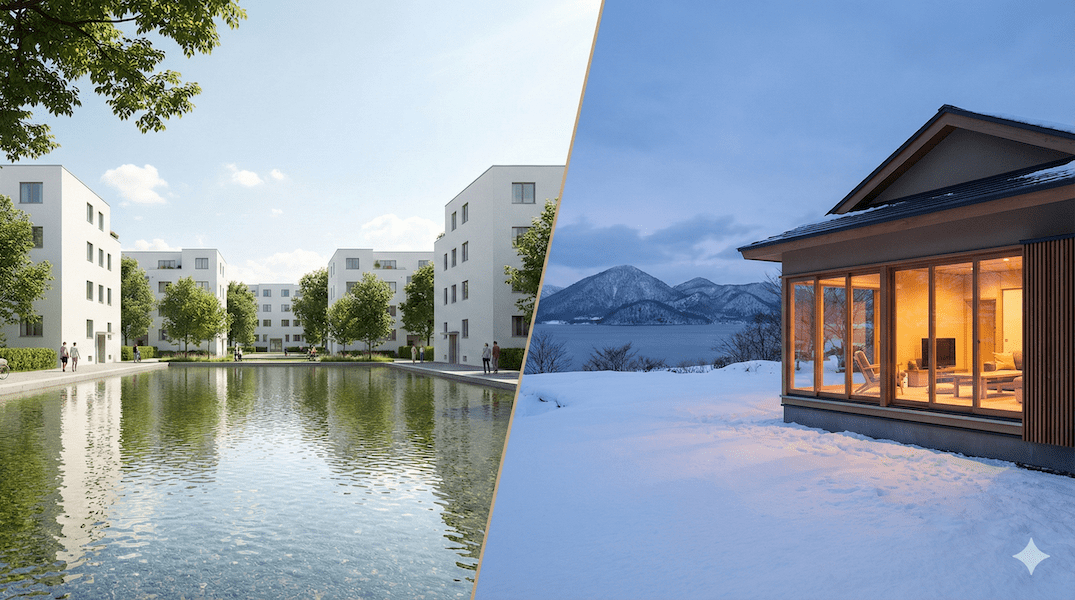
Based on this historical analysis, let us now turn our attention to the modern-day town of Toyako in Hokkaido. Although Toyako boasts a beautiful caldera lake and hot springs, it faces the common challenges faced by Japanese local governments: a declining population and an increasing number of vacant houses.
However, by applying the knowledge of the German Siedlung, these issues can be transformed into "new value." Below, we propose three specific strategies.
Strategy 1: Japanese Siedlung, with thermal insulation performance as "capital"
Hokkaido and Germany share the commonality of severely cold winters and high demand for heating energy. In Germany, low utility bills (running costs) are one of the factors that greatly influence the asset value of a home.
The real goal in Toyako Town's vacant house countermeasures is not superficial renovations, but thorough "insulation renovations." Specifically, the ideal goal would be to aim for performance approaching the German Passivhaus standard (heating demand of 15 kWh/m² per year or less) by installing triple-glazed windows and adding insulation.
- [Economic benefits]
Branding the house as one with dramatically lower winter utility bills, even though rent and a mortgage are required, will attract potential new residents from an economically rational standpoint. - [Financial Scheme]
Similar to the role played by the "Hauszinssteuer" during the Weimar era, it is hoped that a system will be established today to publicly support initial investments, funded by "decarbonization-related subsidies" and "green bonds" issued by local governments.
Strategy 2: Area management through "decentralized Siedlung"
The key to the Siedlung's success was that it managed the area rather than the individual buildings, with cooperatives (Genossenschaft) and other organizations taking care of the gardens and maintaining them all together.
In Toyako Town, too, a model in which scattered vacant houses are treated as a single virtual "decentralized housing complex (a residential version of an albergo diffuso)" and managed collectively by a local trading company or urban development company would be effective.
For example, instead of new residents having to shovel snow or mow the grass individually, they can pay a management fee and have local young people and business owners do the work for them. This lowers the barrier to relocating while also creating jobs and money circulation within the community. This could be considered a form of "new mutual aid (commons)" in a society with a declining population.
▼[Map] Toyako Town, Hokkaido (target area)
A decentralized regeneration plan is needed that takes into account the characteristics of both the lakeside area and the residential area on the mountain side.
Strategy 3: Introducing Bruno Taut's "Color" and "Borrowed Scenery"
Architect Bruno Taut stayed in Japan in the 1930s and praised Katsura Imperial Villa and other buildings, calling them "so beautiful it brings me to tears." He saw potential in the fusion (hybrid) of traditional Japanese architecture and modernism.
The idea behind Siedlung's "color plan" is a very useful hint for shaping the landscape of Toyako Town. However, rather than painting it in the same colors as Germany, it is important to create a unique color palette that harmonizes with the "color of the water" of Lake Toya, the "white" of the snow, and the "green" of the surrounding mountains.
Furthermore, to ensure the "view from the window (borrowed scenery)" that Taut emphasized, urban planning will need to be more minimalist, such as reducing the number of vacant houses and ensuring that neighboring houses have views of the lake. Beautiful scenery is itself a powerful tourist resource and a source of civic pride for residents.
Conclusion: From homes that are consumed to social capital that is accumulated
The message that the German Siedlung of the 1920s sends to the modern world is powerful.
"Low-quality housing is a liability to society in the future. Conversely, high-quality housing becomes social capital that will last for 100 years."
Toyako Town in Hokkaido should not simply aim to fill up its vacant houses. Just as our German predecessors overcame the crisis with a system called "Hauszinssteuer" and the "intelligence of architects," we too need to update our homes using modern tools such as "insulation technology" and "area management."
"If you go to Toyako Town, you'll find warm vintage houses where you can wear a T-shirt even in winter, some of the most spectacular views in the world can be seen from the windows, and there is a system in place where the entire community supports each other's lives."
This kind of lifestyle (well-being) is sure to be the most powerful content that will attract people from all over the world. Now is the time to take the first step, believing that 100 years from now, the town we have created today will be recognized as the "Siedlung of the Heisei and Reiwa eras."
Related Links
- UNESCO World Heritage Centre – Berlin Modernism Housing Estates
- Toyako Town– Urban Planning Master Plan
Inquiries and requests
We help solve local issues.
Please feel free to contact us even if it is a small matter.