〜Urban planning for "expansion" and "contraction" may seem polar opposites at first glance, but they share a common, cold-hearted calculation of "how to survive with limited resources."〜
*This article is based on publicly available information as of February 2026.
"History does not repeat itself, but it does rhyme" -- this aphorism, attributed to Mark Twain, resonates with a poignant reality in the history of urban planning in Japan.
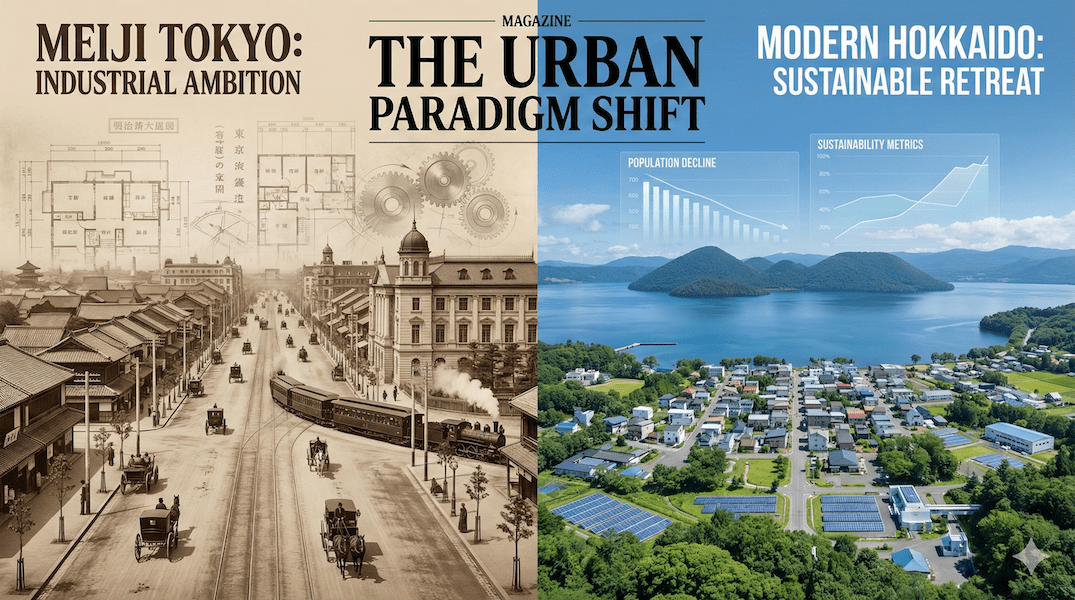
Let's turn back the clock to the end of the 19th century. Meiji-era Tokyo was a story of expansion and growth as the city tried to catch up with the great powers. Now, let's turn to Toyako Town in Hokkaido in the 21st century. What is happening there today is a story of shrinkage and withdrawal due to a declining population.
At first glance, these two eras seem to be polar opposites, like the accelerator and the brake. However, if we carefully dig deeper, a surprising commonality emerges. This is the situation in which we are struggling to find the optimal solution by allocating extremely limited resources while being caught between fatal external pressures (epidemics and global competition) and internal pressures (financial difficulties and demographic changes)."Survival Strategy"It is nothing but that.
This article uses primary sources and official statistics to thoroughly compare the Meiji-era national project "Tokyo City Ward Reform" with the "public facility reorganization and downsizing urban development" that is currently at the forefront of Hokkaido's efforts. How can the successes and failures of the past serve as guideposts for the "sustainable retreat battle" that Japan faces in the future?
1. Transcending into a Modern City: The Truth about Tokyo's Ward Reform and the Curse of Article 7
Fear of "death" looming over the capital: epidemic prevention and fire prevention
After the Meiji Restoration, Tokyo still retained the castle town structure that was a legacy of the Edo Shogunate. Although it had excellent military defense functions, it had fatal structural flaws as the capital of a modern nation.
Specifically, Tokyo at that time was a city that was constantly on the brink of death."Public health collapse"The lack of water supply and sewage systems created a breeding ground for waterborne infectious diseases such as cholera and dysentery, and Tokyo was hit by repeated epidemics from the early to mid-Meiji period.
According to documents from the National Diet Library, Tokyo during the Meiji period was repeatedly affected by epidemics of infectious diseases, including cholera, against the backdrop of a deteriorating sanitary environment. This was not simply a matter of disease, but a security crisis that affected the maintenance of urban functions.
The second crisis"Weak disaster prevention capabilities"Densely built wooden urban areas were extremely vulnerable to fire, and it was no longer an era when people could afford to take it easy and say, "Fires and fights are the flowers of Edo." Repeated fires, including the Great Ginza Fire (1872), paralyzed the capital's functions, and the economic losses were immeasurable.
The plan was created to solve these problems and demonstrate that Japan was a "civilized nation" on a par with the Western powers."Tokyo City Ward Reform"This was not just a road construction project, but a huge project that put the nation's prestige at stake.
▼ The center of Tokyo's ward reform (around the Imperial Palace and Hibiya)
The "budget barrier" that shatters ideals: The reality of Article 7 of the ordinance
However, from the very beginning, this grand plan faced the practical obstacle of money. The legal basis for this plan was the Act promulgated in 1888 (Meiji 21)."Tokyo City Ward Reform Ordinance (Imperial Ordinance No. 62 of August 15, 1888)"is.
According to archives such as the National Archives of Japan, this ordinance included strict financial discipline along with the scope of projects (roads, bridges, canals, sewers, etc.). In particular, the provisions regarding project expenses (budgetary constraints related to Article 7) had a major impact on the implementation of the plan. The Ministry of Finance at the time was extremely wary of loose finances due to infrastructure investment, and so it imposed a "cap" (budget limit) on urban planning in advance.
In today's corporate management, this would be equivalent to the finance department imposing strict spending restrictions on projects with uncertain ROI (return on investment).
The decisive difference from Paris: aesthetics or practicality?
The model that Meiji era urban planners used was the "Remodeling of Paris (1853-1870)" by Georges Haussmann of France. However, the actual situation was very different. Please see the comparison table below.
| Comparison items | [Ideal] Paris Remodel (Haussmann's Paris) |
[Reality] Tokyo City Ward Reform (Meiji Tokyo) |
|---|---|---|
| Main purpose | Imperial power demonstration, riot suppression (A main street with good visibility) |
Disease prevention and fire prevention Appealing to Treaty Revision as "Civilized" |
| Funding | Massive debt and land speculation Development profit return model |
Limited government subsidies + beneficiary charges Strict budget limits set by ordinance |
| Execution method | Forced demolition of existing slums Straight boulevard penetration |
Prioritizing the use of "fire-affected areas" Mainly widening of existing streets |
| result | A unified aesthetic created by stone architecture Fundamental changes to urban structure |
Fireproofing is not thorough (mostly wooden buildings) Progressive infrastructure development |
While Paris invested all of its national resources to completely restructure its urban structure, Tokyo's ward reform was carried out amid the reality of financial difficulties.Taking advantage of the fire disaster (widening the road after it has burned)We had no choice but to take an extremely pragmatic or cold-hearted approach.
As the project progressed, rising prices and other factors made budget shortfalls apparent. Research into urban planning history reveals that the committee made recommendations to "speed up" the project in order to break the stagnation, and records show that the committee struggled to balance ideals with reality (budget). This could be seen as a decision made by the practitioners on the ground to "select and focus," in which they felt the need to complete at least the minimum infrastructure, even if it meant putting aesthetics and ideals on the back burner.
2. The current state of Toyako Town in Hokkaido and the reality of its "degeneration"
Population halving: demographics reversing
Fast forward to the 21st century. Hokkaido, which once continued to expand its frontiers under the name of "development," is now at the forefront of Japan's most rapid population decline. Let's take a look at the current situation in Toyako Town as a symbolic example of this.
The demographic trends of Toyako Town (former Abuta Town and Toya Village merged) highlight the challenges facing local governments in Japan. Based on data from the national census and other sources, the current population trends within the town are as follows:
Population trends in Toyako Town
*Based on the National Census (1970-2020) and the Basic Resident Register (2025)
At its peak in 1970, the population exceeded 16,000 people in today's town area, but after half a century, it has shrunk to less than half that. Even more serious is the situation itself, with the aging rate exceeding 40% (see the 2015 Population Census, etc.), and the decline in the working-age population is directly linked to a decline in tax revenue.
▼ Toyako Town, Hokkaido (wide area)
Modern-day "Section 7": The Pressures of Fiscal Consolidation
For modern local governments, the financial burden on them is comparable to that of the Meiji era's "Article 7 of the Ordinance," which came into force in 2007."Act on the Soundness of Local Government Finances (Financial Soundness Act)"is.
Toyako Town has also faced severe financial situations in the past. According to the town's published documents and assembly reports, thorough administrative and financial reforms were required to improve the financial soundness assessment ratio and avoid future financial crises. Under these legal and environmental constraints, it is extremely difficult to build new buildings, and reducing the maintenance costs (running costs) of existing facilities is a top priority.
A typical example is the issue of consolidating and closing public facilities. For example, in the case of the town-run swimming pool, the aging of the facilities and malfunctioning of the filtration system led to a weighing of the high costs of maintenance and renewal against the financial burden, and discussions were held on whether to consider closing the facility or bring forward the plan (for details, please refer to the town's "Comprehensive Management Plan for Public Facilities, etc." and public documents such as the town council newsletter).
Even if infrastructure is important to residents, we live in an age where its survival is in jeopardy in the face of the absolute ruler of "finance." If Tokyo in the Meiji era suffered because "we couldn't build it because we didn't have the budget," modern Hokkaido is"We can't fix it because we don't have the budget (it's out of service)"They are faced with a pain that comes with a greater sense of loss.
3. Comparative analysis: growing pains vs. shrinking pains
Let's compare the structural issues that the two companies faced. Although the historical backgrounds are different, there are clear contrasts in the mechanisms behind them.
Phase: Expansion and growth
The supply of infrastructure could not keep up with the rapid population influx. The problem was "shortage," and the solution was "construction."
- 📈 population:Explosive growth
- 🚧 Bottleneck:Lack of physical capacity
- 🎯 strategy:Expanding supply capacity (dams, roads)
- 💡 Mind:"If you create it, you will be rewarded."
Phase: Maturity and contraction
Population outflow has led to an excess of past infrastructure. The problem is "surplus," and the solution is "disposal and consolidation."
- 📉 population:Sustained decline
- 🏚️ Bottleneck:Maintenance and management expenses (OpEx)
- ✂️ strategy:Total volume reduction, consolidation, and integration
- 💡 Mind:"Reduction is justice"
Tokyo also faces a shrinking phase in 2040
What is particularly noteworthy is that the current phenomenon occurring in Toyako Town suggests what Tokyo will look like in the future.
According to estimates such as the "Future Tokyo Strategy" published by the Tokyo Metropolitan Government, the total population of Tokyo isThe population will peak at approximately 14.24 million in 2025 and then begin to decline, reaching approximately 13.84 million in 2040 and approximately 13.22 million in 2050.Even the capital, which has been premised on steady growth until now, will soon face a wave of serious population decline and super-aging.
The "urban sponge phenomenon," in which vacant houses and vacant lots randomly appear within cities and density declines, leads to inefficient administrative costs. In other words, Toyako Town's difficult decision is not something that only affects other cities. It should be seen as a precedent for the "withdrawal battles" that will occur in all local governments and unprofitable divisions of large companies in Japan.
4. Local Potential: A Paradigm Shift for Survival
However, it is not all pessimistic. It is precisely constraints that give rise to innovation. Just as Tokyo in the Meiji era modernized after a fire, Toyako Town today is also seeking a new urban model after shrinking.
1. Earning "foreign currency" through exchange population
In order to maintain infrastructure while the resident population (those who pay resident tax) is declining, an inflow of funds from outside the region, in other words "foreign currency," is essential. Just as Meiji Japan sought economic status in the international community through treaty revisions, Toyako Town"sightseeing"was positioned as a lifeline for survival.
According to statistics from the town and the tourist association (see 2020, etc.), even during the COVID-19 pandemic, the town has maintained a certain number of overnight guests and tourists, supporting the local economy. Leveraging its certification as a Global Geopark and its history as the host of the G8 Summit, the town is establishing itself as a "tourist destination of choice around the world." This is not simply a PR activity, but an extremely serious economic strategy to protect the infrastructure of residents' lives (water supply, roads, hospitals, etc.).
2. "Escape City Planning" to make disaster prevention a culture
Another possibility is a model of coexistence with disasters. In this region, home to the active volcano Mount Usu, eruptions are seen as a "periodic part of everyday life" rather than an "abnormal event that must be avoided."
While Tokyo in the Meiji era aimed to become a "fireproof city" (emphasis on infrastructure) by widening roads to prevent the spread of fires, Toyako Town aimed to protect lives by allowing people to evacuate quickly even in the event of an eruption."The City of Escape (Software Emphasis)"The aim is to regulate land use based on hazard maps and develop a "relic park" that preserves and displays remains from the 2000 eruption. These are more rational and lower-cost adaptation measures than building huge concrete barriers.
Transforming the negative legacy of disaster risk into the positive assets of education and tourism resources. This reversal of thinking (resilience thinking) is the key to the survival of resource-poor regional cities.
3. Compact and thorough network
Finally, there is the reorganization of spatial structures. The "Compact Plus Network" concept advocated by the Ministry of Internal Affairs and Communications and the Ministry of Land, Infrastructure, Transport and Tourism will be most effective in a vast land area like Hokkaido.
Rather than providing services evenly across the entire area, urban functions will be concentrated in hubs such as the Toyako Onsen district and Abuta Honmachi (compactification), and connected to surrounding areas by public transport and digital networks (networking). In response to residents' concerns about inconvenience, the process of reaching a consensus between the government and residents through dialogue on what to discard and what to preserve will itself be a litmus test for the maturity of democracy in the future.
Conclusion: Evolution towards technology that "folds" cities
Charles Darwin, the father of evolution, said:"It is not the strongest that survives, nor the most intelligent that survives. It is those who are most adaptable to change."and.
The Meiji era Tokyo city ward reform was a way to reorganize the city in order to survive as a modern nation."spread"It was a change. Despite facing a tight budget, our predecessors worked hard to pave the way.
Now, Toyako Town in Hokkaido is working on how to appropriately restructure the city to sustain the local community."Fold (downsize)"It's a change.
Population decline is an unavoidable reality, but it does not necessarily mean despair. It is important to abandon the "dreams of expansion" of the past and redesign the city into a more muscular structure that suits its size. And it is important to maximize the unique value of tourism and disaster prevention. Toyako Town's challenge offers a hopeful "solution" for all Japanese cities and businesses as they enter an era of "shrinkage."
What is required of us is not to lament the current situation, but to have the courage to make a strategic retreat and redesign relationships within limited capital.
Related Links
- Ministry of Land, Infrastructure, Transport and Tourism: History and Transition of Urban Planning
- TokyoNational Archives: History of urban development in Tokyo
- Toyako Town: Comprehensive Urban Development Plan
Inquiries and requests
We help solve local issues.
Please feel free to contact us even if it is a small matter.