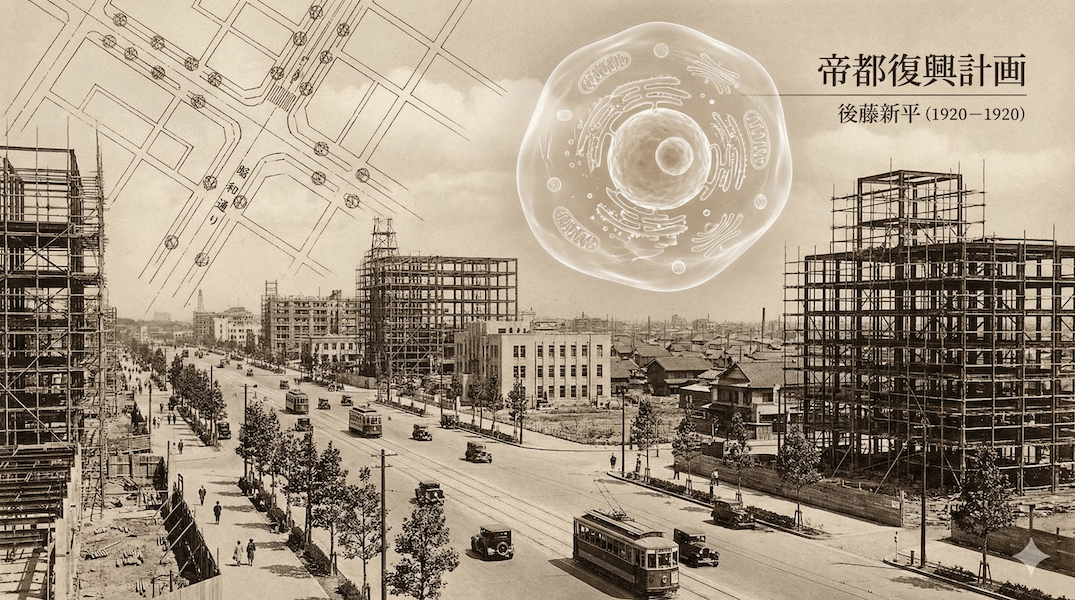
〜Goto Shinpei's "Imperial Capital Reconstruction Plan" was not just a restoration project, but a surgical operation that treated the city as a living organism.〜
*This article is based on information as of February 2026.
"Politics is the hygiene of the nation"
So said Goto Shinpei, a physician-turned-politician who served as civil administrator of the Taiwan Governor-General's Office and the first president of the South Manchuria Railway. To him, nations and cities were not just collections of inorganic buildings, but rather huge "organisms" that circulate, breathe, and metabolize.
His unique perspective would prove its worth during the greatest challenge in modern Japanese history. At 11:58 a.m. on September 1, 1923 (Taisho 12), a massive earthquake with a magnitude of 7.9, centered in the Sagami Trough, known as the Great Kanto Earthquake, suddenly struck the imperial capital of Tokyo.
The scale of the damage was truly beyond description. According to official records, the total number of damaged houses, including those completely destroyed, partially destroyed, or burned, reached approximately 370,000, with approximately 40% of the Tokyo area at the time and approximately 90% of the Yokohama area burned down. Approximately 105,000 people were killed or went missing. Of particular note is the breakdown of the causes of death. The fact that approximately 92,000 people (approximately 90% of the total) were "burned to death by fire" grimly highlights how fragile the urban structure of Japan at the time, with its densely packed wooden houses, was.
However, in response to this unprecedented national crisis, rather than simply "restoring the state to its original state," it was Goto Shinpei, who took office as Minister of Home Affairs the day after the earthquake, who attempted a fundamental "urban remodeling" with a century-long outlook. The "Imperial Capital Reconstruction Plan" he drew up was an ambitious concept that amounted to several times the national budget at the time, and was derided by his political opponents as "big talk." Nevertheless, the resilient framework that supports central Tokyo today - main roads such as Showa-dori and Meiji-dori, and disaster prevention green spaces such as Sumida Park - are undoubtedly legacies that were born at this time.
In this article, we will delve into the historical background of the time, examine the full picture and failures of the Imperial Capital Reconstruction Plan, compare it with urban planning overseas (the remodeling of Paris), and trace the lineage of the "pre-reconstruction" in Toyako Town, Hokkaido today, to consider what perspective we should have in future disaster prevention urban planning.
1. Performing "Surgery" on the City: The Ideas and Historical Changes of the Imperial Capital Reconstruction Plan
A doctor's perspective on urban "metabolism" and its four major principles
Immediately after the Great Kanto Earthquake, with Japan in the depths of despair, Goto Shinpei was appointed Minister of Home Affairs on September 2nd in the newly formed Second Cabinet of Yamamoto Gonbei. His actions were extremely swift and thorough. Immediately after taking office, he dismissed the "capital relocation theory" (argument that Tokyo should be abandoned and the capital moved to another safe location) that had been rising in some quarters.
He then quickly sought advice from his friend, the American political scientist Charles Beard, who gave him a strong recommendation: "Construct a new Tokyo based on new urban planning principles." Encouraged by this, Goto submitted a "Proposal for the Reconstruction of the Imperial Capital" to the Cabinet in early September, just a few days after the earthquake. In the proposal, he loudly proclaimed the following four major principles:
- First principle: The capital will never be moved.
We will not abandon Tokyo, but will rebuild it here as a modern capital, demonstrating national prestige. - Second principle: 3 billion yen (later 4 billion yen) will be allocated for reconstruction costs.
A huge amount of money, far exceeding the national general account budget at the time (approximately 1.5 billion yen), was invested in making fundamental reforms. - Third principle: Adopt the latest urban planning methods from Europe and the United States.
It is not just restoration, but the creation of a modern infrastructure that rivals or even surpasses that of London or Paris. - Fourth Principle: Take a firm stance against landowners to implement the New Urban Plan.
In order to prioritize the public interest (road widening and land readjustment), they exercise strong authority, even to the point of nationalizing land.
It is worth noting here that Goto's approach to urban planning was rooted in what he advocated as "biological principles." With a background as a doctor, he emphasized the importance of carefully observing local conditions (systems, customs, etc.) and implementing measures that were appropriate to those conditions. He believed that in order to heal a city severely damaged by a disaster, surgical "improvement of the city's constitution" was essential, rather than symptomatic repairs such as applying bandages.
Specifically, given the horrific fact that approximately 90% of the deaths were caused by fire, the city placed the highest priority on making the city fireproof and preventing the spread of fire. Like human blood vessels, wide arterial roads were built in radial and circular patterns to ensure the flow of traffic and goods. Furthermore, parks, the "lungs of the city," were placed at these intersections and strategic locations. This created physical "wind paths" and "firebreaks" within the city, preventing the spread of fire in the event of a future fire and enhancing the city's own immunity (disaster prevention resilience).
Political conflict and shrinking "big talk"
On September 27, about one month after the disaster, the Imperial Capital Reconstruction Agency was established as a special administrative agency to vigorously promote reconstruction work, with Goto himself serving as its president. He drew up a grand vision for the future, including the construction of wide roads, the reorganization of canals, the construction of a subway network, and even the nationalization of land.
However, this idealistic plan soon ran into harsh realities. It faced fierce opposition from the Ministry of Finance, which feared the huge financial burden it would pose, opposition forces in parliament led by the Seiyukai party, and landowners who were unwilling to have their land reduced (reduced).
[Graph] Dramatic changes in the budget size of the Imperial Capital Reconstruction Plan
*The general account budget at the time was approximately 1.5 billion yen. The final approved amount was reduced to about one-seventh of the planned amount.
As the graph above shows, the "lofty" budget of approximately 4 billion yen was forced to compromise in the Diet and was ultimately cut down to 575 million yen (about one-seventh of the original plan). The Imperial Capital Reconstruction Agency itself was abolished and downgraded to the Reconstruction Bureau, a subordinate organization of the Ministry of Home Affairs.
As a result, many of their ideals, such as the development of canals, the modernization of ports, and making all of Tokyo completely fireproof, were abandoned. However, with limited budgets and authority, Goto and his colleagues risked their lives to protect the main arterial roads that would form the "backbone of the city," and the development of the three major reconstruction parks (Sumida, Hamacho, and Kinshi).
2. Comparison with Paris Renovations: Why Tokyo Failed to Generate "Development Benefits"
Crucial differences in financial foundations and methods
When Goto Shinpei introduced the "latest urban planning in Europe and the United States," he was most conscious of and used as a model the "Remodeling of Paris (Haussmann Plan)" carried out in France in the mid-19th century. This major project, which cleared away the unsanitary, complicated alleys that had existed since the Middle Ages and created beautiful radial boulevards, was the envy of urban planners the world over.
However, there are crucial differences between the two in terms of the authority and funding mechanisms they have to advance their businesses. See the comparison table below.
| Comparison items | Imperial Capital Restoration Plan (Tokyo, Goto Shinpei) |
Paris Remodel (France, Haussmann) |
|---|---|---|
| Implementation period and authority |
1923 – 1930 (approximately 7 years) Under the Taisho Democracy, there was a strong demand for compromise and results in a short period of time, due to the change of government and opposition from the parliament. |
1853 – 1870 (approximately 17 years) Under the dictatorship of the absolute ruler Napoleon III, a consistent plan was continued over a long period of time. |
| Target scale and method |
Land readjustment area: Approximately 2,970 ha This was carried out in approximately 861 TP3T areas of the burned area. This was the world's first large-scale application of the area-wide land exchange method, which involves gradually donating private land in a "genbu" (reduction) scheme. |
Renovation area: Approximately 43% in the Paris metropolitan area The back alleys were boldly destroyed. Rather than land readjustment, the construction of linear roads was the focus of the project, driven primarily by forced acquisition. |
| Fundraising The crucial difference |
Dependence on government bond issuance and taxes (general account) The proposal to make the land public was rejected as an infringement of private rights. The government was unable to absorb the development profits, which became a major cause of financial pressure and led to budget cuts. |
Excessive expropriation (Haussmannisation) This is a business model of "development profit return," in which the land where the road is planned to be built and the surrounding land are forcibly purchased at low prices, and then sold at a higher price after land prices have skyrocketed due to infrastructure development. |
The greatest reason for the success of Georges-Eugène Haussmann, the prefect of the Seine department in Paris, was his establishment of an alchemical fundraising method known as "expropriation (Haussmannisation)." This was an extremely rational business model in which the profits generated by urban development in the form of rising land prices were collected not by the landowners but by the state or city that was the project owner, and used this money to fund further development.
On the other hand, Goto Shinpei also initially explored this method (nationalizing land). However, in Japan, where legal systems were being developed as a modern nation and democratic momentum was on the rise, it was politically extremely difficult to forcibly restrict the private property rights of landowners. As a result, Tokyo's redevelopment project had a structural flaw: the more development there was, the larger the national debt (public bonds) became. It encountered fierce resistance from the Ministry of Finance, and was ultimately forced to stall (and be scaled down).
3. Evaluation of merits and demerits: Legacies 100 years from now and issues left unresolved
Although there was a significant setback from the ideal, the Imperial Capital Reconstruction Festival was held in March 1930 (Showa 5), marking the completion of the approximately seven-year reconstruction project. There are both positive and negative aspects to Goto Shinpei's scientific and rational top-down approach. Here, we will summarize the evaluations from each perspective.
Wide road vision:
The 44m-wide main road network, including Showa-dori and Meiji-dori, which were mocked at the time as "looking like they could land an airplane on it," seemed unnecessary in an era before cars were widespread, but it functioned perfectly as a receptacle for postwar motorization. Furthermore, the wide median strip became space for the development of subway networks and utility tunnels, proving Goto's "power of foresight to see 100 years into the future."
Disaster prevention blocks and reconstruction elementary schools:
In addition to arranging 55 parks, including the three major parks of Sumida Park, Hamacho Park, and Kinshi Park, we also constructed 117 "Reconstruction Elementary Schools" made of reinforced concrete, adopting the groundbreaking method of always having 52 small parks adjacent to each one. This "spatial composition," which functions as a core for education and community in normal times and as a robust evacuation base for the region in times of emergency, is the origin of modern evacuation shelter design.
Unfinished "Unburnable City" and new risks:
The biggest negative legacy is that land readjustment was limited to certain areas due to budget cuts. Approximately 861 TP3T of the burned-down area was reorganized, but areas outside of this (particularly the areas around the Yamanote Line) were not adequately rezoned even during the war reconstruction, and remain today as "wooden housing densely concentrated areas (wood-dense areas)." According to Tokyo's damage estimates (for a direct hit in the southern part of the city center), these densely wooded areas are predicted to suffer severe fire damage, and even 100 years later, the completion of a "fire-resistant city" is still only half-way complete.
Disregard for political consensus building:
The top-down approach, which prioritized scientific and functional aspects and neglected the "soft" aspects such as people's feelings, downtown atmosphere, and community divisions, left a huge legacy of problems for future generations. For example, landowners were forced to provide about 10% of their land free of charge (reducing the area).
The current state of Sumida Park and its surroundings, a symbol of the restoration of the imperial capital
Sumida Park, one of the symbols of the Imperial Capital Reconstruction Plan, and the surrounding area of the wide Showa-dori Street still retain strong traces of the plan at that time. The map below also shows how the carefully developed waterfront open space served as a valuable "lung" in the overcrowded center of Tokyo.
4. Comparing major disasters in Japan: The evolution of recovery approaches
Japan's urban planning and disaster prevention strategies have updated their paradigms by absorbing lessons learned from each major disaster. While the Great Kanto Earthquake was a "fight against fire," the nature of damage caused by later disasters has changed, leading to corresponding shifts in investment priorities. Let's compare the three major earthquakes in Japan.
| Comparison items | Great Kanto Earthquake (1923) |
Great Hanshin-Awaji Earthquake (1995) |
Great East Japan Earthquake (2011) |
|---|---|---|---|
| Characteristics of the damage and cause of death |
Destroyed by a fire tornado Approximately 370,000 buildings were completely destroyed, partially destroyed, or burned down. Approximately 105,000 people died (about 90% of deaths were caused by fire). |
Collapse due to earthquake motion directly beneath the ground Approximately 250,000 buildings were completely or partially destroyed. 6,434 people died (approximately 881 deaths were due to crushing or suffocation) |
Washed out by a huge tsunami Approximately 130,000 buildings were completely destroyed or washed away. Approximately 22,300 people died (including related deaths, with over 90% being drowning) |
| Focus of the reconstruction plan |
"The Unburnable City" Land readjustment, wide roads to prevent the spread of fire, and reinforced concrete buildings are recommended. |
"Rebuilding an unbreakable city and lives" Strengthening the Building Standards Act (earthquake resistance standards), early restoration of infrastructure, and support for rebuilding damaged apartment buildings. |
"Fleeing City: Multiple Defenses" Relocation to higher ground, construction of seawalls, and urban development that separates work and residential areas. |
| Evolution of methods |
Top-down State-led zoning. Strong leadership. |
Bottom-up support A resident-led urban development council. Focus on community opinion. |
Reconstruction Agency unification and pre-reconstruction concept Promoting relocation to higher ground. A fusion of hardware and software. |
While the Great Kanto Earthquake focused on top-down "hard" (physical structural) reforms, the Great Hanshin-Awaji Earthquake placed emphasis on "soft support with resident participation," such as community councils. The Great East Japan Earthquake taught us the painful lesson that no matter how strong the levees (hard structures) we build, the force of nature can still overcome them. This led to the establishment of new concepts such as "escape routes" and "moving residences to safer locations in advance." This leads to the idea of "pre-emptive reconstruction," which will be discussed in the next chapter.
5. The crystallization of Gotoism, "pre-disaster reconstruction," seen in Toyako Town, Hokkaido
Disasters are not an "uncertain risk" but a "certain future"
Goto Shinpei's urban planning philosophy based on the "principles of biology" is quietly but surely being revived in modern urban planning in the form of "pre-reconstruction."
The affinity of this philosophy is particularly evident in Hokkaido, where Shinpei Goto served as president of Takushoku University. In particular, the town development of Toyako Town (formerly Abuta Town/formerly Toya Village), Hokkaido, which coexists with the active volcano Mount Usu, has been highly praised internationally.
For Toyako Town, Mount Usu has erupted repeatedly in the past, at intervals of several decades (e.g., 1910, 1943-45, 1977-78, 2000). Here, disasters are not an "uncertain risk" that may occur someday, but rather are incorporated into the common understanding of local residents as a "certain future" that will definitely occur. Therefore, their biggest theme is not to "rebuild from scratch and return to the way things were after each eruption (restoring the situation to its original state)," but to "restore the situation to the way it was before the eruption.""We will build a town structure that minimizes damage in advance, assuming an eruption will occur."That's it.
"Zoning" and "Ecomuseums" for Disaster Mitigation
The specific "pre-disaster recovery" approach being implemented in Toyako Town is surprisingly similar to the ideals of Goto Shinpei.
- 1. Thorough zoning (land use regulations) based on hazard maps:
In addition to developing and publishing hazard maps based on past eruption records, efforts are being made to curb residence and construction in risky areas through the designation of "disaster risk zones" under Article 39 of the Building Standards Act and disaster prevention collective relocation promotion projects. This is a modern application of the "fire buffer created by green belts" that Goto aimed for in the Imperial Capital Reconstruction Plan. By creating physically uninhabited spaces, human casualties can be fundamentally avoided. - 2. Disaster mitigation through software (changing residents' behavior):
When Mt. Usu erupted in 2000, detailed advance evacuation plans and practical hazard maps were disseminated, resulting in the successful evacuation of up to 15,815 people following evacuation orders and advisories. Despite the massive eruption, no human casualties were reported. This was a successful example of "biological adaptation," combining scientific data (forecasting) with the adaptability of residents, rather than relying solely on physical structures (levee systems). - 3. Turning disaster ruins into tourism resources (ecomuseums):
The damaged roads and buildings have not been removed but instead preserved as "disaster remains," and are being used as tourist and educational resources, such as the Nishiyama Foothills Crater Walking Trail. These efforts have been internationally recognized, and after joining the Global Geoparks Network in 2009, the city has now been recertified as the "Toyako-Usuzan UNESCO Global Geopark." This system, which imprints the memory of the disaster in the space and gives the local community immunity to the next disaster, is the very embodiment of the perspective of viewing cities as organisms that grow over time.
Currently, the Japanese government has positioned "national resilience" as a pillar of its national strategy, and is continually investing huge amounts of money in rebuilding infrastructure and addressing aging issues. With an eye on the possibility of an earthquake directly beneath the capital or the Nankai Trough earthquake, the fundamental premise is that infrastructure must be strong enough to "stand up to fire and destruction," and cities are continuing to evolve, ensuring "redundancy" to maintain urban functions (electricity, communications, logistics) even after a disaster.
Conclusion: What can we leave behind for the citizens 100 years from now? The courage to spread "big promises"
Goto Shinpei's plan to rebuild the imperial capital was ridiculed by many of his contemporaries as an "unrealistic, grandiose plan," and after fierce political struggles, the budget was drastically cut.
However, the city's "skeleton," such as Showa-dori Avenue and Sumida Park, which he carved into the earth of Tokyo at the risk of his political life, have withstood 100 years of hardship and survived the flames of war, and even today they continue to support the prosperity of Tokyo, one of the world's largest metropolises, and the lives of tens of millions of its citizens.
We who live in the modern age should not be limited to immediate cost-cutting and short-term economic rationality. We need to have the courage to paint a grand vision (big talk) of "what kind of city we want to leave for 100 years into the future," while also taking a dispassionate look at "scientific evidence."
The combination of the hard lessons learned from the Imperial Capital Reconstruction Plan and the soft wisdom of pre-disaster recovery practiced by Toyako Town in Hokkaido, which is to "properly fear the threat of nature and wisely avoid it," will surely be the most reliable compass for designing a resilient and resilient society in the face of future mega-disasters.
Related Links
- Cabinet Office Disaster Prevention Information Page: Report of the Expert Committee on Inheriting Disaster Lessons Learned
- Tokyo Reconstruction Memorial Hall (Yokoamicho Park)
- Ministry of Land, Infrastructure, Transport and Tourism: National Resilience Initiatives
Inquiries and requests
We help solve local issues.
Please feel free to contact us even if it is a small matter.