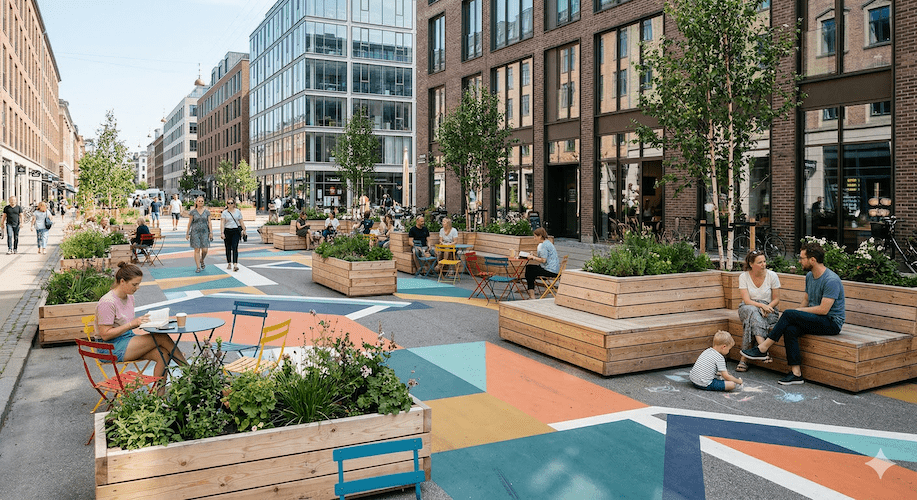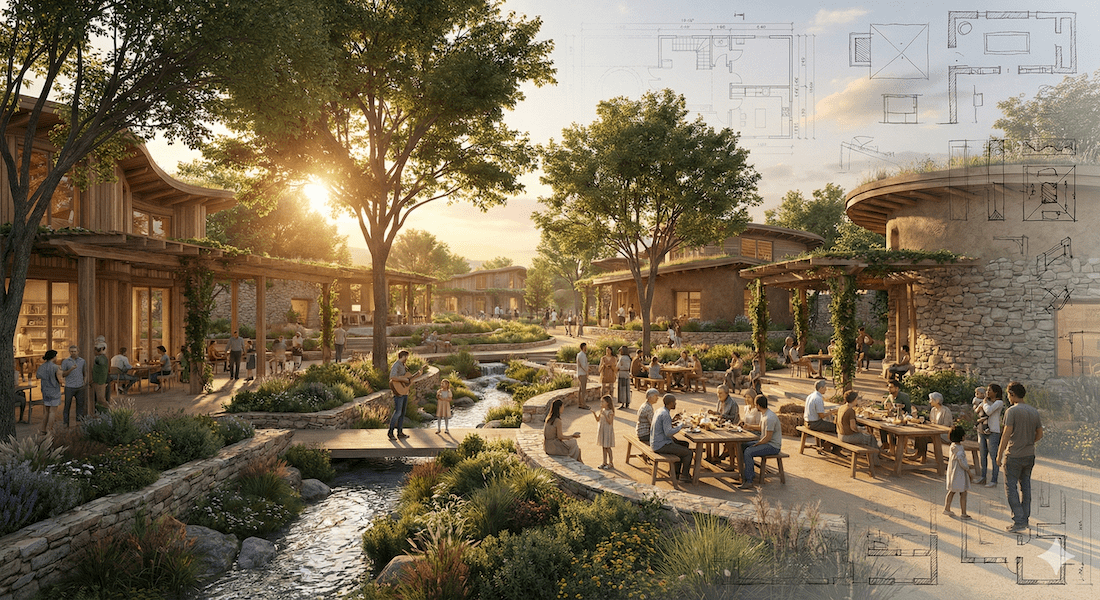
〜Shift from expert-led to citizen-participatory urban development〜
*This article is based on information as of February 2026.
"Cities and buildings have no life unless they are created by all members of society," architect Christopher Alexander once wrote in the preface to one of his major works. But who should design the cities and homes in which we live every day?
Since the period of rapid economic growth, modern urban planning and civil infrastructure development have relied heavily on top-down "master plans" created by a small number of experts and government agencies. However, in today's society, where population decline, lifestyle diversification, and aging social capital (infrastructure) are occurring simultaneously, rigid systems that are difficult to change once decided are reaching their institutional limits.
Now, a groundbreaking theory proposed in the 1970s called "A Pattern Language" is once again attracting global attention. This was created as a "common language" to verbalize the rules of space (success patterns) that everyone finds comfortable, enabling ordinary people without specialized knowledge of architecture or civil engineering to design and improve their own environments.
This article delves deeply into the historical background and essential philosophy of pattern language, based on the latest facts. It also delves into a wide range of topics from research trends in "AI-assisted Pattern Language," which utilizes generative AI, to the example of Kawasaki City's "Machi-Pata," and practical solutions to problems in regional cities (such as harmonizing infrastructure renewal with the landscape and building consensus among residents) using Toyako Town in Hokkaido as a model case.
1. The history and evolution of the pursuit of "unnamable quality"
A strong antithesis to top-down urban planning
The formation of Pattern Language is deeply connected to the accumulation of research and practice centered around the Center for Environmental Structure (CES), based in Berkeley, California. Founded in 1967 by architect Christopher Alexander, CES, along with a research team including Sarah Ishikawa and Murray Silverstein, questioned the inorganic, human-centered environmental design methods that were mainstream at the time, and began exploring a more human-centered, organic approach.
The core concept they advocated was that space possesses a "Quality Without a Name" that is filled with a sense of vitality, wholeness, and spirituality. Alexander strongly asserted that good design is not a matter of subjective taste or a difference in artistic opinion, but rather an objective, empirically verifiable truth, like the difference between health and illness. This philosophical assertion went beyond being a mere manual for spatial planning; it was systematized as a "grammar" for harmonizing human activities with physical space, from the vast scale of urban planning to individual homes and even "rooms where light shines in."
A Historical Turning Point: The University of Oregon Experiment
A decisive turning point for this theory came with the Oregon Experiment, conducted in the early 1970s. Having been commissioned by the University of Oregon to plan its campus, Alexander and his colleagues at CES embarked on a groundbreaking attempt to have a community of approximately 15,000 students, faculty, and staff take the initiative in designing and managing the future environment.
What is noteworthy about this project is that it has moved away from the traditional method of relying on static "fixed-image master plans" and instead shifted its focus to a progressive planning philosophy that accumulates decision-making through patterns and processes. A continuous growth process based on the principles of "organic order," "resident participation," "gradual growth," "pattern," "diagnosis," and "adjustment" has been introduced, and an approach has been adopted in which the space is partially repaired in accordance with the daily changes in the community.
His research was later compiled into a book called "A Pattern Language: Towns, Buildings, Construction," which was published in 1977. Despite being a massive work of over 1,000 pages, it contained 253 patterns interlinked in a network-like structure, and became an international bestseller, an unprecedented feat for an architecture book.
2. Impact on Software Engineering and the Current State of Localization
From Architecture to IT: The Origins of Object-Oriented Design and Wiki
The strongest testament to the universality of the logical structure of pattern languages is their dramatic impact on other fields, particularly software engineering. In 1987, software engineers Kent Beck and Ward Cunningham presented a pioneering attempt at applying Alexander's "pattern language" ideas to object-oriented programming (OOP) design at the OOPSLA conference.
This network-based approach, which involves breaking down complex problems into solvable modules (patterns) and combining them to build a whole, subsequently spread widely in the software field as a pattern culture. This led to the GoF Design Patterns of 1994, and further became deeply connected to the world's first Wiki, which was launched in 1995 (a knowledge-sharing mechanism that forms the basis of modern-day Wikipedia, etc.). The fact that a theory that discussed the placement of physical bricks and concrete became the foundation for shaping digital information architecture can be considered a historic paradigm shift.
Localization for the local community in Japan
While there are many cases overseas where original patterns have been implemented in physical infrastructure development, when we look at implementation cases in Japan, we see interesting translations that are tailored to the local context.
Representative examples of this are initiatives such as "Machipata (Sawaku Ward's version of urban development pattern language)" and "Kirapata" in Saiwai Ward, Kawasaki City, Kanagawa Prefecture. Rather than simply applying 253 original patterns, these patterns extract "secrets" and "know-how" from resident-led urban development activities that are actually active in the area, and re-edit and verbalize them as a region-specific pattern language. This shows that in Japanese urban development, emphasis is placed on utilizing these as a "soft foundation" such as building relationships among local residents and fostering community, rather than on developing hard aspects.
3. Essential differences and comparison with conventional master plans
Urban development using pattern language is often confused with traditional government-led "master plans," but the approach is clearly different. The comparison is summarized in the table below.
| Comparison element | Traditional master plan (fixed image type) | Pattern Language (Process/Incremental) |
|---|---|---|
| Design and planning entity | Urban planners, civil engineers, government agencies (top-down structure by experts) | Local residents, facility users, and the on-site community (bottom-up structure) |
| How to understand cities and spaces | A structure built from a blank slate to a static, future finished image | An organic network that continues to grow and repair itself in response to environmental changes |
| Rules and their application | Strict zoning, quantitative regulations such as numerical targets, and zoning | Guidelines based on flexible combinations of "patterns" that verbalize everyday problems and solutions |
| Timeframe and investment | Large-scale integrated development. There is a risk that the project will become obsolete due to changes in social conditions upon completion. | Gradual and partial growth. Accumulating small improvements makes it resistant to uncertainty. |
While a master plan attempts to define the "end-state," a pattern language defines the "process" by which space is generated. The latter framework is extremely effective in increasing the resilience of cities in an unpredictable future.
4. The conflict between advantages and disadvantages in urban development practice
However, while there are clear benefits to implementing this theory into actual administrative processes and infrastructure development, there are also challenges that face the field.
1. Dramatically facilitate the formation of consensus among residents
By using experiential common language such as "a room where light shines in" and "pedestrian streets" rather than specialized architectural drawings or civil engineering terminology, citizens can actively participate in the design, which reduces opposition to NIMBY (nuisance by-products) issues.
2. The scientific basis for well-being
There is a systematic review that shows that biophilic design (design that emphasizes connections with nature) has a positive effect on reducing people's stress in specific areas such as medical facilities. Pattern Language's guidelines, such as "appropriate guidance of natural light," are in line with this modern scientific knowledge.
3. Diversification of financial risk
By gradually repairing the infrastructure as the community grows, we can reduce the initial large financial risk and respond agilely to changes in the environment.
1. Conflict with existing expert authority
The idea that "people themselves should design their own cities" is likely to clash with the traditional professional roles of architects and urban planning consultants, and is institutionally difficult to incorporate into existing legal regulations and top-down development schemes.
2. Complex processes and barriers to facilitation
The task of extracting a list that matches local issues from a thousand pages of patterns and assembling it in a consistent manner places a huge cognitive load on ordinary citizens. Without a good facilitator, the discussion will go off track.
3. Risk of bureaucracy and formalism
As was pointed out in the case of the University of Oregon, there is always an inherent danger that maintaining a system over a long period of time will lead to the organization becoming increasingly bureaucratic, and that pattern language will be reduced to a mere "formal checklist."
5. Possibilities for solving problems in Toyako Town, a regional city
To translate theory into practice, we will use the town development project in Toyako Town, Hokkaido, as a model case to analyze how the perspective of pattern language contributes to the design of relationships.
Transforming aging infrastructure renewal from a "job" to "fostering pride"
In Toyako Town and many other local governments, the infrastructure for daily life (such as waterworks) that was built during the period of rapid economic growth is reaching the time for renewal. The value of the infrastructure throughout its life cycle will change significantly depending on whether this is treated as simply "civil engineering restoration work" or whether it is seen as an opportunity to reconnect residents' lives with the surrounding natural landscape (Lake Toya and Mount Usu).
Let's look at one estimate from the perspective of budget structure.
Toyako Town: Estimated financial structure for water supply-related project costs (million yen)
*The figures in this section are breakdowns based on budget-related materials published in fiscal year 2022, and strict audits and comparisons based on corporate accounting standards, etc., require confirmation of the original primary documents from the relevant local government.
* Replacement of water distribution pipes in the Takada area (29.31 million yen), detailed design for the Shimizu and Irie areas (6.18 million yen), etc.
It is important to note that much of the development of social capital is funded by "town bonds," a burden that must be passed on to future generations. If civil engineering work proceeds with little involvement from residents, a sense of ownership over the infrastructure will not develop. This is where the concepts of "waterfront boundaries" and "green streets" from the Pattern Language come into play, and residents need to be involved in the initial process of infrastructure renewal. Fostering a sense of "their town's assets" will encourage voluntary cooperation in future maintenance and management, which will ultimately make it possible to reduce long-term lifecycle costs.
Designing the boundary between tourism and daily life
Furthermore, Toyako Town is urgently tasked with separating and integrating tourist destinations (the extraordinary) and living spaces (the everyday). To harmonize these opposing elements, patterns such as "neighborhood boundaries," "promenades," and "quiet back spaces" work effectively. The vitality of tourists can be spread to the local economy while ensuring residents' privacy. Residents themselves need to communicate this win-win circular zoning structure with the government using a common language.
6. Integration with Technology: Prospects for AI-assisted Pattern Language
The biggest weakness of pattern language, the "enormous information processing load," is currently being overcome through technological breakthroughs.
Design support process using generative AI (LLM)
To avoid confusion with the existing "2.0" classification in the software field (such as in the context of Web 2.0), this paper refers to the new practice of using generative AI as an auxiliary line as "AI-assisted Pattern Language." Since 2025, research into frameworks for integrating pattern languages using large-scale language models (LLMs) and prototyping for practical applications have been progressing rapidly.
By inputting a specific site or local issue (e.g., "walking space design in a hot spring town with an aging population") in natural language, AI will suggest an optimal context-dependent subset from a vast number of patterns and help build a specific experiential narrative. This significantly lowers the hurdle for stakeholders without specialized knowledge to make intuitive architectural choices.
Evidence-based spatial quantification
Furthermore, progress in quantification using network science and data science cannot be overlooked. There is also academic research that attempts to turn Alexander's concepts of "wholeness" and "centers" into mathematical and quantitative indicators using graph theory and other methods. This is laying the groundwork for discussing "creating comfortable spaces" in government budgeting processes as an investment based on objective evidence, rather than simply emotional arguments.
Conclusion: We must regain the power to design our environment
The greatest achievement of Christopher Alexander's "Pattern Language" is not that it shows how to create beautiful buildings,"The idea was to use language as a tool to take back the power to design the environment, which had previously been monopolized by experts and bureaucrats, and give it back to the people."is located.
As we face the creation of new urban areas, we must consider the question, "What is true resident participation?" The process of asking people for their approval or disapproval of a master plan prepared by the government after the fact is merely an "approval procedure," not participation. True participation is the process of drawing out people's "lived experiences" in their daily lives in a common language and working together to define issues and develop solutions.
It is precisely in regional cities, where harsh yet beautiful natural environments are directly linked to the renewal of aging social capital, that residents themselves need to verbalize spatial rules that are in line with the local context and design relationships through dialogue. Now that AI technology and quantitative evidence have lowered the hurdles, it is time to move away from reliance on top-down planning and shift course toward vibrant urban development led by the local community itself.
Related Links
- Center for Environmental Structure (CES)
- Kawasaki City: Machipata, a pattern language from Saiwai Ward
Inquiries and requests
We help solve local issues.
Please feel free to contact us even if it is a small matter.