〜The impact and potential of a psychogeographical approach on modern walkable urban development, tourism, and regional revitalization〜
*This article is based on information as of February 2026.
When we normally walk through cities or towns, our routes are unconsciously determined by "efficiency" and "the shortest distance." Whether it's commuting to work, shopping at the supermarket, or touring the sights at a tourist destination, there is always a clear "destination," and a functionalist approach to walking is required, one that seeks to move without wasting the resource of time. However, there is a school of thought that challenges this capitalist way of understanding space and seeks to fundamentally reinterpret urban space. This is the practice of "Dérive" (drifting), which was born in France in the 1950s and was initiated by the Situationist movement.
Furthermore, this idea is not just an artistic movement of the past. In modern urban planning and regional revitalization, it is being re-evaluated as a "relationship design" that maximizes the ROI (return on investment) of invested resources (time, money, and effort) and stabilizes local ecosystems.
Guy Debord, a central figure in the Situationist International, wrote in his 1958 book, The Theory of Drifting:
"In drifting, people temporarily abandon their everyday relationships, their work and leisure activities, and all the usual motives for movement and action, and surrender to the gravitational pull of the terrain and the encounters that arise there."
In this article, we will examine the historical background and various data to see what implications this radical urban experience approach known as "Delive" has for modern-day "walkable urban development" and regional city tourism strategies (utilizing inbound consumption and accommodation taxes). Let's think together about how to recapture the rich relationship between people and space that has been lost as a result of the pursuit of efficiency.
1. Rebellion against the Efficiency of the City: The Situationists and the Birth of "Drifting"
Psychogeography: A new approach to spatial analysis and ROI perspectives
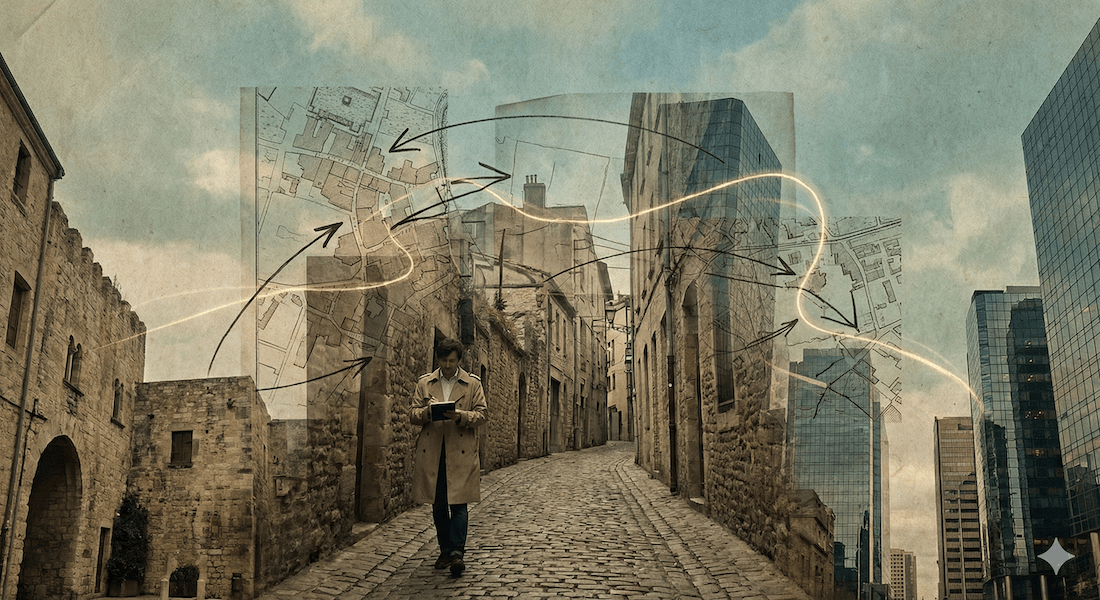
The "dérives" advocated by the Situationists are not simply a casual stroll or aimless wandering. They are a practical approach that involves intentionally escaping from the routes of movement preordained by urban planning and capitalist efficiency, and wandering around the city following the psychological attractions and repulsions of space. The theoretical framework underlying this practice is called "psychogeography," which Debord defined in a 1955 essay as "the study of the specific effects and laws that geographical environments, whether consciously organized or not, have on individual emotions and behavior."
The important fact that can be deduced from this is that walking is not simply a means of transportation to a destination, but an active research method that analytically explores how sensory data such as surrounding architecture, alleys, smells, and sounds affect the human psyche, uncovering hidden aspects of the city.
Translated into modern business terms, it was a strategic attempt to deepen "engagement" with sei-katsu-sha on the platform of the city and maximize the potential value (capital) of the space.
Haussmann's Great Reform of Paris and Resistance to Functionalism
The background to the birth of this idea lies in strong criticism of the urban redevelopment of Paris led by Baron Georges Haussmann during the Second Empire in the 19th century. Generally, Haussmann's urban redevelopment had the clear objective of modernizing the city, such as improving sanitation and developing transportation networks and landscapes. However, it has also been pointed out that the destruction of complex alleyways and the construction of wide, straight boulevards made it difficult to form barricades during popular uprisings, and contributed to the movement of troops and the maintenance of public order (although there is debate in historical interpretation about the police and military aspects of this).
The Situationists felt a sense of crisis at the way this historical process had transformed modern cities into functionalist spaces that prioritized the smooth passage of automobiles, reducing citizens to passive consumers under capitalist propaganda. Guy Debord criticized this as the "society of the spectacle." Therefore, d'érive began as a radical political and artistic resistance to transform spaces of alienated labor and passive consumption into realms of play and adventure.
The crucial difference between a "flaneur" and a "dérive"
The Situationist concept of "dérives" is often confused with the concept of the "flâneur" (fête de flâneur), which was created in mid-19th century Paris by Charles Baudelaire and others, as they both involve walking through the city. However, the two are based on fundamentally different paradigms in terms of their goals, principles of action, and stance toward the city. The following table summarizes the differences.
| Comparison items | [Flâneur (Freund)] | [Drift (Drifting / Psychogeography)] |
|---|---|---|
| Era of emergence and main proponents | Mid-19th century (Ottoman urban remodeling period) Baudelaire, Walter Benjamin |
1950s (period of increasing motorization) Guy Debord, Situationist |
| The purpose and nature of walking | A aimless stroll without any purpose. A "passive" and "aesthetic" attitude of observing others. |
The purpose of this study was to clarify the psychological impact of space. "Active" and "experimental" practice and research. |
| Stance towards capitalist society | Fascinated by consumer society (arcades, etc.), They have no intention of directly criticizing or reforming the system. |
A fierce political resistance to the car industry and functionalism. The intention is to hack urban space and restore play. |
| Walking pace and symbolic behavior | The extremely slow pace is a provocation to busy citizens. There is also a symbolic anecdote about how at the time, people tied a turtle to a string to synchronize their stride. |
Develop a route according to psychological attraction and repulsion. There are also experiments with navigating using maps of different cities. |
2. The pros and cons of walkable urban development: Reconstructing ecosystems
Real estate value and economic benefits created by "walkability"
The influence of the Situationist movement changed and diminished after events such as the May 1968 crisis, eventually leading to its dissolution in 1972. However, the theories of Dériv and psychogeography have been powerfully reevaluated and applied in contemporary urban planning, social geography, and city development. In contemporary urban planning, this concept is finding practical application in human-centered urban design such as "walkable urban development" and "placemaking."
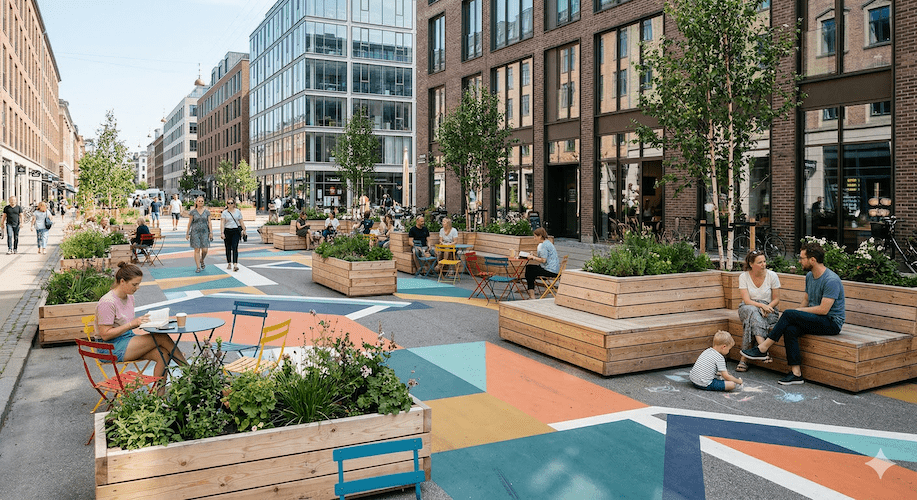
It is worth noting that reports such as those from CEOs for Cities have pointed out that reorganizing cities into spaces that are more conducive to walking goes beyond simple infrastructure development and contributes to a direct increase in real estate values (the Walkability Premium). Highly connected, compact environments with a diverse mix of functions increase the location demand of residents and businesses. Numerous urban economic studies have also suggested that when pedestrian-only spaces and plazas that allow people to walk safely are developed, people tend to stay in those areas longer, resulting in increased spending at nearby retail stores and restaurants, which has a ripple effect on the economy.
・Reevaluation of regional resources and increase in real estate value:The development of "distributed hotels" that renovate scattered historical buildings and old houses and treat the entire town as a single accommodation facility will create an inevitability for guests to walk around the entire area, transforming overlooked alleys and landscapes into new tourist resources.
・Ripple economic effects from extended stay:Research suggests that a decrease in walking speed leads to an increase in consumption opportunities.
・Reducing environmental impact and realizing a sustainable society:Promoting daily walking activity will improve the physical and mental health of residents and contribute to reducing medical costs in the long term.
- Social exclusion due to gentrification:As a neighborhood's appeal and real estate values increase, rents and property taxes rise, forcing longtime low-income and elderly residents to move out.
・Homogenization of space and disintegration of community:Capital-led urban development often results in the creation of uniform consumption spaces (such as high-end cafes) aimed at the wealthy, which runs the risk of destroying indigenous culture.
- Financial burden of infrastructure development and maintenance:There are concerns that the large initial investments required for road repaving and undergrounding of power lines, as well as the administrative costs of reaching consensus, will put a strain on local government finances.
A paradoxical perspective: The contradiction of quantified "walkability"
On the other hand, one perspective that is often overlooked is that a city's "walkability" is quantified using indicators such as the Walk Score and incorporated as a factor reinforcing real estate values and the capitalist system. This is a paradoxical issue that completely contradicts the Situationist ideology that originally aimed to "hack anti-capitalist spaces." Isn't the urban development we promote merely reproducing a clean, walkable "monotonous spectacle (the city as an object of consumption)"? We must always be aware of this bias and design a circular structure that is a win-win.
3. Current status of "walking cities" as seen through data: Comparison of Japan and the world
The uniqueness of megacity Tokyo and European pedestrianism
Based on an original analysis by the comparison website Compare the Market Australia published in 2025, a correlation between urban structure and economic factors can be seen by comparing the scores of major cities based on multiple indicators for "walkability." While European cities occupy the top positions, Tokyo, despite being a megacity, has received an extremely high evaluation for walkability.
[Graph] Unique walkability scores for major cities (out of 100 / analysis by comparison site)
The analysis gave Tokyo an extremely high pedestrian safety score of 75.29 points, suggesting that its winding alleyways and well-developed public transportation network provide the physical foundation that enables car-free exploration of minute spaces (driv).
On the other hand, the same analysis points out that cities such as Houston in the United States and Perth in Australia have extremely low populations within walking distance of essential services (only 8% in Houston) due to urban sprawl and a strict car-oriented culture. As evidenced by urban planner Jan Gehl's research and the pedestrianization of New York's Times Square (since 2009), relevant research and reports have shown that reallocating space for cars to pedestrians not only improves traffic safety (reports of reduced pedestrian injuries, such as those from the NYC DOT), but also brings economic benefits such as increased sales for surrounding retailers. In 2024, Japan's inbound tourist numbers reached a record high of approximately 36.9 million, with spending reaching approximately ¥8.1 trillion (based on official statistics). Japan's "fragmented urban structure, which allows for safe walking and serendipitous discoveries," is itself a huge asset.
4. Application of Delive to Regional Revitalization: The Challenge of Toyako Town, Hokkaido
Moving away from transit tourism and identifying bottlenecks
Let's apply the discussion of urban walkability to the field of regional revitalization. Many local governments in Hokkaido face the dual challenges of an "extremely car-dependent society" due to the country's vast land area, and structural "population decline." Take Toyako Town in Hokkaido, for example. Based on the 2020 census, which is also included in the government's regional revitalization plan, the town's population was 8,442. However, based on the Ministry of Internal Affairs and Communications' Basic Resident Register, the population had fallen to 8,068 as of January 2024. Recalculation of statistical data shows that the natural increase was minus 1.931 TP3T. The decline in the resident population, which forms the foundation of the local economy, cannot be ignored.
The biggest bottleneck in this situation is the traditional structure of transit-based tourism, where visitors arrive in large tourist buses, take a quick look at the scenic spots, and then leave. The question is how to reconstruct the natural environment of the hot spring towns and Lake Toya shores not as something to be viewed from a car window, but as a "space" where visitors can walk on foot and form a psychological connection with the area. There is an urgent need to create a "Delive-like" system of stay-based tourism that connects the scattered vacant houses and natural landscapes with lines and allows visitors to travel around the entire area.
Micro-spatial design and relationship design funded by accommodation tax
Hokkaido has introduced a prefectural accommodation tax as a new source of revenue for the development of pedestrian spaces and the reconstruction of tourism infrastructure. According to documents released by the Hokkaido government for the travel industry, the tax will begin on April 1, 2026, for accommodations. The tax will be levied at a flat rate of 100 yen for stays under 20,000 yen, 200 yen for stays between 20,000 and 50,000 yen, and 500 yen for stays over 50,000 yen. Furthermore, media reports estimate that the tax revenue from the prefectural accommodation tax will be approximately 4.5 billion yen (approximately 4.48 billion yen) per year in a normal fiscal year. Note: The "maximum of 500 yen per night" is the upper limit for Hokkaido's share (prefectural tax). In areas where municipalities have implemented a separate accommodation tax, the total amount is the combined amount of prefectural tax and municipal tax.
Toyako Town is also planning to introduce a municipal accommodation tax, which Hokkaido government documents (as of August 2025, Reiwa 7) list as "Toyako Town *Planned to be introduced." The proposed tax rates (a tiered flat rate based on the accommodation fee per person per night) are 200 yen for rates under 20,000 yen, 500 yen for rates between 20,000 and 50,000 yen, and 1,000 yen for rates over 50,000 yen, which, when combined with the prefectural tax, amount to 300 yen, 700 yen, and 1,500 yen. Regarding the practical process of collection and payment, Hokkaido government documents indicate that in areas where the municipal accommodation tax is in place, accommodation facilities will collect both the municipal and prefectural taxes, and then declare and pay the taxes to the municipality (which will then pay the prefectural tax portion to Hokkaido). (Note: Local government explanations also clearly state that the accommodation tax is generally considered a non-statutory special purpose tax, and new procedures (such as the approval of the Minister of Internal Affairs and Communications) are required.)
The strategic implication that can be drawn from this is that, rather than investing newly secured tax revenue in the construction of a single, massive tourist facility (investment in physical structures), we should invest in micro-spatial design that allows tourists to drift around the region on foot and form a deep connection with Lake Toya's culture. Reorganizing walking paths, optimizing signage to encourage free-flowing strolls, and visualizing the area's historical context. Investing in these "relationship designs" is the shortest route to maximizing the return on invested capital and building a win-win ecosystem for both local residents and visitors.
5. A Future Urban Experience Integrating Technology: Generated Drift
Implementing Generative Psychogeography
In the coming years, urban planning and tourism development may see the implementation of "generative psychogeography," a sophisticated fusion of digital technology and psychogeography. This involves using GPS tracks and GIS (geographic information systems) such as Google Maps to generate walking routes using random algorithms.
Furthermore, we can imagine a scenario in which technology will become widespread, where an AI algorithm will quantify emotional changes using an individual's walking data and biometric sensors (heart rate and stress levels), suggesting "unpredictable walking routes" in real time that are tailored to that individual's psychological state. In fact, similar attempts already exist, such as location-based apps that generate destinations based on random algorithms (random navigation). This will evolve the urban walking experience from simple transportation to mind-expanding entertainment. This service offers intentional "getting lost," the polar opposite of the "shortest route/highest efficiency" suggested by existing map apps. In a fully managed smart city, deliberately incorporating noise and randomness into the system will become a new added value (premium) in future urban experiences.
Conclusion: From efficiency to "randomness": Urban development that maximizes humanity and capital
The perspective we should ponder through this report is the fundamental question of how to restore "human emotional fluctuations" and "chance encounters" to modern urban spaces that have developed with "efficiency," "convenience," and "short-term economic rationality" as supreme priorities. "Dérives" (drifting), advocated by the Situationists in the 1950s, was a modest rebellion against the thoroughly controlled everyday, a philosophical and physical attempt to reexamine the relationship between space and the self.
Rather than being satisfied with the superficial beauty of streets that have been made too clean and tidy by excessive gentrification, we today need to intentionally incorporate into urban planning and community development the psychological value of exploring back alleys and getting lost, even if it may seem pointless at first glance. Governments, businesses, and those of us who use space involved in regional revitalization must cultivate a "psychogeographical" imagination that considers the ripples a space casts on people's deeper psyches, rather than simply pursuing short-term economic effects based on figures. Utilizing a region's historical stock and "designing relationships" between people and people, and between people and the land, through walking, is the key to maximizing capital over the medium to long term and building a sustainable and resilient ecosystem.
Related Links
- Ministry of Land, Infrastructure, Transport and Tourism: Creating comfortable and walkable towns
- Japan Tourism Agency: Support project to create tourism content to attract inbound tourists to regional areas and increase consumption
- Statistics Bureau, Ministry of Internal Affairs and Communications: Census and population estimate data
Inquiries and requests
We help solve local issues.
Please feel free to contact us even if it is a small matter.