〜Is redevelopment that only preserves the exterior the right decision?〜
*This article is based on information as of March 2026.
"Cities have the capability of providing something for everybody, only because, and only when, they are created by everybody." This is how Jane Jacobs, the renowned urban planner and journalist, explained the importance of urban diversity and the activities of the people who live there in her book.
In modern urban planning and urban development, the challenge of balancing the preservation of historic streetscapes (hardware) with the maintenance of the lives of the people who live there (software) is an extremely difficult issue faced by local governments around the world. If old buildings are to be preserved, maintenance and repair costs will skyrocket, placing a heavy burden on owners. On the other hand, if tourism and commercialization are pushed too far, land prices and rents will rise rapidly, leading to the tragedy of "gentrification," in which the residents who originally supported the area are forced out. Conversely, if scrap-and-build redevelopment prioritizes economic efficiency alone, the unique memories and identity of the area will be forever lost in the shadow of impersonal buildings.
So what choice should we make? In the 1970s, a clear and practical solution to this complex dilemma was presented in Italy. This was the anti-speculation model, commonly known as the "Agricultural Landmark Model," which simultaneously achieved the preservation of historical buildings and the protection of the housing rights of low-income and working-class people."Bologna Method (Integrated Conservation)"This article delves into the historical background and contemporary challenges of this groundbreaking approach, which goes beyond mere facade preservation. Furthermore, we will examine the applicability of this approach from multiple angles, combining the dual perspectives of architectural approach and urban planning, to regional Japanese cities facing issues of depopulation and vacant houses, particularly the case of Toyako Town in Hokkaido.
1. The birth of the Bologna method: urban reform to protect “accumulations of memory” from speculation
The shadow of rapid economic growth and the philosophy of "conservative restoration"
It would be a very superficial interpretation to see the Bologna Method as simply a nostalgic preservation movement for the appreciation of old buildings."An extremely detailed and strategic ecosystem design that intentionally separates the city from a speculative object in the central real estate market and redefines it as a living space (social right) for residents."Because it is nothing other than that.
Let's turn back the clock a little. After World War II, Italy experienced rapid urbanization and sprawl (uncontrolled suburban expansion) in tandem with its rapid economic growth. Historic city centers were engulfed in the waves of global commercialization, and skyrocketing land prices forced the working class that had long made up the city to the suburbs. In 1960, Giuseppe Campos Venuti, who served as Assessore all'Urbanistica (Assessore all'Urbanistica) in charge of urban planning from 1960 to 1966 under the Bologna Municipal Government (then governed by the Italian Communist Party), felt a strong sense of crisis about this dire situation and laid the foundations for radical urban reform to directly combat land speculation.
The architectural approach they adopted was not "facade preservation," which simply involves beautifully remodeling the facades of buildings. They viewed the city as a single, organic "artifact" (accumulation of memories). In other words, they thoroughly implemented the philosophy of "conservative restoration," which strictly maintains the historical and formal value of old buildings while adapting their internal structures and facilities to modern living standards and social demands.
[Reference map] Bologna historic center
*The entire old town, with its rows of red roofs, has become the subject of a comprehensive preservation plan.
Building a strong legal foundation and developing PEEP
More importantly, they not only spoke of their ideas, but also built a robust legal system. A 1962 law (known as "National Law No. 167") established a framework that made it easier for local governments to secure land for purposes such as social housing, and the city of Bologna used this system as leverage to develop housing and land policies linked to cooperative housing. Subsequently, on July 21, 1969, a resolution of the city council adopted the "Historic City Center Plan" (Piano per il centro storico), led by architect Pier Luigi Cervellati and others. This plan did not treat urban buildings as individual monuments, but instead created a hierarchy of intervention categories based on architectural "typology," establishing a framework for preserving the urban organism as a whole.
Of particular note is the "Piano per l'Edilizia Economica e Popolare (PEEP) for the City Center," which was adopted on March 7, 1973, and expanded the framework of the existing social housing plan to the city center. Five of the 13 comparti (functionally and morphologically consistent areas) that make up the city were selected as priority areas, and the iconic porticos (cloisters) and courtyards that have existed since the Middle Ages were preserved as semi-public spaces for residents. This social housing plan did not simply provide housing units, but also placed emphasis on providing a complete set of living infrastructure, including complementary services such as green spaces, childcare, and support for the elderly. A key point of the plan was to ensure that "the conditions for original residents to continue living in the city" within the historical landscape.
2. Comparing architectural approaches: integrated conservation vs. facade preservation
The "integrated conservation" advocated by the Bologna Method is often confused with other urban redevelopment methods. However, the two are completely different from each other in terms of the technical and philosophical aspects of how the lifespan of a building is perceived and how the existing structural framework is evaluated. The table below clearly compares the philosophies of each development method and the differences in their specific approaches.
| Comparison element | [Bologna method] Integrated Conservation |
[Similar method] Facade preservation (Facadism) |
|---|---|---|
| Fundamental purpose | Maintaining the historical form of the building and ensuring the settlement and social rights of existing low-income residents. | Maintaining the aesthetic appearance of the townscape and maximizing the economic value of the real estate by introducing the latest facilities. |
| How to perceive the subject (scale) | The entire city is viewed as an organic "accumulation of memories," and preservation is carried out in a planar and holistic manner using the entire block. | Individual buildings of historical value and the "exterior only" of buildings facing specific streets are captured as points or lines. |
| Impact on residents | By expropriating land and converting it into a cooperative (decommodification), the area will be separated from the real estate market, and residents will be legally prevented from being evicted. | The interiors will be converted into luxury apartments and commercial facilities, forcing former residents out due to rising land and rents. |
| Key points of construction methods | We will carry out strict "conservative restoration (adapting the space to modern functions)" based on typology, making the most of the potential of the existing structure. | Only the facade (front wall) will remain, and the internal structure will be completely demolished to build new, state-of-the-art facilities. |
Thus, even from an architectural professional's perspective, the Bologna Method is not simply a cosmetic makeover, but an advanced approach that respects the cultural significance of the building's fundamental structure and spatial composition (such as the framework of the floor plan), and seamlessly connects it to modern residential infrastructure.
3. The "light and dark" of integrated conservation and the contemporary crisis
The Bologna System is a model that strikes an excellent balance between maximizing a city's capital and designing relationships, but there are also significant trade-offs in its operation. Here, we will clearly outline the advantages and disadvantages from the perspectives of both proponents and opponents.
Ensuring sustainability and inclusiveness
The first achievement isOrganic and comprehensive inheritance of historical and cultural identityThis method has allowed the porticos (cloisters) that have existed since the Middle Ages to survive as living urban spaces, and in 2021 they were registered as a UNESCO World Heritage Site as the "Porticoes of Bologna."
Secondly,Curbing capitalist sprawlThis approach, which prevents chaotic suburban development and reuses existing infrastructure (water supply, sewerage, road networks, etc.), has environmental and economic benefits that are a precursor to modern SDGs and compact city policies.
Third,Social inclusion and preservation of social capitalAs a result of "decommodification," which guaranteed low-income people the right to settle in their neighborhoods, neighborhood networks that had been cultivated over many years were preserved, dramatically strengthening the city's resilience.
Huge costs and functional rigidity
However, the biggest concern isA huge and ongoing burden on public finances"Conservative repairs" that bring existing homes up to modern standards (earthquake resistance, insulation, sanitary facilities, etc.) require detailed building condition surveys, which require more advanced technology and costs than new construction. Maintaining these repairs puts a significant strain on local government finances.
Also,Functional rigidity due to strict regulationsIt has also been pointed out that strict rules on building use and form may restrict the free economic activity of private real estate businesses and make it difficult to flexibly respond to changes in commercial needs.
And in recent years, the most serious issue has been the platform economy."Second Gentrification"Ironically, this beautiful cityscape has become a target for speculation by global capital.
Modern-day new threats: overtourism and the "housing crisis"
Bologna's streets once protected workers from excessive development by real estate developers, but with the rise of short-term rental platforms such as Airbnb, the city is now facing a new level of threat known as "Disneyfication."
"Authentic historic spaces" preserved with public funds are extremely attractive to short-term travelers. As landlords prioritize the high yields they can get from short-term travelers over the stable rents they can get from long-term residents, the residential housing stock has drastically decreased.
[Conceptual graph: The increase in short-term accommodation facilities brings about a pressure on living space]
*Blue = for long-term residents, red = for short-term travelers.
According to empirical analysis (data from 2017 to 2019) including analytical materials from the European Parliament, a significant positive correlation has been reported between short-term rental density and rental prices in Bologna.
As a result, a serious housing crisis has emerged, with young people, including students at the University of Bologna, and people from rural areas unable to find housing. Academics have also pointed out the connection to socioeconomic vulnerabilities in the real estate market, such as pressure on the student rental market. This phenomenon, in which urban functions are optimized for tourists, creating friction with residents, could be said to be the greatest paradox facing preserved historic urban areas today.
4. Application to local cities in Japan: From the perspective of Toyako Town, Hokkaido
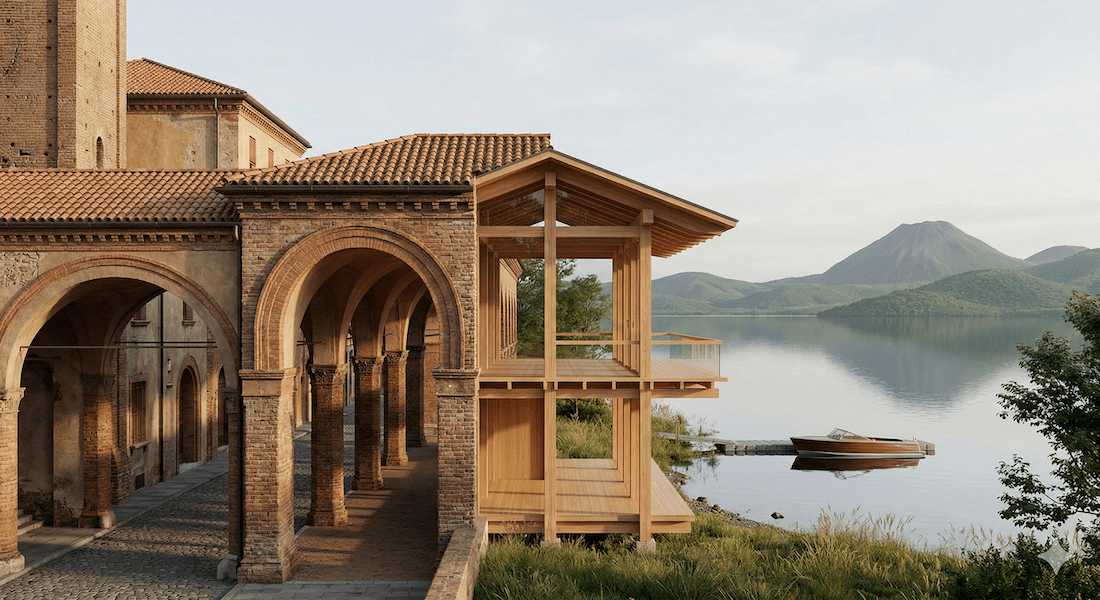
So far we have looked at the Italian example, but the principles underlying the Bologna Method also offer extremely important insights for local governments in Japan, particularly in areas facing depopulation and serious problems with vacant houses.Here, we will examine the possibilities and challenges of using the area around Toyako Town in Hokkaido as a model case.The area has a rare natural landscape certified as a UNESCO Global Geopark, and in June 2021, it transitioned to a landscape administrative organization and formulated the Toyako Town Landscape Plan.
[Reference map] Toyako Town, Hokkaido
*This area is home to beautiful lakeside scenery and historical heritage from the pioneering era.
The collapse of the landscape due to "natural population decline" rather than "speculative eviction"
First of all, we must recognize that the root causes of the problems faced by regional cities in Italy in the 1960s and those in modern-day Japan are completely opposite. While Bologna fought against the concentration of capital and the displacement of residents due to speculation, many regions in Japan, including Hokkaido,"Natural decline and outflow of residents due to declining birthrate, aging population, and depopulation"We are facing a silent crisis.
As people move away from these areas, the number of vacant and abandoned buildings that are not properly maintained is rapidly increasing. Hokkaido is dotted with many unique historical buildings that symbolize the pioneering era, such as silos, French plasterwork blocks, buildings with mansard roofs, and fishery guardhouses. However, these buildings are aging in the harsh natural environment, and as a result, they are threatening the region's beautiful scenery and public safety itself.
Integrating "hardware" based on architectural evaluation with "software" to promote relocation
Under these circumstances, the problem cannot be solved by simply enacting a regulation (rule) that says, "Don't demolish buildings to protect the landscape." It is essential to take an architectural and civil engineering approach, including properly conducting "existing housing inspections" to evaluate the soundness of buildings' foundations and structures, objectively understanding the condition of buildings, and then safely repairing and utilizing them in accordance with modern needs.
At the same time, the soft side of things needs to be improved, that is, how to attract new migrants and long-term residents. For example, noteworthy attempts have been made to structurally reinforce abandoned historic buildings and use them as satellite offices that accommodate today's diverse work styles, or as long-term accommodation facilities for migrants from urban areas. This unique approach of using them as bases for "increasing the number of people entering" could be called a modern-day Japanese version of the "Bologna Method." What is needed is not just to preserve the exterior of the buildings, but also to design new "relationships" and "occupations" within them and create a system for running a sustainable ecosystem.
5. Future Urban Planning: HUL and the Prospects of Hybrid Regulation
In the area of international conservation of historic urban areas, the "Historic Urban Landscape (HUL)" Recommendation adopted by UNESCO in 2011 is positioned as an additional tool for integrating urban development and heritage conservation. This resonates with the idea of the Bologna Method, which goes beyond the preservation of scattered monuments and views cities as an "organic whole" that includes the natural environment and socio-economic activities. In response to global climate change risks, "comprehensive and resilient conservation" is being called for as a core theme in urban planning, including improving the energy efficiency of buildings and strengthening the disaster resistance of infrastructure.
Aiming for the strict separation and coexistence of tourism and residential areas
Furthermore, discussions are underway in cities around the world on "hybrid legal regulations" to combat the "second gentrification" brought about by Airbnb and other services. According to the arguments of some platform operators and market analysis, simply banning short-term rentals (STRs) strictly could lead to a concentration of demand for accommodation at existing hotels, causing prices to rise and potentially causing tourists to concentrate excessively in certain areas (the extent of price increases and causal relationships need to be carefully examined for each city).
Therefore, what is needed is a policy that precisely combines total volume restrictions and zoning (zoning designation) for hotels and STRs to meet tourism demand with maintaining reasonable rents for local residents (rent control, public subsidies, expansion of cooperative housing).We are now in an era where sophisticated policy tuning is inevitable, combining the appropriate distribution of demand throughout the region with the legal sanctuary of residential areas (decommodification).
Conclusion: Instead of treating the building as a specimen, design it to protect the ecosystem of people's activities.
The greatest lesson that the history of "integrated conservation" established in Bologna in the 1970s can offer to modern Japan and local governments is:Urban spaces must not be reduced to simply beautiful "museums"That's all there is to it.
No matter how well-established landscape ordinances are and how beautifully the facades of old buildings are maintained, if the local residents who live their daily lives and foster their culture are driven out by economic pressures (real estate speculation and excessive tourism) or the collapse of infrastructure due to depopulation, the town will lose its soul. In the long term, the town will lose its inherent authenticity and even its appeal as a tourist resource will wither.
When we draft landscape ordinances, subsidy systems for historic buildings, or measures to address vacant houses, we must fundamentally reexamine the question of "for whom preservation is being undertaken." Rather than simply subsidizing the renovation costs of buildings and improving their "exterior," we should consider building a "breakwater" that combines both hard (structural safety of buildings) and soft (residents' right to live) measures, such as schemes that legally restrict the use of renovated buildings to "residential residence" or "continuation of livelihoods" after renovation, and land trust and cooperative approaches to prevent real estate speculation. Even in areas like Toyako Town in Hokkaido, which is struggling with depopulation and vacant houses, there is an urgent need to build a new, Japanese-style, integrated preservation model that goes beyond mere landscape preservation and incorporates "systems that allow people to continue living there."
Related Links
- UNESCO World Heritage Centre – The Porticoes of Bologna
- Ministry of Land, Infrastructure, Transport and Tourism Landscape Portal Site
- Japan Tourism Agency: Measures to prevent and curb overtourism
Inquiries and requests
We help solve local issues.
Please feel free to contact us even if it is a small matter.