〜How can this grand action plan, which can be considered the origin of the SDGs, be applied to local urban development?〜
*This article is based on objective data as of March 2026 and information from various public institutions.
"Think globally, act locally."
This phrase, said to have been coined by the French microbiologist and environmental thinker René Dubos, sharply hits the heart of modern environmental conservation and urban planning, or "urban development." The global challenges we face today, such as climate change and resource depletion, are the result of a complex intertwining of the daily production activities and consumption behavior of individual local communities, as well as the state of civil engineering and construction infrastructure. Therefore, the key to solving these problems must also be sought in the local community.
In 1992, the United Nations Conference on Environment and Development (commonly known as the Earth Summit, UNCED) was held in Rio de Janeiro, Brazil. This historic conference was attended by 172 governments and 108 heads of state and government. At the conference, Agenda 21, a global action plan for humanity to achieve sustainable development while preserving the global environment, was adopted.
Agenda 21, which consists of 40 chapters, is compiled as an action plan of approximately 300 pages in the UN version. Of these, Chapter 28 is particularly relevant to modern urban development. Based on a strong recognition that many of the solutions to global environmental problems are rooted in the local community, this chapter clearly states the extreme importance of "Local Agenda 21," a local action plan formulated by each local government in collaboration with citizens and businesses.
Conversely, the "SDGs (Sustainable Development Goals)" that we see on a daily basis today are a strong continuation of the ideas of Agenda 21, and have been further quantified and systematized to suit modern issues. However, while awareness of the term SDGs in Japan has reached an astonishing level of approximately 90%, various domestic surveys have pointed out a significant discrepancy in the rate at which this is linked to actual consumer behavior and essential urban development "actions."
This article uses detailed data to unravel the historical lineage of environmental policies that began with Agenda 21. It also delves deeper into the gap between awareness and action, the structural and financial challenges facing local governments, and the state of "next-generation urban development" in a widely decentralized society like Toyako Town in Hokkaido, incorporating perspectives of spatial design and social infrastructure.
1. Agenda 21's historical trajectory and institutional overview
Progressive integration from the Earth Summit to the SDGs
The historical significance of Agenda 21 lies in the fact that it presented an integrated and ambitious guideline for "sustainable development" in response to the deep-seated dichotomy between developed and developing countries at the time: "Should we prioritize economic growth or environmental conservation?", the so-called North-South problem.
From the late 1990s through the 2000s, this philosophy was spread around the world through local government networks (such as ICLEI), and today a robust international network has been formed with over 2,500 participating local governments.
[Reference: 1992 Earth Summit venue (Rio de Janeiro, Brazil)]
Local governments in Japan also stepped up in response to the national movement. Specifically, Toyonaka City in Osaka Prefecture was one of the first to promulgate the "Toyonaka City Environmental Basic Ordinance" in 1995 (Heisei 7), and the following year, in 1996, launched the "Toyonaka Citizens' Environmental Council," chaired by the mayor and with the participation of 153 organizations. This is one of Japan's leading examples of an effort to solve local issues through citizen participation.
Subsequently, with the increasing severity of extreme weather due to global climate change and the progression of "polycrises," where multiple crises link together, greater effectiveness of this plan was required. As a result, at the United Nations Sustainable Development Summit held in 2015, the basic principles of Agenda 21 were retained as is, and the scope was expanded and integrated into "Agenda 2030," which clearly quantified the scope into 17 goals and 169 targets, or the "Sustainable Development Goals (SDGs)" as we know them today.
Comparison with similar international frameworks
Agenda 21 is often confused with other international environmental frameworks (such as the Paris Agreement), but there are clear differences in their scope and legal binding power. Below is a comparison table to help you correctly understand and use these systems in urban development.
| Name of the system/framework | Agenda 21 (1992) | SDGs / Paris Agreement (2015) |
|---|---|---|
| Scope and nature | It covers the entire scope of global environmental conservation and sustainable development, and is an extremely broad plan that includes all aspects of urban development, including poverty, urban planning, and social development. | [SDGs]Social issues in general are highly quantified into 17 goals and 169 targets. [Paris Agreement]Specializing in a single focus: climate change (reducing greenhouse gas emissions). |
| Legal binding force and characteristics | "Non-legally binding voluntary action plan"There is a strong emphasis on citizen participation not only at the national level but also at the local government level (local agenda). | [SDGs]Universal goals that apply to all member states (not legally binding). [Paris Agreement]"International Treaty (Legal Framework)"It has clear binding force. |
2. The gap between "cognition" and "action" in Japan
In order to objectively evaluate the effectiveness of environmental policies in urban development, it is necessary to objectively compare data from Japan and overseas. In terms of the current status of achieving the SDGs, which inherit the principles of Local Agenda 21, there are differences that could be described as structural between Japan and European countries.
International comparison of SDGs overall scores
Japan boasts a high level of education and a robust infrastructure, but tends to lag behind Nordic countries in the areas of climate action and gender equality. While the citation of SDG achievement (country scores) varies depending on the edition, based on data from the Sustainable Development Report 2025, Japan is ranked 19th with an overall score of 80.66.
Sustainable Development Goals (SDGs) Overall Score Comparison between Top Countries and Japan (2025 Data)
Challenges in building a resource circulation model
Specific issues facing urban development in Japan include waste disposal and the state of the transition to a circular economy. Japan was quick to establish the initial system, enacting the Basic Act for Promoting the Creation of a Recycling-Based Society in 2000. However, according to the results of a survey conducted by the Ministry of the Environment in 2022,The direct incineration rate for municipal waste remains at approximately 80.11 TP3T.It occupies 100% of the market.
While European countries are rapidly moving towards a complete resource recycling model that eliminates waste from the product design stage, Japan is calling for greater investment in hard-side reforms, such as building renewable energy networks and rebuilding civil engineering infrastructure to support a recycling-oriented society. It is necessary to move beyond awareness-raising activities to a phase of fundamentally rethinking urban planning.
3. Benefits and Structural Challenges in Urban Development
In promoting environmentally conscious urban development in line with Local Agenda 21, we will outline in detail the "positive aspects" that government, businesses, and citizens will each enjoy, as well as the "negative aspects" that they will have to face.
The biggest advantage is that it breaks down the traditional vertical administrative structure."Cross-sectoral Regional Governance"This will create a platform that brings together citizens and local businesses, transcending the boundaries of departments such as the environment, welfare, and urban planning (architecture and civil engineering).
Furthermore, setting environmental goals means new opportunities for fundraising. By utilizing the Joint Crediting Mechanism (JCM) and other mechanisms, the government can provide support to local small and medium-sized enterprises when they deploy their advanced environmental technologies and infrastructure development know-how overseas. This is an incentive that directly leads to strengthening (improving resilience of) the local economy.
The most serious challenge is"Lack of specialized resources and securing economies of scale"It is important to note that the local government systems in Japan and the UK are different, but for example, Japan has 1,741 cities, wards, towns and villages (this number fluctuates depending on the time), and the simple average of the census population is about 72,000 people per local government. On the other hand, the simple average for the UK (England and Wales) is about 194,000 people.
Smaller municipalities face difficulties in securing the personnel and budget required to handle advanced data analysis and inter-departmental coordination. There are also structural challenges, such as a mismatch between the speed at which national legislation is being developed and the ambitious environmental goals set by individual municipalities.
4. The reality of a wide-area decentralized society: From the perspective of Toyako Town, Hokkaido
When analyzing the "ground-up action" advocated by Agenda 21 from the perspective of Hokkaido, which has a vast area and a unique natural environment, a harsh reality emerges that is completely different from the discussions in urban areas.
Threats to key industries and the difficulty of decarbonization
In Toyako Town, the site of the G8 Hokkaido Toyako Summit in 2008, climate change is not just an environmental issue, but is being discussed as a direct threat to the town's survival, including its vital tourism industry and its local resources, such as its beautiful lakes and forests.
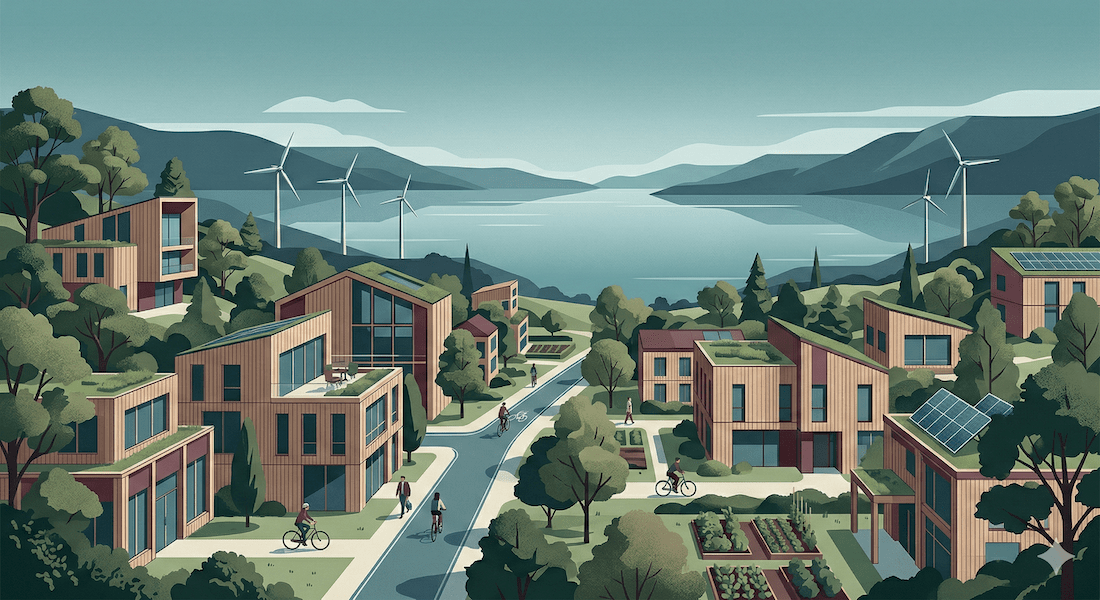
However, decarbonization is extremely difficult in a widely decentralized society like Hokkaido. Because the infrastructure for daily life is widely dispersed, an overwhelmingly car-oriented society has been formed, making it difficult to reduce CO2 emissions in the "household sector" and "transportation sector," which are directly linked to residents' lifestyles. Promoting the electrification of mobility across a vast area and carrying out large-scale high-insulation and energy-saving renovations of existing building stock requires much higher costs and more meticulous civil engineering and architectural approaches than in urban areas.
[Reference: Eco-Model City Toyako Town, Hokkaido]
The correlation between lifestyle and "healthy town development"
Furthermore, the sustainability that Agenda 21 aims for also includes the "health and welfare of residents." According to survey data from FY2022 related to the "Healthy Hokkaido 21" initiative published by Hokkaido Prefecture, the "percentage of people who exercise regularly" among people aged 20 to 64 remains at a low level of 22.9% for men and 16.0% for women. This shows that dependence on car transportation and the cold climate are affecting the exercise habits of Hokkaido residents.
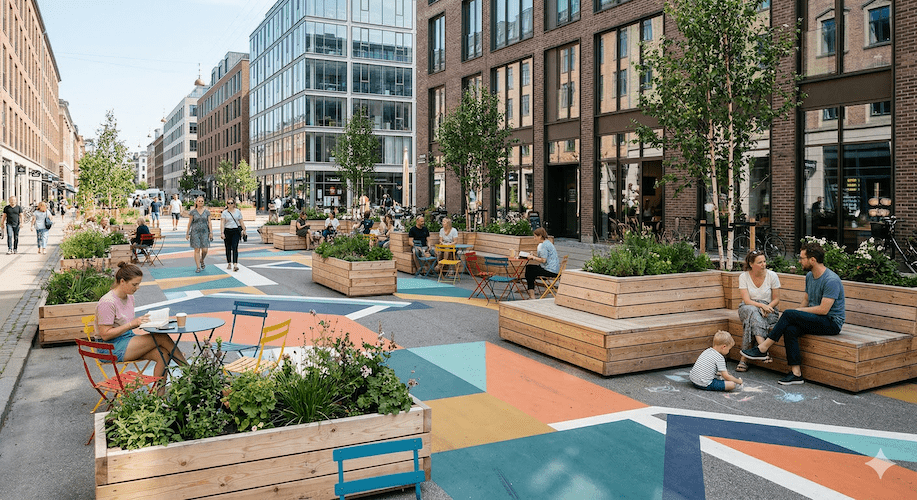
Therefore, in addition to environmental considerations, it is important to create spatial designs that make a city "walkable," which encourages people to walk. Approaching this from both hard and soft aspects, from maintaining public transportation as a means of transportation to designing public spaces that naturally encourage residents to gather and walk, is an urgent agenda for the next generation.
Conclusion: Urban Development as a Never-Ending Practice
“You can't change things by fighting the existing reality. If you want to change something, build a new model that makes the existing model obsolete.”
— Buckminster Fuller (American thinker and architect)
As this phrase indicates, we must move from the phase of raising awareness to the phase of rebuilding concrete systems. In the future, evaluation methods for environmental policies in urban development will evolve, and frameworks such as the "Voluntary Local Review (VLR)," in which local governments directly report their own progress to international organizations, are expected to become established as a new standard.
At the same time, financial independence is essential for local governments to ensure sustainability. For example, according to publicly available information, Toyako Town's hometown tax donations are expected to reach 190.61 million yen in fiscal 2022 and 232.35 million yen in fiscal 2023. This valuable independent financial resource is directly allocated to maintaining daily infrastructure, such as childcare support measures for children who will be the backbone of a sustainable local community, and the operation of shopping support buses.
More than 30 years have passed since the 1992 Earth Summit. The time has come to pass when sustainability was discussed as an idea in conference rooms. Now, with limited population and financial resources, we must be prepared to analyze objective data and implement sometimes painful reforms to our social structures and infrastructure.
Urban development is not about worrying about the global environment in the distant future. It is nothing other than an "endless field of practice" in which each individual takes responsibility for that future by making decisions about their town's budget allocation, tax system, and everyday civil engineering and construction infrastructure.
Related Links
- Ministry of the Environment: Local Agenda 21
- United Nations Information Centre: 2030 Agenda
- Regional Revitalization Promotion Office: Eco-Model City/Eco-Future City
Inquiries and requests
We help solve local issues.
Please feel free to contact us even if it is a small matter.