〜The Light and Shadow of Compact Cities〜
*This article is based on information as of March 2026.
"Cities are formed for the sake of life, and exist for the sake of the good life." This is how the great ancient Greek philosopher Aristotle beautifully and essentially expressed the fundamental reason for the existence of cities. Jane Jacobs, a journalist who had a profound influence on 20th-century urban planning, said, "Because cities are created by all, they have the capacity to offer something to all," and she saw through the fact that diversity and high-density interaction are the lifeblood of cities. However, does the reality of urban space we face today really embody the "good life" and "rich diversity" envisioned by these great figures?
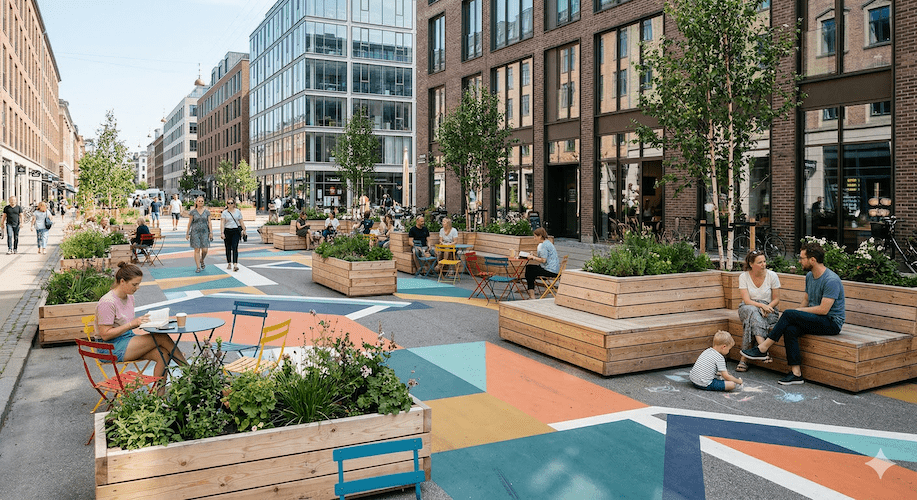
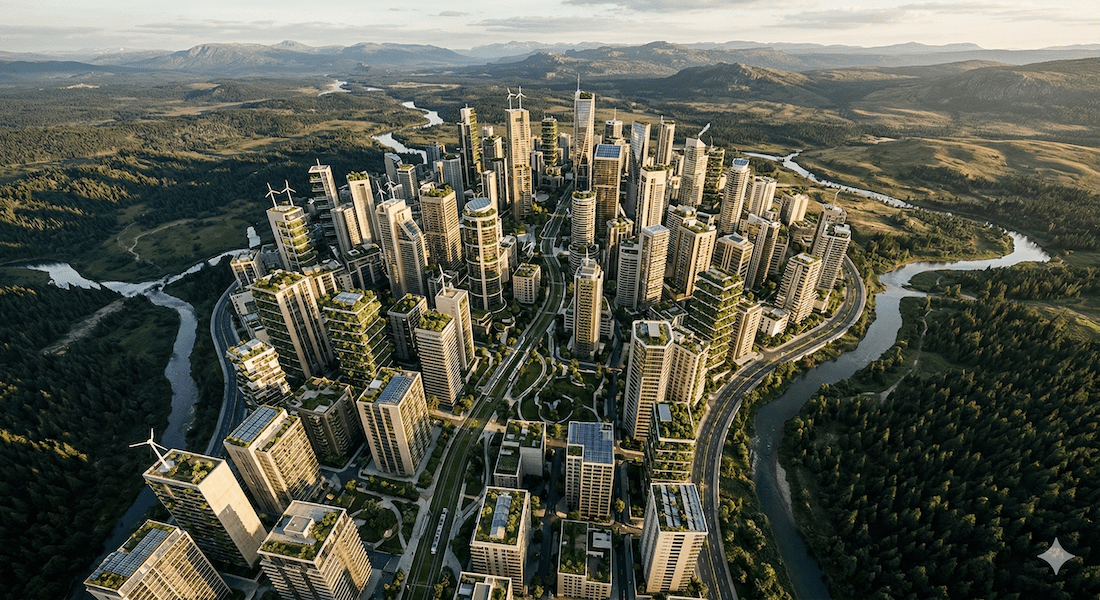
The term "compact city," which is often heard in the context of urban planning and urban development, can be summed up as a policy concept that intentionally moves urban functions such as housing, commercial facilities, and public services, which have been sprawled out to the suburbs over the past few decades, back to the city center and reconstructs an efficient and sustainable living area centered on walking and public transportation. The core of this policy approach is not simply improving the landscape. By intentionally maintaining and concentrating population density in a certain area, it aims to optimize the enormous maintenance costs that governments will have to bear in the future for infrastructure (such as maintaining road networks, updating water and sewer systems, garbage collection routes, and snow removal in snowy, cold regions), while at the same time weaning citizens from excessive reliance on automobiles.
Let's delve deeper into historical developments. The concept of compact cities began to be advocated primarily in Europe from the 1990s onward, as a response to the rapid motorization and resulting suburbanization of cities in developed countries in the second half of the 20th century. The uncontrolled expansion of cities to their fringes, known as "urban sprawl," not only destroyed the city's rich natural environment, but also created serious external diseconomies that threatened citizens' lives, such as increased greenhouse gas emissions due to longer commutes, chronic traffic congestion, worsening air pollution, and an increased risk of traffic accidents. Even more importantly, the financial costs of continuing to provide uniform public services (such as postal services, police, fire services, and medical care) to these sprawling, low-density residential areas skyrocketed, placing a fatal strain on local government operations.
Turning our attention to Japanese society today, the situation is even more serious. Japan is currently entering an unprecedented phase, the likes of which no other country in the world has ever experienced, in which nationwide population decline and super-aging occur simultaneously. As the absolute population declines and the "urban sponge phenomenon" (low density) of cities, in which vacant houses and vacant lots appear like moth-eaten moths throughout urban areas, progresses quietly but surely, it is clear that if we continue with the traditional "urban planning premised on expansion" that is designed on the premise of steady economic growth and population increase, many local governments will soon be at risk of financial collapse.
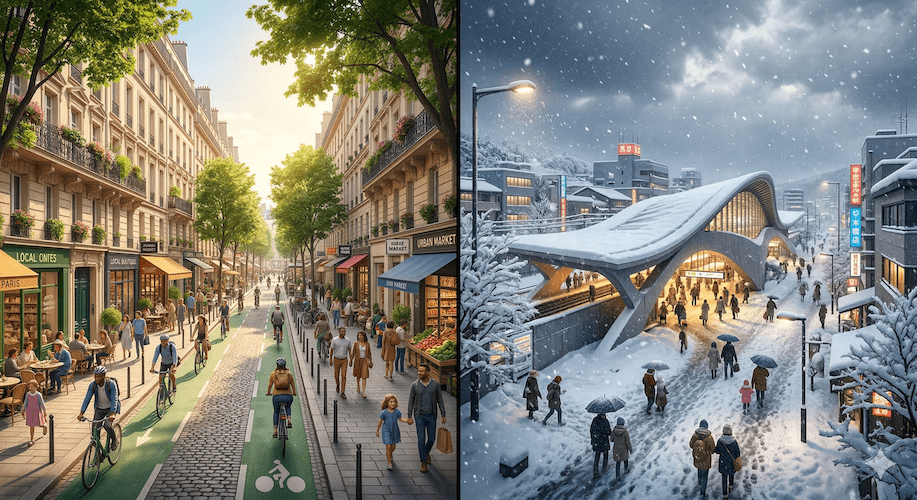
Compact city policies are the trump card for avoiding such a dire scenario and systematically shrinking cities (smart shrink). The centralization of functions allows residents to easily access all the services they need within compact daily living routes centered around transportation hubs (train stations and bus terminals), which is expected to dramatically improve the energy efficiency of the entire community and enhance the quality of life (QOL) of each citizen. Based on the latest research data released by public institutions both in Japan and overseas and real-world examples from specific regions, this article thoroughly analyzes the enormous benefits of compact cities, the harsh trade-offs (pros and cons) that lie behind them, and offers prescriptions for future urban development.
1. The Costs of Sprawl and the Economic Advantages of Compact Development
The first paradox of "urban sponges" revealed by the latest data
The environment surrounding modern urban policy has become extremely complex due to multiple megatrends: a strong global demand for climate change measures (carbon neutrality), drastic changes in local demographics, and widening economic disparities between regions. What we should pay the most attention to here is the existence of a serious paradox that the latest objective data has brutally highlighted.
The first paradox is the perplexing phenomenon of "sprawl amidst population decline" in rural areas. The Organization for Economic Cooperation and Development (OECD) released its latest report on regional development and urban policy in 2024, "Regions and Cities at a Glance," revealing a shocking fact: even in remote regions facing severe population decline, the built-up area (the area with densely built-up areas) expanded by an average of 111 TP3T in just the 10-year period from 2010 to 2020. This completely contradicts common sense. A declining population should shrink cities. However, in reality, despite the declining population, the physical footprint of cities continues to expand, encroaching on farmland and forests on their fringes, resulting in extremely inefficient and unregulated land use.
Behind this phenomenon is the runaway market principle that prioritizes short-term economic rationality, where high land prices and complex property rights in city centers are rejected, and cheap, easily developed farmland in the suburbs is converted into large commercial facilities and new residential areas for development. As a result, the city center is hollowing out, and the "sponge urbanization" of the city, where low-density development spreads to the suburbs, is accelerating.
[Graph] OECD Report: Paradox of Expanding Urban Areas in Remote Areas (2010-2020)
*Created based on data from OECD's "Regions and Cities at a Glance 2024"
The brutal reality of infrastructure maintenance costs and lessons learned from Halifax, Canada
This kind of uncontrolled suburban expansion (sprawl) accompanied by population decline has a direct and devastating impact on municipal administrative costs. This brutal reality is vividly demonstrated by a comprehensive empirical study of the Halifax Regional Municipality in Nova Scotia, Canada. The Halifax study is widely regarded among urban planning experts as a bible that visualizes the "hidden costs of sprawl development."
The study's meticulous data analysis revealed that the cost of providing public services (paving and repairing asphalt roads, laying and operating water and sewer pipes, running garbage truck routes, and police and fire department dispatches, etc.) to sprawling, low-density suburban development areas is more than double the cost of providing services to compact development areas with high-density functions. The reason for this is very simple: the number of residents (density) dependent on roads and water pipes per kilometer is extremely low, so the per-capita burden of infrastructure maintenance skyrockets. Conversely, if urban planning can be strongly controlled and compact development can be guided, the government's infrastructure provision costs can be reduced to less than half of those in sprawling areas, making this an extremely economically rational solution.
[Reference map] Halifax, Nova Scotia, Canada (location of infrastructure cost demonstration study)
The comparison table below combines a variety of domestic and international data, including the latest OECD report, to comprehensively summarize the crucial gap between compact and sprawl development. If you are viewing this on a smartphone, please scroll horizontally to view the detailed data.
| Comparison indicators/analysis items | Compact development and metropolitan areas | Sprawl and small suburbs |
|---|---|---|
| Public Services and Infrastructure Financial cost of provision |
Sprawl development areas Less than half the costCan be maintained at (*From a survey in Halifax, Canada) |
In central urban areas Huge cost increase of more than double (*Due to pipeline extensions and inefficient collection routes) |
| Disparities in housing prices and real estate values (OECD average data) |
From smaller cities86% more expensive (*Due to concentrated demand, there has been a dramatic increase of 68% over the past 10 years.) |
Comparison reference value (baseline) (※Relatively affordable but lacking in convenience) |
| Expansion of urbanized areas (Trends from 2010 to 2020) |
Gradual expansion in proportion to population growth (*Restrained by strict land use regulations) |
Even in areas with declining populations 11%'s sprawling expansionis in progress |
| Conservation of the natural environment Local differences in temperature rise |
Adapting to the heat environment by protecting green spaces, etc. (*Heat island countermeasures are being implemented in a planned manner) |
Loss of green space exposes people to adverse effects Maximum temperature rise of 0.7°CRisk of occurrence |
2. The "light and shadow" structure inherent in the concentration of urban functions
As the facts and data show, compact city policies that concentrate urban functions in specific high-density areas are by no means a "universal magic" that will unconditionally make everyone happy. While they provide administrative organizations and infrastructure developers with enormous economic rationality in avoiding financial collapse, they also contain extremely serious negative externalities (trade-offs) for the residents who actually live in the area and for communities that are left behind in surrounding areas (suburbs). Therefore, when discussing urban development, it is essential to objectively analyze both the logic of the administrative side that is promoting the policy and the concerns of the residents who will be directly affected.
1) Dramatic reduction in public service costs and fiscal reconstruction
The biggest benefit is as a financial survival strategy. By being freed from the legal obligation to maintain and upgrade aging infrastructure across vast areas, it will be the most powerful tool to prevent local governments from collapsing financially as tax revenues dwindle due to population decline.
② Maintaining public transportation routes and ensuring "freedom of movement"
By concentrating functions at specific nodes, the density of transportation use (number of passengers) is spatially guaranteed. This will enable the continuation of local bus routes that are in danger of being discontinued due to declining profitability, and will directly lead to ensuring mobility (freedom of movement) for elderly people and others who do not have a driver's license.
3) Significant reduction in environmental impact and transition to a green economy
This will dramatically reduce the distance people travel by car, curbing greenhouse gas (GHG) emissions from road traffic. Furthermore, preventing urban sprawl will preserve surrounding forests and farmland, improving the region's inherent resilience to climate change.
1) Social exclusion due to skyrocketing housing prices (gentrification)
This is the "second paradox" highlighted by OECD data: With demand concentrated in central areas with better infrastructure, housing costs in metropolitan areas with populations of 1.5 million or more are 861 TP3T higher than in smaller cities, and have risen sharply by 681 TP3T over the past decade, crowding out low-income households from affordable housing.
② Increased exposure to natural disaster risks due to overcrowding
The concentration of population and assets in one area creates fatal blind spots that significantly increase the vulnerability of the city itself in the event of an emergency such as a major earthquake, tsunami, volcanic eruption, or an unknown pandemic.
3) Spatial division of communities due to the abandonment of suburban areas
When government investment is concentrated in the "residentially-inducing zone (center)," residents left behind in the suburbs outside the zone will suffer serious disadvantages in terms of future road repairs and snow removal, creating a clear social and spatial divide between "privileged areas" and "abandoned areas."
The decisive difference from similar concepts: Layer comparison of smart city and location optimization plans
In modern urban development discussions, the three buzzwords "compact city," "location optimization plan," and "smart city" are often used interchangeably. However, in order to increase the effectiveness of policies, it is necessary to clearly distinguish which layer of approach each of these represents.
First,"Compact City"It is a long-term "grand vision and concept for the urban structure itself" that focuses on optimizing the physical spatial layout (hard aspects) and population density.
Secondly,"Location Optimization Plan"" refers to the administrative means and legal framework for making this abstract concept a reality. Specifically, it is a practical tool that clearly delineates "residentially desirable areas (places where people want to live)" and "urban function desirable areas (places where hospitals and businesses are concentrated)" on a map as part of a master plan based on the City Planning Act, making it legally binding.
Third,"Smart City"does not necessarily require the physical consolidation of cities (such as relocating buildings). It is an approach to "solving problems with digital technology (software/data layer)" that optimizes energy networks and transportation systems by spreading ICT (information and communication technology) and IoT sensor networks over existing urban spaces.
In other words, using the "rules" of location optimization planning, we can create a robust and efficient "container (hardware)" called a compact city, and then run the countless "nervous systems (software)" of a smart city on top of that container. This is what can be said to be the perfect ideal form of next-generation sustainable urban policy.
3. Practices and Issues in a Specific Region: A Case Study of Toyako Town, Hokkaido
In order to explore the feasibility of compact cities and the real issues they pose, rather than merely theoretical ones, it is necessary to carefully consider the geographical and climatic conditions specific to each region. From this perspective, Hokkaido, which can be considered a microcosm of Japan's land mass, and in particular the specific urban planning master plan for Toyako Town, offer an extremely unique and thought-provoking example of this.
The difficult task of spatially balancing "volcano tourism," "disaster prevention," and "life infrastructure"
The urban planning master plan, formulated in line with Toyako Town's top-level plan, the Toyako Town Comprehensive Urban Development Plan, paints a detailed picture of the city's future 20 years from now, with 2045 as the target year. The town's unique and greatest constraint is its zoning (land use classification) in a harsh environment where the overwhelming natural benefits (tourism resources) brought by world-class geoparks such as Mount Usu and Lake Toya coexist in close proximity with the unavoidable threat (volcanic disasters) of repeated eruptions every few decades.
[Reference Map] Toyako Town, Hokkaido (Toyako Onsen and Bus Terminal Area)
Specifically, when we examine the Toyako Onsen area master plan, we see that it goes beyond the simple dualism of simply concentrating residential areas. The formation and maintenance of a "tourist hub commercial and business district" that will serve as a place to stay for tourists from Japan and abroad is seen as the town's economic lifeline, and is seen as a key priority. The plan also includes a strong policy of thoroughly strengthening the transport hub function of the bus terminal, which serves as the town's gateway, and systematically maintaining and updating the hot spring town's aging infrastructure.
Meanwhile, the town's residential areas are clearly divided into "exclusive residential areas" with ample space and abundant greenery and "general residential areas" that take advantage of convenience and interaction, and a policy of gradual consolidation has been put in place in conjunction with the preservation of surrounding forests. However, one thing that must not be overlooked is the severe constraints of "disaster prevention urban development." Due to the town's location at the foot of Mount Usu, an active volcano that has caused devastating damage countless times in the past, concentrating the population densely in the center simply for the sake of administrative efficiency carries the fatal risk of artificially exacerbating the damage caused by an eruption. Therefore, extremely careful and safe consolidation in areas where "improving the local disaster prevention and evacuation alert system" can be guaranteed, including improving the earthquake resistance of homes and ensuring the availability of evacuation shelters and evacuation routes, is an absolute requirement.
Snow countermeasure investments bring about a 50.4 billion yen economic ripple effect and urban survival strategies
Furthermore, when viewed from a bird's-eye view, an even more serious and reliably occurring financial threat to all local governments across Hokkaido is "maintaining infrastructure (particularly snow countermeasures) specific to snowy, cold regions." As mentioned above, the disorderly expansion of urban areas endlessly extends the "total length of snow removal routes" that snowplows must travel, maximizing the financial burden and workload of local governments already struggling with labor shortages and rising fuel prices.
[Graph] Sapporo City Estimate: The Powerful Economic Impact (ROI) of Snow Removal in Urban Areas
Snow removal costs
Economic ripple effect (return)
*Based on data from the Sapporo City Snow Countermeasures Council (January 2026). The estimated ripple effect is a whopping 50.4 billion yen.
There is some astonishing data to support this. According to the latest report released by the Sapporo City Snow Countermeasures Council (January 2026), thorough snow removal in urban areas would improve vehicle speeds in winter and alleviate deadly traffic congestion, resulting in an "economic ripple effect" that is an astronomical 1.8 times the cost of snow removal, amounting to approximately 50.4 billion yen. Sapporo faces the unique challenge of its snow dumping sites being located far out in the suburbs, meaning that the cost of transporting and removing snow per kilometer is several times higher than in other cities. Nevertheless, this huge figure clearly demonstrates how maintaining the functionality of road infrastructure (ensuring a robust snow removal system) in Hokkaido's cities creates enormous economic value for the entire region.
Let's apply this logic to Toyako Town and other small municipalities in snowy, cold regions. Compacting urban areas and shortening and streamlining the distances and areas responsible for snow removal is not simply a defensive way to reduce administrative costs. It means that precious resources—limited heavy machinery and personnel (operators)—can be concentrated on the town's main arterial roads and around bus terminals. This ultimately leads to an aggressive investment strategy that directly benefits the economy by preventing damage to the tourism industry, a core industry of the local area, and protecting the supply chain (logistics) through maintaining smooth, uninterrupted transportation even in winter. This is the strongest argument for vigorously promoting compact cities in snowy, cold regions, no matter what opposition there may be.
Conclusion: Facing pain and building consensus is what will design the cities of the future
What became clear through this research is the cold, hard truth that compact cities are by no means a convenient "panacea" that will save a society with a declining population. While there is tremendous economic rationality in that they dramatically reduce infrastructure maintenance costs to less than half of those in sprawl areas, they are also a "drastic drug" that contains extremely heavy and serious trade-offs, having caused housing prices in major cities to rise by 681 TP3T over the past 10 years, ruthlessly excluding low-income earners, and even abandoning suburban communities that have been cultivated for many years in the name of efficiency.
In the near future, toward the 2040s, the target year of the Master Plan, Japan's urban policy will be forced to undergo a complete paradigm shift from a mere "passive retreat to reduce infrastructure maintenance costs" to "strategic spatial reorganization" to fundamentally strengthen adaptation to climate change and the resilience of local economies. In large cities, strong market intervention measures, such as mandatory provision of affordable housing to control runaway markets, will become inevitable, while in rural areas, more coercive incentives for relocation to residentially-inducing zones will likely be introduced.
The perspective we must truly consider and debate cannot be reduced to a simple spatial design or financial issue of "where to efficiently consolidate urban functions." It is a deeply human, political, and social issue of equity: "Who will suffer and shed tears as a result of this consolidation?" and "How should limited wealth and safety be redistributed throughout society?" The process of intentionally shrinking a city inevitably leads to a reallocation of resources from the periphery to the center, forcing painful choices. As the example of Toyako Town's efforts to promote volcanic tourism and achieve safe consolidation to protect lives suggests, the key issue is not simply to trim financial statements, but to institutionally ensure the region's unique natural landscape, historical culture, and, above all, the quality of life (QOL) of residents at risk of being cut off. While conducting a cold-hearted cost analysis based on facts and data, we must never shy away from a thorough, sometimes painful, consensus-building process involving local residents. This is the only absolute path to truly successful sustainable urban development for the future.
Related Links
- Ministry of Land, Infrastructure, Transport and Tourism – Urban Planning Master Plan and Location Optimization Plan
- Sapporo City – Snow Countermeasures Council Report and Estimated Economic Effects of Snow Removal
Inquiries and requests
We help solve local issues.
Please feel free to contact us even if it is a small matter.