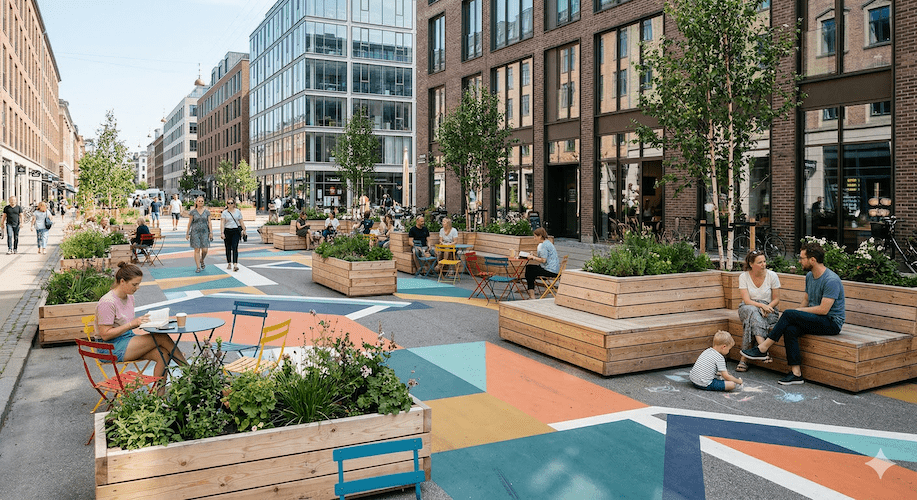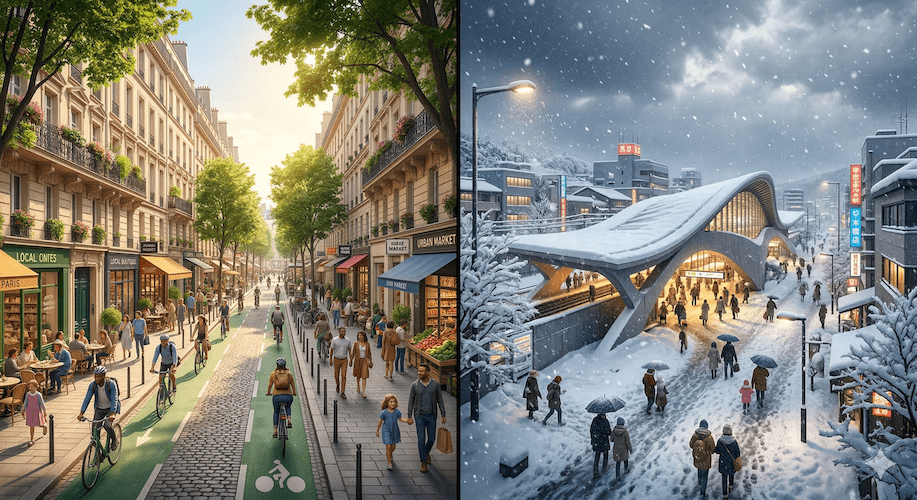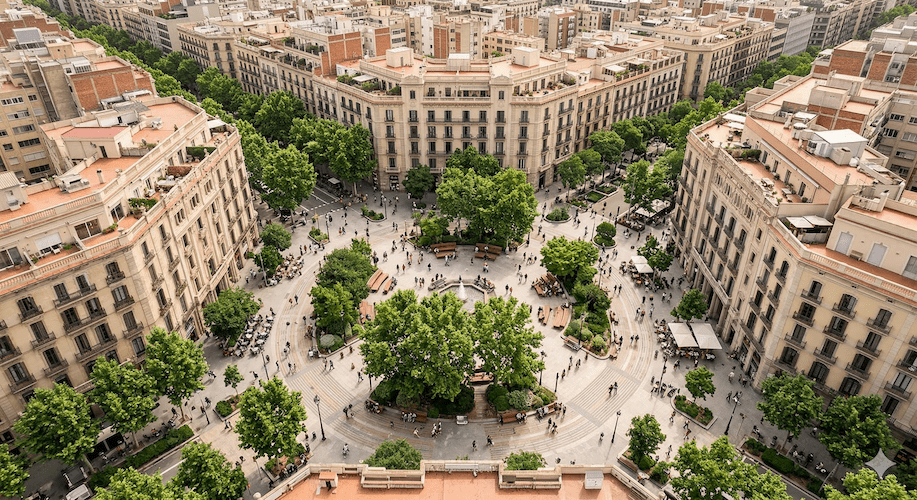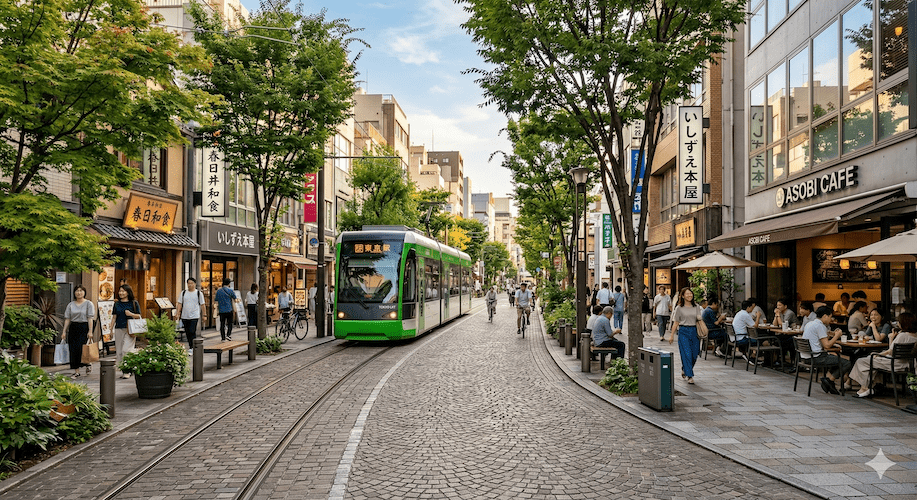
〜From road spaces centered on automobiles to road spaces that prioritize pedestrians and public transport.〜
*This article is based on information as of March 2026.
Jan Gehl, a renowned Danish urban planner and architect, repeatedly emphasizes this point in his book "Cities for People.""First we shape the cities – then they shape us."Note 1The "road space" that we casually walk through every day and that forms the basis of our lives is more than just physical infrastructure for transportation; it is an extremely powerful mechanism that fundamentally determines the lifestyles and values of the people who live there, as well as the nature of the local economy.
In contemporary urban planning, moving away from excessive reliance on automobiles and creating sustainable, human-centered spaces have become paramount international challenges. Amid unavoidable megatrends such as environmental concerns and the arrival of a super-aging society, the concept of urban design at the heart of this paradigm shift is..."Transit Mall"is.
This article delves deeply into the essence of transit malls, one of the most important keywords in future urban development. We will explore its basic definition, historical evolution in Japan, clear differences from similar road management systems, the advantages and disadvantages faced by stakeholders, and the cutting-edge implementation model being attempted in Toyako Town, Hokkaido, a snowy and cold region, using its own unique revenue source (accommodation tax). We will unravel this mystery from multiple perspectives. Let's explore clues to how future urban spaces will change.
1. What is a transit mall?: Definition and historical background in Japan
Redistribution from "mobility (traffic processing)" to "place (space for staying)"
A transit mall, as defined by discussions with the Ministry of Land, Infrastructure, Transport and Tourism and other organizations, is "a reallocation of road space that restricts the use of general vehicles on main streets in central urban areas, thereby improving the quality of pedestrian spaces while ensuring the convenience of public transportation (transit) such as buses and light rail transit (LRT)."Note 2refers to.
Since the period of rapid economic growth, conventional road design in our society has pursued to the extreme efficiency of traffic handling (mobility), focusing solely on "how to get as many cars through as quickly and smoothly as possible." However, transit malls rethink this premise. In other words, they are a method of redesigning roads with the aim of improving the quality of space (place), focusing on "how people can walk safely, stay comfortably, and access public transport smoothly."
In recent years, this concept has connected with and evolved into a broader policy theme: "walkable" urban development, which transforms urban spaces into more pedestrian-friendly and comfortable environments. By making pedestrians and public transport the main players, this comprehensive urban restructuring method is attracting attention worldwide as it simultaneously achieves the revitalization of commercial activity along roadsides, a dramatic reduction in the risk of traffic accidents, and a reduction in environmental impact such as automobile exhaust fumes and noise.
The beginning in Japan: 1999 Hamamatsu City's "Omnibus Town Policy"
The concept of transit malls itself has developed primarily in Europe (such as Strasbourg in France and Freiburg in Germany), where pedestrian-centered thinking has long been established, due to concerns about traffic congestion and air pollution in city centers accompanying the advancement of motorization. On the other hand, the history of its introduction in Japan can be traced back to the example of Hamamatsu City in Shizuoka Prefecture in 1999 (Heisei 11), which is clearly documented.
From March 15th to 28th, 1999, traffic restrictions were implemented in the vicinity of Kajimachi Street in Hamamatsu City as part of the "Omnibus Town Initiative," in cooperation with local transportation operators and other organizations. This was "Japan's first full-scale transit mall social experiment."Note 3This is etched into the history of current urban planning. The Omnibus Town policy is a comprehensive urban transportation policy centered on improving the convenience of buses, and this experiment started not merely as road regulation, but as a grand test case aimed at optimizing the entire urban transportation system.
However, this experiment did not immediately lead to a full-scale permanent installation due to difficulties in coordinating with the police and reaching agreements with local residents and shopping districts. Although some publicity activities were conducted beforehand, it has been pointed out that insufficient time for explanations and discussions to bridge the gap in understanding among stakeholders before the experiment was implemented became a source of friction later on.Note 4Nevertheless, the historical fact that this 1999 experiment became a symbolic example of the transit mall debate in Japan—the idea of "restricting automobiles and allowing public transport and pedestrians to coexist"—and had a significant impact on subsequent discussions in cities across the country cannot be overlooked.
2. Comparison with similar systems: The crucial difference from pedestrian zones
Permanent alteration of space, or temporary restrictions?
Transit malls are often confused with pedestrian zones or "community lanes," which have become increasingly common in residential areas, by the general public. However, there are crucial differences between them in terms of urban planning objectives and legal and spatial characteristics. To accurately understand their reality and positioning, we have structured and organized specific comparative data in the table below. Please pay attention to the differences in the objectives of each system and the nature of infrastructure investment.
| item | Transit Mall | Pedestrian zone (Pedestrian-only street) |
Living Path Zone |
|---|---|---|---|
| Main Objective | A permanent qualitative transformation of urban spaces, such as city centers, through improved public transport and pedestrian flow. | Ensuring the safety and comfort of temporary pedestrian spaces for shoppers and others. | The primary objective is to improve pedestrian safety and reduce through traffic on residential streets and other local roads. |
| Public transport | Allowing and prioritizing passage (assuming LRT and route buses coexist with pedestrian spaces). | No passage allowed (during the designated hours, route buses and other public transportation will also need to take detours). | It is passable (however, as it is a residential street, large buses rarely use it). |
| Spatial development (hardware aspects) | In many cases, after verifying the effectiveness of social experiments and reaching a consensus, the project transitions to permanent infrastructure improvements such as eliminating steps and beautifying the area. | The measures primarily involve soft measures such as temporarily blocking existing roads with signs and barricades, without altering the road structure itself. | Structural modifications are made to control speed, such as the addition of speed bumps (physical steps) and chicanes (narrowings). |
| Implementation period and time slots | Ultimately, the goal is often to implement permanent measures that are in place 24/7, 365 days a year. | It is common for services to be limited to specific days and times, such as during the daytime on Sundays and public holidays. | All day, 365 days a year (due to physical structural changes). |
As is clear from the comparison table above, transit malls are not simply a change in traffic rules. They are fundamentally different from pedestrian zones in that they "prioritize and allow the passage of public transport" and "visualize the effects and challenges through traffic regulations such as social experiments, build consensus, and gradually move to infrastructure development, aiming to reconstruct the space." They are an extremely sophisticated and irreversible urban development method.
3. The Light and Shadow of Introducing Transit Malls
The structure of advantages and disadvantages viewed from multiple perspectives
While the introduction of transit malls has the powerful potential to dramatically improve urban functionality and landscape, it also carries the risk of creating significant friction (pains) on existing economic activities and the lifestyles of citizens. To objectively evaluate this policy, we will structure and analyze in detail the benefits expected by proponents and the government, and the disadvantages that roadside businesses and car users are concerned about.
1. Revitalizing the local economy through improved accessibility:
By freeing pedestrians from the fear of exhaust fumes and traffic accidents, the "stay time" spent in road spaces will increase dramatically. As roads transform into public squares, it will become easier to set up open terraces for cafes and hold street markets, leading to increased foot traffic to roadside businesses, resulting in direct economic ripple effects and an improvement in the value of the area.
2. Fundamental improvement of the convenience and punctuality of public transportation:
Because general vehicles, which are the main cause of traffic congestion, will be restricted, LRTs and route buses will be able to maintain the same high level of punctuality as railways. In addition, if infrastructure improvements are made to make the difference in height between vehicle entrances and sidewalks flat, it will be possible to create a city with universal design that is friendly to the elderly and people using strollers.
3. Reducing environmental impact and building a city brand:
Restricting the influx of cars into the city center will significantly reduce air pollutants such as CO2 and NOx. Reducing asphalt and promoting greening will also contribute to mitigating the urban heat island effect. Being an "environmentally friendly and walkable city" will create a strong urban brand (civic pride) that will attract investment and talent from both within Japan and internationally.
1. Restrictions on logistics and delivery routes and deterioration of operational efficiency:
The biggest operational challenge is logistics. There are concerns about restrictions on the access of commercial trucks that deliver goods to stores and collect waste. Time restrictions, such as "allowing access only for a few hours in the morning," could hinder operational efficiency, and the establishment of a joint delivery system could impose additional costs and effort on businesses.
2. Obstruction of access for car-dependent consumers and risk of customer attrition:
In car-dependent communities such as regional cities, this could impair the convenience of customers who previously accessed stores by car. If supplementary measures such as "park-and-ride" programs, which involve developing large-scale parking lots in the surrounding area, are insufficient, there is a risk that customers will flock to large suburban stores with free parking.
3. The cost of infrastructure development and the difficulty of reaching a consensus:
If a full-scale improvement project is to be implemented, significant initial costs (public funds) will be required for things like widening sidewalks, repairing tracks, and beautifying the pavement. Furthermore, there are concerns about "traffic congestion" caused by restricted traffic flowing from the city center onto surrounding detours, which will create new traffic jams. Building consensus with local residents and shopping districts will require enormous time and human resources.
The biggest Achilles' heel: reaching a consensus
Thus, while transit malls can create an extremely rational and aesthetically pleasing final design, their transition period can cause significant pain to existing stakeholders. In many cases in Japan, challenges become apparent during the social experiment phase, and the delay in transitioning to infrastructure development stems precisely from the complexity of this consensus-building process and the difficulty of reconciling conflicting interests. How to engage in dialogue and overcome the barrier of "agreement in principle, disagreement on specifics" will be a true test of the capabilities of local governments and urban planners.
4. [Case Study] The Challenges of Toyako Town, Hokkaido, a Snow-Covered, Cold Region, and the "Accommodation Tax"
Walkable strategies in tourist destinations and the harsh challenges of "snow country" environments
Currently, the trend in urban planning in Japan is to adopt walkable urban development as an important strategy to enhance spatial value, not only in the central business districts of major cities but also in major tourist destinations in regional areas. This is being considered and implemented in a variety of areas across the country, such as around Kokusai Street in Naha City, Okinawa Prefecture, and the Dogo district in Matsuyama City, Ehime Prefecture.
One particularly noteworthy and cutting-edge example is the initiative in Toyako Town, Hokkaido. This town, one of Japan's leading hot spring resorts and an international tourist destination boasting magnificent natural scenery within a national park, is planning to introduce walkable urban development aimed at reorganizing its urban space from car-centric to pedestrian-centric. This is an extremely strategic approach that will fundamentally enhance the town's appeal as a tourist destination, extend visitors' stays, and stimulate consumption.
However, developing spaces in Hokkaido, a snowy and cold region, presents unique and extremely challenging problems that are on a completely different level than those in the warmer regions of Honshu. The biggest obstacle is "measures against snow and ice in winter." No matter how beautifully designed a flat pedestrian space may be, if it is covered with tens of centimeters of snow and thick ice for nearly half the year, walking becomes extremely difficult and dangerous. To solve this, the widespread installation of road heating (snow melting equipment) and the provision of shelter functions such as arcades are being considered, but these involve not only enormous initial costs but also high running costs such as fuel and electricity, which place a heavy burden on the finances of local governments.
Furthermore, the "car-dependent society" resulting from the vast scale of the project poses a significant obstacle. How can we convince local residents, who rely on their own cars for all their daily transportation needs, to accept walkable spaces for tourists seeking a unique experience? Discussions about zoning that separates "tourist traffic" from "residential traffic" become essential.
Implementation of a self-sustaining infrastructure engine: the "accommodation tax" scheduled to take effect in 2026.
To overcome the unique challenge of maintaining infrastructure in this snowy region and secure sustainable financial resources, Toyako Town has taken an extremely strategic and innovative step: the introduction of a "lodging tax," a non-statutory tax unique to local governments. According to reports, with the approval of the Ministry of Internal Affairs and Communications, it is scheduled to be implemented on April 1, 2026.Note 5This system employs a progressive structure where charges are collected in three stages depending on the accommodation fee.
[Chart] Hokkaido, Toyako Town: Planned tiered tax rates for accommodation tax
*Scheduled to take effect on April 1, 2026 / Three categories based on accommodation charges (per person, per night, room only).
Estimated tax revenue for a normal fiscal year: Approximately 150 million yen (projection)
*This is separate from the "Hokkaido Wide-Area Accommodation Tax (100 yen to 500 yen)" which is scheduled to start on the same day, and accommodation facilities will collect these taxes together.Note 6。
This projected new revenue of approximately 150 million yen per year will be an extremely powerful engine for urban development investment for local governments with small populations. The accommodation tax system involves having tourists (visitors) who directly benefit from walkable spaces bear a small portion of the costs, and using the tax revenue to cover maintenance costs such as sidewalk improvements, landscape beautification, and winter road heating. It is attracting keen attention from tourism-oriented municipalities nationwide as a brilliant method of building a highly rational and sustainable "benefit and burden ecosystem" without excessively relying on the taxes of ordinary residents (general revenue).
5. A Vision for the Future: The Integration of Self-Sufficient Infrastructure and Next-Generation Mobility
The arrival of MaaS and autonomous area management
In the near future, the concepts of transit malls and walkable urban development are strongly expected to evolve beyond mere "reorganization of road space as a physical structure" to "complete integration with next-generation mobility services (MaaS)."
Specifically, while appropriately controlling the entry of general vehicles into the area, the social implementation of "hybrid pedestrian-vehicle coexistence spaces" will progress in regional cities across Japan, where small electric mobility vehicles (green slow mobility) operating autonomously at low speeds and shared bicycles seamlessly circulate within pedestrian spaces to support last-mile transportation for the elderly and those with mobility limitations.
Furthermore, we are facing a major turning point in terms of securing funding. As seen in the example of the accommodation tax that Toyako Town plans to introduce, it is expected that a self-sustaining financial model will spread, which skillfully utilizes "external funds (tourist spending and private investment)" to maintain and manage public spaces. Rather than relying solely on subsidies, the movement to redefine road spaces as "infrastructure that earns and sustains itself" will accelerate, by combining area management contributions and naming rights for spaces.
Conclusion: Redefine roads as "spaces for whom and for what purpose."
In discussions about introducing transit malls, the most essential perspective we should consider is the very "philosophy of road space."
In today's world, facing severe constraints such as population decline, the arrival of a super-aging society, and worsening global environmental problems, the value demanded of urban spaces is no longer simply "the speed at which cars pass." Rather, the aspect of "a rich place to stay where people can safely remain, interact with each other, engage in comfortable consumer activities, and walk while maintaining physical and mental health" is becoming the true indicator of urban richness.
The temporary inconvenience caused by restricting the use of private vehicles, and the friction within the community regarding logistics and access to daily life, can be considered inevitable labor pains that arise during the process of transforming into a new city. However, a quarter of a century has passed since the full-scale social experiment in Hamamatsu City in 1999, and now "next-generation self-sufficient spatial design," such as that which Toyako Town is pursuing with its own unique revenue system (accommodation tax), is vigorously sprouting up all over the country.
We hope that our readers will not be confined to the narrow framework of merely debating the merits of short-term traffic regulations, but rather will consider this trend of walkable urban development and transit malls from the perspective of a long-term spatial investment strategy that considers "what cities and regional lifestyles should be like in several decades."
Related Links
- Ministry of Land, Infrastructure, Transport and Tourism: Creating walkable cities
- Ministry of Land, Infrastructure, Transport and Tourism: On the development of spaces for pedestrians and trams - Towards the introduction of transit malls
- Toyako Town: Regarding the introduction of a lodging tax
Inquiries and requests
We help solve local issues.
Please feel free to contact us even if it is a small matter.