〜Outstanding cost performance and integration with urban planning (TOD)〜
*This article is based on information as of March 2026.
Fundamentally, "freedom of movement" and "economic revitalization" are two sides of the same coin in urban development. Therefore, the design of transportation infrastructure is not merely about securing means of transportation, but is a crucial issue that determines people's lifestyles and the urban ecosystem itself. However, in many modern cities, especially regional cities in Japan, outdated mobility policies have reached their limits in the face of structural challenges such as a chronic shortage of drivers, ballooning infrastructure maintenance and renewal costs, and a serious population decline.
In this context, this article delves into the true value of the BRT (Bus Rapid Transit) system, which originated half a century ago in Kyritiba, a city in southern Brazil, and continues to evolve today. First, we will explain that BRT is not merely a vehicle replacement, but a tool for "maximizing capital" that designs the urban framework in conjunction with land-use planning. Furthermore, we will highlight its strengths and weaknesses based on multifaceted facts, including not only past successes but also the negative spirals it has faced in recent years and the latest modernization projects. Finally, we will explain in detail its strategic and realistic applicability in regional cities facing unique challenges, such as Toyako Town in Hokkaido.
1. Definition and innovativeness of BRT (Bus Rapid Transit)
A sophisticated urban framework that functions as an "above-ground subway."
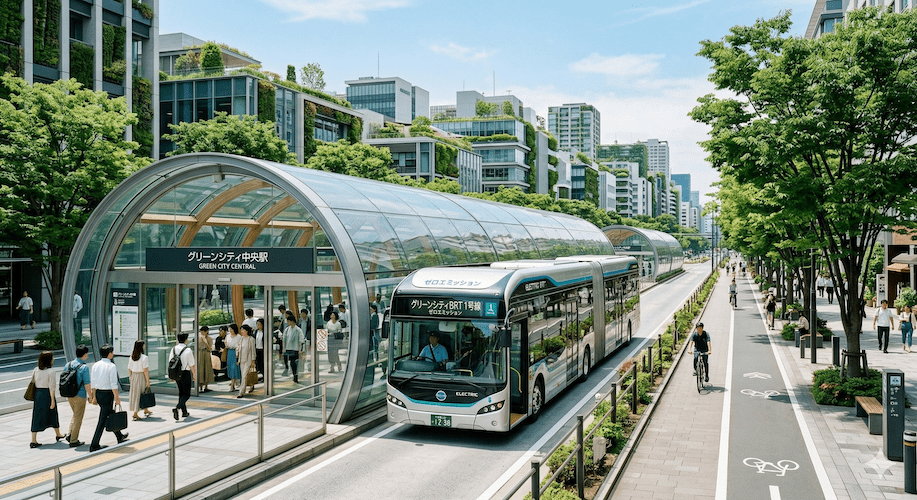
First and foremost, BRT (Bus Rapid Transit) can be described in a nutshell as "an advanced urban transportation system based on dedicated lanes that highly integrates the speed and high transport capacity of subways with the flexibility and low cost of route buses." The biggest weakness of typical route buses is delays caused by traffic congestion due to mixing with general vehicles. However, BRT completely overcomes this problem by securing physically isolated dedicated lanes (or dedicated roads) and introducing bus-priority signal control at intersections (Transit Signal Priority).
What is even more noteworthy are its operational elements and boarding/alighting system. As exemplified by Kyrichiba's system, BRT dramatically reduces passenger boarding and alighting times by combining "off-board fare collection," "horizontal boarding and alighting at floor level with no gap between the vehicle and platform," and "integrated terminals connecting trunk lines and feeder lines." In other words, this is not simply an extension of a bus, but should be defined as a comprehensive infrastructure system that functions as a "surface subway."
Outstanding return on investment (ROI) in infrastructure development
Next, we will compare the economic advantages and transport capacity of the systems from a quantitative perspective. As the table and graph below show, BRT can be extremely cost-effective depending on the design. In Kyrichiba, the "dedicated busway + advanced stations and fare collection" option was chosen, which could be developed at a lower cost than a subway, and the reference value at the time of implementation was approximately $200,000/km. On the other hand, urban rail systems require large-scale infrastructure such as roadbeds, tracks, and electrification, and can generally be expensive (construction costs for LRT and subways vary greatly depending on the terrain and conditions).
■ [Graph] Comparison of initial infrastructure construction costs per kilometer (conceptual diagram)
(*Based on actual data from that time)
*The BRT figures are based on examples from when Kyuritiba was introduced. LRT/subway figures are estimates based on general international market rates.
| Comparison element | BRT (Bus Rapid Transit) | LRT (next generation streetcar) | Subway / Heavy rail |
|---|---|---|---|
| Infrastructure development costs | Extremely low cost. Because it primarily involves developing dedicated lanes and platforms on existing road spaces, initial costs are easy to keep down. | It is expensive. Even on existing roads, laying rails, installing overhead lines, and constructing substations are essential. | Enormous. Constructing completely independent tracks, such as underground tunnels and elevated bridges, would require astronomical costs. |
| Transportation capacity (Per hour, per direction) |
A combination of dedicated rail space and high-frequency operation enables increased capacity. For example, TransMilenio in Bogotá, Colombia, has reported approximately 41,000 passengers (pphpd). | Large capacity (approximately 30,000 people at its maximum). A high passenger capacity can be achieved by connecting multiple vehicles. | Maximum capacity (approximately 52,000 to 90,000 people). Overwhelming mass transportation due to long train formations and high-density service intervals. |
| Speed and punctuality | It's expensive. Physical dedicated lanes and priority signals allow it to avoid congestion caused by regular traffic. | Expensive. Punctuality and speed are ensured by dedicated tracks (such as transit malls). | Extremely high. A completely independent space, unaffected by any other modes of transportation or traffic signals. |
2. Historical Transformation and Paradigm Shift in Kyrthyba
Kyritiba, the capital of Paraná state in southern Brazil.
A sense of crisis regarding urban sprawl and the formulation of a master plan.
A look at history reveals that Kyrichiba's innovation was not a product of chance, but rather a result of a sense of crisis regarding serious urban problems. From the 1940s onward, the population rapidly increased due to a massive influx of agricultural workers into the city. According to specific statistics (IBGE), the population, which was about 140,000 in 1940, doubled to about 360,000 in 1960, and continued to expand explosively thereafter. As a result, the city faced uncontrolled urban sprawl and severe traffic congestion in the city center.
In this context, while many cities were focusing on widening roads for automobiles, the city of Curitiba attempted a fundamental paradigm shift. The plan discussed at the "Curitiba of Tomorrow" seminar in 1965 was formalized in 1966 as the city's first historical master plan. The core of this plan was to prevent the city from expanding haphazardly in all directions and to guide urban growth linearly along five designated structural axes.
The leadership of Mayor Jaime Lerner and "creative solutions"
Then, in 1971, a major turning point in history occurred when Jaime Lerner, an architect and urban planner, became mayor. He made the creative decision to make buses the main mode of transport, which were cheaper and could be implemented more quickly, rather than relying on the construction of a subway system that required a huge budget, and he began to develop a structural busway system around 1974. He later spoke forcefully about his philosophy of urban planning as follows:
"The city is not the problem; the city is the solution."
— Jaime Lerner (former mayor of Kyritchba and urban planner)
In 1991, his idea led to the introduction of futuristic glass-enclosed "tube-shaped bus stops," enabling pre-payment and quick boarding and alighting. A unified network of local, express, and branch bus lines was completed, allowing citizens to transfer seamlessly. Including the integrated network in the metropolitan area, it grew into a massive infrastructure, with daily ridership reaching approximately 2.5 million people around 2014.
3. Light and Shadow: A Multifaceted Evaluation and Current Challenges in BRT Promotion
However, even the best systems are not perfect. A thorough and objective assessment of the significant advantages from the perspective of government and businesses, and the potential disadvantages from the user and political standpoint, is essential for a truly understanding of the system.
The greatest advantage for administrators and urban planners is the creation of "profitable infrastructure" linked to land use planning. At the time, Kyrichiba set the floor area ratio (FAR) at an extremely high 6:1 in many of the structural corridors (which was later revised), guiding the development towards low-density residential areas as you moved away from the axis.
Furthermore, through systems such as the "Transfer of Development Rights (TDR)" scheme, private investment naturally concentrated along the BRT lines, creating a compact, pedestrian-centered urban structure (Transit-Oriented Development: TOD) that does not rely on automobiles. As a result, infrastructure development costs were suppressed, while a stable foundation was strengthened through tax revenues along the lines.
On the other hand, there are significant risks associated with introducing and maintaining a BRT (Bus Rapid Transit) system. Firstly, securing dedicated lanes means encroaching on public road space, which is likely to provoke political opposition from private car users.
Secondly, there is vulnerability to external economic factors and political conflicts. According to various commentary articles, the number of users has decreased in recent years due to the rise of ride-hailing services, falling to approximately 710,000 per day in 2020. Furthermore, it has been pointed out that in 2015, several surrounding municipalities temporarily withdrew from the integrated network due to conflicts over financial burdens, exposing the risk of inter-administrative division in maintaining seamless coordination of wide-area transportation.
A counteroffensive through reinvestment: Launching large-scale modernization projects
To overcome this situation, Kyrčiva is currently promoting a large-scale modernization project, including financing from the New Development Bank (NDB). Specifically, measures such as increasing transport capacity by adding "passing lanes" to existing dedicated lanes are underway, and the number of daily users is expected to recover to 1.1 million by 2022. Furthermore, as an environmental measure, the city recently announced a plan to purchase 70 electric buses (EVs) and is currently undergoing the process of obtaining parliamentary approval, demonstrating the fact that systems must be constantly updated.
4. Application in a specific region: Simulation in Toyako Town, Hokkaido
So, how can these insights be applied to regional cities in Japan? Here, we will logically examine the applicability and challenges faced by Toyako Town in Hokkaido, which has a unique geographical and economic environment, as a concrete example.
Toyako Town, Abuta District, Hokkaido. Regional cooperation and the maintenance of transportation infrastructure are major challenges.
Securing a means of transportation to support industries amidst a severe financial crisis.
According to documents such as Toyako Town's medium-term financial plan, the "fiscal strength index," which indicates the self-sufficiency of a local government, was a low 0.287 in fiscal year 2019. Furthermore, the current account balance ratio has remained around 90% in recent years, indicating a rigid financial structure in which the majority of the budget is absorbed by mandatory expenditures.
Looking at Toyako Town's industrial structure, agricultural output (estimated for 2023) was 5.64 billion yen (2.32 billion yen for crop farming and 3.32 billion yen for livestock farming), and the value of manufactured goods shipped by the manufacturing industry was 7.99 billion yen in 2021. Maintaining a stable transportation network is essential from the perspective of commuting for employees who support these local industries, as well as the logistics of agricultural and marine products and processed goods. However, under a fragile financial base, introducing rail-based transportation, which requires enormous initial investment, is difficult. Therefore, BRT (or flexible dedicated bus lane operation), which can be implemented simply by redefining existing roads, emerges as an extremely realistic option.
Building wide-area cooperation (settlement and self-reliance zones) and hierarchical networks
Because the transportation demand in Toyako Town alone is limited, designing a wide-area network within a "self-sufficient settlement area" in cooperation with neighboring municipalities is essential. In the vast area of Hokkaido, rather than covering all settlements with large buses on fixed routes, building a "hierarchical network" where high-speed, punctual "trunk axes" run along major arterial roads, and local on-demand transportation and shared taxis connect from each hub to the branch areas beyond, is the most ROI-worthy ecosystem design.
5. A Vision for the Future: Evolution to Next-Generation Mobility
Zero emissions and autonomous driving brought about by the integration of technology
Half a century after its inception, BRT has dramatically evolved beyond the mere physical framework of "dedicated bus lanes" into a smart platform integrating digital technology and clean energy.
Firstly, there is the wave of electrification. In addition to the aforementioned plan to introduce EV buses in Kyritiba, a BRT (Bus Rapid Transit) system using 100% electric buses has already begun operation in Dakar, Senegal, Africa. The former concerns about the environmental impact of internal combustion engine buses are being completely dispelled by technological innovation.
Even more important is the social implementation of autonomous vehicles. The BRT's characteristic of being a "dedicated space isolated from other vehicles" reduces the risk of unpredictable collisions with pedestrians and other vehicles, providing fertile ground for the earliest and safest introduction of advanced driverless buses. This has great potential to fundamentally solve the critical bottleneck currently facing Japan: the shortage of drivers.
Conclusion: Building "Continuous Governance" Beyond Hardware Deployment
The true reason why Kyrichiba's BRT has functioned as the backbone of the city for half a century and continues to be praised around the world is not because of the superficial cost-cutting of "choosing cheaper buses instead of a subway." Rather, it was because they made an extremely sophisticated decision to redesign the relationship between urban space and people itself, not only by pursuing the efficiency of the transportation system itself, but also by utilizing floor area ratio control and land use regulations to "concentrate residential and commercial facilities along transportation axes (TOD)."
The greatest lesson that Japanese regional cities should learn from this is the "perfect synchronization" of transportation policy and urban planning. In order for local governments facing declining birthrates, an aging population, and severe financial constraints to ensure sustainability, it is essential to abandon the outdated method of maintaining dispersed infrastructure and to demonstrate leadership in intentionally compacting functions around strong transportation axes. At the same time, even the best systems cannot escape the drastic changes in the external environment. Urban transportation is not something that is completed by pouring concrete once; it is a "living thing" that constantly requires updates. Building "social consensus" to maintain and evolve the system, and establishing "continuous governance" among regional governments, are the essential challenges we must address in next-generation urban development.
Related Links
- Ministry of Land, Infrastructure, Transport and Tourism: About BRT (Bus Rapid Transit)
- ITDP (Institute for Transportation and Development Policy): BRT Standard
- New Development Bank (NDB): Curitiba Rideability Improvement Project
Inquiries and requests
We help solve local issues.
Please feel free to contact us even if it is a small matter.