〜How can we transform the "negative legacy" of soil contamination into a regional asset?〜
*This article is based on information as of March 2026.
In the outskirts of our cities and rural areas, there are vast, undeveloped lands that once powerfully drove the local economy but are now surrounded by high fences and eerily quiet. These lands, formerly used as factories, massive industrial facilities, or mines, have not been reused or redeveloped due to the presence or strong concerns about soil contamination, casting a dark shadow over the urban landscape. In the fields of urban planning and real estate, these are collectively known as "brownfields."
Winston Churchill, a historical British leader, once said,"We shape our buildings, and afterwards our buildings shape us."He left us with these profound words. These words eloquently illustrate the solemn fact that how we confront and rebuild abandoned ruins and lands tainted by invisible pollution will ultimately determine the spirituality and economic nature of future communities.
In the first place, the regeneration of brownfields is not simply limited to "pollution control" or "civil engineering" that involves replacing contaminated soil with heavy machinery. It is an extremely sophisticated and strategic urban development process that involves confronting the "heavy memories of the city," including traces of harsh labor and environmental destruction from the past, and transforming them into true assets that can be passed on to future generations. In this article, we will take a multifaceted and in-depth look at the deep-seated challenges facing brownfields and the new possibilities that can emerge from them, incorporating global trends, cutting-edge data utilization, and the unique history of Hokkaido as a case study.
1. Overview and Background: What is the true definition of "brownfield"?
Basic concepts and differences in legal interpretation between Japan and the United States
First, let's define what a brownfield actually is. In short, it refers to "undeveloped land (a negative legacy) that was once used as an industrial base but has been left untouched due to the risk of soil contamination, preventing redevelopment." These properties often have the troublesome characteristic of being "imprisoned" for long periods of time, despite being in prime locations such as the heart of a city or with already established infrastructure, because the invisible risk of contamination lurking underground significantly diminishes their value as real estate.
Let's delve a little deeper. There are clear differences in legal interpretations and approaches across countries. According to the strict definition of the U.S. Environmental Protection Agency (EPA), a brownfield is defined as "a property whose expansion, redevelopment, or reuse is complicated by the presence or potential presence of hazardous materials, pollutants, or petroleum contamination." In the United States, this is not merely an environmental issue, but is taken head-on as an "economic challenge that needs to be addressed."
On the other hand, in Japan, there is no clear legal definition of such land. However, in practice, the Ministry of the Environment and other relevant bodies define it as "land that is not being used in a way that is commensurate with its inherent potential value due to the presence or concern of soil contamination." For a long time in Japan, there has been a strong tendency to avoid such land in real estate transactions, considering it a "dangerous place to not touch."
A new spatial interpretation: "Brown Earth-Work"
Of particular note is the fact that a very interesting concept has been proposed in recent years in the fields of landscape architecture and cutting-edge urban planning research. This is the academic approach called "Brown Earth-Work." Although this is not a common legal term or standard policy term, it is an innovative perspective that re-examines the physical and spatial extent of contaminated soil not as a mere "abominable obstacle to be removed," but as the very material that forms the core of the regeneration process.
This approach attempts to integrate the remediation process of contaminated soil into landscape systems and ecosystem restoration processes, presenting the natural healing process over time as a framework for urban design and education. It represents a mature societal discussion that seeks to break away from the conventional method of "covering up" and ignoring the problem.
2. History and Transformation: Global Trends and the Miracle Germany Created
Global context and the threat of "sprawl"
The concept of brownfields emerged as a serious social problem following the rapid globalization and transformation of industrial structures from the 1980s onward. In developed countries, as there was a shift from heavy industries such as steel, coal, and shipbuilding to knowledge-intensive industries such as IT and finance, large-scale factory closures occurred one after another in traditional industrial areas of North America and Europe.
This resulted in vast areas of vacant land contaminated with hazardous substances being left behind in urban areas. This was not simply a superficial problem of "having too much land." It led to a drastic decrease in tax revenues, such as property taxes, and a rapid deterioration of public safety in surrounding communities. Even more fatal was that developers and contractors, disliking the pollution risks and high cleanup costs in existing urban areas, carelessly cleared untouched suburban natural green spaces and farmland (greenfields), causing "uncontrolled development expansion (land sprawl)." The European Union's ambitious goal of "zero net land take by 2050" is based on these historical lessons.
Pioneering project: Landschaft Park Duisburg Nord
In this context, the creation of "Landschaftspark Duisburg-Nord" in Germany's Ruhr industrial region marked a historic turning point in the revitalization of brownfields and gave hope to the world.
The Meiderich Ironworks, located on this vast site, began construction in 1901 and continued to support the post-war economic recovery, but it could not withstand the tide of time and finally ceased operations completely on April 4, 1985. What remained was a huge, polluted industrial ruin spanning approximately 180 hectares.
Immediately after its closure, local politicians and government officials, fearing the enormous maintenance costs, strongly advocated for the complete demolition of the facility. However, a preservation movement emerged, arguing that the steel mill was a historical symbol of Duisburg. An investigation by a committee of experts revealed that "the option of demolition, involving the complete removal of contaminated soil, would be far more expensive than preserving the factory," leading to a major shift in policy toward preservation.
Peter Lutz's design philosophy and the current state of the place, which attracts 1 million visitors annually.
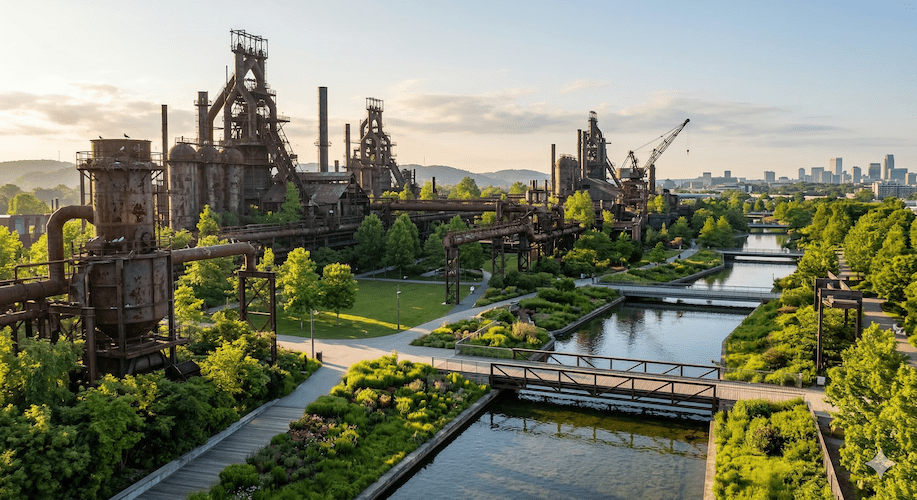
Peter Latz, selected as the designer in 1991 after an international competition in 1989, employed a groundbreaking approach. Rather than shunning the industrial past, he made "healing and understanding" the devastated state of the site the core of his design. Instead of spending enormous sums to remove the contaminated soil, he opted for a gradual restoration using "phytoremediation," which involves purifying the soil with plants, and isolated and contained the highly toxic soil inside the existing massive concrete storage bunker.
Since 1994, this park, where nature and industrial heritage blend seamlessly, has undergone remarkable development. Former gas tanks have been transformed into Europe's largest artificial diving center, and ore storage bunkers into alpine climbing training grounds. Today, it is a world-renowned tourist and cultural hub, attracting approximately one million visitors annually to witness its spectacular landscape enhanced by light displays.
3. Comparative Data: Key Differences Between Policies and Approaches in Other Countries and Japan
Approaches to brownfields vary greatly depending on each country's legal system and cultural background. While the United States and Europe have a strategic approach to this issue, Japan faces a significant gap between its legal framework and practical real estate transaction practices. Let's examine this in the following comparison table.
| Comparison items | [United States and Europe] (EPA-led EU strategy) |
【Japan】 (Estimates and systems by the Ministry of the Environment, etc.) |
|---|---|---|
| Main objectives of the policy | Promoting beneficial reuse and economic regeneration. The EU aims for "zero net land take" by 2050. | The primary objective is "prevention of harm to human health (risk management type)" based on the Soil Contamination Countermeasures Act. The incentive for beneficial reuse is limited. |
| Government subsidies and budgets | Since 1995, the EPA has provided approximately $2.9 billion in grants. The EU also provides substantial financial support through its Regional Development Fund and other means. | Compared to Europe and the United States, comprehensive remediation promotion systems are limited (although some subsidies from the Soil Contamination Countermeasures Fund and loan programs from public financial institutions and local governments do exist). |
| Cost of purification measures | By avoiding complete excavation and removal, and allowing for plant-based remediation and containment within existing structures, costs can be significantly reduced, and coexistence can be achieved. | Legally, containment measures are permitted, but in real estate transactions...In practice, "complete excavation and removal" remains the dominant approach.As a result, the cost of countermeasures has skyrocketed. |
| Economic challenges | Federal funding has spurred public and private investment, resulting in the creation of hundreds of thousands of jobs and the development of a world-class tourist destination. | It is estimated that "potential brownfields," where the cost of countermeasures is a burden and makes it difficult to sell, amount to approximately 10.8 trillion yen (approximately 28,000 hectares) (as of 2007). |
Japan's Soil Contamination Countermeasures Act is fundamentally a "health risk management" type of law, and the system does not uniformly require complete excavation and removal. However, in the practical aspects of land sales and transaction practices, there are still few cases where buyers accept methods other than "complete removal" (such as immobilization or containment), and excavation and removal account for the majority of cases. It cannot be denied that this practical zero-risk thinking is contributing to the "immobilization" of land.
[Conceptual Diagram] Estimated Potential Asset Size Related to Soil Contamination in Japan
*This conceptual representation is based on estimates from the Ministry of the Environment in 2007 (Heisei 19) and may differ from current actual figures.
4. Advantages and Disadvantages: The Light and Shadow of Regeneration Projects
While brownfield regeneration, if successful, can bring immeasurable benefits to cities, it also entails extremely complex uncertainties, risks, and social side effects. This analysis objectively summarizes the advantages for proponents (government and businesses) and the disadvantages for opponents (users and concerns).
From the perspective of government and businesses
■ Creating economic value from underutilized assets
By transforming what would otherwise be a negative legacy—a property that would devalue surrounding real estate—into commercial facilities or business parks, the tax revenue base of the local government can be dramatically restored. As demonstrated by the US EPA grants, initial public support has proven to be a powerful catalyst for attracting private investment.
■ Strong suppression of sprawl (uncontrolled expansion)
Many brownfield areas are located within cities where infrastructure is already in place. Prioritizing their development allows for the consolidation of urban functions (creating compact cities) without destroying valuable suburban natural areas.
■ Preservation of industrial history and its transformation into cultural and tourism resources
By carefully preserving and renovating industrial buildings, we can create value that goes beyond that of a mere park. By maintaining the region's industrial identity while adding artistic touches, we can transform them into world-class tourist attractions.
From the perspective of local residents and users
■ Extreme uncertainty regarding purification costs
It is extremely difficult to fully grasp the extent of underground contamination before a project begins. If unexpectedly high levels of contamination are discovered during development, there is a fatal risk that remediation costs will skyrocket, which is the biggest obstacle to private sector participation.
■ Persistent health concerns regarding residual substances
If "on-site containment" or "plant-based remediation" is employed, it is not easy to dispel the psychological resistance of residents using the facility to the fact that "contaminants are not completely removed and remain at their feet."
■ Induction of gentrification (upgrading)
When an area undergoes dramatic revitalization and transforms into an attractive location, it's inevitable that surrounding land prices and rents will skyrocket. As a result, there are concerns that long-standing low-income groups and small business owners will be unable to withstand the rising rents and may be excluded from the community.
5. Potential in Specific Regions: Challenges and Opportunities Facing the Greater Hokkaido Area
The collapse of company towns and the negative chain reaction accompanying the shift in energy policy.
In rural Japan, particularly in Hokkaido, a region with vast landmasses, the brownfield problem carries a unique weight and severity different from other regions. Since the Meiji era, Hokkaido has a history of concentrated development of infrastructure such as roads, ports, and railways, along with coal and mining development, as a strong national policy of the government. Coal production grew rapidly, fundamentally supporting Japan's modernization.
However, the post-war energy revolution (the shift from coal to oil) forced the once-flourishing coal mines to close one after another. The collapse of these company towns resulted not only in massive job losses, but also in the successive closures of railway lines that served as vital transportation for local residents, leading to a chain reaction of damage that continues to this day: severe depopulation and disruption of local access.
Serious mining pollution risks and the beginnings of "phytoremediation"
Many of the remaining closed coal mines and former mining sites have significantly altered soil physical and chemical properties, and in some cases, heavy metal contamination persists over a wide area. These pose a potential threat to the agricultural environment, which is a key industry in Hokkaido.
On the other hand, some research suggests that due to the harsh environmental pressures, certain plant groups growing naturally in contaminated areas have acquired the ability to accumulate heavy metals at high concentrations (bioaccumulation), resulting in the formation of unique plant ecosystems. Discussions are beginning to explore the possibility of utilizing these sites as technological centers for "phytoremediation," a method that intentionally takes advantage of these plant characteristics to slowly purify the soil.
Acceptance of "negative history" and geopark collaboration in the wider area including Lake Toya, Sobetsu, and Noboribetsu
Let's shift our focus to a more localized, specific example. The wider area encompassing Lake Toya, Sobetsu, and Noboribetsu in southwestern Hokkaido retains many historical traces of mining, including the former Horobetsu Mine (located in Noboribetsu City, which produced sulfur, gold, silver, etc.) and its related facilities (such as mine wastewater treatment operations in Sobetsu Town).
This area already has a world-class educational and tourism infrastructure as the "Lake Toya-Usu Geopark," where people can learn about the natural threats and blessings of volcanic eruptions in an integrated way. In this context, couldn't we utilize the historical brownfields, such as abandoned mine sites scattered throughout the surrounding area, with a new approach, rather than simply concealing them as "dangerous restricted areas"?
For example, one approach involves adopting a perspective similar to Germany's Landschaftpark, linking it with the regional geopark program as a "place to observe the process by which nature repairs itself from pollution and destruction." Hokkaido's development history also includes extremely dark negative aspects such as harsh labor. If we can convey this historical background comprehensively, rather than merely focusing on superficial nostalgia, and give it significance as a "dark tourism hub" that considers human rights and the environment, it could become a tourist resource with a powerful message, fusing geological and industrial history.
6. Conclusion and Outlook: Towards next-generation urban development that coexists with risk
Transition to renewable energy and attempts at risk prediction using data
Looking ahead, how will brownfield regeneration evolve? One promising trend is the large-scale conversion of land to renewable energy. Even land with severe soil contamination is being utilized in Europe and elsewhere as a site for mega solar power plants (photovoltaic power generation) or large-scale battery storage systems (BESS) that do not require large-scale excavation. This is a practical way to achieve both decarbonization and monetization of idle land while minimizing physical alteration of the land.
Furthermore, attempts are underway to use technology to address the biggest bottleneck in remediation projects: the difficulty in predicting cleanup costs. In the United States, non-profit data science support organizations such as "Community Lattice" and "DataKind" are currently leading the development of tools that use machine learning (AI) to analyze project data collected by the EPA in the past and predict cleanup costs in advance. While these are still experimental support tools, they are expected to become an important compass for local governments and community organizations to conduct highly accurate risk assessments in the early stages of their operations.
A paradigm shift from "complete elimination" to "risk management and coexistence."
Ultimately, a paradigm shift in real estate transactions and societal perceptions is essential in Japan as well. Despite the institutional objective being "management of health risks," the current zero-risk mindset, which assumes "complete excavation and removal" in all practical cases, is causing significant losses from an economic rationality standpoint.
Going forward, it will be necessary to shift to a more realistic and comprehensive risk communication approach that flexibly accepts containment and plant-based remediation depending on the land use (for example, whether it is a residential area where people settle permanently or a business site with little access), and that "manages land resources from a long-term perspective while effectively dealing with soil contamination."
Conclusion: Heal the negative legacy and reweave it into a source of pride for future generations.
Brownfields are the painful scars left behind by the rapid economic prosperity that humanity once enjoyed. However, the German example, which attracts a million visitors annually, powerfully demonstrates that even neglected soil contaminated with heavy metals can be transformed into a cultural and historical landmark that local residents can be truly proud of, when combined with the miraculous resilience of nature and the power of excellent human landscape design.
Even in regions like Hokkaido, which once prospered from intense energy development and has since suffered the pain of a rapid shift in industrial structure, we should not continue to shun the remaining ruins and contaminated areas as mere "inconvenient legacies to be concealed." Instead of clinging to complete detoxification and leaving vast tracts of land stagnant, we should sincerely coexist with the unique historical background and environmental risks of the land, and create "new value" from the natural process of slow regeneration itself. Such a flexible yet resilient shift in thinking is precisely what is needed in our urban development today.
Related Links
- Ministry of the Environment: Overview of the Soil Contamination Countermeasures Act and related materials
- U.S. Environmental Protection Agency (EPA): Brownfields Program
Inquiries and requests
We help solve local issues.
Please feel free to contact us even if it is a small matter.