〜"Strategic Shrinkage" in a Declining Population Society and New Paths to Urban Regeneration
*This article is based on information as of December 2025.
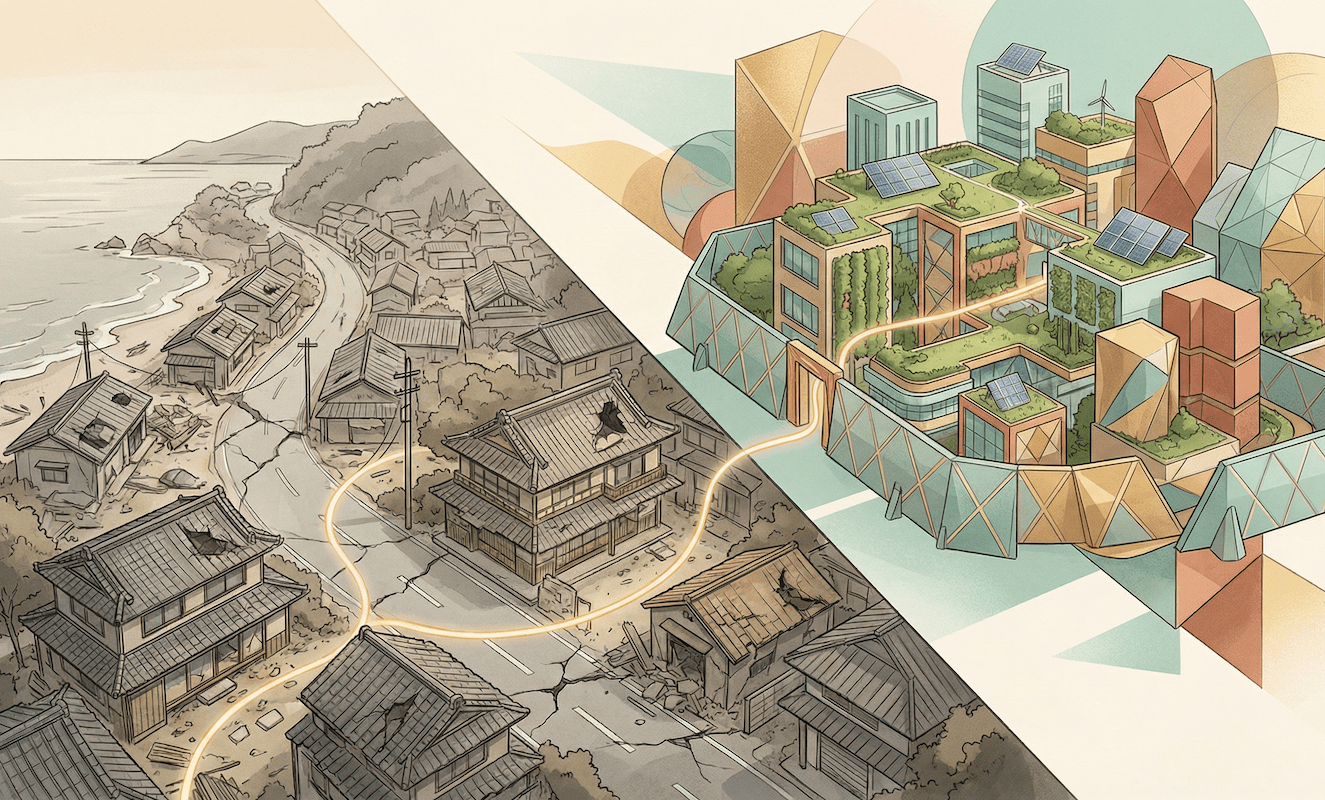
The city's contours are beginning to change quietly but surely. Wooden houses, once built during the period of rapid economic growth, once supported family gatherings and the vitality of the local community. Now, without their owners, they are decaying in a silence that seems as if time has stopped. Are these really "heritage" that should be passed on to the next generation? Or are they "time bombs" that threaten the safety of the local community?
"Renovate good old buildings and turn them into tourist attractions" - such hopeful words are often spoken in the context of regional revitalization. However, once you peel back the idealistic surface, the reality reveals a colder, crueler face. Abandoned vacant houses are prone to collapse in earthquakes, parts flying off in typhoons, and become breeding grounds for arson, threatening the peaceful lives of nearby residents.
On the other hand, what about the owners? They are faced with an economic cliff that makes it impossible for them to demolish their properties even if they want to. Rising demolition costs, the removal of preferential property tax treatment, and a complex web of property rights are forcing people to choose to "maintain the status quo (i.e., leave it alone)."
This article thoroughly analyzes this structural dilemma, where the "public justice" of ensuring safety clashes with the "individual logic" of protecting assets, using the latest data and a case study from Toyako Town in Hokkaido. In Japan, where one in three homes is predicted to be vacant by 2033, what is the "urban end-of-life planning" that we must face head-on? We explore a prescription for this.
1. The dichotomy: the deep divide between "safety" and "assets"
Public safety vs. private property
First, we must understand that there is no single "justice" when it comes to the issue of vacant houses. Two conflicting social demands exist simultaneously and strongly, and this has led to a stalemate in the issue.
The first request is,"Disaster Prevention, Mitigation, and Safety (Safety & Security)"This is the public logic.
According to data from the Fire and Disaster Management Agency of the Ministry of Internal Affairs and Communications, "arson" and "suspected arson" remain among the leading causes of building fires. Poorly maintained, unattended vacant houses can be ideal targets for criminals. Furthermore, with the recent rise in concerns about the Nankai Trough earthquake and a Tokyo metropolitan earthquake, dilapidated, vacant houses with low earthquake resistance could collapse and become lethal weapons, blocking evacuation routes and hindering rescue efforts. Therefore, from the perspective of protecting the safety of local communities, the only and absolute optimal solution is to quickly "remove (demolish)" these dangerous stocks and physically block the risk.
However, in direct opposition to this is the second requirement:"Utilization & Preservation of Stocks", and the owner's logic of "asset defense."
In Japan, where the population is declining and the birthrate is aging, existing building stock should essentially be a reusable resource. From the perspective of the SDGs, extending the lifespan of buildings through renovation is recommended rather than demolishing them and generating large amounts of waste.
Additionally, for individual owners, there are even more compelling economic reasons. The cash outflow of several million yen that would accompany demolition and the sharp increase in property taxes due to the land being cleared (the lifting of the special exemption for residential land) are life-or-death issues that shake up household finances. In a situation where "demolition will result in a loss, and just owning it will increase costs," choosing to maintain the status quo (stowing) ironically becomes the most economically rational course of action.
| Comparative Perspective | [Public Logic] Safety/disaster prevention |
[Private rights and economic logic] Asset maintenance and cost avoidance |
|---|---|---|
| Main purpose | Blocking the risk of collapse, fire, and crime. Protection of the lives and property of local residents. |
Maintaining asset value (unrealized gains). Minimizing losses due to demolition costs and tax burdens. |
| Ideal Action | Immediate dismantling (removal), Or, risk can be eliminated by clearing the land. |
Maintaining the status quo (salting), Or rent or sell at low cost. |
| The biggest obstacle | A strong wall of "private property rights." The strictness of the requirements for administrative enforcement. |
Rising demolition costs (average approximately 1.88 million yen). Fixed asset tax after vacant land (up to six times higher). |
| Future risks | Administrative responsibility in the event of a collapse accident. Damage to local value due to slum development. |
Enforcement by designating a specific vacant house. Risk of bankruptcy due to claims for damages. |
(You can scroll left and right to see more details.)
Historical background: The cost of scrap and build
First of all, why has Japan become such a "country of vacant houses"? To find the cause, we need to turn back the clock to postwar housing policies.
From the 1950s to the 1970s, Japan was recovering from the devastation of post-war Japan and faced a serious housing shortage. The government made "ownership of homes" a national policy, providing low-interest loans and tax breaks through the Japan Housing Loan Corporation, and strongly promoted the supply of wooden houses in the suburbs. At the time, the population was exploding, and speed, prioritizing "quantity over quality," was given priority above all else. The scrap-and-build philosophy that was formed during this period, which held that "buildings should be replaced every 20 to 30 years," functioned as an engine of economic growth.
However, the problem lies in how Japan responded after the bubble burst. Since the 1990s, a state of "stock oversupply" in which the total number of housing units exceeded the total number of households has taken hold, reversing the balance of supply and demand. Despite this, preferential policies for new construction continued as an economic stimulus measure. In other words, Japan fell into a structural oversupply state in which new homes continued to be supplied while old homes remained on the market - a state that could be called "housing metabolic syndrome."
2. Crisis scenarios for 2033 and economic barriers
"Sales are a loss, and destruction is a loss" - a dead end
Now, here comes the essential problem of our time. Are you aware of the shocking prediction by Nomura Research Institute? If current trends continue, the number of vacant houses in Japan could exceed 20 million by 2033, with the vacancy rate reaching around 30%. This means that one in three houses in a city will be vacant, a situation that is no longer controllable through conventional government responses alone.
What has exacerbated this crisis is the "rising demolition costs" caused by the recent rapid inflation and labor shortages. The cost of demolishing a wooden house, which once cost around 1 million yen, has now nearly doubled. Below is a graph showing the breakdown and trend of demolition costs for a typical wooden house (100-130 sq. m).
[Illustration] Structure of rising wooden house demolition costs (image)
*Prices are being pushed up by the mandatory pre-inspection of asbestos materials due to the 2021 amendment to the Air Pollution Control Act, and increased transportation costs due to the "2024 problem" in logistics.
In particular, in rural areas where land prices are low, there are many cases where the average demolition cost of 1.88 million yen exceeds the resale price of the land after it has been cleared. This is a situation known as "negative margin," where "even if you sell the land, you cannot even cover the demolition costs."
In addition, clearing the land voids the special residential land exemption (1/6 reduction) on fixed asset tax, which means there is a tax penalty that increases ownership costs by up to six times. These complex factors are intertwined, forcing owners into a dead end where they cannot demolish their properties even if they want to.
2025 Legal Reform: New Barriers to Renovation
Some may say, "In that case, why not just renovate and utilize them instead of demolishing them?" Certainly, restoring old houses is an attractive option. However, even here, new institutional barriers are about to appear. This is due to the new law, which is scheduled to come into effect in April 2025.Amendment to the Building Standards Act (reduction of exception No. 4)is.
Until now, small houses such as two-story wooden buildings were classified as "Type 4 buildings" and were exempted from some of the building inspection procedures (special exceptions). This made it possible to carry out large-scale renovations with relatively simple procedures. However, with this special exception being scaled back, in the future, even full renovations will require the submission of structural calculations proving compliance with current strict earthquake resistance and energy-saving standards.
As a result, it is inevitable that the design costs and reinforcement costs for renovations will increase significantly. The cost of bringing vacant houses built to outdated standards, known as "non-compliant existing houses," into compliance with current regulations can be as high as or even higher than that of new construction. As a result, the path to "utilization" of half-old vacant houses is closed, but they also cannot be "demolished," increasing the risk that they will be abandoned by the market as completely "stale properties."
3. Global and local perspectives
Differences in the intensity of "intervention" learned from the West
While Japan relies on individual "voluntary management" and administrative guidance based on "requests," Western countries use stronger legal tools to control market liquidity. This shows a fundamental difference in how they think about "ownership."
for example,United Kingdom (England)So,EDMOs (Empty Dwelling Management Orders) There is a powerful system called "Abandoned House Management System." This system allows local governments to temporarily and compulsorily acquire management rights for vacant houses that have been left abandoned for a certain period of time, and after repairs, they have the authority to forcibly put the houses on the rental market.
The carrot-and-stick approach is also clear in terms of taxation. If a house remains vacant for more than two years, an "empty house tax premium" is applied, which increases the council tax by up to four times. This sends a strong message that "ownership comes with responsibility" and "if you're not going to live in it, put it back on the market."
On the other hand,USSo,Land BankThis system is in operation in many cities. It is a centralized management system in which a public institution (land bank) efficiently acquires ownership of properties that have been abandoned due to unpaid taxes, etc., and after clarifying the rights, demolishes them and turns them into green spaces, or renovates them and provides them to residents at low cost. It is a rational approach that prevents a decline in asset values throughout the region by quickly removing "bad apples" from the basket.
Reality seen in local cases: Toyako Town and the risk of "snow"
Let's return to the situation in Japan. In Hokkaido, and particularly in tourist destinations like Toyako, this dilemma is even more acute.
First, as a problem specific to Hokkaido,The physical time limit of "snow damage"It is important to remember that uninhabited vacant houses do not have heating, so the snow on the roof does not melt and snow removal is not carried out, which increases the risk of the roof collapsing or collapsing due to the weight of the snow.
The wet snow around Toyako Town is heavy, and abandoned vacant houses get closer to collapse with each passing winter. This can literally become a "deadly weapon" when falling snow and buildings collapse during the snowmelt period in early spring, trapping passersby.
Furthermore, there are some challenges unique to international tourist destinations,“Absentee Owners”The problem of dangerous conditions is also serious. There are many cases where owners live outside the town, outside the prefecture, or even overseas, and so notifications from the government do not reach them, creating a vicious cycle in which dangerous conditions are left unattended.
The cruel reality of "no subsidies"
So, is the government providing sufficient support to cover these costs? Here again, the harsh reality is clear.
Many local governments have subsidy systems in place for the demolition of vacant houses, but in Toyako Town, based on publicly available information as of 2025, there is no fixed-rate subsidy system in place for the simple "demolition and removal" of private homes (as a general removal support measure, with the exception of cases where the home has been designated as a specific vacant house). On the other hand, incentives for "utilization" are available, such as the "Challenge Shop Support Project," which provides subsidies of up to 500,000 yen for renovation costs when using vacant homes for business purposes.
However, if we turn this around,Exit strategies for "buildings that have deteriorated to the point that they can no longer be used" are closedThis means that even compared to cases where neighboring municipalities subsidize part of the demolition costs, the financial hurdle for owners is extremely high, with almost the entire demolition cost (average 1.88 million yen) being borne by themselves.
[Illustration] The overwhelming gap between demolition costs and self-payment
*Even if a neighboring municipality has a subsidy system (e.g., a maximum of 300,000 yen), you will still be left with a self-payment of more than 1.5 million yen, but if there is no such system, the burden will be even greater.
This "unbridgeable gap in price" is the biggest factor slowing down the owner's decision. "I know it's dangerous, but I can't come up with nearly 2 million yen in cash." While they hesitate, the snow continues to fall and the building's deterioration progresses irreversibly.
Conclusion: A paradigm shift from "assets" to "liabilities"
There is no magic bullet to resolve the dilemma between utilizing vacant houses and ensuring safety. However, what has become clear through the analysis in this paper is the fact that we must break away from "urban planning in an era of steady growth."
First, property owners need to fundamentally change their perceptions. Faint hopes that "someone might live here someday" or "land prices might rise" are likely to be dashed by the aging of buildings and rising demolition costs (inflation). Looking ahead to stricter legal regulations from 2025 onwards, early "seismic assessments," "rights clearance," and making the difficult decision (whether to demolish or sell at a low price) will ultimately be the best economic defense. Real estate is no longer an "asset," but a "liability (or potential liability)" that comes with management responsibilities.
Local communities and governments must face the harsh reality that "it is not possible to save all vacant houses." In a society with a declining population, it is essential to reach a consensus on "smart shrinkage," which involves consolidating urban functions in the city center and conducting a safe retreat for the periphery. Dangerous vacant houses outside of residentially-inducing zones will be systematically demolished and returned to nature. This is by no means a "defeat," but rather an "adaptation" to a sustainable future.
“Cities have the capability of providing something for everybody, only because, and only when, they are created by everybody.”
(Cities offer something to everyone because they are created by everyone.)
-- Jane Jacobs
If we apply Jane Jacobs' words to modern-day Japan, it would mean that the "destiny" of a city is not something that can be left to the government, but rather it is up to each and every one of us who live there. We are now being asked to show our resolve.
Related Links
- Ministry of Land, Infrastructure, Transport and Tourism: Special website for measures against vacant houses (legal amendment information)
- Toyako Town: Housing and Living (Vacant House Bank and Support System)
- Toyako Town:Support for purchasing used homes
Inquiries and requests
We help solve local issues.
Please feel free to contact us even if it is a small matter.