〜Disaster prevention and public health systems born from lessons learned from the Great Fire of London〜
*This article was compiled and written based on publicly available information as of January 2026.
"A city brimming with greenery" - what image comes to mind when we hear these words?
For many people, the word evokes idyllic and sentimental images, such as beautiful tree-lined avenues, parks bustling with families on holiday, or environmental protection slogans.
However, if we delve deeper into the history of urban planning, we will realize that its origins are inscribed with a more urgent and even cold-hearted "will to survive," far removed from the image that modern people have of it.
Approximately 340 years ago, in 1682, in North America, the Quaker William Penn conceived the city plan for Philadelphia, which was a response to the tragic disasters that struck Europe at the time, bringing together the wisdom of humanity. Amazingly, the blueprint he drew continues to offer highly effective solutions to the challenges we face in the 21st century, such as torrential rain disasters caused by climate change, pandemics, and the hollowing out of local cities.
This paper examines the deep structure of the historic "Philadelphia Plan" and traces its evolution into the modern cutting-edge technology of "green infrastructure." Furthermore, it discusses from multiple perspectives how the findings can be applied to the unique field of Toyako Town, Hokkaido.
1. Lessons from the Burnt Earth in 1682: The Dedication to the "Unburnable City"
In modern urban planning, William Penn is remembered as the man who popularized the "grid street" throughout the Americas. However, the question we should ask here is not "what did he do?" but rather "why did he need such an orderly urban form?"
"Greene Country Towne" born from two London tragedies
To understand Penn's vision for the city, we must first consider his own formative experiences in his youth: the two devastating catastrophes that struck London, then a global city.
The first tragedy was the Great Plague of 1665. At the time, London was a maze-like city with wooden houses packed tightly together, as it had been since the Middle Ages, and there were no water or sewer systems. The filth and stagnant air that overflowed into the alleys created the perfect breeding ground for infectious diseases, resulting in an explosive death toll.
To make matters worse, the Great Fire of London occurred the following year, in 1666. Once the fire broke out, it engulfed rows of houses built close together, one after the other, reducing much of the city to ashes. Penn experienced firsthand that overcrowding is the greatest risk factor for cities.
When Penn received the Pennsylvania grant from King Charles II in 1681 and began to build a city in the New World, he made a firm pledge: a complete rejection of "overcrowded and insanitary cities" like London.
Let every house be placed, if the person pleases, in the middle of its plat, as to the breadth way of it, that so there may be ground on each side for gardens or orchards, or fields, that it may be a green country town, which will never be burnt, and always be wholesome.
(Every house should be placed in the center of its lot, so that there would be space on either side for gardens, orchards, or fields. This would be a "green garden city" that would never burn again and would always be hygienic.)
-William Penn, 1681
That is, the concept he proposed"Greene Country Towne""Households" was not simply an expression of idyllic yearning or aesthetic sense. It was the name of an extremely practical "epidemic prevention and disaster prevention system" based on the scientific knowledge of the time, which ensured sufficient physical distance (open space) between each house to physically block the spread of fire and constantly circulated fresh air to prevent the accumulation of pathogens.
Structural comparison: London-style overcrowded cities vs. Philadelphia-style decentralized cities
The innovative urban structure that Penn aimed for can be compared to traditional cities as follows:
| Comparison items | Old London-style city | Penn's Philadelphia Plan |
|---|---|---|
| spatial density | An extremely densely populated area of wooden buildings. There is no gap between the houses next door. |
Low density single-family home layout. A garden (buffer) on the premises is recommended. |
| road structure | A naturally occurring maze of narrow roads. Evacuation and firefighting activities are difficult. |
A linear grid based on surveying. It is wide and highly expandable. |
| Disaster prevention measures | Only after-the-fact response. There is no way to prevent the fire from spreading. |
Prevention. Green areas prevent the spread of fire (firebreaks). |
| Hygiene philosophy | A mix of pollution and habitation. | Utilizing the natural purifying effects (ventilation and lighting). |
2. Five squares as the "lungs" of the city
The logic behind the layout of public spaces and its continuation into the present day
Another innovation in Penn's planning is the way he intentionally embedded "voids" within urban functions.
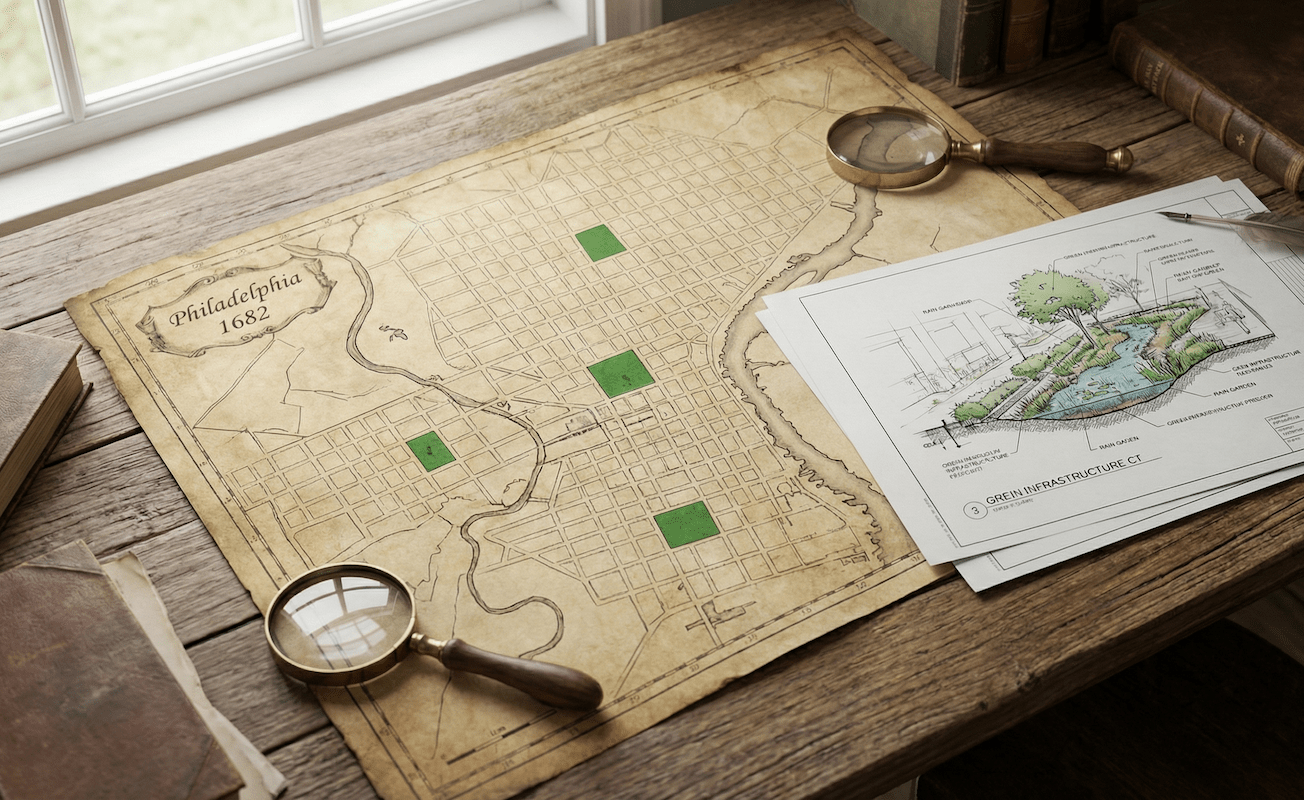
Working with Surveyor Thomas Holm, he mapped out a huge rectangular grid on the plain between the Delaware and Schuylkill rivers, and placed five public squares—one in each of its four quadrants (northeast, southeast, northwest, and southwest)—in its geometric center.
▲ The former "Centre Square" is now home to Philadelphia City Hall, which serves as the center of the city.
This structurally guaranteed that residents of any block would have lush green open spaces within walking distance. It is remarkable that what we would call "park accessibility" in modern urban planning terms was at the core of a master plan in the 17th century.
What is particularly noteworthy is the fact that these squares continue to function as important open spaces in the city even today, more than 300 years later.
- ● Centre Square: Current Philadelphia City Hall, a hub for government administration and transportation.
- ● Southwest (Rittenhouse Square): Jane Jacobs also compared four plazas and discussed the success or failure of urban parks, and this is one of the most successful urban parks in the United States. It harmonizes with the upscale residential area and serves as a place of relaxation for citizens.
- ● Southeast (Washington Square): A tranquil park with historical monuments.
- ● Northwest (Logan Square): Logan Circle is the gateway to the Museum District.
- ● Northeast (Franklin Square): It has been renovated as a family recreational facility.
This idea of "embedding green cores at equal intervals within the city" had a strong influence on the urban planning of Japan during the Meiji period, particularly in Hokkaido by the Hokkaido Development Commission. In the urban structure of Sapporo, the fact that Odori Park was originally designed as a "firebreak" resonates beautifully with Penn's ideas.
3. The Ideal Resurrected in Modern Times: The Impact of "Green City, Clean Waters"
However, history does not always proceed as planned. During the Industrial Revolution in the 19th century, Philadelphia was engulfed in a wave of rapid industrialization. To accommodate the rapidly increasing number of immigrants, the once-large garden lots were subdivided, and narrow row houses filled the back streets. Ironically, Penn's ideal of "low density" was lost, and the city was transformed into a high-density industrial city.
Now in the 21st century, Philadelphia faces serious urban infrastructure problems as a result of its densification.
Limitations of combined sewer systems and the CSO problem
The biggest problem was the aging "Combined Sewer System." This is an old system in which wastewater from homes and stormwater are collected and treated in a single pipe. This isn't a problem on sunny days, but once heavy rain hits, a large amount of water flows into the sewer pipes, exceeding their treatment capacity. As a result, "Combined Sewer Overflows (CSOs)" became frequent, in which untreated sewage mixed with stormwater overflows directly into the river.
After receiving a corrective order from the Environmental Protection Agency (EPA), the Philadelphia Water Department (PWD) was faced with two extreme choices.
(Traditional civil engineering method)
This method involves constructing a huge concrete storage tunnel deep underground to temporarily store overflowing water.
- ● Estimated cost: Approximately $10 billion or more
- ● Area of effect: Rainwater treatment only (single function)
- ● Disadvantages: The huge financial burden, long construction period, and benefits to citizens' lives are difficult to visualize.
(Innovative distributed processing)
This method involves increasing the amount of green space above ground, permeable pavement, and street trees, turning the entire city into a "sponge" that absorbs rainwater.
- ● Estimated cost: Approximately $2.4 billion(significant decrease)
- ● Area of effect: Flood control + heat control + scenery + improved land prices
- ● Features: A return to the original PEN philosophy. Environmental improvement in a way that is visible to the public.
A return from concrete to "earth and greenery": the triple bottom line
Philadelphia chose Plan B, which offered overwhelming cost-effectiveness and multiple benefits. This was the first ambitious 25-year plan in the United States, formulated in 2011."Green City, Clean Waters"is.
They have removed urban asphalt to create rain gardens, replaced parking lot pavement with materials that allow water to soak up, and planted greenery on building rooftops. William Penn's dream of "incorporating the functions of nature into cities" 300 years ago has been combined with the latest civil engineering and IoT technology to vividly revive it as a savior for modern cities struggling with financial difficulties.
Comparison of infrastructure investment costs
Grey Infrastructure
(Tunnel proposal)
Green Infrastructure
(Recruitment proposal)
*Comparison based on estimates from the Philadelphia Water Department
What's more, this change is not just about reducing stormwater treatment costs. The increased greenery has alleviated the heat island effect, and turning abandoned vacant lots into parks has improved public safety and increased real estate values. This is becauseEconomy, Society, EnvironmentIt is attracting attention from cities around the world as a successful example of the "triple bottom line" that simultaneously achieves these three benefits.
4. A suggestion for Toyako Town, Hokkaido: Landscape is the strongest infrastructure
Now, let's shift our perspective from North America to Hokkaido, Japan. At first glance, the large city of Philadelphia and the scenic tourist destination of Toyako Town may seem unrelated. However, the two cities share a deep commonality when it comes to the underlying challenge of "maximizing natural capital and maintaining sustainable communities."
"Degeneration" and greening strategies in an era of population decline
Today, Toyako Town and other regional cities in Japan are facing rapid population decline and aging. While a declining population means declining tax revenues, the cost of maintaining the extensive roads and sewer systems built during past periods of expansion remains unchanged. This is the "sponge" problem that puts strain on local finances.
What is effective here is the perspective of "replacement of infrastructure with green infrastructure," as demonstrated in Philadelphia.
For example, instead of simply leaving vacant lots (holes in the sponge) that have arisen due to an increase in vacant houses as vacant lots, we can regenerate them as green spaces (pocket parks) that allow rainwater to permeate. This will utilize the natural drainage function of the area and reduce the burden on infrastructure, rather than replacing and expanding aging sewer pipes. Reducing costs by cleverly "returning to nature" rather than "developing" - this could be said to be the most rational survival strategy for urban planning in an age of shrinking populations.
Redefining "landscape" as an economic asset
Furthermore, in the Toyako area, a conflict has emerged between the construction of large wind power plants and mega solar power plants and the preservation of the landscape. The importance of renewable energy is undeniable, but for tourist destinations, the "landscape" is not simply a backdrop, but an irreplaceable "production facility" that attracts inbound tourist spending worth tens of billions of yen annually.
William Penn's "Greene Country Towne" was successful because it allowed the grid (order/development) and green space (nature/conservation) to coexist under clear rules.
Even today, we need to be stricter about zoning, determining "where to develop and where to thoroughly protect," and reach consensus with a 100-year outlook. Protecting the "invisible infrastructure" of the landscape will ultimately increase local real estate values and create a sustainable economic cycle.
Conclusion: Urban design is a "reservation" for the future
The line William Penn drew in 1682 and the green space he laid out continue to protect Philadelphians from floods and provide a place to relax 340 years later. His plan may have seemed like a pipe dream to those at the time, but in the long run, it has proven to be a more cost-effective public investment than any other project.
The history and rebirth of Philadelphia teach us the following truth:"Cities are not in conflict with nature; they can only become resilient and sustainable by incorporating the functions of nature into their infrastructure."That is what it means.
Our goal at KAMENOAYUMI is not just to achieve immediate profits, but also to design the "relationships" with this land. The landscape rules we decide today, the tree we plant, and the vacant lot we leave are by no means wasted space. They are the very "assets" that our children 100 years from now will inherit.
Learning from history, implementing it with modern technology, and passing it on to the future - our work is part of this long relay.
Related Links
- Philadelphia Water Department: Green City, Clean Waters
- Ministry of Land, Infrastructure, Transport and Tourism: Green Infrastructure Portal Site
- Sapporo City: Green City Development
Inquiries and requests
We help solve local issues.
Please feel free to contact us even if it is a small matter.