〜The structural contradiction of existing residents being pushed out by rising land prices〜
*This article is based on official documents and statistical information as of February 2026.
First of all, when talking about modern urban development and urban planning, there is one extremely important topic that should be discussed most, yet is often overlooked: gentrification (the phenomenon of urban affluence).
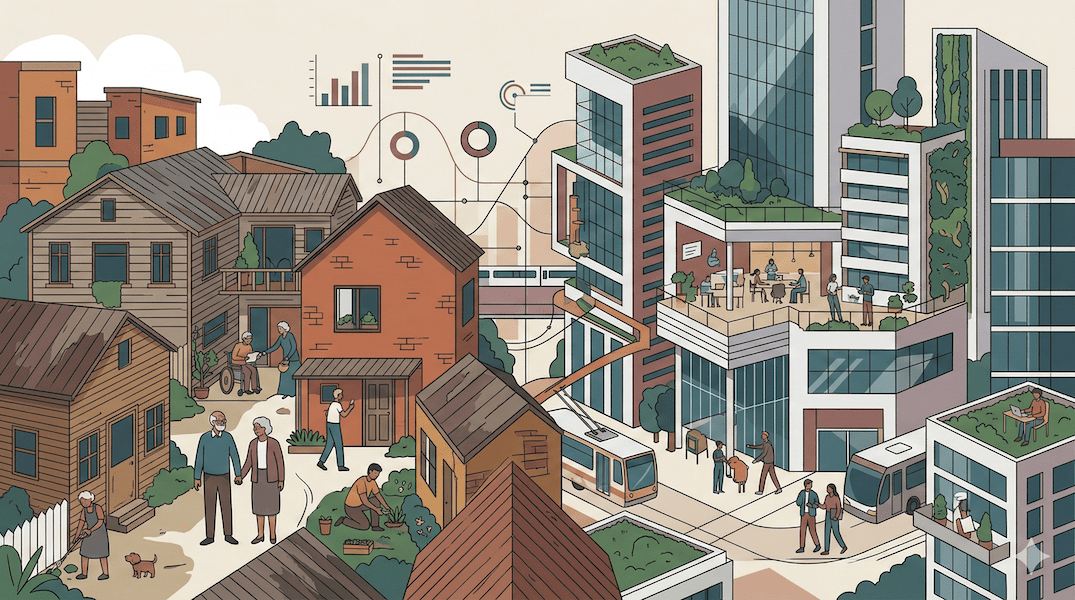
Simply put, gentrification refers to the phenomenon in which local real estate values soar as a result of urban redevelopment and improvements to its appeal, replacing longtime low-income and elderly residents with a new influx of high-income (wealthy) residents. Specifically, it is a structural change that inevitably occurs in the process of physically improving and modernizing the living environments of aging inner cities (run-down areas around the city center) and low-income areas through government-led urban development and an influx of private capital.
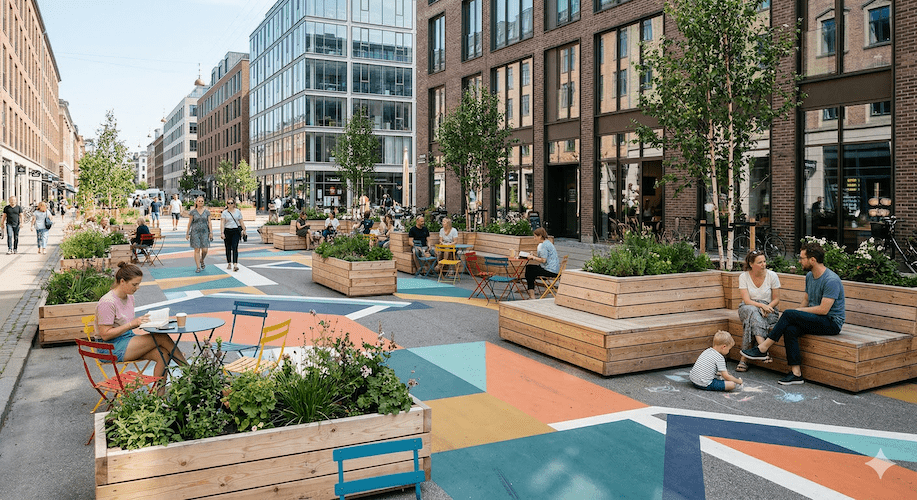
Of course, "improving the attractiveness of a town" through measures such as improving sidewalks and landscaping has extremely positive aspects, such as increasing the ROI (return on investment) of invested resources and revitalizing the local area. However, we cannot overlook the contradiction that this also poses: it causes a sudden rise in rents and property taxes, forcing existing residents and small local businesses that have supported the local economic foundation to move for economic reasons, resulting in serious "social exclusion."
Jane Jacobs, a prominent urban scholar, once said:"Cities have something to offer everyone because they are built by everyone."These are essential words. In other words, can capitalist spatial reconstruction, which benefits only a certain wealthy class and dismantles existing communities, really be called a sustainable ecosystem? In this article, we will explore, based on rigorous primary data, the historical background of gentrification and the lineage of "advocacy planning," as well as the current state of urban planning costs in the global market and the unique challenges facing Japan (particularly the Hokkaido area), and delve into next-generation urban strategies that balance the "maximization of capital" and "relationship design" required for the coming era.
1. The History of Gentrification and the Genealogy of Advocacy
The birth of a concept: "class conflict" in Islington, London
Looking back at history, the term "gentrification" was first coined by British sociologist Ruth Glass in 1964. She closely observed the process of class change in Islington, which was then a working-class neighborhood in London, where dilapidated Victorian terraced houses were purchased one after another by the middle class and renovated into luxury housing.
[Figure] Islington, London, where the term gentrification originated
"Gentry" originally referred to the traditional British landowners and lower aristocracy. Ruth Glass coined the term to capture the social irony of the transformation of living spaces for workers into consumption spaces for the wealthy, as well as the clear class conflict that lies within.
Top-down development led by government and global capital inevitably leads to social exclusion. The concept of "advocacy planning" was born in the United States as a powerful counter to this structural contradiction. Its historical starting point is a paper published by urban planner Paul Davidoff in 1965. He argued that "urban planning is by no means a value-neutral technique, and that planners, like lawyers, should advocate for the interests of socially disadvantaged groups," and had a major impact on the way urban development has been carried out since then. This philosophy did not remain merely an armchair theory, but was implemented in real urban spaces through the twin wheels of "education," "practice," and "organization," as follows:
At Hunter College in New York, Davidoff founded a new urban planning department, which sent its first graduates into the workforce in 1967 and, in 1970, renowned planner Robert Weaver joined the faculty, strengthening the school's training system for the next generation of planners committed to social justice.
Their activities did not remain limited to university classrooms. In 1969, Davidoff and others founded the Suburban Action Institute (SAI), which began practical activities to directly defend the housing rights of low-income people against exclusionary suburban development.
At that time in the United States, the Planners for Equal Opportunity (PEO) was formed against the backdrop of the civil rights movement as a national organization of innovative urban planners who fought against issues of racial discrimination and poverty. PEO itself was dissolved in 1974, but their strong network and philosophy of "reflecting the voices of socially disadvantaged people in the planning process" never died out and has been firmly passed down to the Planners Network, which continues to operate today.
Clear differences from similar concepts (comparison with redevelopment and regional revitalization)
As such, gentrification is not simply an improvement of the physical environment, but a phenomenon underpinned by clear power structures and the logic of capital. Here, we clarify the clear differences between gentrification and concepts such as "urban redevelopment" and "regional revitalization," which are frequently used in the context of urban development and are easily confused with it. The differences in their respective objectives, leaders, and impact on existing low-income groups (risk of exclusion) are as follows:
| concept | Main objectives and approach (leader) | Impact on low-income groups (exclusion risk) |
|---|---|---|
| Gentrification | The "enrichment phenomenon" occurs when real estate values in certain low-income areas rise and the residential class shifts from low-income to wealthy. [Leaders] Market principles, global capital, private developers |
[Very large/definite] Skyrocketing rents and property taxes inevitably lead to physical and economic exclusion (eviction) of low-income earners and the elderly. |
| urban redevelopment | A planned hard development policy to physically renovate aging infrastructure and buildings and improve the disaster prevention capabilities and economic efficiency of cities. [Leaders] Government, national government, major developers |
【large】 The purpose is to improve the environment, but the end result is a dramatic increase in land prices, which becomes an extremely powerful trigger for wealth creation. |
| Regional revitalization | This initiative aims to halt the decline of the region and restore economic strength and vitality to the community. It focuses on soft aspects such as creating a connected population and business support. [Leaders] Local residents, NPOs, local governments |
[Medium to small] If the residents are involved, it can be maintained, but if it relies on external capital such as "promotion of walkability," it will unintentionally lead to enrichment. |
2. Current state of the global market and financial challenges facing planning administration
Synchronicity and local price polarization
Today's gentrification is no longer a localized phenomenon limited to a few major cities, but is developing into a global housing crisis caused by the high mobility of global capital.Based on data from UBS and other sources over the past 10 years (2015-2025), real estate markets in major cities around the world are experiencing a significant divergence between real housing price growth and rent growth.
Changes in real housing prices in major cities around the world (2015-2025)
*Inflation-adjusted percentage change. Created from UBS data, etc.
Huge urban planning costs and burden on the public sector
Curbing market-driven rapid price hikes and gentrification and implementing appropriate urban planning for residents requires enormous management and implementation costs for local governments, but in reality, many local governments are facing serious financial shortages.
Regarding the cost of processing planning applications in England, based on the Planning Advisory Service's (PAS) 2012/13 benchmark (estimated at the time), national estimates indicate that it costs £379.1 million to process approximately 624,918 applications per year. Fee revenues at the time were £222.9 million, and it has been pointed out that a structural shortfall of £156.2 million, equivalent to 411 TP3Ts, could not be covered by fees. Furthermore, regarding the cost of developing Spatial Development Strategies (SDSs), the impact assessment (Annex 14) of the UK's Planning and Infrastructure Bill estimates that the public sector costs associated with preparing SDSs will range from £62.7 million to £147.2 million (with a central estimate of £101 million).
Furthermore, the UK's official development assistance (ODA), which funds international assistance including urban planning, fell from £14,479 million in 2020 to £11,423 million in 2021 (a decrease of £3.05 billion, or approximately 21.11 TP3T, from the previous year). If the reduction to 0.31 TP3T as a percentage of GNI were to be implemented, it is estimated that the budget size would be expected to shrink to approximately £9.2 billion in 2027, highlighting the global trend of shrinking public planning support resources.
3. The double-edged sword inherent in urban development policies and human resources
Proponents and opponents' perspectives
Government-led urban redevelopment and policies such as "walkable urban development" maximize the ROI of invested resources and act as a powerful stimulant to revitalize local economies. However, at the same time, they are a "double-edged sword" that can induce gentrification and destroy existing communities. We will compare and organize the specific advantages and disadvantages from each perspective.
1. Dramatic increase in real estate values and increased tax revenue:
Pedestrian-centered, comfortable spatial design will increase the attractiveness of the area, and rising land prices will directly lead to increased property tax and other tax revenues. This will provide valuable financial resources for the development of new public services.
② Attracting new businesses and creating high-value-added spaces:
This influx of people with high purchasing power will boost consumption prices throughout the region, creating a virtuous cycle (rebuilding the ecosystem) that will in turn attract job creation and investment from outside.
③ Modernizing aging infrastructure and improving the physical environment:
The influx of private capital will enable rapid progress in infrastructure development (removing utility poles, earthquake resistance, etc.) that would have been difficult to achieve through government funding alone, significantly enhancing the city's disaster prevention capabilities.
1) Social exclusion and deprivation of housing rights:
As the area becomes more attractive, rents and property taxes will rise, making it impossible for low-income earners and elderly people who have lived there for many years to maintain their homes. This is a problem that will decisively widen disparities within the area.
2) Homogenization of space and destruction of indigenous communities:
Profit efficiency takes top priority, resulting in the creation of uniform consumption spaces that can be found anywhere in the country, destroying indigenous cultures such as history, landscapes, and mutual aid networks among local people.
3) Increased financial burden on the government and social costs:
Infrastructure investment requires huge initial costs, intensifies conflicts of interest between development proponents and existing residents, and requires significant time and management costs to reach democratic consensus.
Ensuring diversity and expertise to support the plan
In order to overcome these conflicts and design appropriate relationships, diversity and support systems among planning personnel are essential. Regarding the racial composition of urban planning education in the United States today, according to the 2023 Annual Report of the Planning Accreditation Board (PAB), among graduate students (U.S. citizens and residents) enrolled in accredited programs, the proportion of African Americans (Black/African Americans) is 419 out of a total of 3,508 (approximately 11.9%). Ensuring this diversity is extremely important in order to reflect the voices of minority groups who are most susceptible to the impacts of gentrification.
Furthermore, in terms of the reality of planning support in the UK, Planning Aid England (PAE) reports that of its 244 registered volunteers, 621 TP3Ts are qualified, and volunteers with specialized knowledge are supporting citizens' rights. Meanwhile, as an example of urban development support in Japan, the 11th business report of the Machimirai Chiyoda Foundation shows that the budget for "dispatching urban development advisors" was 260,000 yen, but the final amount was recorded as 120,000 yen (execution rate of 46.21 TP3Ts), indicating that the project is being carried out within the framework of a limited budget.
4. Japan's unique structural challenges: transformation of Tokyo and the regions
Japan is experiencing extreme demand concentration and regional decline at the same time
In Japan, despite the country's overall population declining, there is a continuing influx of people from rural areas to Tokyo in search of economic opportunities, and the real estate market in central Tokyo continues to soar due to the influx of global money. Meanwhile, depopulation is progressing in rural areas, resulting in a large number of vacant homes with no one to take them. In this way, Japan's current situation is one in which two opposing phenomena are occurring simultaneously: gentrification in urban areas due to extreme demand concentration, and the collapse of infrastructure in rural areas.
Toyako Town faces community vulnerability and population decline
However, the wave of gentrification is certainly sweeping over regional cities as well. Let's take a look at the example of a regional city in Hokkaido, which is booming with inbound demand thanks to its abundant natural resources.
Toyako Town, which has a strong tourist resource in the form of a national park, is currently discussing an urgent policy issue of moving away from "pass-through tourism," where tourists simply stay for a short time and then pass through. To ensure the stable growth of the local ecosystem, the town is promoting "walkable tourism," which aims to shift to longer-stay tourism.
However, the decline in the permanent population that should underpin this policy is a serious bottleneck. According to data from the government's regional revitalization plan and other sources, Toyako Town's population was 8,442 as of the 2020 census, but by January 2024, just a few years later, it had plummeted to 8,068. Natural growth was recorded at minus 1.931 TP3T, and traditional collaborative frameworks such as neighborhood associations have weakened. With this weakened internal community cohesion, excessive development led by private capital will lead to skyrocketing land prices and property taxes, putting the remaining local residents at extreme risk of social exclusion.
Related Cases: Abnormal Rise in Land Prices in the Niseko Area and the Possibility of an "Accommodation Tax"
An extreme precedent where this concern has already become a reality is the neighboring Niseko area (Kutchan Town, Abuta District, Hokkaido). The Niseko Hirafu district is experiencing intense hyper-gentrification due to the influx of foreign capital, and in the 2024 land price announcement, land prices in residential areas (Niseko Hirafu 5-jo 3-chome, Kutchan Town) reached 165,000 yen/m2, an astonishing increase of 105,771 TP3T compared to the previous year, an abnormal rise of more than double.
This extreme rise in land prices has made it virtually impossible for local workers and service industry workers to pay rent, completely changing the residential demographics of the area. This has led to the collapse of the ecosystem, as the people who should be providing services are no longer able to live in the city.
As a practical solution to prevent this kind of capital-driven, disorderly gentrification, Toyako Town and other areas are discussing the introduction of an "accommodation tax." The essence of this approach is to create a system that collects funds directly and widely from outside visitors and then recycles them into improving the local ecosystem, without imposing an excessive burden on the declining existing permanent population in the form of increased property taxes and other taxes. This is truly an excellent example of "relationship design," which results in a win-win for both you and those around you.
Conclusion: Toward "relational design" that transcends the logic of capital
To put it simply, I predict that future gentrification and fluctuations in the housing market will bring about extreme polarization and a labor shortage crisis both globally and locally within the next few years. In Japan, too, driven by the weak yen and inbound demand, development will progress in certain areas at a level that completely exceeds the purchasing power of local residents, exacerbating the problem of service workers being unable to afford housing.
Therefore, when it comes to urban development promoted by government and business entities, we must never forget that behind the scenes of beautifully maintained cities and economic prosperity, we must consider who exactly is being excluded from those cities. Hasty development driven entirely by the logic of capital may bring about a temporary increase in tax revenue, but ultimately it destroys the unique history and culture of the area and deteriorates the city into a homogenous, unattractive consumer space. As US advocacy planning has historically shown, it is essential to always represent the rights of the socially disadvantaged and adopt an inclusive perspective.
What local governments and urban development experts will be strongly required to do in the future is to incorporate a "decommodification" perspective into their systems, protecting not only the value of homes and living spaces as "products" but also their role as the foundation of communities, even as they face the enormous administrative costs of urban planning. The key to the success or failure of next-generation urban development is a sense of balance that builds a gradual and sustainable "relationship design" within the community, while protecting the socially vulnerable from sudden rises in land prices, such as through a system that utilizes an accommodation tax to recycle external funds within the community. The true value of a city lies not in how tall the buildings are, but in how diverse a population it can continue to live there.
Related Links
- Ministry of Land, Infrastructure, Transport and Tourism: Town development and urban planning
- Planning Accreditation Board (PAB) Data
Inquiries and requests
We help solve local issues.
Please feel free to contact us even if it is a small matter.