〜The "functionalism" of CIAM (Congress of Modern Architecture), which dominated urban planning in the 20th century, and its ideals and limitations〜
*This article is based on survey information and published data as of February 2026.
Cities must be containers that rationally accommodate human activity.
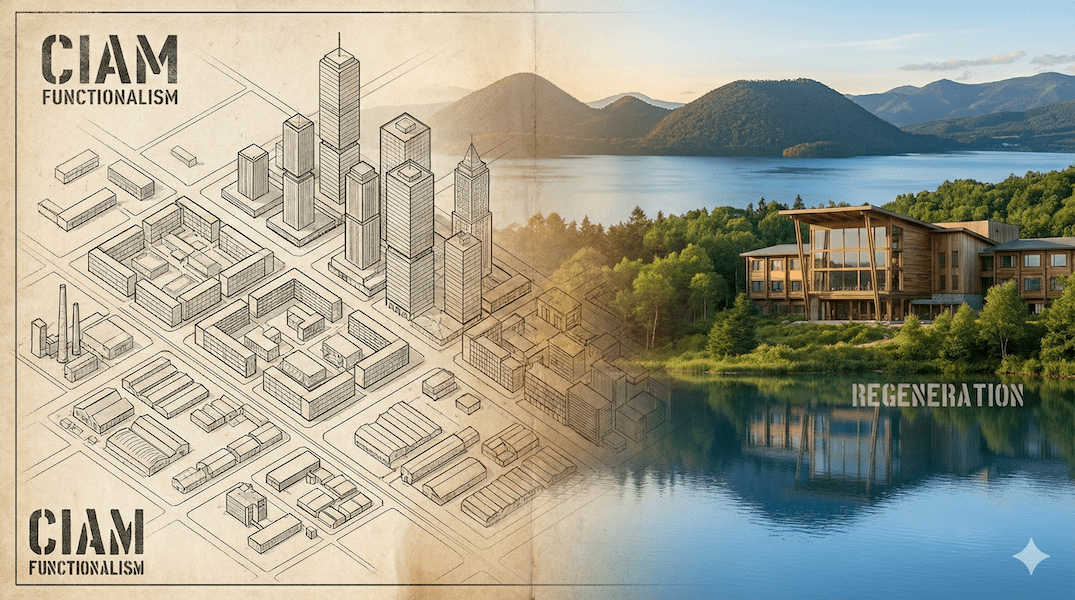
Early 20th-century architects had this idea in mind when they witnessed the chaos, overcrowding, and poor hygiene that had plagued cities since the Industrial Revolution. They dreamed of cities that functioned efficiently, without waste, and in a hygienic manner, just like precision machines.
The ideological pillar of this movement was the International Congress of Modern Architecture (CIAM) and the Athens Charter it adopted. This document continues to have a decisive influence on urban planning around the world to this day, particularly on new town development and national land planning in Japan after the war.
However, now that a quarter of a century has passed since the 21st century, we are entering the uncharted territory of "population decline" and "shrinking cities," the polar opposite of the paradigm of "population explosion" and "unlimited growth" that CIAM assumed. Zoning (separation of functions), once considered rational, is now being reconsidered as a breeding ground for new urban problems, such as long-distance commuting due to the separation of work and residence, and the weakening of community.
This paper delves deeply into the theory of CIAM, the origin of modernist urban planning, and analyzes how it has undergone unique transformations within Japan's legal system. It then focuses on Hokkaido, once at the forefront of Japan's modernization, and Toyako Town, which is currently facing a serious population decline. There, a quiet yet powerful process of "urban development in an age of decline" is underway, in which the stock left behind by modernism is "edited" and new value is woven.
1. The Legacy of CIAM: The Ideal and Reality of the "Functional City" Envisioned by the Athens Charter
Led by the master of modernist architecture, Le Corbusier, and armed with the theory of Sigfried Giedion and others, CIAM (Congrès International d'Architecture Moderne) continued its struggle to elevate architecture from a mere aesthetic object to a "means of social change" from its foundation in 1928 until its dissolution in 1959.
Urban surgery using the "four functions"
The Athens Charter, adopted at the Fourth Congress held on board the Mediterranean passenger ship Patris II in 1933, is one of the most influential documents in the history of urban planning. In it, they analyzed the extremely complex activities of cities by reducing them to the following four functions:
The "Athens Charter" referred to in this article refers to the version edited and published by Le Corbusier in 1943, based on the results of the deliberations of CIAM IV in 1933.
[Four functions proposed by the Athens Charter]
- ① Dwelling
A quiet living space with plenty of sunlight and ventilation. A sanctuary isolated from major roads and factories. - ② Working
Places for production activities will be concentrated into efficient industrial zones and business districts, and separated from residential areas by green belts. - ③ Recreation
Places of rest for the reproduction of the workforce: parks, sports facilities, and open spaces within cities. - ④ Transportation
This is an artery that connects the three functions above. It completely separates pedestrians and automobiles (pedestrian-vehicle separation) and enables high-speed travel.
The core of the Athens Charter was "functional segregation," which clearly separated these four functions spatially. At the time, European cities were home to a mixture of factories and residential buildings, and the soot and noise were damaging to the health of citizens. In response to this, CIAM proposed a very clear, surgical prescription: "Don't mix, separate."
This idea exerted tremendous influence during the post-war reconstruction period. High-rise residential complexes, industrial parks, and the highway networks connecting them can all be said to be the embodiment of the Athens Charter. However, as a result of over-purifying functions, it also created urban spaces lacking in vitality, such as business districts that become deserted at night and commuter towns that become ghost towns during the day.
2. The Truth about Japanese Zoning: A System of Inclusion, Not Exclusion
Japan has also used the CIAM-style zoning method, the "use zoning system," as the backbone of urban development since the enactment of the New City Planning Act in 1968. However, compared to Western systems, the Japanese system has an extremely unique feature: its "tolerance of mixed use."
Western "exclusionary" vs. Japanese "accumulation"
Euclidean zoning in the United States is explained as a system based on the separation of residential, commercial, industrial, etc. This is close to the idea of functional separation in the Charter of Athens, and while it aims to purify the living environment, it has also been one of the causes of the sprawl phenomenon, which makes it difficult to live without cars.
On the other hand, Japan's zoning system is designed by listing prohibited uses for each building, and even residential areas are permitted to have stores and other businesses under certain conditions, which results in a tendency for mixed use to occur. This system has created the convenience and diverse charm that is unique to Japanese cities.
The table below provides a comparative analysis of the degree of "functional mixing" in Japan's major land use districts.
| Classification of zoning areas | Main features and purpose | Tolerance for intermingling (this is Japanese) |
|---|---|---|
| Low-rise residential (Type 1 and Type 2 low-rise buildings, etc.) |
An area designed to protect the good environment of low-rise housing. The most strict regulations. |
Surprisingly tolerant Elementary and junior high schools, clinics, and multi-purpose residences (such as homes and bakeries) can be built. Convenience stores are also allowed if they are Type 2 properties. |
| Mid- to high-rise residential buildings (Type 1, Type 2 mid-rise, etc.) |
A mid- to high-rise residential area centered around apartment buildings. A receptacle for urban housing. |
Emphasis on convenience Supermarkets, hospitals, universities, etc. can be found in the same area. Daily life can be easily completed within walking distance. |
| Residential/Semi-residential (Type 1, Type 2 residence, etc.) |
A mixed residential, commercial and business area. An area where work and home are close together. |
Gateway to Chaos Hotels, pachinko parlors, karaoke parlors, large stores, etc. are permitted to be built next to residential buildings. |
| Commercial system (neighborhood businesses and commercial establishments) |
The core of the city, home to banks, movie theaters, and department stores. The floor area ratio is high. |
Housing is also OK Even in commercial areas, the construction of apartment buildings is not prohibited, which makes it possible to live in the city center. |
| Industrial (Semi-industrial, industrial, technical college) |
Area for factories. There is a risk of noise and odor. |
Scenery of a local factory Residential construction is permitted in areas other than the "industrial zones," creating a downtown vibe with small factories and apartment buildings side by side. |
*In 2018, a "rural residential area" was added, aiming to harmonize agriculture and residential areas, bringing the total to 13 types.
As can be seen from this table, Japan has prioritized "convenience of living" and "freedom of land use" over "purity of living environment." This deviates from the ideals of the Athens Charter, but as a result, Japan has succeeded in creating unique urban spaces where convenience stores and vending machines are everywhere, streets are well-lit at night, and people can live on foot (high walkability).
3. Toyako Town, Hokkaido: The Frontline of "Degeneration" and Current Status Data
While modernist urban planning in Japan was premised on expansion and growth, Hokkaido is currently in a serious phase of decline and shrinkage. We will look at this reality using the example of Toyako Town, one of Japan's leading tourist destinations.
Countdown to a society with a halved population
Toyako Town is located at the heart of Shikotsu-Toya National Park and is visited by many tourists throughout the year, but the town's permanent population is continuing to decline. Based on estimated data from the National Institute of Population and Social Security Research (NSSR) and the town's future vision, we visualize the town's demographics.
Toyako Town's future population estimates (2020-2050)
*Source: Created based on town-published materials such as "Toyako Town Population Vision" (the estimate by the Institute for Social Sciences is one of the reference sources). The rate of decline is based on 2020 (100%).
By 2050, the population is predicted to decrease to roughly half of what it was in 2020. This means that the maintenance costs (per capita) of infrastructure such as roads, waterworks, and bridges will double. It is clear that the CIAM model of "continuously expanding cities" will lead to financial collapse in this situation.
Geographical features of Toyako Town as seen on Google Maps
Toyako Town has a unique topography, containing Lake Toya, a caldera lake, and Mount Usu, an active volcano. The town is divided into the Toyako Onsen area, which is a tourist hub, the Abuta area, where administrative functions are concentrated, and the Toya area, where agriculture is carried out, and the challenge is how to network these areas.
4. The Magic of Architectural Editing: The Challenge of WE Hotel Toya
What is needed in a society with a declining population is not the construction of new buildings, but reinterpreting existing buildings and changing their value (re-editing). Toyako Town is home to an architectural project that could be said to be symbolic of this.
Reincarnation of "nursing home" into "luxury hotel"
WE Hotel Toya, which opened in 2018, is a beautiful lakeside resort hotel, but its predecessor was an existing nursing home on the shores of Lake Toya. The facility was closed due to a declining birthrate and aging population, and the facility's aging was reborn as a tourist facility with the help of the private sector.
The previous building was an inorganic "box" made of reinforced concrete based on functionalism. The space, designed to suit the function of a nursing home, was efficient, but isolated from the rich natural environment that surrounded it. This can be said to be a typical example of the "Athens Charter"-style separation of functions.
The design of the renovation was overseen by world-renowned architect Kengo Kuma. Rather than demolishing the building, he chose to cover the concrete casing with wood (cedar logs) and fabric (pleated drapes). This method, which blurs the building's outline and blends it with the forest and lake, is a practical example of Kuma's "defeating architecture," and a gentle antithesis to functionalism.
Preserving the memory of a place
The significance of this project is not limited to a simple change of use (conversion). It transforms a welfare facility, a "cost center (a place where tax money is spent)," into a tourist facility, a "profit center (a place where foreign currency is earned)," while reducing the environmental impact by reusing the building's framework.
In Japan's urban planning, which has been dominated by repeated scrap-and-build practices, the spirit of "making the most of what we have" is becoming a new standard in this era of shrinkage.
5. Looking to 2050: Beyond the Athens Charter
The Hokkaido Economic Federation and other organizations have set out a vision for Hokkaido 2050, which positions Hokkaido as a pioneering region in solving problems. Toyako Town's efforts can be said to be a leading example of this.
From "separation of functions" to "integration of functions"
The 13th land use zone, the "Rural Residential Zone," established in 2018, signals a turning point in urban planning. This zone actively allows for the mixing of agricultural facilities and residential areas, making it easier to set up farm stands and farm restaurants.
The Athens Charter strictly separated "living (residential), "working (agriculture)" and "play (tourism)" but these are once again beginning to overlap in the same place. New lifestyles such as workcation and dual-base living are also accelerating this trend toward "functional integration."
The "functional city" that modernism once aimed for was to break down and reorganize elements. However, the "truly functional city" of the future will likely be one that organically connects these broken down elements and reorganizes communities that can feel rich even in the face of a declining population.
Conclusion: Hope for "editing" beyond degeneration
The "functional city" envisioned by CIAM was a brilliant solution to the social challenges of the 20th century. However, answers change with the times. In Japan, where the population is declining and aging, and in Hokkaido in particular, it is no longer possible to paint an ideal city on a blank canvas.
The question we face today is how to deal with the enormous concrete legacy left behind by our ancestors. Toyako Town's efforts prove that even if the population declines, unprecedented abundance can be created by "editing" the existing stock with wisdom and the power of design.
Breaking free from the spell of the Athens Charter, recombining functions and coexisting with nature, the seeds of this "postmodernism" are beginning to emerge on the lakeside of the northern land.
Related Links
- Toyako Town Official Website | Urban Development and Planning
- Ministry of Land, Infrastructure, Transport and Tourism | Overview of the City Planning System (Use Zones)
- Ministry of the Environment | Shikotsu-Toya National Park
Inquiries and requests
We help solve local issues.
Please feel free to contact us even if it is a small matter.