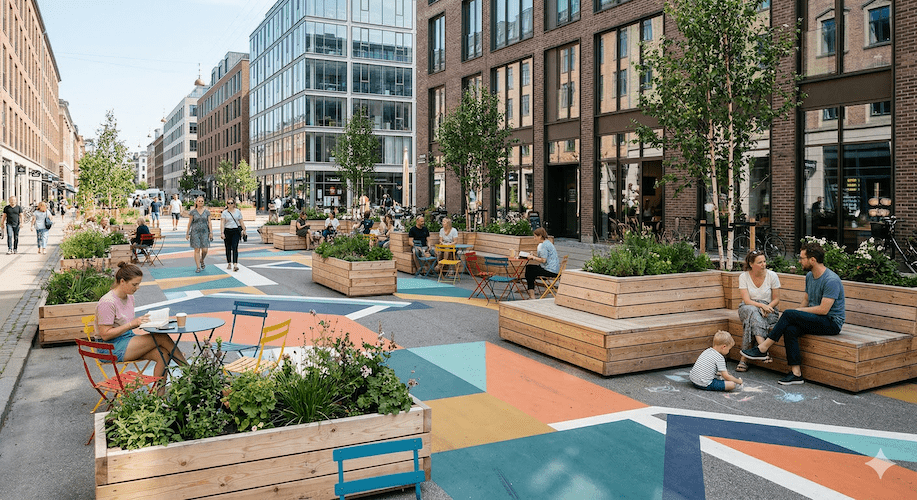
〜Modern-day gentrification measures〜
*This article is based on information as of February 2026.
When we hear the terms urban planning and community development, we tend to subconsciously believe that "engineers and government officials with advanced expertise will be able to derive optimal solutions from a neutral standpoint for the benefit of society as a whole (the public)." However, in the complex social systems of reality, is there really such a thing as a single "public interest" that everyone can agree on? Large economic benefits for one group can often result in fatal costs for other groups (especially the socially vulnerable), or the destruction of living environments that have been cultivated for many years.
Jane Jacobs, the American journalist and influential figure in urban planning, once said:
"Cities have the capability of providing something for everybody, only because, and only when, they are created by everybody."
This illusion of "objective and rational planning" was particularly shattered in the United States in the 1960s, when large-scale infrastructure development and highway construction carried out in the name of Urban Renewal ended up physically dividing and destroying minority neighborhoods and low-income communities.
It was urban planner and lawyer Paul Davidoff who posed a groundbreaking question that shook the industry to its core, challenging this dominant paradigm: "Who speaks for the poor, the disenfranchised, and minorities?"
The "advocacy planning" he proposed in 1965 explicitly rejects the idea of experts acting as value-neutral engineers. Instead, it was born as a practical and pluralistic planning theory that intentionally and professionally represents the interests of the socially disadvantaged and the "voiceless," and directly reflects their compelling rights and claims in the actual urban planning process.
This article provides a comprehensive analysis of this radical and fascinating paradigm of advocacy planning, based on a variety of evidence, from its historical evolution to a comparison of international aid systems and budgets based on primary sources, to the contemporary anti-gentrification movement, and its specific applicability to Japan's regional cities, which are struggling with the waves of depopulation, aging, and tourism development.
1. The Birth of Advocacy Planning: A Paradigm Shift and Historical Changes
Denial of the "public interest" and the introduction of pluralism
The dominant approach to urban planning from the end of World War II through the early 1960s was what was called "scientific, objective, or rational planning." This methodology sought to derive the "single correct answer" for society as a whole through systematic cost-benefit evaluations and risk assessments. However, Davidoff sharply criticized this approach, arguing that while it pretended to be "objective," it in fact merely reproduced results that favored existing power structures, the wealthy, and large-scale developers.
In contrast, advocacy planning recognizes that there is no single correct answer in planning, and that there are multiple conflicting interest groups in society.PluralismThe fundamental premise of the theory is therefore that the planner's crucial role is to redefine the "clients" they should support. This positions "advocates" with the same professional knowledge and political skills as official government planners and well-funded developers as those who should stand on the side of and work for specific neighborhoods and special interest groups.
From its origins in the 1960s to its penetration into government (equity planning)
Specifically, this theory gained a firm footing with the publication of Paul Davidoff's article "Advocacy and Pluralism in Planning" in the Journal of the American City Planning Association in 1965. This innovative philosophy quickly spread to the field of education. Ruth Weintraub, Dean of Hunter College of the City University of New York, invited Davidoff to found a new urban planning program to train socially conscious professionals. The program graduated its first class in 1967.
▲Hunter College, City University of New York, played an important role as an educational base for advocacy planning.
Furthermore, in 1970, Dr. Robert C. Weaver, the first African-American U.S. Cabinet Secretary (Secretary of Housing and Urban Development), joined the school as a professor, further strengthening its educational base.
This movement also expanded into legal battles and organizing. In 1969, Davidoff founded the Suburban Action Institute (SAI) to legally challenge exclusionary zoning in suburban areas (land use regulations that exclude low-income residents and minorities). After the first national organization of advocacy planners, the Conference of Planners for Equal Opportunity (PEO), dissolved in 1974, its spirit and legacy was carried on by the Planners Network, founded in 1975, which continues to function as a coalition of progressive planners today.
In the 1970s, this approach of outside protest was applied to the interior of government. Norman Krumholtz, a student of Davidoff's, served as planning commissioner for the City of Cleveland and advocated for using administrative power and budgets directly to promote social justice."Equity Planning"He has developed his theory into a groundbreaking method for advocating for the weak from within public institutions.
| Name of the planning approach | Expected major clients | The roles and characteristics required of a planner |
|---|---|---|
| Rational Planning (Rational Planning) |
The Public Interest | Value-neutral engineers who pretend to be objective but tend to produce results that favor existing power structures. |
| Advocacy Planning (Advocacy Planning) |
the poor, minorities, and neighborhood residents | "Advocates" who specialize in representing specific groups, affirm political bias, and create programs to counter government. |
| Equity Planning (Equity Planning) |
All interest groups (especially vulnerable groups) | "Insiders" within government agencies use public authority and budgets to directly correct inequalities. |
| Communication Planning (Communicative Planning) |
All stakeholders | A facilitator of dialogue, who does not take sides and fight, but rather promotes the process of consensus building itself. |
2. International comparison of support systems for the vulnerable: Institutionalized expertise and overwhelming budget disparities
No matter how excellent the concept of advocacy planning may be, it is nothing more than a pipe dream without the capital (budget and human resources) to put it into practice. Overseas, particularly in the UK, large amounts of public budget and highly skilled expert organizations are invested in systems to support the participation of vulnerable people in planning. In contrast, when we look at the current situation in Japan, the actual scale and structural disparities in the support system are extremely serious.
Data reveals an unbridgeable gap in urban development support between Japan and the UK
In the UK, there is a powerful support organization called Planning Aid England (PAE), run by the Royal Town Planning Institute (RTPI). According to official annual reports, as of 2020, there were 244 registered volunteers, of which 621 TP3T (151) were qualified accredited planners. This means that an infrastructure has been established at the national level in which highly specialized practitioners are systematically involved in supporting the vulnerable as pro bono (unpaid activities for the public good) organizations.
The difference is even more striking when we look at the financial side. According to a national estimate of the cost of processing planning applications in England at the time, based on the Planning Advisory Service's (PAS) 2012/13 benchmark, it cost approximately 379.1 million pounds (379.1m) to process approximately 624,918 planning applications per year. What is particularly noteworthy is the fact that the enormous cost of approximately 156.2 million pounds (156.2m, 41% in total), which could not be covered by fee income from applicants at the time (approximately 222.9 million pounds), was effectively "burdened by the public." This shows how public funds are invested in the entire spatial planning system, indirectly running the system for the entire society.
| Comparison items | [UK] Infrastructure such as Planning Aid England | [Japan] Examples of local government urban development support systems |
|---|---|---|
| Scale of experts and volunteers | There are 244 registered volunteers (as of 2020), of which 621 TP3T are qualified certified planners. Highly skilled practitioners are systematically involved as pro bono volunteers. | The number of "advisors" registered by each local government is usually limited to a few to a dozen people. |
| Examples of supporting public costs | In the PAS estimates (2012/13), of the total cost of processing planning applications (£379.1m), £156.2m (41%) that could not be covered by fees was classified as the public share. | Machimirai Chiyoda (11th term): Budget for the city planning advisor dispatch project: 260,000 yen. Final amount: 120,000 yen (execution rate: 46.2%). |
[Graph] Estimated funding sources for the cost of processing planning applications in England (based on the 2012/13 benchmark)
(approximately £222.9 million)
(approximately £156.2 million)
*While the UK allows for huge public burdens (cost absorption) for the entire planning processing system, Japan's community support budget at the grassroots level (for example, Chiyoda Ward's final settlement amount is 120,000 yen) remains extremely small.
At the same time, the trend toward supporting vulnerable groups in international development is facing strong headwinds. Total UK Official Development Assistance (UK ODA) fell from approximately £14.479 billion in 2020 to approximately £11.423 billion in 2021, a significant decrease of 21.11 TP3T (approximately £3.054 billion) compared to the previous year. Furthermore, according to Library of Congress data, if the TP3T/GNI ratio is reduced to 0.31, it is estimated that this will fall to a historic low of approximately £9.2 billion by 2027. We must not overlook the solemn fact that a wave of serious funding shortages is sweeping across the entire global system for supporting vulnerable groups.
3. Light and Shadow: The Pros and Cons of Advocacy Planning
In the highly specialized and difficult field of urban planning, this approach of translating the voices of vulnerable people into legal and technical language is a powerful tool for generating leverage, but its implementation also poses deep structural challenges and ethical dilemmas.
Empowerment and making rights visible through "translation":
The greatest effect is that, through the intervention of planners, the vague anxieties and earnest voices of local residents who lack specialized skills are translated into an "official language" that can be used to challenge the government. By sublimating simple dissatisfaction with daily life into elaborate rhetoric that pursues "residents' rights" and "legal obligations of the government," it has the power to logically move the government.
Expanding democratic options through counter-planning:
By presenting a community-led "counterplan" (such as the West Harlem Plan or the UNITY Plan) with expert backing in opposition to the "single official plan" presented by the government or large corporations, a check function is put in place to prevent unilateral, top-down development and the organizational foundation of the residents is permanently strengthened.
The dilemma of "excessive reliance on experts":
The biggest academic criticism is that outside experts tend to speak too fluently "on behalf of" local residents, which risks stifling the buds of spontaneous grassroots movements that should be taking root in the local community.
Lack of diversity within the profession (distorted representation):
The very makeup of urban planning professionals presents challenges. Extreme bias has been pointed out in the past, and a 2023 report from the Planning Accreditation Board (PAB) shows signs of improvement, with African Americans accounting for approximately 11.91 TP3T (419 out of 3,508) of graduate students in accredited programs who are U.S. nationals or residents. However, ethical doubts remain about whether majority planners can completely eliminate unconscious bias.
4. Potential in a specific area: The perspective of Toyako Town, Hokkaido, which is caught between depopulation and tourism
The concepts of citizen participation and advocacy, which originated in the United States, have evolved over time and become indigenous in Japan as the "Machizukuri" movement, which respects the history and knowledge unique to each region. In particular, in regional cities in Hokkaido, where rapid population decline and super-aging are occurring simultaneously, it is necessary to precisely update the definition of "client" to suit the current local context and design a new ecosystem (circulatory structure).
Redefining the "Modern Local Vulnerable" and the Rural Version of Gentrification
The client image of "slum poor and minorities" targeted in 1960s American advocacy planning takes on a completely different guise in Toyako Town and Toyoura Town in Hokkaido. Specifically, these include "those with mobility restrictions who have lost access to public transportation such as bus routes (the transportation-vulnerable)," "single elderly households who have difficulty shoveling snow or doing daily shopping," and "non-regular workers who support the tourism industry, a key industry." It's not uncommon for municipalities in Hokkaido's depopulated areas to have an aging rate of over 40%-50%, and the proportion of these "residents who find it difficult to speak up on their own" directly correlates to the potential scale of advocacy in the area.
Furthermore, while the recent surge in inbound tourism and large-scale resort development funded by outside capital has brought valuable tax revenue and employment to the region, it has also caused land and commodity prices to soar and changed living environments. This phenomenon can be described as a "rural version of gentrification," indirectly oppressing local residents who have lived quietly for many years. The existence of an "advocate (strategic partner)" who can accurately balance the interests that arise between government and businesses seeking to maximize regional capital by promoting tourism policies and local residents seeking to maintain a peaceful lifestyle, and who can design a win-win relationship for both parties, will be a solution to the inevitable bottlenecks in future regional management.
Disaster prevention plans are a lifeline for geopark-designated areas
Toyako Town is designated as part of the Toyako-Usuzan Geopark, and behind its beautiful natural scenery, it is in an environment where the risk of natural disasters due to active volcanic activity is constantly at hand.
▲The area around Toyako Town in Hokkaido, where the risk of volcanic activity from Mount Usu coexists with abundant tourist resources.
In such areas, infrastructure development based on rational planning that simply prioritizes cost-effectiveness and efficiency is not enough. For elderly people who have difficulty evacuating on their own in the event of a disaster, and for people with disabilities, detailed evacuation plans (disaster prevention urban development) that take their perspectives into account based on the international Convention on the Rights of Persons with Disabilities (CRPD), the advocacy process of accurately representing the voices of those involved and incorporating them into official planning drawings is literally a lifeline for residents.
5. Conclusions and Outlook: Transforming to a Resilient Society
The costs of institutionalizing pluralistic community planning.
The cost of incorporating diverse voices in urban planning is by no means cheap. According to the appendix to the Impact Assessment of the UK's Planning and Infrastructure Bill, the cost to the public sector of formulating a Spatial Development Strategy (SDS) is estimated at approximately 62.7 million to 147.2 million pounds (median estimate: approximately 101 million pounds), and formulating a wide-ranging plan requires a huge investment. However, the trend of society as a whole bearing the burden (budgeting) of resources that allow citizens to formulate their own plans and propose them to the government is predicted to become an irreversible standard for planning in developed countries.
Conclusion: The art of listening to the silence hidden in perfect blueprints
Urban planning and city development are not simply "value-neutral sciences" that arrange physical buildings, roads, and infrastructure in a beautiful and rational manner. They are highly political and ethical processes that determine who benefits and who is excluded within the limited resources of space, budget, and time. The biggest question that Paul Davidoff's advocacy planning poses to us today is,"Whose voice is this beautiful plan that seems perfect not listening to?"This is nothing but a cold-hearted perspective.
What we need to consider is not simply blindly accepting the rational plans presented by government officials and experts, but the importance of a process for carefully translating the silence of oppressed local residents and minorities into "legal and technical claims for rights." Even in a region like Toyako Town in Hokkaido, which has a unique natural environment and tourist resources, amid the conflict between the pursuit of economic growth (maximization of capital) and the protection of residents' livelihoods, a shift to "pluralistic urban development" that places the voices of the most vulnerable at the center is the only key to designing a circular structure for a society that is truly resilient and sustainable.
Related Links
- City Planning Institute of Japan
- Ministry of Land, Infrastructure, Transport and Tourism: Urban Development in Local Cities
- Planners Network
Inquiries and requests
We help solve local issues.
Please feel free to contact us even if it is a small matter.