〜Unraveling the challenges facing modern regional cities and prescriptions for the future through historical conflicts with large-scale development〜
*This article is based on information as of February 2026.
"Because a city is created by everyone, it can offer something to everyone."
These are the words of Jane Jacobs, the civil rights activist and journalist who brought about one of the most fundamental paradigm shifts in urban planning of the 20th century.
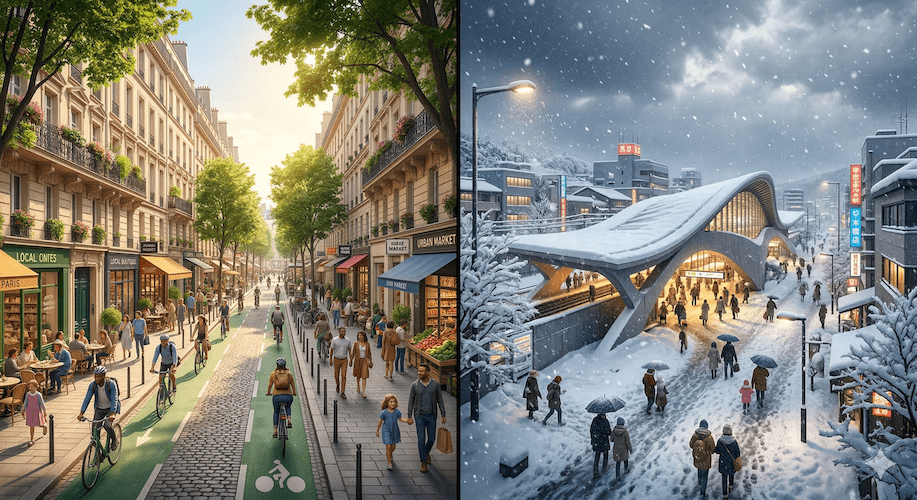
Is the city we live in every day really a gigantic, sophisticated machine drawn by a few experts on blueprints? Or is it a living ecosystem that grows as diverse people and economic activities intertwine in complex ways?
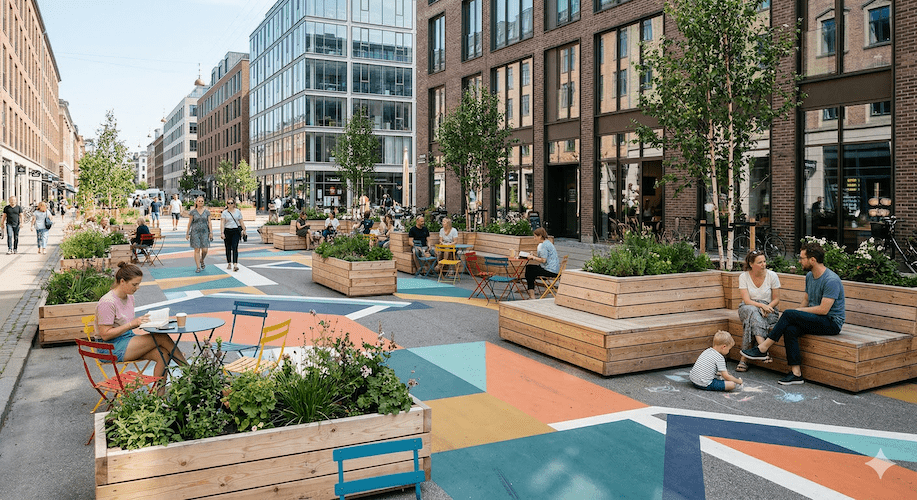
In modern society, the spatial challenges we face are becoming more complex than ever before, such as the serious population decline and vacant house problems in regional cities, and the aging infrastructure in urban areas. When confronting these challenges, we often face the debate of whether to pursue "top-down large-scale development (scrap and build) that requires huge investment of capital," or "urban development led by local residents that makes use of existing stock."
In fact, the "modern urban planning (modernism)" that Jacobs so sharply criticized originated in 1920s Germany (during the Weimar Republic) with an extremely innovative and noble, "human-centered" ideal to save workers from poor living conditions. However, over time, it became linked to huge capital and transformed into a "meat cleaver" that divided local communities.
This article explores the history of modern urban planning's inherent "light" (Berlin's innovative housing policy) and its transformation into massive infrastructure development (New York's LOMEX plan and Jacobs's struggle). It also explores Japan's unique "history of public housing" and the often-misunderstood "30-year lifespan of Japanese wooden houses," providing a multifaceted look at the future of "truly sustainable urban development" that is required in the coming era.
1. The "Light" of Modern Urban Planning: Innovative Housing Policy in Weimar Germany
Modern urban planning techniques such as zoning and superblocks, which Jacobs would later criticize, were not originally designed to destroy cities. Their origins lie in solving the enormous urban problems of the 19th and early 20th centuries.
Mietskaserne (rented barracks) - misery and the spread of disease
Following the Industrial Revolution, large cities such as Berlin experienced a rapid population influx, resulting in the proliferation of high-density housing complexes for workers known as "Mietskaserne" (rented barracks). As noted in historical museum documents, these buildings were built in multiple layers around a courtyard, and compared to the front building (Vorderhaus) facing the main street, the rear building (Hinterhaus), which was set back, had significantly worse lighting, ventilation, and sanitary conditions. The overcrowded and unsanitary conditions of many workers crammed into one small room made it a life-threatening living environment where diseases, including various infectious diseases, could easily spread.
Article 155 of the Weimar Constitution and the Hauszinssteuer (Housing Interest Tax) financial scheme
In order to overcome this dire situation, the Weimar Constitution, enacted in 1919, clearly stated in Article 155, Paragraph 1, "To everyone healthy housing...", demonstrating the state's commitment to guaranteeing the living environment of its citizens.
What is particularly noteworthy here is the mechanism by which the funding was secured. The hyperinflation that hit Germany after World War I wreaked havoc on the economy, but it also had the by-product of essentially wiping out the mortgage debts of landlords who had borrowed money to build apartment buildings before the war. In 1924, the German government introduced the "Hauszinssteuer" (housing interest tax), which collected "unearned income"-like profits from property owners whose debts had essentially been wiped out by this inflation. This enormous tax revenue was then vigorously circulated as funds (low-interest loans, subordinated mortgages, etc.) for the construction of new public housing. This is an impressive example of successful urban policy through capital reallocation.
Light, air, sun, and the colors of Bruno Taut
Architects, who had ample funds, built one modern housing complex after another under the slogan of providing "light, air, and sunshine" to everyone. The concept of "Existenzminimum" (minimum dwelling), which functionally designs the minimum amount of space necessary for living, later became a global standard at CIAM (International Congress of Modern Architecture: held in Frankfurt in 1929, etc.). Also in the 1920s, Margarete Schütte-Lihotzky designed the "Frankfurt Kitchen," the origin of the modern system kitchen, which maximized the efficiency of circulation.
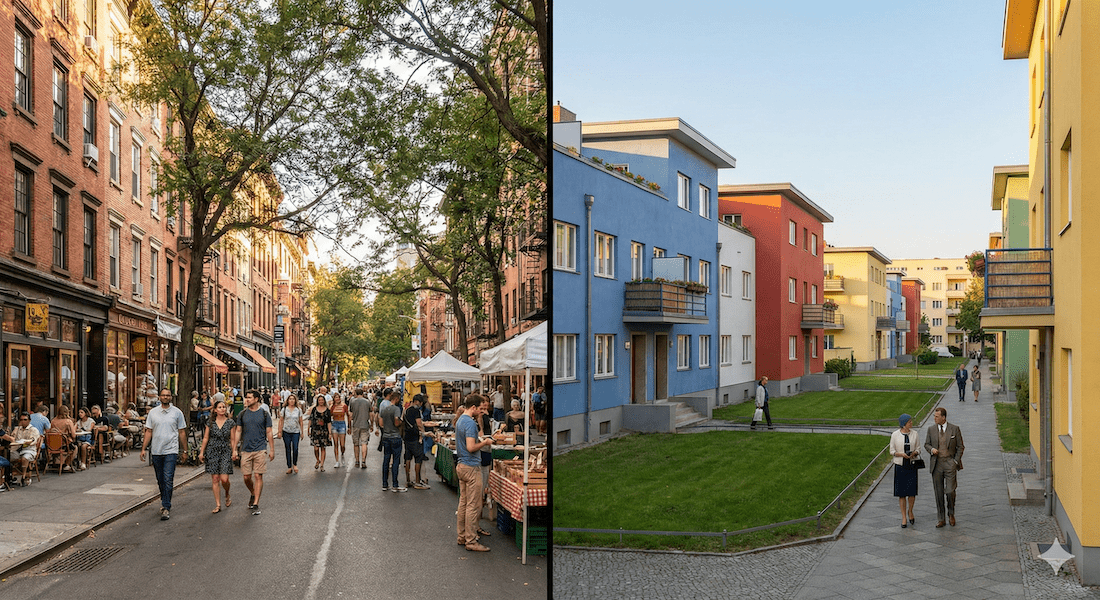
The Berlin Modernist Housing Estates (built mainly between 1910 and 1933), which are also registered as a UNESCO World Heritage Site, are the culmination of this era. Architect Bruno Taut, who later lived in Japan and praised Katsura Imperial Villa as "so beautiful it brings me to tears," was involved in the design of these housing estates (including the Hufeisensiedlung), introducing a "color scheme" that used vivid, contrasting colors on the exterior walls and interiors of large housing estates, which tended to be monotonous. These housing estates continue to function as homes for Berliners to this day.
▲ The Horseshoe Housing Estate (Hufeisen Siedlung) in Berlin, a UNESCO World Heritage Site that is still in operation today
2. The Transformation of Ideas and Jacobs' Counterattack: The New York LOMEX Project
Modern urban planning began with the lofty ideal of providing a hygienic environment for workers, but as time went on, it became linked to the spread of automobiles (motorization) and huge development capital, causing a major transformation in its nature. Zoning, which strictly divides cities into functions (residential, labor, and commercial), and top-down large-scale development (Urban Renewal) that connects these areas with highways, became mainstream in the United States after World War II.
Robert Moses' "Meat Cleaver"
In New York City, the man who pushed for this top-down development was Robert Moses, known as the "Master Builder." He boasted that "the only way to do business in an overcrowded city is to cut it open with a meat axe." He designated dilapidated urban areas as "slums" and used bulldozers to remove them (slum clearance), then replaced them with huge highways and impersonal high-rise housing complexes.
The LOMEX Project and Jacobs' "Four Principles"
One of Moses's biggest projects was the Lower Manhattan Expressway (LOMEX), a massive project to build a 10-lane elevated highway through southern Manhattan. If it had gone through, it would have divided what are now SoHo and Little Italy, physically destroying and eradicating 14 existing city blocks, and forcing thousands of residents and local businesses to move.
Jane Jacobs, a simple journalist living in Greenwich Village, responded by organizing a fierce opposition movement, arguing that "cities are not machines but complex, interconnected ecosystems." In her 1961 book, The Death and Life of Great American Cities, she sharply criticized the urban planning of the time and established four principles for maintaining vibrant and safe urban spaces.
- 1. Adequate high-density development: The appropriate population density allows people to gather and for economic and cultural exchange to occur naturally.
- 2. A mix of old and new buildings: Creating a diverse range of rents will leave room for young entrepreneurs and independent shops with limited capital to enter the city.
- 3. Mixed-use: The goal is to create a mix of residential, commercial, and office spaces, with people constantly on the streets, day and night.
- 4. Short Blocks: The goal is to create a mesh-like structure that allows pedestrians to choose from a variety of routes, creating opportunities for chance encounters on street corners.
The grassroots struggle led by Jacobs and others eventually generated enormous political pressure, and the LOMEX plan was miraculously scrapped in 1969. By putting her life on the line, she dramatically shifted the needle in the history of urban planning, from top-down "development" to bottom-up "urban development."
▲The area around Greenwich Village in New York that Jacobs successfully protected from massive highway development
3. Comparative Data: The Destructive Power and Evolution of Megaprojects
In order to accurately grasp the physical and economic impact that top-down development (urban renewal) derived from modernism has on cities, we compare data from past unfinished overseas projects (LOMEX) with a contemporary redevelopment example in Japan (Azabudai Hills). It is noteworthy that in modern times, the focus of development has evolved from "infrastructure supremacy" to "coexistence with nature and multi-functionality."
| Comparison items | [A] USA, NY: LOMEX (highway project) [Unfinished Plans of the Past / Moses Style] |
[B] Japan, Tokyo: Azabudai Hills (redevelopment project) [Modern Examples / Area Accumulation] |
|---|---|---|
| Development focus | Responding to motorization (resolving traffic congestion), eliminating poor neighborhoods through slum clearance | Coexistence with nature (greening), creation of pedestrian spaces, and high-density accumulation of Jacobs-style multi-functionality (work, housing, and commerce) |
| Total project cost (investment amount) | Approximately $150 million (1968 estimate) | Approximately 640 billion yen |
| Impact of the target area | Complete physical destruction of 14 existing blocks. Eviction targets: 1,972 households and 804 businesses (forced eviction). | The construction of this super high-rise building will secure a vast green space (pedestrian space) of approximately 24,000 m² on the site. The project was the result of over 30 years of negotiations with landowners. |
4. Reality and fact-check of housing conditions in Japan
Modernist architecture and Jacobs's theories, which originated in Europe and the United States, have been adopted in a unique way in Japan, resulting in modern urban development. Here, we will conduct a fact-check on the current state of public housing, which led Japan's postwar housing policy, and the lifespan of Japanese wooden houses, an issue that cannot be avoided when discussing modern urban development.
The reality of public housing in the 1950s: Were bathrooms standard equipment?
The Japan Housing Corporation, established in 1955 to alleviate the serious housing shortage after the war, established the modern lifestyle of "separating eating and sleeping areas (introducing the dining and kitchen = DK)" in urban Japanese life. This groundbreaking "2DK" floor plan was heavily influenced by European modernism, such as the Frankfurt Kitchen mentioned above.
However, it's important to be wary of popular myths about the living environment of the time. According to a paper by the Architectural Institute of Japan (analysis in 2025, etc.), the estimated floor area of public housing and public corporation housing in the 1950s, such as the public corporation's "55-4N-2DK" type, was approximately 35.16 m2. The paper points out that the simple myth that "public corporation housing was 3.3 sq. m. larger than public housing, and used that space to add a dining room, kitchen, and bathroom" needs to be reconsidered. The fact is that there was a clear distinction between "bathroom availability" and "non-availability" depending on the type of housing unit at the time (e.g., the 54C-1 type had a bathroom), and bathrooms were not uniformly installed in a specific proportion across all housing complexes at the time; rather, various prototypes were trial and error.
Fact Check: Is it true that Japanese wooden houses only last 30 years?
In Japan's urban development, one of the most frequently cited factors preventing the utilization of existing stock (old buildings) is that "Japanese wooden houses have a short lifespan of about 30 years, and will soon require scrap-and-build (rebuilding)." However, this statement contains a serious misunderstanding due to a mix-up of statistical data.
According to frequently cited analyses such as data from the Ministry of Land, Infrastructure, Transport and Tourism, the average age of houses demolished between 2008 and 2013 was about 32.1 years. However, this is onlyAge at time of dismembermentand the physical structure of the building."lifespan"It's not that.
Why will it be destroyed in 32.1 years?
The reason why houses are demolished after just over 30 years is not because they are no longer physically habitable. It is largely due to social and economic reasons specific to the Japanese real estate market, such as changes in family structure (such as when children move out and couples become single), a preference for new construction due to the immaturity of the used housing market, or the fact that selling the land as a vacant lot is more advantageous in terms of taxation and liquidity.
Physical potential is approximately 70 years
On the other hand, in a rigorous estimation study (academic paper) using fixed asset ledgers, etc., the estimated average lifespan of a wooden detached house in Japan isApproximately 69.53 years (2021 estimate)With proper maintenance, Japanese wooden houses have the physical potential to be used as long-term assets, just like Western houses.
Jacobs argued that "old buildings are important infrastructure for nurturing new ideas." Japan's scrap-and-build mentality, in which buildings are demolished after just over 30 years for social reasons despite their physical lifespan of nearly 70 years, can be said to be destroying the "urban margins (diverse rent ranges)" that allow entrepreneurs and cultural figures to start their activities at low cost.
5. Application to local cities: A practical approach in Toyako Town, Hokkaido
Jacobs's concepts of "the value of old buildings" and "maintaining diversity," which we have looked at so far, are also powerful prescriptions for Japan's regional cities, which are facing population decline. For example, let's consider Toyako Town in Hokkaido, which has abundant tourism resources and an agricultural base, as a model.
Moving away from scrap-and-build and diversifying investments in the "bathing tax"
An analysis of Toyako Town's urban development plan points out that one of its challenges is the "weak connections between key industries such as agriculture, fisheries, and tourism." This means that the interactions within the ecosystem are being disrupted. At the same time, the town is experiencing an increase in vacant houses and stores that have been abandoned before their lifespan is over.
Rather than relying on top-down development where the local government borrows heavily to build huge new facilities (such as tourist centers), it is important to renovate and utilize the existing vacant houses scattered throughout the town as a network.Toyako Town has a powerful independent source of revenue, namely the "bathing tax," which generates approximately 124.35 million yen per year (as of the fiscal year ending March 2022 settlement) due to inbound demand and other factors.
[Graph] Toyako Town's bathing tax revenue and its main allocation
(Based on fiscal year 2022 settlement)
*Partial excerpt of total project costs.
Part of this strong cash flow should be diversified and invested not just in infrastructure maintenance, but also in things like "subsidies for entrepreneurs to renovate vacant houses." Infusing new functions (mixed-use) into old stock that still has a physical lifespan is Jacobs' way of rebuilding a resilient local economy.
Conclusion: A vision for the future of "appropriate density" derived from historical reflection
The innovative housing policy of Weimar Germany, which was created to rescue workers from harsh living conditions, eventually became linked to big capital in the United States and transformed into Robert Moses's "meat cleaver" (destruction of community). Jane Jacobs disagreed with this and defended not old buildings as mere nostalgia, but the "mechanism of the city as an ecosystem" where diverse people mix together and carry out economic activity.
Even in Japan, the lineage of modernism (public housing, etc.) that dramatically improved living environments after the war has now created a social illusion that "wooden houses have a lifespan of 30 years," and an unconscious scrap-and-build mentality is resulting in the loss of "urban margins (old stock)" that serve as seedbeds for entrepreneurship and culture.
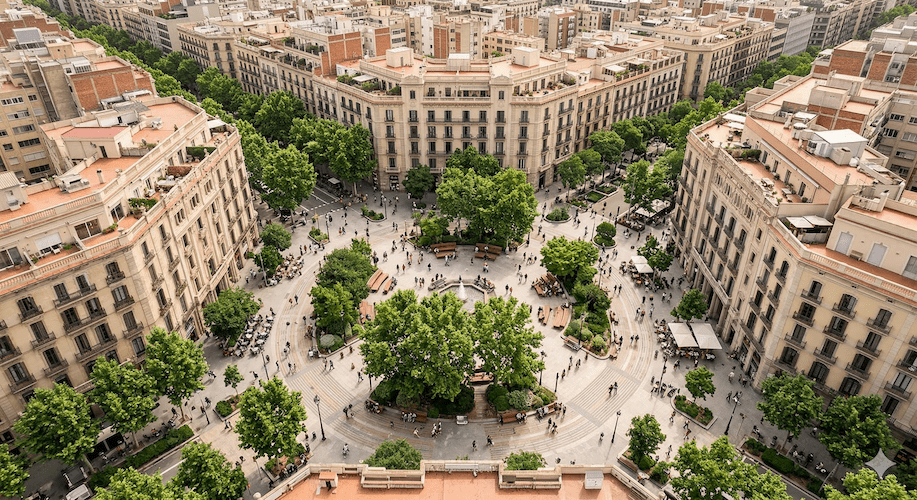
When we think about future urban development, there is no need to completely reject the top-down development of the past. Modern-day regional infrastructure renewal requires huge amounts of capital and technology. However, what breathes life into it is a Jacobsian, bottom-up perspective that cherishes old buildings and fosters diverse businesses in their backstreets. By determining the true lifespan of old stock (approximately 70 years), we can renovate appropriately and mix various uses. This is the optimal solution for creating "appropriate high density" in an era of population decline and building a sustainable ecosystem.
Related Links
- UNESCO World Heritage Centre: Berlin Modernist Housing Estates
- Ministry of Land, Infrastructure, Transport and Tourism: Urban Development Promotion Page
- Town development information site "Machiko Net"
Inquiries and requests
We help solve local issues.
Please feel free to contact us even if it is a small matter.