〜The uniqueness of Japanese urban planning and the balance between "regulation" and "freedom" seen in Toyako Town, Hokkaido
*This article is based on information as of December 2025.
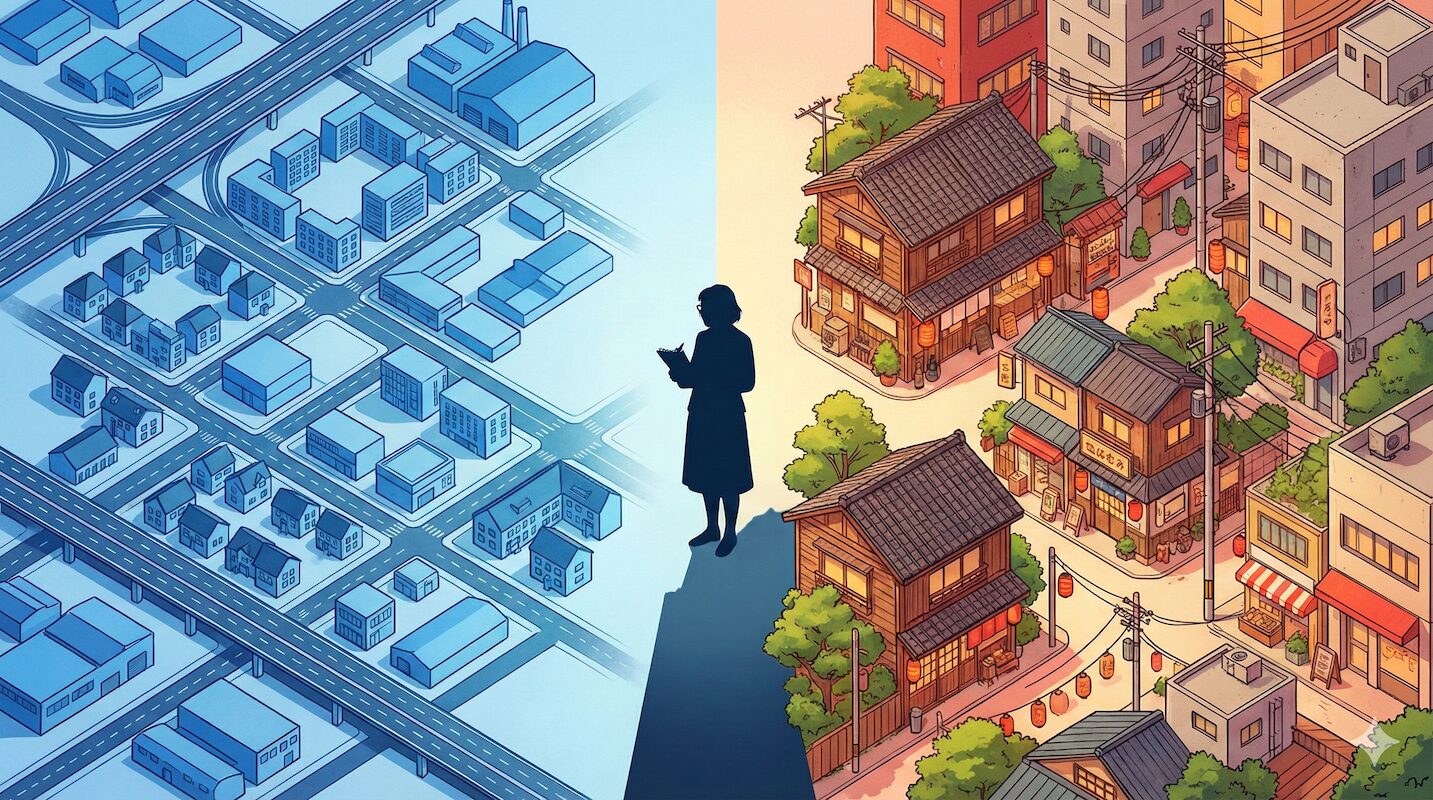
Imagine walking through a Japanese city. For example, you turn a corner in a quiet residential area and suddenly a bustling shopping street appears before your eyes. And just behind it, you might even hear the hum of machinery from a small local factory.
For us Japanese, this "mixed" landscape is our original landscape and our everyday life. However, what about from the macro perspective of urban planning? Or, when compared to the orderly cities of Europe and the United States,"Chaos rarely seen anywhere in the world"On the other hand, many experts believe that"Miraculous functional beauty"We praise it for being such a great person.
Why do Japanese cities have such a diverse mix of functions? In fact, the key to solving this mystery lies in a proposal by Jane Jacobs, a leading urban theorist of the 20th century. Additionally, the invention of "cumulative zoning," which Japan developed independently after the Meiji period, is also an extremely important factor.
In this article, we take a thorough look at the latest example of Toyako Town in Hokkaido, which is trying to preserve its beauty as a tourist destination while taking advantage of the benefits of this "Japanese chaos." Modern urban development vacillates between "freedom" and "regulation." In conclusion, we will unravel the intricate puzzle that lies at the forefront of this.
1. Jane Jacobs's Will and the "Death" of Cities
Modern urban planning brings about a "boring hell"
Let's turn back the clock to the 1960s. At the time, the mainstream of urban planning around the world was the idea of the "shining city," as represented by Le Corbusier. Specifically, this was an approach that viewed cities as machines. The plan called for clearly defined zoning (division) into "places to live," "places to work," and "places to play," and for these to be efficiently connected by highways.
At first glance, this seems like a rational and hygienic plan, but Jane Jacobs took a firm stance against it. In fact, the arguments she made in her classic book, The Death and Life of Great American Cities, completely overturned the common sense of the time.
"Beneath the city's seemingly chaotic landscape lies a strange yet surprisingly strong order: a complex and interwoven order that maintains the city's safety and freedom."
The fatal risks of a "clean city"
She further analyzed that a "clean city" with its purified functions would become deserted at certain times of the day, and as a result, residents would no longer be able to keep an eye on it, warning that it could become a breeding ground for crime.
On the other hand, what about cities with a mix of uses? People come and go there day and night. He argued that this would result in a "living city" where natural surveillance (street eyes) would function. In other words, he argued that the most safe places are the diverse streets that appear chaotic at first glance.
Japan's affinity with the "four conditions" that create vitality
Jacobs then listed the following four conditions as necessary for a city to maintain its vitality. Surprisingly, these appear to accurately describe the urban structure of modern Japan.
| Jacobs's condition | Its meaning and effects | Appearance in Japanese cities |
|---|---|---|
| ① Mixed uses (Mixed Primary Uses) |
It needs two or more functions such as residential, commercial, or business, and attracts people at different times. | A common sight is the coexistence of convenience stores, apartment buildings, and offices on the same block. |
| ② Small block (Small Blocks) |
Shorter blocks mean more corner lots, which increases pedestrian route options and improves mobility. | The area has a network of narrow alleys and backstreets, which stems from the town layout of the Edo period. |
| 3) Preserving old buildings (Aged Buildings) |
Older buildings with low rents can become homes for experimental shops and low-profit cultural facilities. | Renovated cafes and old houses for offices. Rent varies depending on the age of the building. |
| 4. The need for concentration (Concentration) |
Diversity cannot be maintained without a certain level of population and building density. | One of the world's most densely populated residential areas, with tiny houses and pencil-shaped buildings. |
As you can see, the "diversity" that Jacobs envisioned is not something that can be easily created through planning. However, Japanese cities somehow manage to meet this condition spontaneously. The secret to this lies in their unique legal system, which will be explained in the next chapter.
2. Comparative Analysis: The Crucial Differences Between Japanese and American Zoning Structures
There are two main approaches to zoning (land use regulation) in the world. One is "exclusionary zoning" in the West, and the other is "cumulative zoning" in Japan. It is impossible to discuss Japanese cityscapes without understanding this difference.
Contrasting Western and Japanese approaches
The two approaches are fundamentally different, so take a look at the comparison chart below.
[Principle: Purification and Exclusion]
The name comes from a 1926 US Supreme Court ruling that divides land into pieces like a puzzle, strictly stipulating that "anything but housing is prohibited here."
↓ No mixing with other uses
【result】
Although this preserves a quiet environment, it also means that people need a car to go shopping, which has resulted in "urban sprawl" and a weakening of community.
[Principle: inclusion and tolerance]
This is a method of gradually increasing the use of land based on the "use that causes the least inconvenience (housing)." In other words, even in a lower-ranking zoning district, a higher-ranking use (housing) can be built.
*You can build all of them!
【result】
Condominiums are built in commercial areas, and detached houses are built in semi-industrial areas. Therefore, even without legal enforcement, "living close to work" is realized naturally through market principles.
Why is Japan "lax"? History since 1919
There is a historical inevitability behind Japan's lenient zoning. Specifically, when the first City Planning Act was enacted in 1919 (Taisho 8), the "combined work and home" lifestyle in row houses and home-based handicraft industries were already well established in Japanese cities.
What would have happened if Japan had implemented strict separations like those in Europe and the United States at the time? Economic activity in Japan would likely have come to a halt. Therefore, this realism of "accepting the status quo" became the DNA of Japan's cumulative zoning. It also served as a flexible mechanism for accommodating rapid urbanization during the postwar period of rapid economic growth.
3. Toyako Town's Challenge: "Overwriting and Saving" the Landscape
The negative effects of "building anything"
However, there is always a flip side to everything. In Japan, the "freedom to build anything" is synonymous with the "risk of destroying the scenery" in tourist areas. For example, if a beautiful lakeside is overrun with impersonal signs, it will lose its value as a tourist resource.
Toyako Town, Hokkaido. This international tourist destination, with its beautiful caldera lake and views of Mount Usu and Mount Yotei, is currently using a highly sophisticated legal technique to compensate for the weaknesses of Japan's loose zoning system. This is an "overlay" strategy, which places the local government's own regulations on top of the City Planning Act.
Illustration: Toyako Town's "multi-layered regulation" structure
Introduction of the "Munsell value" to limit color numerically
The most distinctive feature of Toyako Town's landscape plan is its thorough "color control." This is because subjective standards such as "no flashy colors" would cause trouble with developers. Therefore, regulations based on the "Munsell value," which quantifies color, were introduced.
For example, even nationwide chain convenience stores and gas stations are no exception. Specifically, the following strict standards are applied:
| Target area | Regulations (Munsell value standard) | Actual change |
|---|---|---|
| exterior wall "Red and yellow" series |
Saturation (vividness) 6 or lessTo keep it to |
Those bright red and orange signs have become more subdued."Brown (brick color)"will change to. |
| exterior wall "Blue/Green" |
Saturation 4 or lessTo keep it to |
To avoid competing with the colors of nature (lakes and forests),"Dusty colors"is required. |
| roof | Reduce brightness | So as not to float in the snowy scenery,"Dark gray" or "dark brown"will be unified into |
In this way, the flexibility of "what to do (use)" - a benefit of the Japanese legal system - is preserved. On the other hand, "how it looks (form)" is strictly bound by local rules. In conclusion, this is the optimal solution that Toyako Town has found.
4. Revitalizing vacant houses and the "200m² wall"
Modern challenges facing the "old buildings" beloved by Jacobs
Jacobs once said, "We need old buildings." This is because new buildings have high rents and can only accommodate national chains, whereas old buildings can accommodate the challenges of young people and small businesses.
Japan's regional cities are overflowing with these very resources (vacant houses and stores). However, even here, there are legal obstacles. These are the hurdles to "changing the use" under the Building Standards Act.
True story: The obstacles faced by young people who want to open a cafe
【case】
We would like to purchase a former hot spring inn (300m²) and renovate it into a cafe on the first floor and a guest house on the second floor.
[Legal barriers]
When changing the use of a property from a "residence" or "hotel" to a "restaurant," the area200㎡If it exceeds this limit, you will need to apply for building approval.
What will happen?
To apply for certification, the entire building must comply with the current Building Standards Act. However, it is rare for a Showa-era building to meet current earthquake and fire resistance standards. As a result, renovation work costing tens of millions of yen would be required, and the project would come to a halt.
This "200-square-meter wall" (previously 100 square meters, but relaxed in 2019) remains the biggest obstacle to renovation and urban development in rural areas. Therefore, in order to revitalize areas like Toyako Town, it is important for the local government to respond flexibly to this hurdle by "partially changing the use of land" or "creating zoning arrangements."
Conclusion: Zoning is not a "restriction" but a "vessel for creativity"
Jane Jacobs's dream of a "diverse city" is, ironically, actually alive in Japan's "gentle chaos," the polar opposite of the modern urban planning she criticized.
Japan's zoning is by no means unplanned. Rather, it was deliberately created to accommodate the changes of the times and the activities of residents."A generous vessel"That's why.
What Toyako Town's challenge teaches us is that the "tolerance (national standards)" of the country's systems and the "aesthetic sense (local rules)" that the region wants to uphold are by no means in conflict. On the contrary, by skillfully overlaying the two, it is possible to create an orderly bustle unlike any other in the world.
The next time you're traveling and come across a beautiful cityscape or a bustling alleyway, you'll surely find hidden within it the dramatic story of how our ancestors drew the line between freedom and regulation.
Related Links
- Ministry of Land, Infrastructure, Transport and Tourism | Building Standards Law System Summary Collection
- Ministry of Land, Infrastructure, Transport and Tourism|Landscape Town Planning Portal Site (Landscape Law and Landscape Plans)
- Toyako Town: Toyako Town Landscape Plan (Landscape creation initiative by local governments in Hokkaido)
Inquiries and requests
We help solve local issues.
Please feel free to contact us even if it is a small matter.