〜"Management of Shrinkage (Lean Urbanism)" for the Survival of Local Cities in Japan〜
*This article is based on information as of March 2026.
"We shape our buildings; thereafter they shape us."
These famous words, spoken by then-Prime Minister Winston Churchill on October 28, 1943, during a debate over the rebuilding of the House of Commons, which had been destroyed in the war, aptly express the inseparable relationship between urban planning and architectural design, and how they have a decisive influence on the lifestyles of the people who live there, economic activity, and even the nature of the social community.
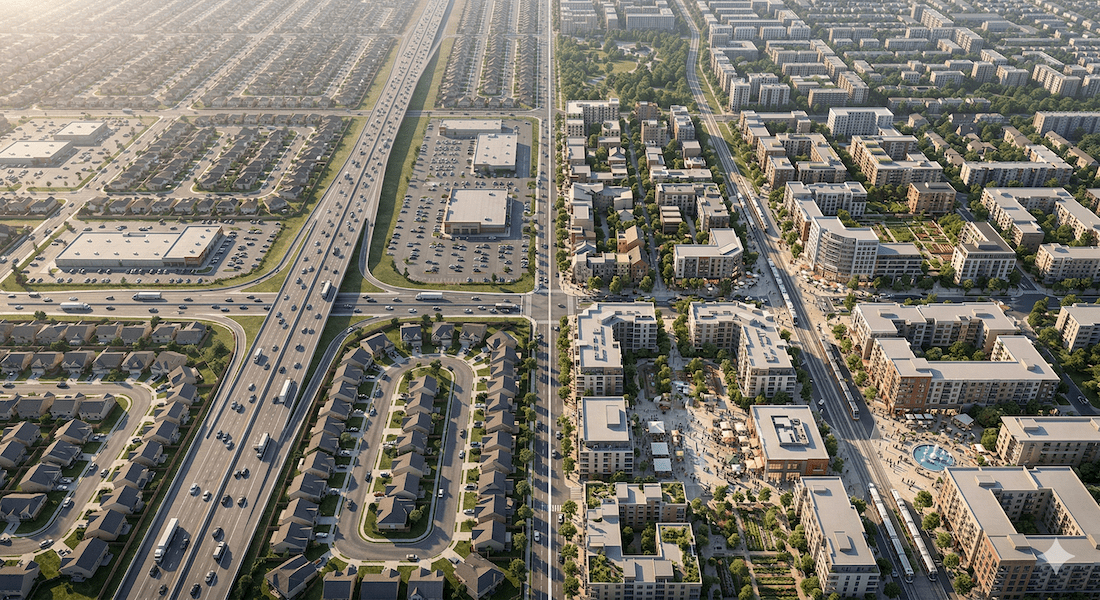
When we unravel the contemporary urban challenges we face, we must trace their origins back to post-World War II American society. At that time, explosive urban development led to low-density suburban development in which residential, commercial, and workplaces were severely separated, a phenomenon known as "sprawl." This approach, known as single-use zoning, provided people with the privacy afforded by single-family homes with spacious yards and automobiles, but in the long term it imposed heavy costs on society as a whole in the form of severe traffic congestion, air pollution, community division, and astronomical infrastructure maintenance costs.
"New Urbanism" is an urban planning and design movement that emerged as a strong reflection on this "endless development premised on car dependency," with the aim of restoring walkable, diverse, and human-centered cities.
This article will summarize the ideas and mechanisms underlying New Urbanism and its dramatic impact on the macroeconomy. Furthermore, it will logically and thoroughly explain how this concept can be applied as an "urban survival strategy (defensive New Urbanism)" in local areas of Japan (such as Toyako Town in Hokkaido) that are facing extreme population decline, a declining birthrate and an aging population, and the limits of infrastructure maintenance.
1. The birth of New Urbanism and pedestrian-centered street design
Rebelling Against Sprawl: Ideological Background and Historical Changes
The grand movement known as New Urbanism was born in the 1970s and 1980s. At the time, motorization was at its height in America, and uncontrolled expansion to the periphery was considered absolute justice. However, in opposition to this trend, architect Léon Krier's theory of reconstructing the "European city" and Christopher Alexander's theory of "pattern language" were proposed, and these became a powerful ideological foundation for the movement.
The first experimental and critically successful example was Seaside, which broke ground on 80 acres along the Florida Panhandle in 1981. The town attracted international attention and demonstrated that physical design could regenerate social communities.
[Reference map: Seaside, Florida, the birthplace of New Urbanism]
Subsequently, the Ahwahnee Principles were formulated by the Local Government Commission in Sacramento, California in 1991, and the Congress for a New Urbanism (CNU) was founded in 1993 as a promotional organization. The Charter for a New Urbanism, adopted in 1996, has been translated into over a dozen languages worldwide. This philosophy has also permeated the national policy level, being widely adopted by the U.S. Department of Housing and Urban Development's (HUD) public housing reconstruction programs (such as HOPE VI, which has provided over $6 billion in grants since 1992). Furthermore, efforts are being made to integrate sustainability with environmental standards, such as the adoption of the Canons of Sustainable Architecture and Urbanism in 2008 and field testing in 2009.
Mechanisms for walkable spaces
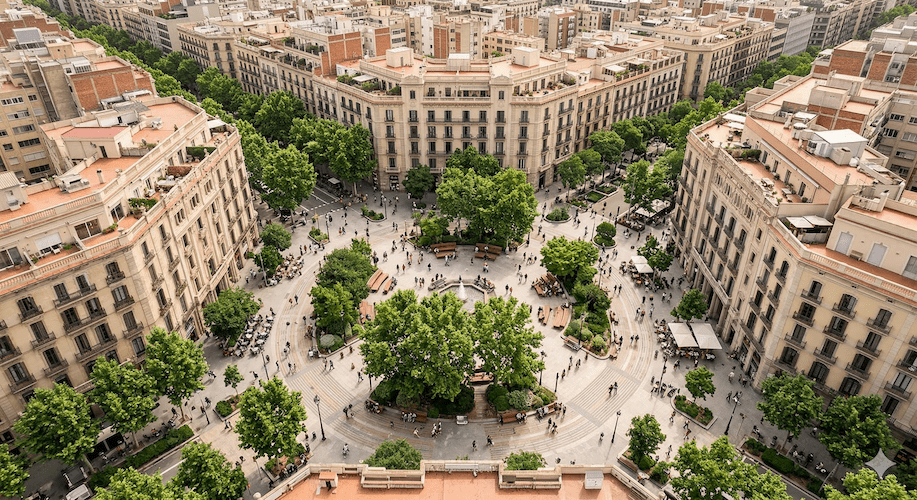
The core principles of New Urbanism are quite clear and logical: first, the existence of a clear central location (such as a square, station, or public facility); second, the ability to carry out major daily functions within a five-minute walk (approximately 400 meters/0.25 miles).
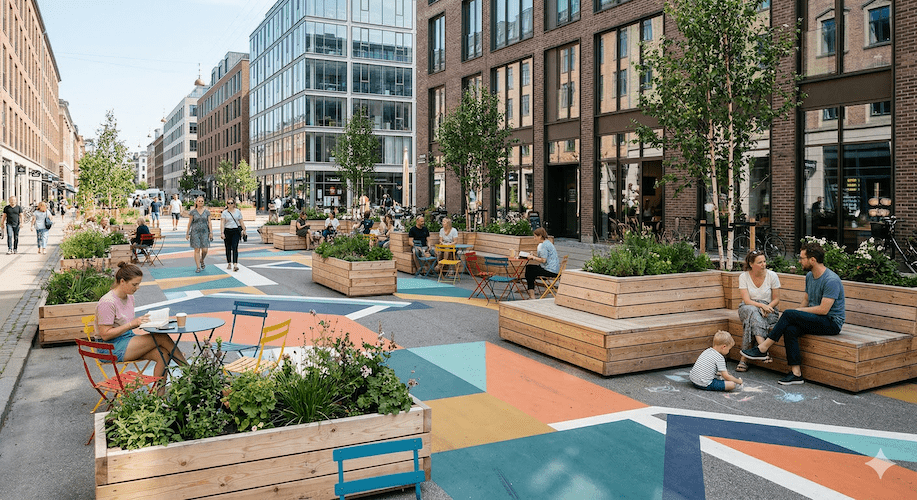
Furthermore, the city intentionally aims to mix a variety of housing types (detached houses, apartments, commercial buildings, etc.) with a variety of income levels, and the roads are intentionally designed to be narrow and green, thereby reducing vehicle speeds and ensuring safety for pedestrians. This not only creates a beautiful landscape, but also functions as a social device that generates spontaneous communication between people.
2. Dramatic Macroeconomic Impacts: The Cost of Sprawl and the Truth About Infrastructure
Data reveals the "economics of density"
The economic impact of urban form is far greater than we might imagine. The graph and table below show the clear cost structure differences between sprawl (such as in the United States) and compact new urbanism (such as in Japan and Europe).
[Graph] Differences in infrastructure and administrative service maintenance costs due to population density (estimated image based on data from local governments and regional organizations in Canada, etc.)
*Low-density residential patterns can result in municipal service costs up to three times higher than the most compact patterns. Furthermore, regional government reorganizations have shown that the life cycle costs of hard infrastructure such as roads and water and sewer systems can be up to ten times higher depending on the pattern, highlighting the structure in which suburban residents are essentially dependent on the taxes of urban residents.
According to analyses such as those by the New Climate Economy, urban sprawl is costing the U.S. economy millions of dollars, including additional costs for infrastructure, public services, and transportation.Over $1 trillion per year (several percent of national GDP)It is estimated that this could result in additional costs.
On the other hand, a shift to compact growth on a global scale is estimated to bring about macroeconomic savings of $17 trillion by 2050. Looking at the wider picture, it is estimated that bold climate action as a whole could generate benefits of $26 trillion by 2030. Furthermore, by compressing urban infrastructure demand between 2015 and 2030 and concentrating investment in existing urban areas,Approximately $3 trillion in new infrastructure investment could be avoided globallyThere is also some debate as to whether this is the case.
| Comparison items | [American-style sprawl] | [Japan-Asia Compact] | Insights and Implications |
|---|---|---|---|
| Average population density of the city (per square mile) |
Approximately 3,300 people | Approximately 10,000 people | America's extremely low density is the root cause of its total reliance on automobiles and its vast infrastructure expansion. |
| According to urban planning Estimated cost reduction effect |
Land consumption: 21% increase Road infrastructure: 10% increase |
Public service deficit: $4.2 billion annual reduction Housing costs: 8% reduction per unit |
As shown in a peer-reviewed paper (Burchell & Mukherji, 2003), smart growth simultaneously reduces budget deficits and housing costs. |
| Public transport infrastructure (Toyama City LRT example, etc.) |
New road construction (enormous cost and time) |
Construction (initial investment) costs: Approximately 75% reduction |
By reusing existing railway tracks, initial investment can be significantly reduced (World Bank data). |
3. Policy Promotion Dilemma: Advantages and Emerging Disadvantages
For governments and businesses, compact city planning is a powerful tool for fiscal reconstruction. Not only does it eliminate the need for infrastructure extension, but spatial concentration also stimulates innovation. OECD analysis has shown that doubling a city's population increases productivity per resident by 2 to 51 TP3T.
In addition to reducing the environmental burden, the positive impact on public health cannot be ignored. According to a summary of research related to housing and community revitalization, in areas where it is easy to walk (areas with high walkability), the likelihood of achieving the recommended amount of physical activity is approximately 501 TP3T higher and the likelihood of being obese is approximately 241 TP3T lower, contributing to extending the healthy life expectancy of residents. The fact that a mix of diverse housing types encourages mutual support between generations is also highly regarded.
However, serious side effects have also occurred. Because New Urbanism towns have become extremely popular in the market, a "New Urbanism premium" has been added, causing real estate prices to soar. For example, in Seaside, it was reported at the time that land prices in the area that were once $15,000 have skyrocketed to millions of dollars, exacerbating "gentrification," in which low- and middle-income residents are forced to move involuntarily.
Furthermore, there is persistent criticism that the strict design codes required to maintain a perfect landscape "deprive residents of the freedom to create spontaneous and diverse living spaces," and that they impose excessive inconvenience on people who prefer large gardens and car transportation.Furthermore, there is skepticism about the evidence regarding the environmental improvement effects, with some arguing that "energy consumption has decreased simply because houses have become smaller."
A clear distinction from similar urban planning approaches
There are several approaches to sustainable cities other than New Urbanism, each with a different focus. It is important to clarify the differences between them to avoid confusion.
- Smart Growth: While New Urbanism emphasizes "physical form and design," this approach focuses on institutional aspects such as "policy, tax systems, and land use regulations." It functions as a legal framework, encouraging infill development and preserving farmland.
- TOD (Transit-Oriented Development): High-density functions will be concentrated at "nodes" within a 400-800m radius of train stations and bus stops. The highest priority will be given to "efficient connections with public transport (solving the last-mile problem)" rather than superior or inferior design.
- Compact City: This concept is mainly promoted in Europe and Japan, and unlike the American movement which is premised on growth, it is characterized by a very strong defensive and downsizing management aspect, such as "maintaining government services" and "reducing infrastructure renewal costs" in an aging and declining population society.
4. Application to local areas in Japan: The "retreat battle" in Toyako Town, Hokkaido
Rapid population decline and infrastructure "sponge"
When applying the idea of "growth management" of New Urbanism to local cities in Japan where population decline is significant, it becomes "management of shrinking cities to prevent collapse," that is,Defensive New UrbanismIt changes the meaning to.
As a typical example, let's look at the current situation in Toyako Town, one of Hokkaido's leading tourist destinations, using official data. According to data from the national census and other sources, Toyako Town's total population dropped from 11,343 in 2005 (at the time of the merger) to 9,299 in 2015, a sharp decline of 2,044 people in just 10 years. Furthermore, the 2015 national census showed that the aging rate had reached 40.4%, meaning that the town is facing an extremely aging society with a declining birthrate, with "one in every 2.5 residents being elderly."
[Reference map: Toyako Town (Hokkaido) takes on the challenge of downsizing its infrastructure]
A lack of successors to industry and an outflow of young people has led to an increase in vacant houses, and the haphazardly dispersed residential area has become "sponge-like" (hollowed out). Because the town is so widely dispersed, it is financially impossible to maintain and update the water supply, sewerage, and roads at their current scale. For the town, which was previously designated as a "fast-track revitalization organization," downsizing its infrastructure is literally a matter of life and death.
Specific numerical targets and "KPIs for reduction"
As stated in the town's population vision, the National Institute of Population and Social Security Research (NSSR) predicts that Toyako's population will naturally decline to 2,239 people by 2070. However, the town has set a goal of maintaining a population of 3,334 in 2070 by mobilizing a variety of measures, including compactification and job creation, to slow the decline.
It is worth noting that the Toyako Town Public Facilities Comprehensive Management Plan calls for the total floor area of public facilities (buildings) to be reduced by fiscal year 2061 (Reiwa 43)."15% reduction"This is nothing less than a powerful declaration of substantial compactness, which will see the consolidation and elimination of public facilities and their consolidation into central locations.
Furthermore, in the indicators of the Third Comprehensive Strategy and other indicators, the city has set a KPI of maintaining the number of community transport users at 10,000 people per year, and is desperately seeking to reorganize walkable areas and the transport network that connects them.
5. Global standardization and responsibility to future generations
Ensuring fairness among cities within 20 minutes
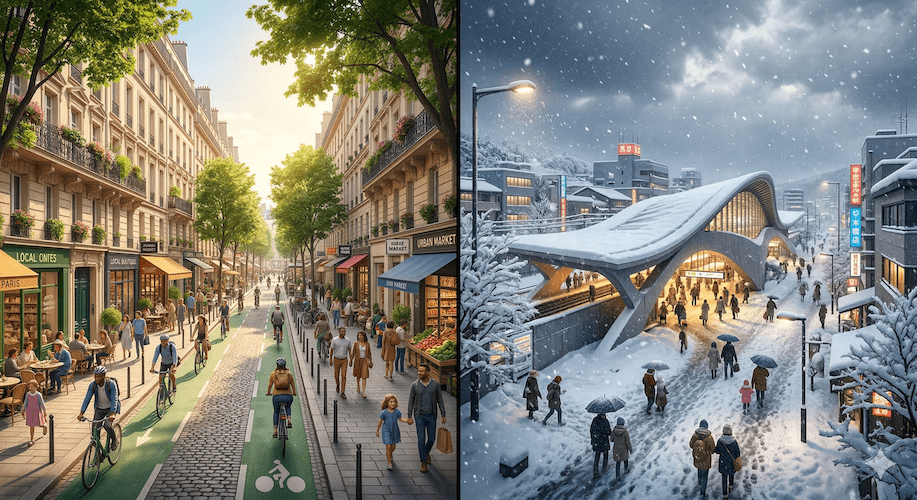
With the experience of the pandemic and the threat of climate change as a backdrop, the concept of New Urbanism is now evolving into "20-Minute Neighborhoods," where everyday needs can be met by walking or cycling. This is expected to become the gold standard for policymaking in developed countries in the coming years.
Furthermore, as the 2024 Charter Revision Process published by CNU strongly emphasized "equity" and "housing," there is an urgent need for efforts to prevent involuntary displacement due to gentrification. "Inclusionary Zoning" is being used as one policy tool that aims to mix a certain percentage of affordable housing so that people of various income levels can live in an area, and the latest trend is to balance sustainability with social inclusion (equity).
Japan's Imperative: Embrace Lean Urbanism
Meanwhile, what is being called for in Japan's regional cities is the practice of "Lean Urbanism," which cuts down on waste at lower costs. Due to government financial limitations, infrastructure investment bases will be forcibly narrowed, and "management of withdrawal" and "guiding people to live in central areas" based on location optimization plans will relentlessly accelerate over the next few years.
Conclusion: Making "painful choices" that won't leave a burden on the next generation
New Urbanism and Smart Growth are by no means simply nostalgic, retrospective landscape design movements.
It is an extremely economical and rational prescription for the "negative legacies of sprawl" such as the explosive rise in infrastructure maintenance costs, enormous economic losses due to traffic congestion, air pollution, and community division.
In particular, in local areas such as Toyako Town, which are at the forefront of depopulation and aging, continuing the conventional lifestyle of "living widely dispersed and remaining completely dependent on cars" is tantamount to passing on a crushing tax burden to future generations in the form of a sharp increase in infrastructure renewal costs decades from now.
Local residents, local businesses, and government officials must now deeply consider the fundamental question of "what size and shape is truly sustainable for our community?" Where to live, how to get around, and where to consolidate public facilities within a limited budget. Everyone must take ownership of these painful choices and, starting today, participate in discussions on compact, people-centered urban development that avoids leaving a burden for future generations. This is the single most powerful strategy for maximizing the capital of our community.
Related Links
- Congress for the New Urbanism (CNU) Official Website
- Ministry of Land, Infrastructure, Transport and Tourism: Promoting location optimization plans and compact city formation
Inquiries and requests
We help solve local issues.
Please feel free to contact us even if it is a small matter.