〜Why did Ebenezer Howard's dream of a "marriage between urban and rural areas" turn into a "commuter town" in Japan?〜
*This article is based on information as of January 2026.
"City and country must marry, and from this joyous union will spring new hopes, new lives, and new civilizations."
You may be familiar with this poetic yet deeply socio-technical statement, penned by Ebenezer Howard, the father of modern urban planning, in his 1898 book, Tomorrow: The Peaceful Road to True Reform (later renamed Garden Cities of Tomorrow).
At the end of the 19th century, London was covered in the soot of the Industrial Revolution. Facing urban problems such as overcrowding, poverty, and the expansion of unsanitary slums, Howard proposed a third option: the "Garden City," which combined the "economic convenience" of the city with the "abundant nature" of the countryside.
More than 120 years later, the stage shifts to modern-day Japan. The "Digital Garden City Nation Initiative" put forward by the Kishida administration (at the time) can be seen as a national attempt to re-implement Howard's ideals using the new infrastructure of digital technology. But do we really understand the true meaning of "garden cities"? Why have Japan's new towns become "commuter towns," which are a far cry from Howard's ideal?
This article returns to the origins of Howard's ideas and thoroughly compares Letchworth in the UK with Denenchofu and Tama New Town in Japan. Using Toyako Town in Hokkaido, a town at the forefront of population decline, as a case study, it explores the potential for technology-driven "new urban development" based on facts and data.
1. The Philosophical Foundation of Ebenezer Howard's Garden Cities of Tomorrow
First, let's review Howard's theory, which is the starting point of everything. His vision was not simply an idyllic idea of "building green cities." It was an extremely radical social reform proposal that went as far as to change land ownership and the structure of economic circulation.
1.1 The Three Magnets: City Selection Mechanism
Howard likened the motivation behind people choosing where to live to the gravitational force of a magnet, and presented a highly logical diagram. He analyzed the social situation at the time and defined the following three options:
[Illustration: The three properties of magnets proposed by Howard]
*Please scroll horizontally to view on your smartphone.
| Magnet types | Gravity (Advantages) | Repulsive force (disadvantage) |
|---|---|---|
| First Magnet "City" (Town) |
|
|
| Second Magnet "Local area" (Country) |
|
|
| Third Magnet "Garden City" (Town-Country) |
The solution is to "marry" these two
An autonomous city that combines the economic opportunities of a city with the natural environment of a rural area.
●Living close to work ●Low rent and high wages ●Clean air and water ●Enriched civic life |
|
In other words, Howard's definition of a garden city is not simply a place with many trees,An autonomous city where "economic activity (jobs)" and "living environment (housing)" are completed within the same regionThis was the decisive turning point for Japan's new towns.
1.2 Community return system for land profits
Even more important is the economic system. Howard disliked the idea that when a city developed and land prices rose, the profits (unincremental value) were monopolized by landowners.
So he proposed"Common ownership of land (trust)"The land in Garden City is not sold to individual residents, but is owned in total by trusts and local governments. Residents "rent" the land, and the rent they pay is used to improve public services and invest in infrastructure. This means that ultimately, local government operating costs will be covered solely by rent income."Rate-Rent (land rent = tax)" systemWe aimed to achieve this.
2. Practice in the UK: Letchworth, the world's first garden city
Howard's ideas did not remain just an armchair theory. In 1903, construction began on Letchworth Garden City, the world's first practical example of such a system, in Hertfordshire, about 50 km north of London.
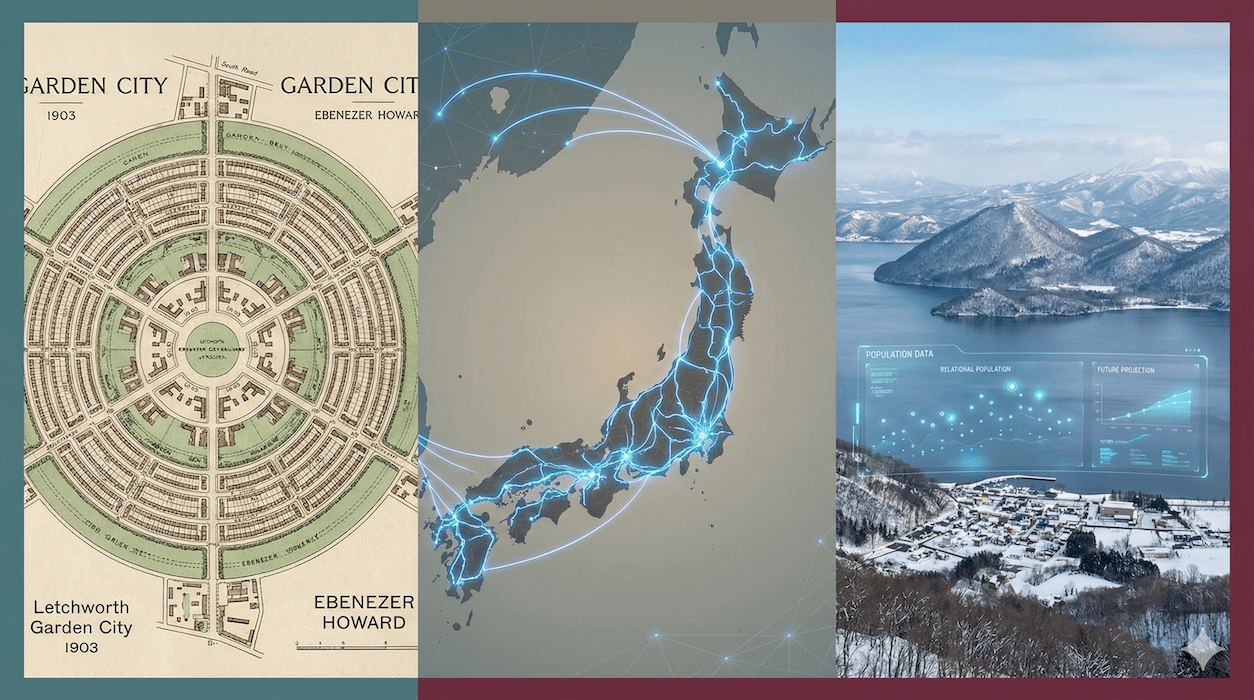
Letchworth, the world's first garden city. You can see how the circular green belt helps to restrain urban expansion.
Even today, Letchworth still retains a strong sense of Howard's ideals. The Letchworth Garden City Heritage Foundation, which manages the town, owns and manages the town's assets (land and commercial facilities), and according to the foundation's annual report (2023/24),Total revenue was approximately 14.42 million pounds (approximately 2.8 billion yen)This generous funding continues to be reinvested in the region as follows:
- ✔ Maintenance of green spaces: Construction of a 13.6-mile greenway.
- ✔ Cultural facility management: Assistance with the operation of Art Deco cinemas and theatres.
- ✔ Subsidies for civic activities: Funding local charities and sports clubs.
This is the practice of what we now call "social common capital," and can be said to be a complete model of growth while restraining the runaway nature of capitalism.
3. Acceptance and transformation in Japan: Why did it become a "commuter town"?
On the other hand, when the term "garden city" was imported to Japan, its meaning changed significantly.
3.1 Shibusawa Eiichi and the miscalculation of Denenchofu
In 1918 (Taisho 7), Eiichi Shibusawa and others founded the Garden City Corporation. Initially, they aimed to build a city based on Howard's ideals, but after his son Hideo Shibusawa visited Europe and the United States and returned to Japan after seeing places such as St. Francis Wood, an upscale residential area in San Francisco, the company revised its policy.
In other words, rather than being an "independent city where work and home are close to each other,""Suburban residential area for wealthy people who work in the city center"After the Great Kanto Earthquake of 1923, there was a surge in interest in moving to suburban areas with better soil, and Denenchofu was a great success, but it was close to the "jobless suburbs" that Howard had feared would be "incomplete cities."
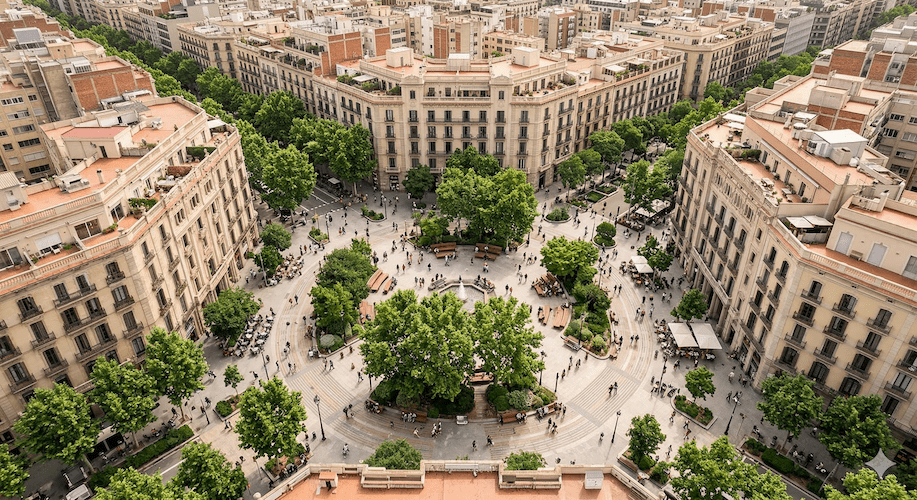
Denenchofu, Ota Ward, Tokyo. The influence of Howard can be seen in the radial road configuration, but there are no industrial areas and it is a purely residential area.
3.2 Structural differences seen in Japan-UK comparative data
Please take a look at the comparison table below. You can see that the OS (basic structure) of a city is fundamentally different between Letchworth in the UK and a new town in Japan (such as Tama).
[Comparison table: Structural differences between Letchworth and Japanese-style new towns]
*Please scroll horizontally to view on your smartphone.
| Comparison items | [UK] Letchworth | [Japan] Tama New Town, etc. |
|---|---|---|
| City Functions | An independent city where work and home are close to each other Industrial areas are located within the city. |
Commuter towns where work and residence are separated Commuting to the city center is required. |
| land ownership | Entire property owned or rented by a foundation Profits are reinvested in the town. |
Subdivided private land Profits go to personal assets. |
| Definition of green space | Green belt (agricultural area) Physically prevent urban expansion. |
Parks and roadside trees This led to sprawl (uncontrolled expansion) in the surrounding area. |
| assignment | The dilemma of preservation and development Existing residents oppose new development. |
Old Town Aging population, vacant houses, and aging facilities. |
4. The True Nature of the "Digital Garden City-State Concept"
Now, taking into account the historical background, how should we evaluate the modern "digital garden city-state concept"?
The essence of this concept is that it aims to achieve the "overcoming of distance" that Howard was unable to achieve in the 19th century, not by rail but by digital technology (fiber optics, 5G, IoT).
4.1 Breaking through physical constraints and KPIs
The government has set KPIs such as increasing the household fiber optic coverage rate to 99.9% by the end of fiscal year 2027. If this is achieved, it will theoretically be possible to enjoy the rich natural environment of rural areas (Country magnetism) while using the power of digital technology to obtain jobs and services equivalent to those in urban areas (Town magnetism).
[Illustration] Comparison of the structure of the Howard model and the digital model
↓
"Work" and "Home"
Located in the same area
↓
"Jobs (Digital)" and "Residence (Rural)"
Can be connected even if they are far apart
However, there are many challenges ahead. Many past "smart city" projects have relied on government subsidies and have been unable to run on their own, resulting in many cases of services being discontinued when the subsidies ended. Simply changing from physical infrastructure administration to digital infrastructure administration is meaningless.
5. Regional Case Study: The Challenge of Toyako Town, Hokkaido
Let's apply this theory to a specific field: Toyako Town in Hokkaido, a world-famous tourist destination with a beautiful caldera lake, Mount Usu Geopark, and a hot spring resort.
5.1 Shocking population projections and the reality of "degeneration"
According to Toyako Town's population vision (established in 2015), the town's population is predicted to decline dramatically as follows:
Toyako Town's future population estimates (from Toyako Town Population Vision)
*Please scroll horizontally to view on your smartphone.
These figures show that traditional urban planning, premised on growth and expansion, is no longer viable. However, if we interpret Howard's ideas in a modern way, we can see a paradoxical opportunity.
5.2 Toyako version of "Tomorrow's Garden City" strategy
This is a model that allows people to live prosperously even in a town with a population of 3,000. It is based on the following three pillars:
Even if the permanent population is 3,000, the economic sphere can be maintained if there are 30,000 digitally connected "related populations (digital townspeople)." The overwhelming natural environment of Lake Toya (Country) is its strongest asset in accommodating workcations and multi-location living. This is a modern version of the "Social City" network.
Based on Howard's "Green Belt" concept, unregulated development is restricted and the landscape of farmland and lakeside areas is strictly protected. This in itself creates a sense of "scarcity" and increases not only tourism value but also brand value (land rent) as a residential area. Beautiful scenery is capital in itself.
Digital technology is a lifeline for this town, which coexists with the active volcano Mount Usu. Continuous monitoring by IoT sensors, drones, and evacuation guidance apps are in place. These provide residents with the ultimate peace of mind. Only with the infrastructure of safety can people continue to live there.
5.3 Zoning Clarification
As suggested in Toyako Town's urban planning master plan, the division of roles (zoning) between areas is also important.
- Toya region: A district where Howardian country life is put into practice, combining lakes, agriculture, and daily life.
- Hot spring areas: An engine for earning external capital as a base for tourism, interaction, and workation.
- Abuta area: A central hub for administrative, disaster prevention, and lifestyle services (compact city).
By connecting these things through a digital network, an ecosystem will be created in which diverse lifestyles can coexist within the small town.
Conclusion: Digital will be the "wedding ring" for 120 years
As we have seen, Ebenezer Howard's ideas are by no means a relic of the past. Rather, their true value is being tested in 21st-century Japan, which is facing a declining population and environmental crises.
In the past, during the course of Japan's rapid economic growth, "work" and "living" were separated, leading to a separation between cities (overcrowded) and rural areas (depopulated). The result is the current overconcentration of population in Tokyo and the decline of rural areas.
However, today we have a new tool at our fingertips: digital technology. This can become the wedding ring that transcends physical distance and reconnects urban economics with rural spirituality.
What Toyako-cho should aim for is not the kind of expansion and growth that Tokyo once enjoyed. While assuming a declining population, it must protect the natural environment (green belts), connect to the world digitally, and circulate the wealth generated within the community. This is the true form of the "garden city of tomorrow" that Howard dreamed of in 1898, but which no one has yet fully achieved.
As a strategic partner, we will work together to help realize this vision by maximizing capital and designing relationships.
Related Links
- Cabinet Secretariat: Digital Garden City State Vision Realization Council Meeting
- Letchworth Garden City Heritage Foundation: The World's First Garden City
- Toyako Town, Hokkaido: Second Toyako Town Town, People, and Job Creation Comprehensive Strategy
Inquiries and requests
We help solve local issues.
Please feel free to contact us even if it is a small matter.