〜Why is the concept of an extremely decentralized city based on a car-based society being reevaluated in the digital age?〜
*This article is based on information as of January 2026.
"Broadacre City" is a grand urban vision that Frank Lloyd Wright, a master of modern architecture, dedicated the latter half of his eventful life to drawing up. This was more than just a proposal for a physical city plan; it was an extremely ambitious plan for social redesign that sought to fundamentally dismantle overcrowded cities and liberate people onto the vast land.
Today, we face the normalization of remote work and the desire for regional decentralization. These issues, coincidentally, can be connected to fragments of the world that Wright saw emerging with his keen insight some 90 years ago. This article delves into the essence of Wright's dream of a "city for free people" from an academic and multifaceted perspective, delving into its contemporary significance in the vast field of Hokkaido and the challenges it faces.
1. The Radical Dismantling of the City and the Return to "One Acre": The Full Story of Broadacre City
The definition of a city that is "everywhere or nowhere"
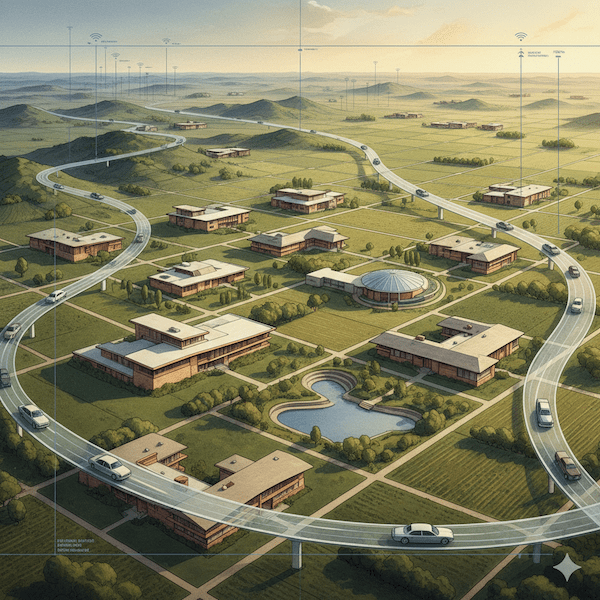
Broadacre City is an extremely decentralized urban concept that combines advanced transportation, communication technology, and vast land areas. The name "Broadacre" comes from his unwavering fundamental principle that every family should have at least one acre of land (approximately 4,047 square meters).
For Wright, existing cities, with their towering skyscrapers and densely packed people, were nothing more than "overcrowded prisons" that suppressed the inherent dignity of human beings. He was convinced that the advanced technologies of the time, such as the automobile, the telephone, and "teletransmissions of sight and sound," would nullify the constraints of physical distance. The result was a literally "sprawling" city, without a specific center, with homes, small factories, schools, and offices organically scattered throughout beautiful rural landscapes.
| Comparison items | Broadacre City (Light) | The Shining City (Le Corbusier) |
|---|---|---|
| Space design direction | "Extreme dispersion" in the horizontal direction | "High density aggregation" in the vertical direction |
| Ideal population density | Approximately 2.5 people/acre (cleared value) | Approximately 400 people or more per acre (ultra-high density) |
| Social/political philosophy | Individualism and freedom through land ownership | Collectivism and efficient public centralized management |
*You can scroll the table left and right to check the details.
2. The origins of ideas and historical changes: The turning point known as the Great Depression
Architecture as a remedy for social crisis
This pioneering concept was first made public in Wright's book, The Disappearing City, published in 1932. The background to this was the Great Depression that occurred in 1929 and shocked the world. Witnessing the poverty, unemployment, and loss of humanity that resulted from the excessive concentration of capital and population, Wright believed that architecture should not be simply a sculpted object, but an "organic device" that could heal society's pain from its roots.
In 1935, a gigantic 12-foot-square scale model was unveiled at Rockefeller Center in New York, causing a major shock not only in the architectural world of the time but across the United States. Wright continued to refine and update this concept throughout his life, and continued to advocate it as "a truly democratic form of residence for free people" up until his final work, The Living City, in 1958. He viewed cities as a relic of the past that needed to be overcome, and remained convinced until his death that social structures could be reorganized through architecture.
3. The Pros and Cons of the Plan: Brought about "sprawl" and Lost "Community"
Living in perfect harmony with nature, ensuring unwavering privacy, and achieving self-sufficiency and economic independence through small farms and workshops - these things maximize personal dignity. Furthermore, in today's remote work environment, it is also seen as a prototype for a "way of working" that is psychologically liberated from the constraints of physical distance.
Extreme decentralization would increase the maintenance and management costs of roads, water, power grids, and communications infrastructure to astronomical levels. It also has serious side effects, such as completely isolating vulnerable people who cannot drive (elderly people and children) from the social structure and eradicating the chance encounters that are the lifeblood of cities.
Comparing Urban Densities: How "Extreme" was Wright's Vision?
| Region/Project Name | Population density (people/acre) | Features |
|---|---|---|
| Broadacre City | Approximately 2.5 | Wright's concept of allocating one acre per family |
| New York (Manhattan) | Approximately 109-117 | Conversion based on U.S. Census Bureau data (2010-2020) |
| Toyako Town, Hokkaido | Approximately 0.17 | Conversion of estimated population density in 2025 to the total area |
*You can scroll the table left and right to check the details.
4. The harsh reality of "dispersed residence" in Toyako Town, Hokkaido
The conflict between vast land area and maintenance costs
Hokkaido, and especially the area around Lake Toya, a world-famous scenic spot, is one of the places that could easily embody Wright's concept of "integrating nature with habitation." However, the area faces the extremely harsh reality of administrative management.
The importance of dispersed residences as seen in data: Current state of road maintenance
| Budget Items (Toyako Town FY2024 Proposal) | Amount (thousand yen) | Main contents |
|---|---|---|
| Road and other environmental improvement projects | 135,800 | Maintenance, repair, and landscape improvement of town roads |
| Bridge life extension repair project | 53,400 | Planned bridge repairs based on inspections |
| Civil engineering costs total | 1,048,910 | Accounts for a large proportion of the general account budget |
*You can scroll the table left and right to check the details.
5. Implications for the present: Technology opens up the "Digital Broadacre"
Latest technology fills in the missing pieces
The one crucial missing piece in Wright's grand vision was who would sustainably bear the costs of transportation and infrastructure connectivity. However, cutting-edge technology in the 21st century is beginning to provide new answers to this question.
-
1. Connectivity with autonomous driving technology:
Self-driving technology can convert travel time into "productive activity time," eliminating the psychological sense of distance. This has the potential to overcome the limitations of the dispersed living caused by automobiles that Wright envisioned.
-
② Distributed energy/off-grid:
"Independent homes" that can generate their own electricity without relying on huge power grids are becoming a reality, and this has the potential to help reduce infrastructure supply costs incurred by governments.
Conclusion: Are we prepared to "cherish the land and use it to its full potential"?
Frank Lloyd Wright once advocated, with deep conviction, the ideal that all citizens should be given equal land according to their individual ability and integrity. What is crucial here is that for him, land was not merely a right to be enjoyed, but also a sacred responsibility to care for and continue to manage it with one's own hands.
The question that Broadacre City poses to us today is not simply a matter of choosing a home. It is a question of whether we are prepared to harness technology and reclaim true freedom rooted in the land. How will we reinvent the vast land of Hokkaido and the beauty of Lake Toya and connect it to the future? Wright's vision is now at our fingertips as a compass for redefining prosperity in a new era.
Related Links
- Frank Lloyd Wright Foundation – Broadacre City
- Ministry of Land, Infrastructure, Transport and Tourism – Overview of Location Optimization Plan
- Toyako Town Official Website – Statistics and Data
Inquiries and requests
We help solve local issues.
Please feel free to contact us even if it is a small matter.