〜Next-generation urban design unraveled through empirical data on New Urbanism〜
*This article is based on information as of March 2026.
For whom exactly is the "city" space where we live, work, and interact every day optimized? In the 20th century, urban planning placed functionality and efficiency above all else, building vast networks centered on the automobile. As the master of modern architecture, Le Corbusier, said, "A city of speed is a city of success," he envisioned a systematic utopia based on the separation of functions.
However, what we faced as a result was a serious breakdown in community and the disorderly expansion of cities into suburban areas (urban sprawl). A new paradigm known as "postmodern urban planning" was born out of this scathing reflection and criticism of "modernist urban planning."
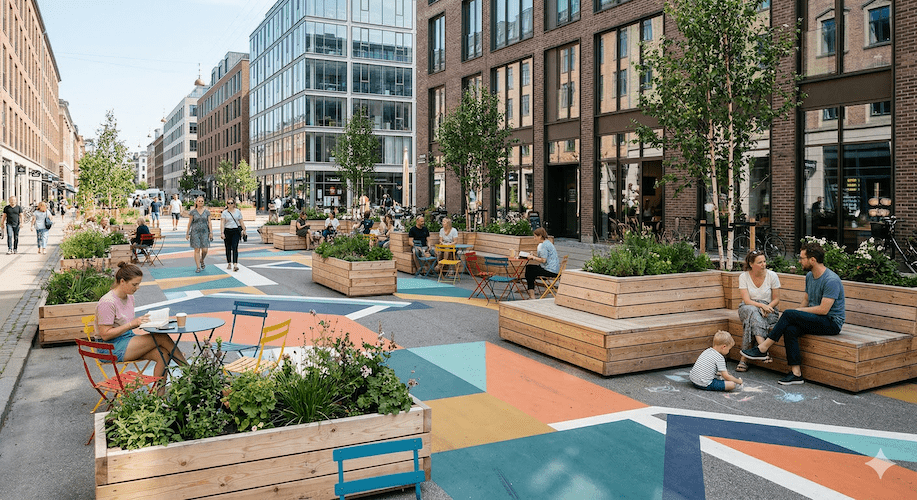
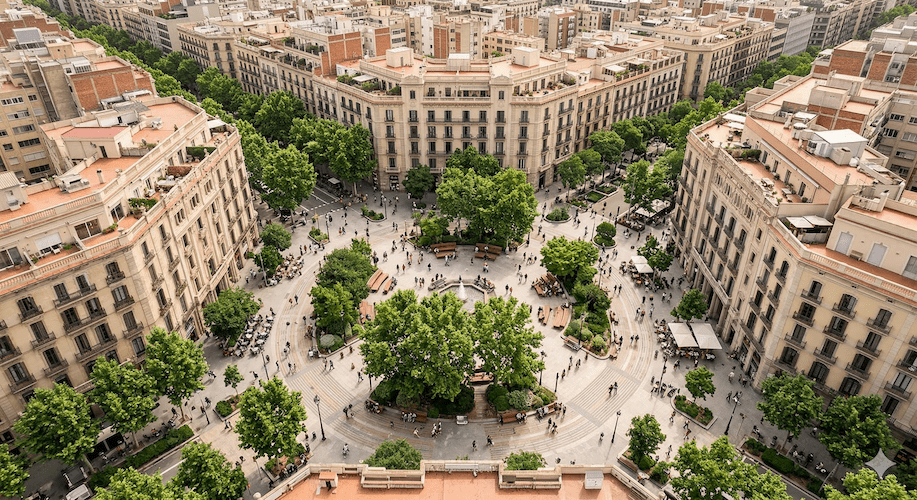
Put simply, postmodern urban planning is a philosophy and practical method of urban design that aims for a "pedestrian-centered human scale," "mixed use," and "the restoration of the history, culture, and decoration unique to each place." As Jane Jacobs, the famous American urban thinker, said, "A city is a mass of diversity. It is this diversity that gives a city its vitality," the aim is to incorporate the complex activities inherent in human beings into space.
In particular, the "New Urbanism" movement systematized in the United States and the concept of "smart growth" that encompasses it are representative models that embody this postmodern approach in the form of specific master plans and building regulations (design codes).By breaking away from traditional zoning (use district systems) that strictly separate uses and concentrating all functions necessary for daily life within walking distance, they aim to simultaneously revitalize communities and reduce environmental impact.
This article delves into a wide range of facts, from the historical background of the birth of postmodern urban planning to concrete empirical data on the effects of smart growth, the evolution of modern "15-minute cities," and the potential for urban revitalization in Toyako Town, Hokkaido. Let's explore optimal solutions for future urban development from the perspective of maximizing capital and designing rich relationships.
1. The birth of postmodern urban planning and its historical background
The Limits of Modernism and the Impact of the Pruitt-Igoe Housing Complex
Modernist urban planning, which was mainstream from the 1960s to the 1970s, quickly took the world by storm. Its strict zoning, which clearly separated residential, commercial, and industrial areas, and its approach of connecting these areas with a vast network of highways, was believed to bring "mechanical efficiency" to cities.
However, the reality was far from ideal. The separation of functions led to the sprawl of cities into the suburbs, and excessive reliance on automobiles led to severe traffic congestion and air pollution. Furthermore, the single-use areas turned into ghost towns at night, and historic cityscapes were transformed into impersonal concrete skyscrapers.
A historic event symbolizing the failure of modernism occurred in St. Louis, Missouri, USA. The Pruitt-Igoe housing complex, which incorporated the most cutting-edge architectural theories of the time and was praised as the ideal example of modernist architecture, had become a serious slum and a hotbed of crime just over a decade after its completion. The first building in the complex was demolished by explosion on March 16, 1972, and after several more explosions in April and June, the entire complex was finally demolished by 1976.
Citing the iconic image of the explosion on July 15, 1972, which was circulated around the world, architectural critic Charles Jencks defined that date as "the death of modern architecture (modernism)." It can be said that the attempt to reclaim human scale and complexity from homogeneous, inorganic space began in these ruins.
The area around the former Pruitt-Igoe housing complex (St. Louis, Missouri, USA), which symbolizes the end of modernist urban planning.
The Birth of New Urbanism: Seaside's New Blueprint
Later, in the early 1980s, "New Urbanism" began in earnest in the United States as a concrete movement to overcome the failures of modernism. One of its monumental projects was "Seaside," whose construction began in Florida in 1981.
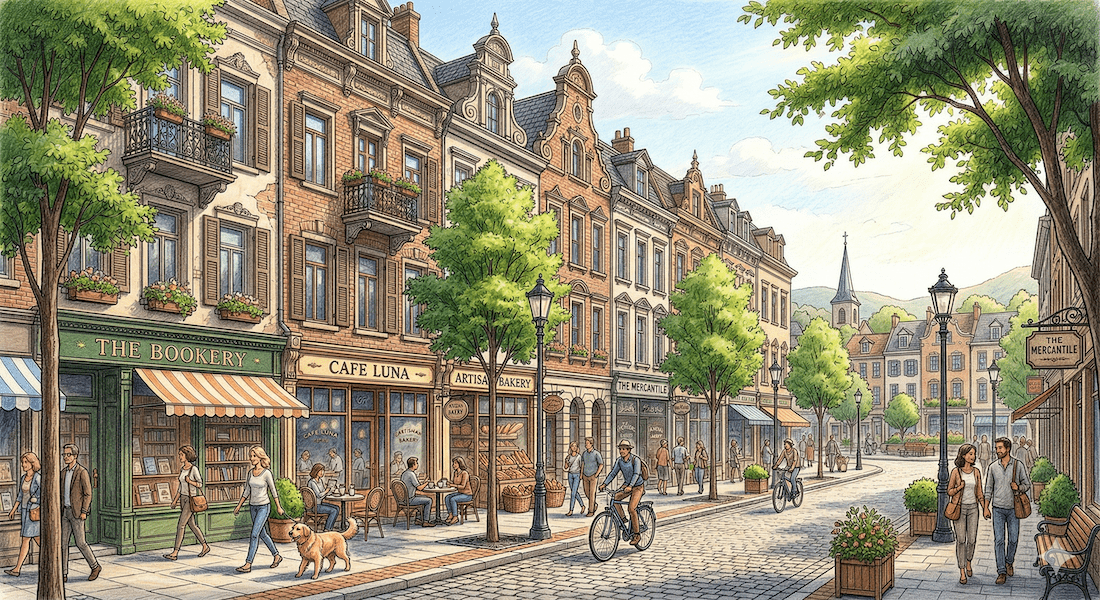
The architects, Andrés Duany and Elisabeth Plater-Zybeck, rejected the car-centric approach and instead incorporated elements of neoclassical and traditional vernacular architecture. They created a "pedestrian-centered spatial composition" by arranging homes, shops, and schools within walking distance of each other around a plaza, allowing people to exchange greetings over their porches.
Following the success of Seaside, development of Kentlands in Maryland began in 1988, and in the early 1990s, the Disney-led Celebration project in Florida began its first residential development in 1996, spreading the idea across the United States. Amid this wave of activity, the Congress for a New Urbanism (CNU) was founded in 1993, and the New Urbanism Charter, which codified its ideas and practical methods, was ratified in 1996.
Seaside, Florida, a renowned example of New Urbanism
Unique reception and development in Japan
What about the situation in Japan? From the perspective of architectural design, postmodern architecture, incorporating historical and unusual designs as "superficial decoration," began to appear mainly in commercial facilities towards the end of the 1990s after the collapse of the bubble economy, as exemplified by "QFRONT" in Shibuya, Tokyo, which was completed in 1999 (Heisei 11). These buildings became a symbol of Japan's flat, information-consuming urban landscape.
At the same time, however, a substantial bottom-up movement was steadily nurturing, seeking to recover the "region's unique historical context" that had been lost due to rapid modernization. A prime example of this is the historic townscape preservation movement, exemplified by Tsumago-juku in Nagano Prefecture. This initiative, which beautifully preserved the landscape of an Edo-period post town under a strict residents' charter (three principles) of "no selling, no renting, no demolishing," became an important foundation that led to later Japanese landscape urban development and postmodern approaches that value regional context.
| Comparison element | [Modernist urban planning] (Traditional suburban development) |
[Postmodern urban planning] (New Urbanism, etc.) |
|---|---|---|
| Basic Philosophy and Approach | Pursuing efficiency, functional separation, and universality. Uniform design based on a top-down master plan. | Respecting diversity, complexity, and historical context, with flexible bottom-up design that responds to the local climate. |
| Land use (use) | Strict zoning leads to the separation of uses, resulting in widespread physical separation of residential areas, commercial facilities, and industrial parks. | Mixed-use: housing, small shops, offices and public spaces are closely spaced within walking distance. |
| Transportation and Street Network | The design is based on automobile travel, with cul-de-sacs and wide main roads creating a multi-level structure. | Pedestrian and transit-oriented design (TOD), with a highly connected grid-like road network and human-scale street widths. |
| Architectural Design and Landscape | A complete elimination of ornamentation, the International Style is geometric and inorganic, primarily made of glass, steel, and concrete. | Restoration of historical and regional characteristics. Allowance of ornamentation, introduction of various styles such as traditional regional styles and neoclassical styles. |
2. The economic and social impact of postmodern urban planning
Overwhelming ROI as seen in comparative data (proof of smart growth)
Long-term comparative data has been compiled by research institutes in the United States on the economic and social effects of postmodern compact urban development. It should be noted that the data below is not evidence of "New Urbanism" alone, but rather a research compilation (reported by Smart Growth America and others) comparing the entire "smart growth development" that encompasses it with traditional suburban development (sprawl).
Specifically, it has been reported that initial infrastructure costs for roads, water supply and sewerage, etc. are approximately 381 TP3T lower on average compared to the conventional model, and ongoing service costs for police, fire departments, and emergency services are also approximately 101 TP3T lower on average.
Furthermore, when tax revenue is reassessed on a per-acre basis rather than a per-unit basis, the property tax and other generating power of mixed-use development far exceeds that of traditional development. Furthermore, comparative case studies such as those by Kentlands (Tu & Eppli, 2001) have shown that mixed-use developments command a price premium of between 4.11 TP3T and 14.91 TP3T over the surrounding market price. This structure, which dramatically improves ROI (return on investment) on limited resources (land and capital), provides extremely powerful leverage for local governments facing financial difficulties.
Improving public health and optimizing infrastructure
The first is the virtuous cycle of a steady reduction in infrastructure-related costs and increased tax revenues. Another thing that cannot be overlooked is the enormous contribution that urban design can make to public health.
According to commentary from the Boston University School of Public Health and other sources, residents living in compact areas with high walkability are 1.5 times more likely to engage in the recommended "sufficient physical activity" and 0.76 times more likely to become obese (a reduction of approximately 241 TP3T) compared to residents of suburban areas. An environment that encourages daily walking is directly linked to the stability of a sustainable ecosystem, which in turn reduces future medical and social security costs.
Gentrification and regulatory barriers
However, behind the bright lights of beautiful redevelopment lies a dark side. Attractive areas attract wealthy individuals and young professionals, resulting in skyrocketing real estate prices and rents. This leads to the serious social issue of "gentrification," in which traditionally low-income residents and small businesses are forced to move out economically.
Furthermore, in practice, most modern urban planning regulations are based on the strict separation of uses. Therefore, realizing mixed-use development requires exceptions to existing zoning regulations, which always carries the risk of lengthening development times and increasing costs. Building consensus with the local community is a major bottleneck, including criticism of "facadeism," which superficially consumes historical decoration.
Evolution to the modern era: The spread of the "15-minute city"
Today, postmodern urban planning ideas have evolved into concepts that integrate climate change measures and public health improvements.
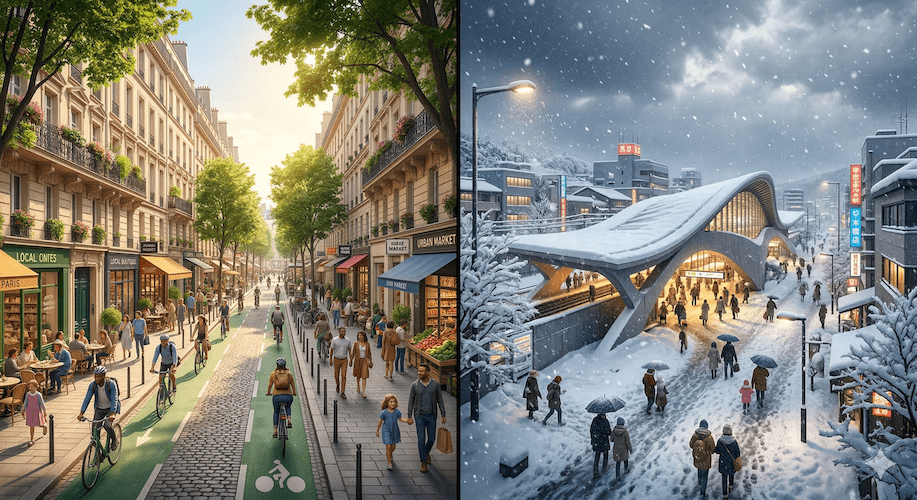
In particular, since the global pandemic of COVID-19, the concept of the "15-minute city," in which all the functions of a living area (work, shopping, education, medical care, and entertainment) can be completed within 15 minutes by foot or bicycle, has rapidly spread. In the city of Paris, France, a policy to reallocate lanes previously reserved for cars to bicycle lanes and pedestrian plazas is being vigorously promoted, and diversity and pedestrian-centric ideas are coming to fruition as a modern global standard.
3. Possibility of implementing "capital maximization" as seen in Toyako Town, Hokkaido
Sponge-like grid cities and the revitalization of historical contexts
Now, when we apply the concepts of postmodern urban planning and smart growth to the context of Japan's regional cities, particularly Hokkaido, we can see some extremely thought-provoking realities and potential.
Unlike other regions in Japan, Hokkaido has a unique history in that American urban planning methods were introduced to the prefecture by the Hokkaido Development Commission during the Meiji period, and modern grid-like urban planning, which opened up wilderness, was applied to the entire prefecture. This efficient development using a modernist approach certainly supported Hokkaido's rapid development. However, with the subsequent motorization (a complete car-based society), urban functions sprawled endlessly into the suburbs.
Currently, many municipalities in Hokkaido are experiencing a phenomenon in which vacant houses and vacant lots are spreading like moths in their central city areas. This is a serious issue known as "urban spongeization," which the Ministry of Land, Infrastructure, Transport and Tourism defined and warned about in a 2017 document.
In particular, Toyako Town, one of Japan's leading hot spring resort areas, has a beautiful natural landscape of a caldera lake and a strong context as a historic hot spring town, but it has been unable to resist the waves of depopulation and population decline, and the maintenance and renewal of widely scattered roads and water and sewerage infrastructure is putting a heavy strain on local government finances. What is required here is how to integrate and implement the concepts of "preserving extraordinary historical and natural landscapes" as a tourist resource and "developing a compact, walkable town" where local residents can live without excessive reliance on cars.
The Toyako area in Hokkaido faces the challenge of balancing tourism and infrastructure
Reducing fiscal burdens and shifting tax revenue efficiency: Seeking leverage
Based on the principle of prioritizing facts, we note that there are currently no official estimates of the specific tax revenue increases or cost savings that would result from the implementation of smart growth specifically in Toyako Town. However, by using financial data from similar local governments in Hokkaido and the aforementioned US statistical coefficients, it is possible to theoretically estimate the potential ROI.
For example, when analyzing the budget structure of a local city in Hokkaido (reference: data from Iwamizawa City's "Outline of the Initial Budget (Draft) for FY2023"), of the total expenditure of approximately 46.6 billion yen, "civil engineering expenses" related to the maintenance of infrastructure such as roads and bridges account for approximately 6.29 billion yen (13.5% of the total), and "sanitation expenses" including garbage disposal, etc. account for a large amount of approximately 3.56 billion yen.
Even when scaling this down to the budget of Toyako Town (population approximately 8,000), expenditures related to infrastructure and public services account for a large proportion of government expenditures. If we apply the theoretical smart growth figures of "a reduction of approximately 381 TP3T in initial infrastructure costs" and "a reduction of approximately 101 TP3T in maintenance costs," based on empirical data from the United States, we can expect a sustainable reduction in the fiscal burden of tens to hundreds of millions of yen over the medium to long term.
Furthermore, the leverage effect in terms of tax revenue is enormous. If high-density development that encourages stay-based consumption by implementing mixed-use and beautifying pedestrian spaces (restoring historical decorations) in the center of a hot spring resort town where tourism is concentrated, there is the potential for a dramatic increase in tax revenue generated per area compared to conventional suburban roadside development. This is a powerful scenario for redesigning the fragile local fiscal structure that is overly dependent on external subsidies into an independent, resilient, win-win ecosystem.
Conclusion: The value of space that we must inherit as we move towards hybrid urbanism
[The following are the author's predictions and outlook]
In the near future, a few years from now, it is predicted that the ideals of postmodern urban planning will be fused with the latest technology to form an advanced "hybrid urbanism." "Efficient and eco-friendly behind-the-scenes systems" such as autonomous driving, energy optimization through smart grids, and zero-emission buildings will be automated using cutting-edge technology.
At the same time, however, the "front spatial configuration" of the city where people come into direct contact will likely return to its postmodern roots of being "pedestrian-centric," "human-scale," and "reflection of the region's unique historical context." The fusion of this back-of-house system with the front-of-house space will be the optimal solution for future sustainable urban development.
The pursuit of efficiency and functionality in modernist urban planning certainly brought about rapid modernization for humanity. However, urban planning is not simply about the layout of physical space or competing for the lowest short-term construction costs. It is a highly ethical and strategic act of design that maximizes the ROI on invested resources from a long-term perspective while also fostering the fortuitous interactions and relationships that the diverse people who live there can be proud of.
Over a long time horizon spanning several decades, we aim to dramatically reduce infrastructure maintenance costs, achieve overwhelming tax revenue efficiency per area, and above all, create well-being for people. The restoration of diversity and history that will achieve these goals will be the most reliable investment for strengthening capital for the next generation and stabilizing the ecosystem.
Related Links
- Ministry of Land, Infrastructure, Transport and Tourism: Town development and urban planning
- Congress for the New Urbanism (CNU)
- Smart Growth America
Inquiries and requests
We help solve local issues.
Please feel free to contact us even if it is a small matter.