~ "Ride sharing" is the same, but completely different? "Urban logic" vs. "Rural survival strategy" ~
"Call a car with your smartphone."
This act, now a common sight around the world, is not simply the spread of a convenient tool. It is a symbol of a major paradigm shift, moving from the "civilization of ownership" that humanity built in the 20th century to the "civilization of access" of the 21st century.
However, this transformation has not been an easy one. It has involved more than 100 years of conflict between regulation and freedom, friction with existing industries, and a history of trial and error within the legal systems of each country.
In this paper, we will examine the phenomenon of ride-sharing."The Hundred Years' War"From the rise and fall of "Jitney" in Los Angeles in 1914, to its reinvention in Silicon Valley, to the complex structure of "Japanese-style ride-sharing," which has evolved in a unique way that is unparalleled anywhere in the world, this book examines the history of ride-sharing.
Furthermore, Toyako Town in Hokkaido, which is at the forefront of this movement, is a project that combines urban logic with rural survival strategies."Next-generation hybrid model"We will thoroughly dissect the whole picture.
Chapter 1: Deja Vu of 1914 - The Future Predicted by "Jitney"
Many people think of ride-sharing as a new Silicon Valley invention of the 2010s, but its origins date back more than 100 years.
The Model T Ford and the "Five-Cent Revolution"
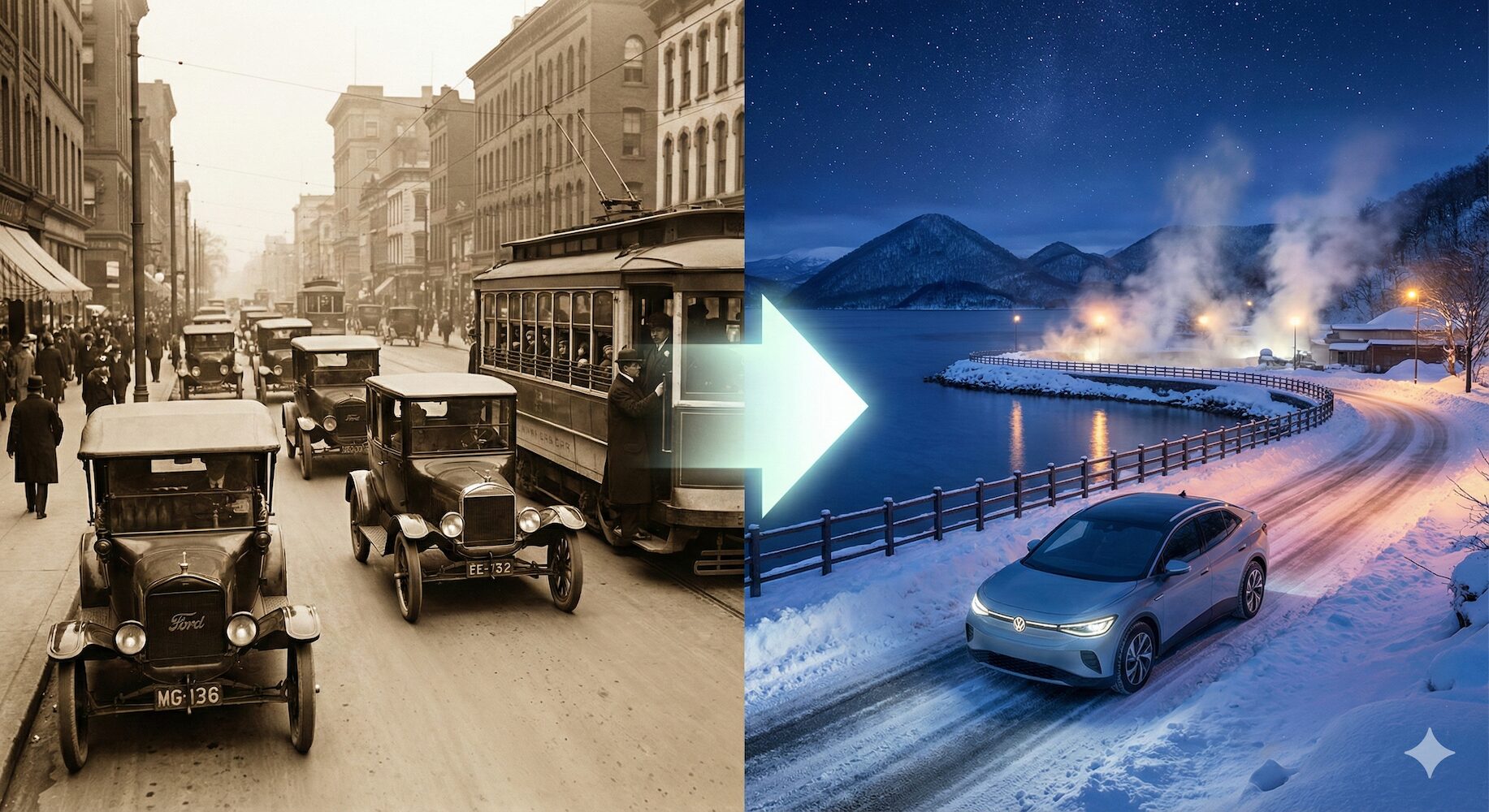
Let's turn back the clock to 1914. The story is set in Los Angeles. Some car owners lost their jobs due to the depression and started picking up pedestrians on the street to earn some extra cash. The fare was 5 cents, the same as the streetcar fare at the time. From the slang term for this 5-cent coin, they"Jitney"It was called.
Amazingly, the characteristics of the century-old Jitney are identical to those of a modern-day Uber.
| Comparison items | 1914 Jitney | 2010s Ride-sharing |
|---|---|---|
| flexibility | There are no fixed tracks or timetables. The route can be changed at the customer's request. |
Specify your destination in the app. Take the shortest route. |
| Speed | There are no frequent stops and it is a direct route. | Door to door on demand. |
| criticism | "Target only profitable routes It's the best of both worlds!" |
"It will take away existing taxi customers. It's a 'free ride'!" |
The service exploded in popularity, with 62,000 vehicles in operation across the United States in no time. It was described in the newspapers as "one of the most fascinating experiments in public transportation." However, it infuriated the existing streetcar companies, who lobbied ferociously, resulting in strict regulations being imposed in 1918, and the Jitney disappearing from the public eye.
However, this desire for freedom of movement did not die out. For 100 years, it lay dormant in the underground currents of cities until technology became available as a weapon.
Chapter 2: Reinventing Trust with Algorithms
This dormant concept was awakened with the founding of Uber in 2009 and the arrival of Lyft in 2012. The combination of smartphones, GPS, and algorithms allowed Jitney to break through barriers that he had previously been unable to overcome.
The essence of the revolution they brought about is not simply matching.The fact that technology has transformed what is inherently a very risky act of "getting into a stranger's car" into a "safe and reliable transaction"is located.
Three types of distrust solved by technology
Not only the driver but also the passengers are evaluated. By "monitoring each other," a pseudo-relationship of trust is instantly built.
In-app payment eliminates the need to exchange money when getting off the bus, dramatically reducing the risk of getting change and robbery.
Prices fluctuate according to demand."If you pay the money, you'll definitely get caught."This realizes the magic of supply and demand adjustment.
Current status of the global market
As of 2024, the global ride-sharing market is worth approximately 20 trillion yen, and is predicted to reach 100 trillion yen by 2035. However, Uber is not the only dominant player. Didi Chuxing in China and Grab in Southeast Asia have evolved in their own unique ways as "super apps" that support all aspects of daily life.
Chapter 3: Japan's unique evolution - The resolution of the increasingly complex "Japanese model"
While the world was going crazy for ride-sharing, Japan remained silent. This was due to the ironclad legal restrictions of Article 78 of the Road Transportation Act (prohibition of unlicensed taxi operations).
However, in April 2024, the Japanese government finally took action due to a serious taxi shortage (a 20% decrease in drivers, an aging population, and a rapid increase in inbound tourists).
The important thing here is,The lifting of the ban on "Japanese-style ride-sharing" is not a monolithic systemCurrently, there are two types of ride-sharing services in Japan, each with different purposes and structures. It is important to understand this.
Private car utilization business
- the purpose:Eliminating taxi shortages (business)
- operation:taxi operators
- driver:Taxi companies hire, train and manage
- Features:"Emphasis on management." It is not a direct IT matching system like overseas, but rather a reinforcement of taxi capabilities.
Private paid passenger transportation
- the purpose:Ensuring local transportation (welfare and survival)
- operation:Local governments and NPOs
- driver:Local volunteers
- Features:"Mutual aid." Not for profit, just the cost of gasoline. Mainly supporting the elderly.
In other words, up until now, Japan has had only two choices: a "business-oriented urban model" or a "welfare-oriented depopulated area model."A "third model" that breaks through that boundaryis about to be born in Hokkaido.
Chapter 4: Frontline Case Study - Toyako Town, Hokkaido's "Hybrid Strategy"
The true value of Japanese-style ride-sharing is not tested in the big city of Tokyo. It is in regional tourist destinations where public transportation is at its limit. The best example of this isToyako Town, Hokkaidois.
Tourist destinations hit by "dinner refugee" problem
Lake Toya is a hot spring resort that is visited by 3 million people a year. However, behind the scenes, tourists are unable to go to restaurants in the hot spring town due to a shortage of drivers caused by the aging population (45%) and lack of transportation at night."Dinner refugees"This represents a huge opportunity loss for the local economy.
The true nature of Toyako Town's demonstration experiment (winter 2025)
That's why Toyako Town launched a groundbreaking project in December 2025. It's a highly strategic hybrid ride-sharing system that utilizes urban systems while relying on a rural spirit (community).
(Professional safety management)
(Mutual aid from residents and the town hall)
- The system adopts an "urban model":
Instead of volunteering, they decided to adopt a "private car utilization project" and entrusted management to a local taxi company. This ensures "professional quality safety" and allows them to proudly transport tourists for a fee. - Drivers come from all over the region:
Not only are there job openings in urban areas, butEven "town hall employees" are registered as drivers as a side jobWe will drive the local economy through "co-creation" rather than conflict. - The app is the national standard "GO":
Instead of using a system that is unique to each region and difficult to use, we have introduced the number one app in the nation, which tourists from Tokyo can use on their regular smartphones.
Toyako Town's challenge goes beyond simply securing transportation. It is rebuilding infrastructure that has become unsustainable due to population decline by combining a new national system (urban tools) with the community's spirit of mutual aid (regional resources). This is an "invention" that will enable Japan's local governments to survive.
Chapter 5: Future Outlook - Towards the World of Mobility 3.0
The experiment taking place on the snowy roads of Toyako Town is a microcosm of Japan's future. So what lies ahead?
1. Transition to autonomous driving (Robotaxi)
In the medium to long term, ride sharing will shift from manned to unmanned (autonomous) driving. If labor costs, which account for 70% of the cost structure, disappear,"It's much cheaper to call a robotaxi than to own a car."The time is coming.
2. The irreversible shift from ownership to sharing
In the 20th century, capitalism defined "owning one's own car" as the goal of wealth. However, in the 21st century, wealth will be defined as "using the necessary mobility services when needed (MaaS)."
Conclusion: Mobility as the Operating System of Communities
The currently banned "Japanese-style ride-sharing" may be just a transitional system that has just begun."How can we incorporate innovation without sacrificing safety?"It is filled with the struggles and ingenuity of Japanese society.
The Toyako Town case teaches us that ride-sharing is not just a cheap alternative to taxis. It is a way for local communities to protect their freedom of movement and keep their economies moving."The operating system (foundation) of the local community"It can become.
A century ago, the Jitney dream was crushed in Los Angeles. Now, in a small town in Hokkaido, it is being reborn in a different form. From ownership to utilization, from fixed to flexible, from conflict to co-creation. Our mobility is quietly but dramatically changing.
Related Links
- Ministry of Land, Infrastructure, Transport and Tourism |About the Private Car Utilization Project
- Toyako Town, Hokkaido|public transportation
- GO Co., Ltd. | News Release
Inquiries and requests
We help solve local issues.
Please feel free to contact us even if it is a small matter.