〜Behind the utopia of light and greenery lurks the sin of "death on the streets"〜
*This article is based on the latest survey and statistical data as of December 2025.
Today, we take for granted the "sunny high-rise apartment buildings" and "vast, well-maintained urban parks" that we enjoy today. If we trace the origins of these landscapes back to the incredibly ambitious ideas of one of the most brilliant architects of the 20th century, his name was Le Corbusier. The urban planning model he proposed in the 1930s, "La Ville Radieuse (The Radiant City)," was a grand "spatial revolution" that aimed to dismantle modern cities, which at the time were at the height of overcrowding and unsanitary conditions, and to fairly distribute the "basic components of a city" - sun, greenery, and space - to all citizens.
However, over the course of more than half a century, this ideal has come under severe criticism, sometimes seen as a "cold mass of concrete" or as a "device that separates local communities from the organic nature of the streets." How should this legacy of modernism be interpreted in contemporary Japan, particularly in a region like Hokkaido, which has entered an unprecedented era of population decline and is burdened with the heavy task of maintaining and managing vast tracts of land?
This paper thoroughly reexamines, from an academic and statistical perspective, the immeasurable merits of this shining city and its historically proven sins. Furthermore, it squarely examines the realities of the "Comprehensive Management Plans for Public Facilities" of local governments such as Toyako Town, and presents a remarkable urban regeneration scenario that transforms the old "theory of expansion" into a modern "prescription for intelligent folding and maintaining density." It is also an intellectual adventure that redefines the very essence of what it means to "live." Now, 100 years later, the ghost of Le Corbusier is reborn in the northern lands with new meaning.
1. Redefining the Shining City: An Architect's Dream of a "Machine for Living"
First, we need to accurately understand what Le Corbusier was trying to break through, along with the intensity of the era. From the late 19th century to the early 20th century, major cities like Paris and London were swept up in the waves of the Industrial Revolution and were reaching their limits due to a rapid influx of population. Slums, where sunlight did not reach the maze-like back alleys and humidity and foul odors permeated the streets, became widespread. With infectious diseases such as tuberculosis threatening life in cities, Corbusier believed that cities had to perfectly fulfill their role as "devices that function efficiently and promote the physical health of humans." He discarded traditional ornamentation and past streetscapes as "irrational obstacles" and attempted to redesign cities using a scientific approach.
Vertical Escape: The Ultimate Rationality of 90%
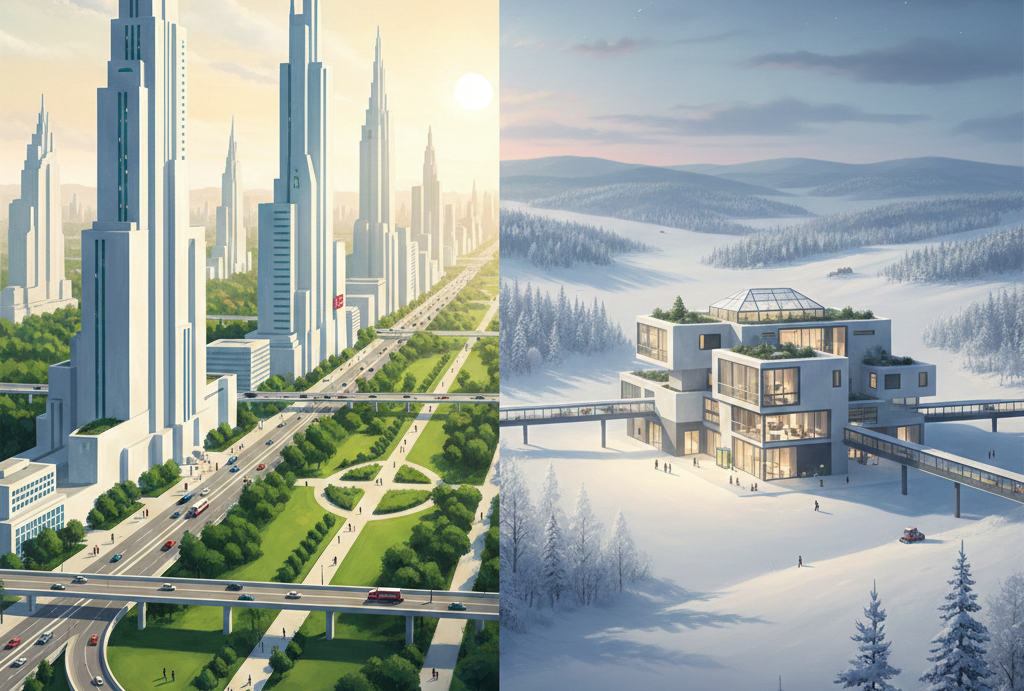
Le Corbusier's proposal was extremely clear and completely overturned the conventional wisdom of the time. It was a geometric idea: "If you extend buildings vertically, the ground becomes free." Whereas conventional cities were filled with buildings on the ground surface and narrow roads formed a network, his ideal for a shining city would be to make buildings super-tall and lift them up on pilotis (spaces only made up of columns), opening up almost the entire ground surface as parks for citizens to relax and transportation routes. Le Corbusier was convinced that this combination of "vertical condensation" and "horizontal openness" was the only way to guarantee equal sunlight, ventilation, and lush green landscapes for all residents.
| comparative index | 19th century overcrowded city | Le Corbusier's "Shining City" |
|---|---|---|
| architectural form | Low-rise, densely built-up areas (stone and brick) | Super high-rise, independent layout (RC construction) |
| Surface vacant lot ratio | About 5% ~ 15% | Approximately 90% ~ 95% (park) |
| City Functions | Mixed living and working environments and chaotic diversity | Strict functional separation (zoning) |
| Concept of movement | A street where pedestrians and horse-drawn carriages coexist | Complete pedestrian and vehicle separation and expressway network |
2. Examining the merits and demerits: Ideals faced the "death of the streets" and the "triumph of efficiency"
Le Corbusier's urban planning became the theoretical basis for the construction of new towns and public housing developments worldwide after the war. Its influence was immeasurable, and it is no exaggeration to say that it created the foundation for our lifestyles. However, his pursuit of "efficiency" also led to irreparable "losses." Here, we will examine the merits and demerits of his work from a multifaceted perspective.
The greatest achievement of shining cities is that they have made full use of modern architectural techniques to spatially guarantee the "right to health." In Japan, the new towns built during the rapid urbanization of the postwar period, and the recent urban redevelopment projects exemplified by Roppongi Hills, are legitimate continuations of this idea of "making efficient use of land and creating abundant public open space above ground." By concentrating population vertically, infrastructure that requires high maintenance costs, such as water supply and sewage systems and energy supply, can be efficiently deployed in the shortest distances, proving to the world its overwhelming economic rationality. This was the wisdom of an extremely advanced civilization that minimized the running costs of cities.
On the other hand, as urban thinker Jane Jacobs sharply criticized in her classic book, "The Death and Life of Great American Cities," the structure in which buildings are "isolated" and scattered throughout vast parks has created numerous "blind spots" where people's eyes cannot reach the streets. Zoning, which mechanically separates functions (separation of residence, work, leisure, and transportation), has taken the joy of walking from everyday life and completely eliminated chance encounters between neighbors and the small-scale economic activity that would naturally emerge in back alleys. There is no denying that this has been a major factor in modern-day "social loneliness" and "community breakdown," and the criticism that humanity has been stripped away in exchange for efficiency still resonates strongly today.
Academic findings on the correlation between urban density and happiness
Modern urban statistics have made it clear that simple densification does not necessarily lead directly to resident well-being. While the "physical health (sunlight and ventilation)" that Corbusier sought was achieved with 20th-century technology, the "spiritual fulfillment" we truly desire in the 21st century requires not only functional efficiency, but also a moderate amount of urban chaos (mixed city) and irrational spaces steeped in history. In other words, cities needed "white space" and "waste," and perhaps this warmth was missing from Corbusier's drawings, in which everything was calculated.
[Conceptual diagram] Correlation between resident satisfaction and life cycle cost (LCC) by urban model
(Suburban Spread)
(15 minute city)
(Shining City)
*Compact cities tend to have the best balance between infrastructure maintenance efficiency and resident satisfaction. Shining cities are extremely efficient, but they still have issues with psychological satisfaction and reinvestment of maintenance costs.
3. A prescription for Hokkaido's shrinking society: "reconsolidation" based on reality
Perhaps Le Corbusier's ideas resonate more poignantly than ever today not in mature metropolises like Paris, but in regional cities in Hokkaido, which are facing the double whammy of rapid population decline and aging infrastructure. As a result of low-density residential areas scattered across vast tracts of land, the per capita costs of road maintenance, snow removal, and water and sewer system renewal are straining local government finances and are nearing the limits of sustainability. Now is the time for us to squarely face up to the "cost of maintaining a city."
The Necessity of Vertical Integration as Seen in the "Comprehensive Management Plan for Public Facilities, etc."
As a concrete example, Toyako Town's latest "Comprehensive Management Plan for Public Facilities, etc." clearly predicts that the available budget will be significantly short of the necessary funds for updating public facilities over the next 40 years. The town's basic policy for overcoming this severe financial crisis is to "consolidate and combine facilities." Here, Le Corbusier's concept of "unité d'habitation" (a gigantic building that combines housing, hospitals, shops, and public services) emerges vividly as a modern solution. "Vertical integration," once used for expansion, is now a "defensive wall" for survival.
| Strategic Steps for a Degenerate Society | Specific approach (hypothetical proposal) | Expected financial and lifestyle benefits |
|---|---|---|
| 1. Multifunctional bases | Town hall, library, clinic, and elderly housing Vertical integration into a single megastructure |
Significant reduction in building maintenance costs, Eliminate the burden of travelling in winter (the ultimate barrier-free environment) |
| 2. Encouraging residential consolidation | From scattered low-density residential areas Gradually promote relocation to highly utilized central hub buildings |
By minimizing the snow removal distance Dramatic improvement in administrative costs and efficiency of public transportation |
| 3. "Renaturalization" of unused land | The vast land that became vacant after the consolidation Without over-management, move to forests, farmlands, or wildlife corridors. |
The ideal of a "shining city" (artificial green space) Converted into "real nature" with no maintenance costs |
Le Corbusier pointed to the sky as a way to accommodate the growing population. However, what we need to do in modern Hokkaido is to wisely gather people into "efficient buildings" to maintain the community's energy amid a declining population and tax revenues, and to return excess infrastructure that can no longer be protected to the beautiful "original landscape" of Hokkaido. This is by no means a "defeat," but rather a "successful decline" based on a highly civilized judgment. The era of mechanical urban expansion is over, and we are entering an era in which we must protect "density" and "quality" with geometric purity.
Financial Simulation: How to Use the "Spare Capacity" Created by Consolidation
If 10% of the residents of an administrative district were to relocate to a multi-purpose complex building in the city center and reduce the distance required to maintain surrounding infrastructure by even a few percent, the financial resources saved could be used to improve nursing care services and support education. When Le Corbusier advocated the concept of a "machine for living," his true aim was to eliminate irrational pain from human life (such as struggling with snow in cold regions) and create more free time. This philosophy should be particularly valuable in Japan, where the population is declining.
Conclusion: Putting the soul of affection into an imperfect "machine"
Le Corbusier once said:"Architecture is a skillful, precise and magnificent play of forms combined under light."He tried to confine cities to a beautiful and orderly order, and while his attempt was a great triumph around the world in terms of functional efficiency, it was left to the harsh judgment of history when it came to the unpredictable chaos of human activity, or in other words, its "emotions."
However, in the uncharted wilderness of the "degenerate society" we now face, the weapon of rationalism he left behind is once again trying to regain its luster. What is important is not to insist on maintaining cities as mere "efficient machines," but to have the flexibility to continue to add the irrational lubricant of "people meeting each other" and "attachment to the place." For a machine to be loved, it must contain a "personal story."
We must respectfully but thoroughly rewrite the blueprint drawn up by this genius from 100 years ago to suit modern climate change, demographic trends, and digitalized lifestyles. To instill the "true brilliance" of a new era in the vast land of Hokkaido, this is not simply about building tall concrete towers, but a courageous decision to reorganize our lives into smarter, warmer, and more sustainable forms. Over 100 years later, Le Corbusier's ideals are becoming a "silent shield" to help people survive the harsh reality of the northern land.
Related Links
- National Museum of Western Art: Le Corbusier and the Museum of Infinite Growth
- Ministry of Land, Infrastructure, Transport and Tourism: Compact City Formation Support System
- Toyako Town: Comprehensive Management Plan for Public Facilities, etc.
Inquiries and requests
We help solve local issues.
Please feel free to contact us even if it is a small matter.