〜Building regulations (codes) and beneficiary-payment mechanisms introduced in response to disasters〜
*This article is based on information as of January 2026.
When a city undergoes dramatic change, it is often accompanied by tragic destruction.
In other words, drastic changes that would be impossible to agree on in peacetime are only justified when faced with the overwhelming reality of mountains of rubble. The most emblematic example of this is none other than the Great Fire of London that occurred in England in the 17th century.
In September 1666, a single flame that started in a bakery's oven quickly engulfed the medieval wooden city and reduced 85% of London to ashes. However, when viewed from the perspective of urban planning experts, this event takes on a meaning that goes beyond mere disaster.
In other words, it was a historic turning point that forced and irreversibly updated the city's operating system from a fragile system of densely packed wooden buildings to a "fireproof city" made of brick and stone.
This paper will provide a detailed analysis of this reconstruction process, which can be considered the origin of modern urban planning, based on the laws and data of the time. Furthermore, it will explore the specific possibilities for applying this knowledge to "resilient urban development" in modern Japan, particularly in Toyako Town, Hokkaido, which lives with the insurmountable natural threat of volcanoes.
1. Why did London burn in 1666?
Densely built wooden cities as "firewood mountains"
First, let's take a look at the situation London was in at the time. In the mid-17th century, London was at the height of its prosperity due to trade, but its urban structure had a fatal flaw.
At that time, London was made up of tarred wooden houses. These were crowded together in narrow, maze-like alleys, literally forming "wood piles." In addition, the plague (Black Death) had been rampant the previous year, in 1665, so improvements to sanitary conditions were urgently needed.
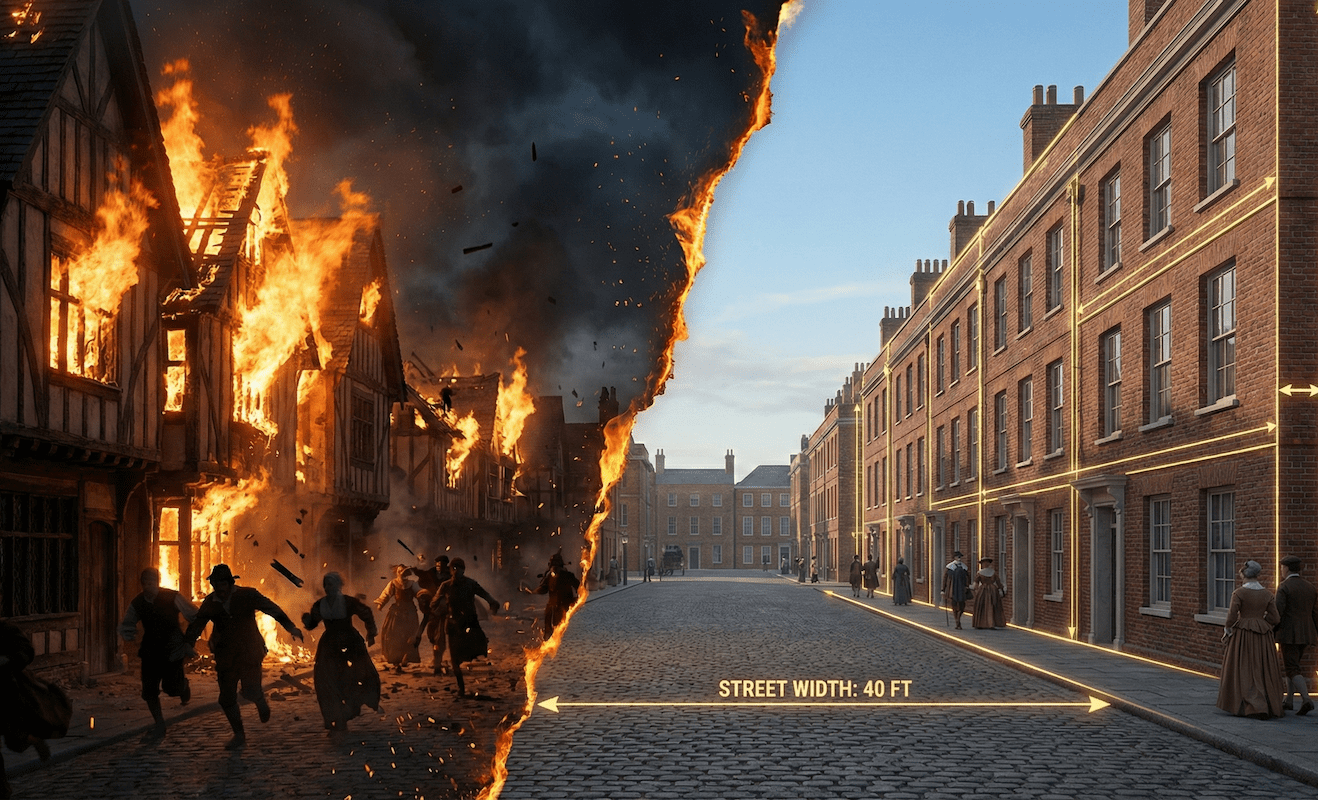
One structural factor that particularly exacerbated the damage was the "jetty," a common architectural style at the time. This was a structure in which the second and third floors of a building jutted out toward the road. Given the limited land area, this was a common idea among the common people to maximize the floor space on the upper floors, but it turned into a fire prevention nightmare.
The roofs of the houses facing each other were so close that they could shake hands across the street. This created a sort of "tunnel effect," allowing the wind to carry the flames across the road and spread the fire from one place to the next.
The Monument to the Great Fire and the area around Pudding Lane where the fire started
A catastrophic four-day timeline
In the early hours of September 2, 1666, a fire broke out in the shop of Thomas Fariner, a royal baker, on Pudding Lane, and was quickly engulfed by the easterly winds that blew through the city.
According to the diary of Samuel Pepys, people rushed to save their belongings rather than fight the fire, and the Thames was filled with loaded boats. The indecisive response of the mayor at the time, Thomas Bloodworth, also contributed to the loss of any opportunity to put out the fire in its early stages.
As a result, the four-day fire caused the following devastating damage:
📊 Estimated damage from the Great Fire of London
*Equivalent to about 1/6 of the population of London at the time
2. "Fireproofing" or "Securing Space"? A Comparison of Reconstruction Philosophy in Japan and the UK
London and Edo: Contrasting Responses to Disasters
Let's broaden our perspective and compare it with contemporary Japan. Coincidentally, nine years before the Great Fire of London, the Meireki Fire also occurred in Edo, Japan, in 1657. Two of the world's largest cities were hit by devastating fires at roughly the same time.
What is interesting is the crucial difference in the subsequent reconstruction approaches. London, which was at low risk of earthquakes, chose the path of "resistance," which involved fortifying the city with heavy, fireproof materials. In contrast, Edo, which was in an earthquake-prone area, chose the path of "avoidance," which assumed that the city would burn but tried to prevent the fire from spreading.
This difference goes beyond mere differences in building materials; it has been passed down to the present day as a difference in "philosophy" in urban planning.
| Comparison items | Great Fire of London (1666) | The Great Fire of Meireki (1657, Edo) |
|---|---|---|
| Basic Strategy |
Brickization The "Go" approach involves physically replacing the entire city with non-flammable materials. |
Firebreaks A "soft" approach that allows fires to break out and then prevents them from breaking out by creating a buffer of space. |
| Main building materials |
Mandatory brick and stone construction *Wooden exterior walls were strictly prohibited. |
Continuation of wooden construction *Although earthen storehouse construction was encouraged, it was limited due to cost. |
| urban space |
Widening and straightening of existing roads (Considerations include the construction of a new King Street and other logistics efficiencies.) |
Establishment of "Hirokoji" and "Firebreak" (Current Ueno Hirokoji is a remnant of this.) |
| reconstruction financial resources |
Coal Tax Public investment funded by port tax, based on the principle of beneficiary payment. |
Shogunate relief funds and self-financing by feudal lords and townspeople (a mixture of self-help and public assistance). |
One notable feature of London's reconstruction was the introduction of a beneficiary-pays system known as the "coal tax." The costs of rebuilding public buildings and churches were covered by taxing the coal Londoners used daily for heating and cooking. This was an advanced system that could be considered a precursor to modern-day city planning taxes and earmarked taxes, and it surpassed the Edo period in the realism of its method of securing financial resources.
3. The birth of modern building regulations: the 1667 Reconstruction Act
"Code" determines urban design
In response to the burnt ruins of London, leading intellectuals of the time, such as Christopher Wren and John Evelyn, proposed grand Baroque city plans modelled on those of Paris and Rome, idealising the city with a geometric grid and radial streets.
However, in reality, this ideal plan was not realized. The main reason for this was the "complexity of land rights." Redrawing all the land boundaries would have required a huge amount of surveying time, and the citizens and merchants who wanted the city to quickly recover as a commercial city could not wait that long.
Instead, the Rebuilding of London Act of 1667 was adopted, which was an extremely pragmatic approach that maintained the existing street network (land divisions) while strictly controlling the quality and standards of buildings.
📜 Key Points of the Act of Reconstruction of 1667
-
1) Completely mandating brick and stone construction
All exterior walls were to be made of fire-resistant materials. Buildings that violated the law were forcibly demolished. -
② Building Standardization
Buildings were classified into four classes according to their importance to the road, and the number of floors and wall thickness for each were strictly regulated.
・Type 1 (back alley): 2-story
・Type 2 (street): 3-story building
・Type 3 (main street): 4-story building
・Type 4 (residence): 4-story building (with setback) -
③ No jetties (overhangs)
Protrusions on the upper floors were prohibited, creating a unified vertical facade, which blocked the route of fire spreading in the sky. -
④ Modernization of stormwater treatment
It was prohibited to let water from roofs directly onto the road, and the installation of downspouts (pipes) was made mandatory.
One of the most technologically groundbreaking features was the provision of "Party Walls." Adjacent buildings shared a brick wall that extended above the roof (a parapet) to physically block the spread of fire.
This is completely consistent with the concepts of "fire compartments" and "partition walls" in modern Japanese building standards. It is astonishing that modern disaster prevention logic was already codified in London 350 years ago.
4. The Pros and Cons of Resilience: For Whom Was the Recovery?
Establishing order and safety
The unification of London to brick construction brought a "permanent order" to the city. The dramatic reduction in fire risk sent a strong message to investors and foreign merchants that "London is a safe place to invest," and supported the subsequent development of the City of London as a global financial center.
Furthermore, the widening of roads and the development of sewerage systems had the secondary effect of eliminating the unsanitary, overcrowded environments that had been breeding grounds for diseases such as the plague that had raged until the previous year. The "Fire Court" also played a role in swiftly adjusting rights, and the city's physical reconstruction was achieved with astonishing speed.
Gentrification and homogenization
On the other hand, the cost of reconstruction was enormous. Poor craftsmen and working-class people who could not afford to build expensive brick buildings could not continue to live in the rebuilt city center, and were instead driven to the East End, a suburb with less stringent regulations. This is said to be a contributing factor to the "poverty of East London" that continues to this day.
Furthermore, the organic and diverse streetscapes characteristic of the Middle Ages were lost, and the landscape of endless standardized red brick walls was criticized at the time as being "monotonous and dull" and "lacking humanity." There is no denying that urban diversity was stripped away in exchange for safety.
5. "Modern Reconstruction Methods" in Toyako Town, Hokkaido
Resilience against volcanoes, not fires
Now, let's move forward to the present day and Toyako Town, Hokkaido. The biggest threat here is not just a "great fire" like in London or Edo. It's the Mount Usu that erupted four times in the 20th century alone (1910, 1944, 1977, and 2000), and the harsh cold and snow of winter.
What we should learn from London's example is not simply to imitate bricks, but the idea of "redefining the physical specifications of cities with disasters in mind."
▼ The relative positions of Lake Toya Onsen and Mount Usu
Recommendation 1: Redefinition of Evacuation Boulevards
Just as London constructed and widened King Street and Queen Street after the Great Fire, the main street of Toyako Onsen town also needs to be redefined as an "absolute evacuation route" rather than simply a tourist road.
Specifically, this means ensuring that roads are wide enough (at least 15 meters) for large evacuation buses and emergency vehicles to pass each other in both directions, even if parts of buildings collapse or volcanic ash accumulates. However, simply widening the roads will result in a loss of the city's vitality.
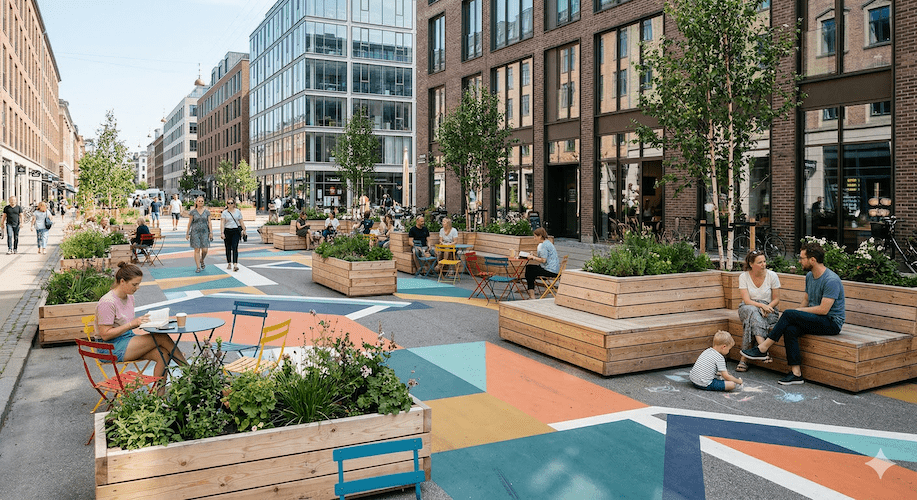
This is where dual-use design becomes important. In normal times, the widened sidewalks can be used as open cafes or event plazas (similar to the Hirokoji of the Edo period), and in times of emergency, the obstacles can be removed to turn them into "roads of life." This flexibility is the essence of modern resilience.
Proposal 2: The revival and evolution of "bricks" in Hokkaido
There is also room for reconsideration of building materials. Hokkaido once had a culture of brick architecture, as exemplified by the former Hokkaido Prefectural Government Office (Red Brick Building). However, brick architecture is no longer mainstream today due to issues with vulnerability to earthquakes and frost damage (deterioration due to internal condensation).
However, technology is advancing. What if the structure (framework) was made of highly earthquake-resistant reinforced concrete or cross-laminated timber (CLT), and the exterior was covered with high-quality bricks from Hokkaido using a "rainscreen construction method"?
This will create a tourist resource similar to London's, with a "solid, fire-resistant, reassuring streetscape," while also achieving modern insulation and earthquake resistance. Guidelines to address the problem of vacant houses, such as removing dilapidated wooden buildings and replacing them with "resilient architecture," should become a "reconstruction law" for modern Toyako.
Proposal 3: Tourism tax as a modern-day "coal tax"
Finally, there is the issue of funding. London introduced a "coal tax" to help with reconstruction. The equivalent for modern tourist destinations would be the expansion of "accommodation taxes" and "bathing taxes."
However, it is important that the tax money is not simply collected but used for "resilience (development of disaster prevention infrastructure)." The message that "your taxes are being used to bury the town's power lines underground and build evacuation routes" will be passed on to tourists as brand value, suggesting that the town is a "safe resort."
Conclusion: Regulation determines the lifespan of a city
The south door of St. Paul's Cathedral bears the following Latin inscription, along with the tombstone of architect Christopher Wren:
“Resurgam”(I get up again)
In 1666, Londoners chose the costly and painful transformation into a "brick city" rather than simply rebuilding barracks on the ruins. It was their agreement to this strict "code" that determined London's subsequent prosperity.
On the other hand, can we today make decisions that take into account not only short-term cost-effectiveness but also "what the landscape will be like 100 years from now" in the face of the declining population, the problem of vacant houses, and impending natural disasters?
A wall one meter thick, a road one meter wide: these are not just numbers, but an expression of the city's strong will to "survive."
Related Links
- London Fire Brigade (LFB) – The Great Fire of London (Official Records from the London Fire Brigade)
- Parliament UK - The Rebuilding of London Act 1667
- Japan Meteorological Agency – Explanation of volcanic activity at Mt. Usu (Background to disaster prevention risks in Hokkaido)
Inquiries and requests
We help solve local issues.
Please feel free to contact us even if it is a small matter.