〜The "Neo-Bastide Concept" balances "protection" and "prosperity" in Toyako Town, Hokkaido, in an era of population decline〜
*This article is based on survey information and statistical data as of December 2025.
"Cities are born so that people can live safely and they exist so that people can live happily."
The ancient Greek philosopher Aristotle defined the essence of a city in this way in his Politics. Thousands of years later, these words are being resurrected with a very real and contemporary resonance in modern Japan, particularly in Hokkaido, a land rocked by waves of depopulation and development.
Currently, local governments in Japan are facing two major threats. One is the risk of financial collapse due to declining tax revenues caused by a declining population and the rising costs of maintaining a sprawling infrastructure network. The other is the increasing severity of natural disasters caused by climate change and geological changes. In response to these challenges, the national government is promoting the creation of "compact cities," but the limits of this uniform application are beginning to become apparent.
On the other hand, in areas such as Niseko in Hokkaido, rapid resort development by foreign capital is progressing, and a modern version of a "walled city" is emerging, a "gated community" (closed residential area) that local residents cannot economically enter.
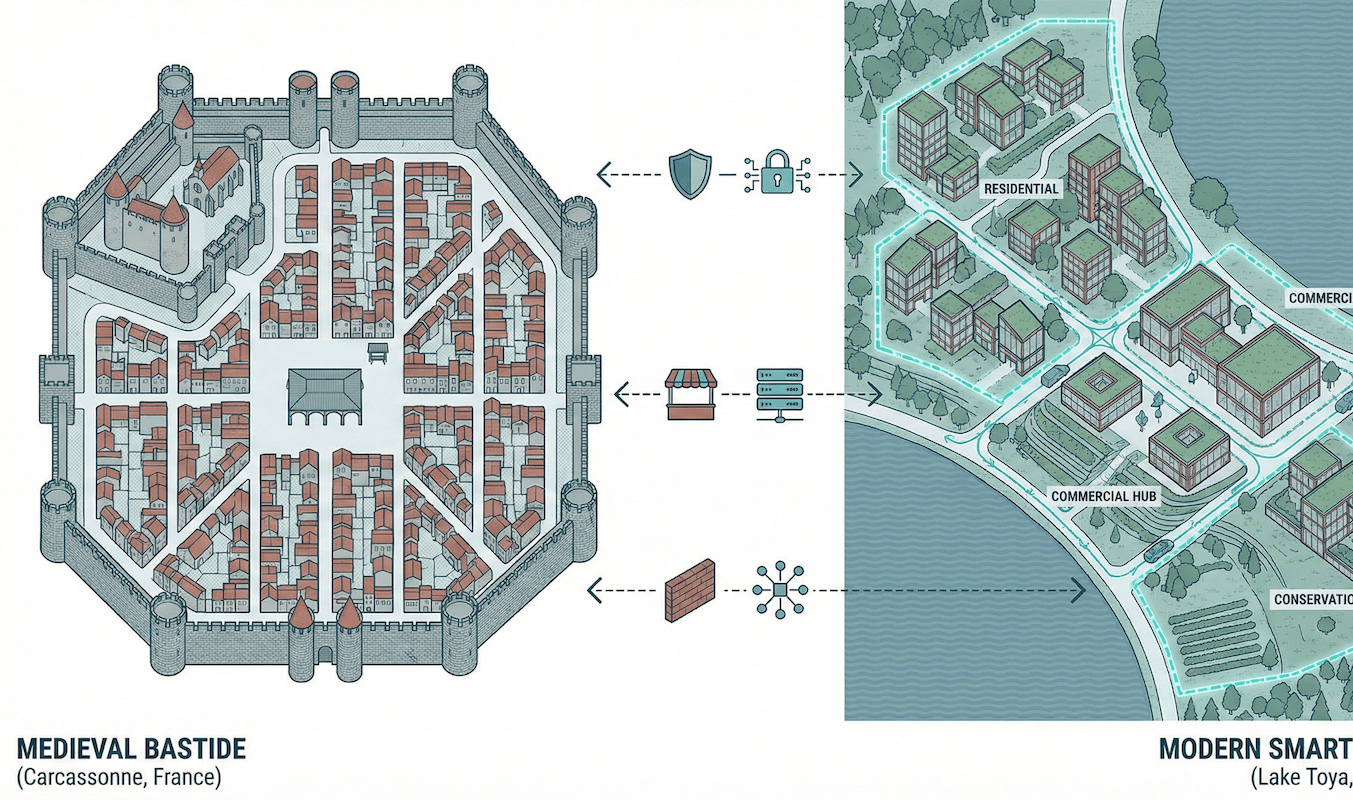
This paper examines from multiple perspectives the historical structure of "walled cities" that developed in medieval Europe, particularly in southern France. These were not simply military fortresses; surprisingly, they were the product of sophisticated urban planning aimed at promoting the economy and protecting the rights of residents. By comparing the wisdom of past "bastides" and "circulades" with modern data and technology, we explore the potential for new urban design that balances "protection" and "prosperity" to address the challenges facing Toyako Town in Hokkaido.
1. Redefining the Walled City: Military Fortress or Special Economic Zone?
When most people hear the term "walled city," they probably think of a military fortress surrounded by sturdy stone walls, such as Carcassonne in France. However, when we dig deeper into its structure from the perspectives of urban planning and historical geography, we can see that it was home to an extremely rational economic system that went beyond simple "defense."
Medieval walled cities can be broadly classified into three types based on their origins and functions. Accurately distinguishing between these types is the first step in applying this theory to the modern world.
(1) Cité: Symbol of authority and control
The first example that comes to mind is the "Cité," typified by Carcassonne (Aude, France). This refers to a city surrounded by strong stone walls (Ramparts) and numerous towers, with a castle (château) at the center, the residence of a lord or bishop. Its main purpose was to secure a base of political and military control, and while the residents were under the protection of the lord, they were also incorporated into a strict control structure.
(2) Circulade: Wisdom of Collective Defense
Next, the "circular villages" (circular settlements) that spontaneously formed in the Languedoc region between the 11th and 12th centuries have a unique structure in which houses are arranged in concentric circles around a central church or castle.
What is particularly noteworthy is that the walls of the houses on the perimeter function as the city's defensive wall (Rempart). In other words, the individual houses are connected to form a huge wall that protects the entire community. This can be said to be the origin of "collective defense," which is similar to modern apartment building security and community-based crime prevention systems that involve mutual surveillance.
(3) Bastide: A medieval economic zone
The most important inspiration for modern urban development comes from the "Bastides," planned new towns built between the 13th and 14th centuries.
The boom in the construction of bastides began as a reconstruction project following the devastation of southern France during the Albigensian Crusade (1209-1229). The Count of Toulouse and the King of France implemented groundbreaking urban policies to concentrate the scattered population and cultivate wasteland to secure tax revenues.
it is,"Grid Streets" and "Market Square (Place du Marché)"The city's design was centered around the idea of "free cities." Even more importantly, it was a "free city." The feudal lords issued "charters" (Charte de coutumes) to the settlers, guaranteeing freedom from feudal servitude, personal freedom, and property rights.
As a result, farmers moved to the bastides in droves. They shifted to a system of paying taxes on trade (buying and selling at the market) rather than on production (harvest). In other words, the bastides were a medieval"Special Economic Zone"The city walls were not only a defense against foreign enemies, but also a physical boundary to protect the internal "vested interests" of a free market economy and civil rights.
2. Comparative Analysis: Medieval and Modern Walls
Taking into account the historical context, we will compare it with modern urban structures. In particular, we will use data to analyze what kind of "walls" define cities in the modern era, when physical city walls have disappeared.
| Comparison items | [Medieval] Bastide (13th-14th century France) |
[Modern] Niseko area (21st century Hokkaido) |
|---|---|---|
| Main purpose of formation | Postwar reconstruction, population concentration, and economic development | Tourism development, asset preservation, and investment income |
| Defense measures (walls) | Stone walls, moats and watchtowers (physical defense) |
High real estate prices and security (Economic filtering) |
| Residents' rights | Protection as "free people" under the Charter Liberation from feudal rule |
Exclusive right of use based on ownership Privacy Protection |
| Maintenance costs | Tax burden of lords and residents (Today, it is publicly funded by the national and local governments.) |
Private investment, management fees (common area fees) Beneficiary payment principle |
| Economic impact | Stabilizing market tax revenue and creating a regional commercial hub | Rising land prices (+19.5%, etc.), increased fixed asset tax The occurrence of gentrification |
The emergence of "invisible walls" and gentrification in modern times
As can be seen from the table above, the "stone walls" of the Middle Ages have transformed into "economic walls" in modern times.
Specifically, the rate of land price increase in Kutchan Town (Niseko area) in Hokkaido has been among the highest in the country in recent years (for example, in the Hanazono area, there have been cases where prices have increased by approximately 201 TP3T compared to the previous year). While this rise in land prices has brought a significant increase in property tax revenue to local governments, it has also produced serious side effects.
This is "gentrification" (the displacement of residents due to the gentrification of residential areas). Setting inbound prices, such as a bowl of ramen costing over 3,000 yen, economically excludes local residents from an area, even without a physical gate. This suggests that in contrast to the inclusive system of medieval bastides, which "opened the market and welcomed peasants," modern gated communities tend to be exclusive systems that "enclose only the chosen few."
The Paradox of Urban Sprawl and Maintenance Costs
Furthermore, the concept of the "boundary" of a walled city is directly linked to the financial problems facing local governments in Japan. As urban functions have spread uncontrollably to the suburbs (sprawl), the efficiency of administrative services such as roads, water supply and sewerage, and snow removal has declined significantly.
[Conceptual diagram] Relationship between urban density and administrative costs per capita
(sprawl)
(Compact city)
*Conceptual model based on published data from Toyama City, etc.
As the diagram above shows, consolidating residential areas (castling) leads to dramatic reductions in administrative costs. Medieval people concentrated their residences within walls not only for defense purposes, but also as a way to efficiently allocate limited resources (water, food, and energy).
3. Toyako version of "Neo-Bastide" concept: A scenario for disaster prevention and coexistence
So, based on these historical lessons and modern data, what kind of urban strategy should Toyako Town draw up? My suggestion is to create a city that uses barriers, not physical barriers, but barriers created by systems and design."Neo-Bastide (New Walled City)"It's a concept.
Toyako Town has to pay the price for its beautiful scenery by living with the risk of the active volcano, Mount Usu. The "castle" here refers to the strict "risk boundary line" established based on a hazard map.
Specifically, relatively safe areas will be defined as "inside the castle (residentially-guided areas)," and public investments will be concentrated there, such as removing utility poles, snow-melting ditches, highly insulated housing, and advanced communications infrastructure. Conversely, high-risk areas will be designated "outside the castle," with less residential space and utilized for agriculture, parks, and nature experience zones. This will create a highly resilient urban structure that will allow the "inside the castle" to function as an evacuation base in the event of a disaster and reduce infrastructure maintenance costs in peacetime.
Just as the Bastides of the past welcomed serfs as "free citizens" and revitalized the economy, modern Toyako has the potential to attract "digital nomads" and teleworkers as new citizens.
Coworking spaces and satellite offices will be positioned as modern-day "marketplaces," and those staying for a certain period of time (the relevant population) will be issued "digital citizenship" such as hot spring passports and the right to use resident services. This will increase the middle class between tourists (short-term) and permanent residents (long-term), and create a stable economic cycle that is not affected by seasonal fluctuations.
Improving migration by creating a circular area around the lake
Furthermore, from the perspective of urban design, Toyako Onsen town needs structural reform, reorganizing the current car-centered flow of people by borrowing the wisdom of medieval circular settlements.
For example, the roads along the lakeside could be made completely pedestrianized, with vehicle traffic being directed to the periphery (bypass). This would create a tranquil and safe "inner" space centered around the lake. The fact that medieval cities were "walkable size" is perfectly aligned with the modern idea of a walkable city (a city where you want to walk). Numerous data have been reported that improving the quality of pedestrian spaces increases the length of time tourists stay in a city and directly leads to an increase in the average consumption amount.
Conclusion: Borders protect not "exclusion" but "the future of the community."
What became clear through the research in this paper is the essential function of medieval European walled cities. It was not "to build walls and keep out the outside world," but"Clear boundaries maximize internal freedom and economic activity and protect the community from unpredictable external threats."It was located in.
In modern Hokkaido, what threatens us is not enemy soldiers. It is uncontrollable natural disasters and the collapse of social systems due to the silent decline in population. What is needed to counter these threats is the courage to redefine our sprawling cities.
We don't need to build physical stone walls, but we need wise land use regulations, strategic infrastructure investments, and fair rules for coexistence between residents and visitors."Institutional walls"There is an urgent need to build
Just as bastides, born in turbulent times, once became bastions of hope for the people and the foundations for new prosperity, Toyako Town's "Neo-Bastide" concept has the potential to become a new model that shows the world what sustainable regional cities should be like.
Related Links
- Ministry of Land, Infrastructure, Transport and Tourism: Towards the creation of compact cities
- French Tourist Development Agency: The walled city of Carcassonne
- Toyako Town: Second Toyako Town Urban Planning Master Plan
Inquiries and requests
We help solve local issues.
Please feel free to contact us even if it is a small matter.