〜What questions does the grand vision of the "Chicago Plan" left behind by Daniel Burnham, the father of modern urban planning, pose to urban development in modern Japan?〜
*This article is compiled and analyzed based on publicly available information as of January 2026.
"Make no little plans."
Anyone involved in urban planning, architecture, or the broader field of design has likely heard this phrase at least once. This is not just a slogan or a spirited call at a construction site. It is the crystallization of one man's unwavering belief, who, more than a century ago, was the driving force behind the transformation of Chicago, a city in the United States that was shrouded in smog and chaos, into "one of the most beautiful cities in the world."
His name was Daniel Hudson Burnham (1846–1912), known as the “father of modern urban planning.” The “Plan of Chicago,” which he proposed and implemented, continues to be referenced today as both a holy book in urban development around the world and a subject of critical scrutiny.
However, one question arises here: In today's Japan, where the population is declining and society is maturing, and even "downsizing" is on the horizon, are the ever-increasing "large-scale developments" and "master plans" of the past now outdated relics?
To put it simply, the answer is no. Rather, we live in an uncertain time where the future is uncertain, and what Burnham advocated as a perspective that looks several generations ahead is what is needed.
This article carefully unravels the true meaning of Burnham's "grand plan" in its historical context, while exploring the possibility of combining it with the contrasting modern method of "tactical urbanism." It then applies this perspective to the specific field of Toyako Town in Hokkaido, and comprehensively considers the ideal form of "urban dignity" and "sustainable development" that should be passed on to future generations.
1. Introduction: Urban Planning as "Magic" and Burnham's True Intentions
First of all, we need to look back at the historical context in which Daniel Burnham left behind his famous words. By tracing back through history, the true weight of his words becomes apparent.
1.1 The true nature of a vision that "gets people's blood boiling"
At the Town Planning Conference held in London in 1910, Burnham stressed the importance of "vision" in urban development. The following phrase, now widely attributed to him, is said to have originated in a speech paper given at the conference ("A City of the Future under a Democratic Government"), among other sources:
“Don’t make small plans, they won’t have the magic to make people’s blood boil and they probably won’t even come to fruition.
Plan big. Aim high in your hopes and your work.
Remember that noble and logical drawings, once recorded, never die, but will live on and assert themselves more and more long after we are gone."
— Daniel Hudson Burnham (Attributed)
At the time, from the late 19th century to the early 20th century, Chicago was in the midst of rapid industrialization. The railroad network was spread out in a chaotic fashion, black smoke billowed from factories, and living conditions for workers were extremely poor. It was a city of desire and chaos, with no regard for "beauty."
Under these circumstances, Burnham's goal was not simply to improve the physical landscape by widening roads and constructing buildings. He sought to bring order and beauty to the city, thereby uplifting the spirits of the people who lived there and fostering civic pride. This was the core of the great wave known as the "City Beautiful Movement."
1.2 The 1909 "Chicago Plan": A vision of the future
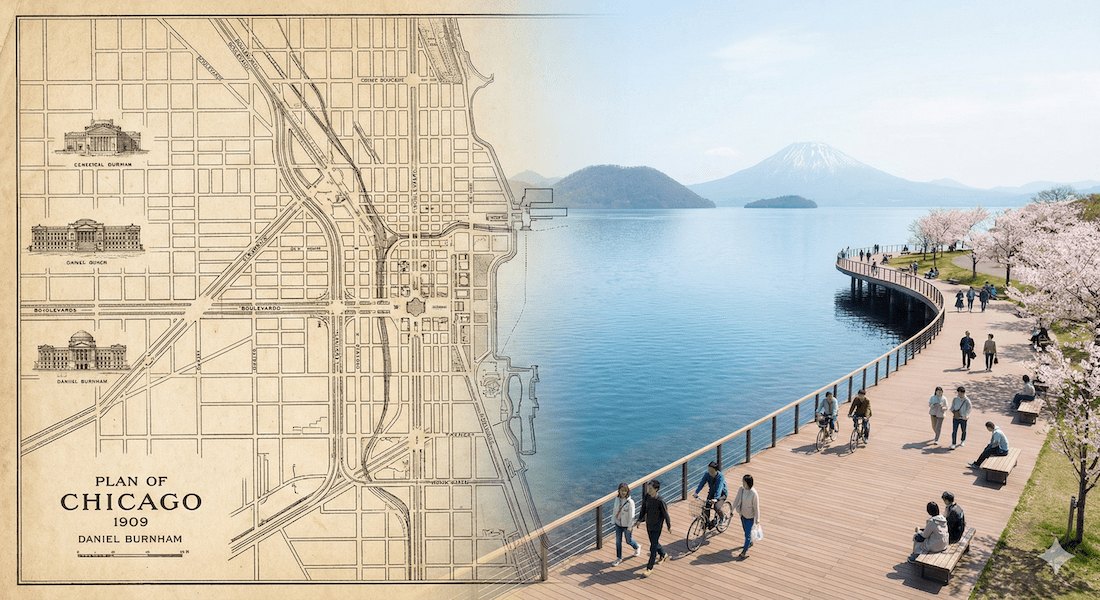
The "Chicago Plan" was drawn up by Burnham and his assistant Edward Bennett and published in 1909. It was the first comprehensive regional urban plan in the United States, taking into account not only the Chicago metropolitan area but the entire metropolitan area (with a radius of approximately 60 miles).
According to sources such as the Chicago Architecture Center, the plan's framework is made up of six main categories:
Six Frameworks of the Chicago Plan (1909)
- 01. Improvement of the Lake Front:
The Lake Michigan shoreline will be freed from industrial use and privatization and developed into a "public park." - 02. System of Highways outside the City:
Develop a road network that efficiently connects the city center with the suburbs, and between suburban cities. - 03. Improvement of Railway Terminals:
The complicated flow of cargo and passengers will be streamlined and terminal stations will be consolidated. - 04. Acquisition of an Outer Park System:
In anticipation of urban overcrowding, forest areas on the outskirts will be set aside as public land (green belts). - 05. Systematic Arrangement of Streets:
Diagonal streets will be introduced to shorten access times to the city center. - 06. Development of Centers of Civic Administration:
Administrative and cultural facilities will be concentrated in one place, and a symbol will be built that will serve as the spiritual center of the city.
Of particular importance was the "publicization of the lakefront." From an economic perspective at the time, the lakefront was the ideal location for factories and warehouses. However, after a legal battle led by catalogue mail-order magnate Aaron Montgomery Ward and others, the principle of "Forever Open, Clear, and Free" was established. Burnham's plan can be said to have spatially embodied this ideal.
As a result, of the current Chicago lakefront (approximately 29-30 miles), approximately 26 miles (approximately 42 km) has been opened to the public as parks and public open space. The Google Map below shows a continuous series of lush green buffer zones that seem to stand against the hustle and bustle of the city.
▲ The Grant Park area in Chicago. Almost the entire lakefront is reserved as public space.
2. Comparative Urban Studies: The crucial differences between the urban structures of Chicago and Japan
Comparing Chicago, where Burnham's "grand plan" was realized, with our Japanese cities highlights the fundamental differences in their philosophies regarding urban formation. Here, we will attempt to analyze the two from both quantitative data and qualitative institutional perspectives.
2.1 [Quantitative analysis] Comparison of two axes: "area" and "closeness"
To evaluate the quality of a city's green space, it is necessary to look at two indicators simultaneously: "area (quantity) per person" and "proximity to home (access)." The chart below compares Chicago and Tokyo (23 wards) using the same criteria.
Park Environment in Japanese and American Cities: A Comparison Using Two Indicators
(Park area per person)
* Chicago is calculated by dividing the managed area (8,800 acres) by the population. For Tokyo, please refer to the Tokyo Metropolitan Government Bureau of Construction data.
(Walking distance coverage rate)
*For Chicago, see TPL ParkScore. Tokyo has small parks scattered throughout the city, and accessibility is at a similar level.
Swipe the graph sideways to see the comparison
This comparative graph illustrates the crucial differences between urban structures in Japan and the United States. Looking at "② Accessibility," the bar extends all the way to the right in both cities, showing that parks are familiar to residents. However, there is a difference of more than three times in "① Spaciousness."
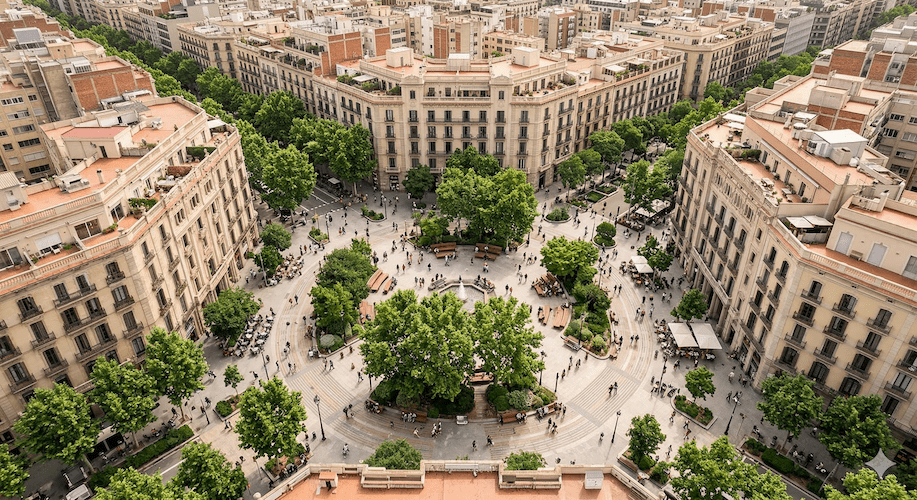
In other words, Tokyo is "a network of small parks spread throughout the city like capillaries (high density, small scale)," while Chicago is "a city with vast open spaces secured in familiar locations (high density, large scale)." Burnham's goal was not just to distribute space in close proximity, but also to distribute it equitably, with a "sufficient scale" that allowed citizens to unwind physically and mentally.
2.2 [Qualitative analysis] Conflicts in zoning ideology: separation or coexistence?
Digging deeper, we find that Japan and the United States have contrasting approaches to the concept of "zoning," which determines the landscape and function of cities.
| Comparison items | American type (Euclidean type) |
Japanese type (cumulative type/inclusive type) |
|---|---|---|
| basic philosophy | Exclusive/separation (Exclusive) "Not mixing" is the right thing to do |
Inclusive/Mixed Tolerance is the basis |
| Regulatory Mechanism | In residential areas, there are only houses. Strict single-use classification. |
Store construction is possible even in residential areas. Mild regulation based on "maximum level of inconvenience." |
| merit | Stabilizing real estate values. A quiet living environment and a unified landscape. |
Proximity of work and home (walkability). Creating unexpected bustle and convenience. |
| Disadvantages | Dependence on car travel. The area is divided and becomes a ghost town at night. |
Chaos in the landscape. Risk of noise and living environment problems. |
Swipe the table sideways to see more details
Burnham's plans prioritize "order," so they have a strong affinity with American (Euclidean) zoning, which separates functions. On the other hand, Japanese urban development has the flexibility to use small plots of land for multiple purposes, which has created a unique "mixed charm." Rather than a dichotomy of which is superior, the key to the future lies in how to utilize the characteristics of both.
3. The Genealogy of "Planned Cities" in Hokkaido and the Influence of America
Now let's shift our focus to Hokkaido, the subject of this article. In fact, Hokkaido has a history of urban development that is completely different from other regions of Japan.
3.1 The Capron Plan and Grid Streets
In the early Meiji period, the Hokkaido Development Commission invited many experts (hired foreigners) from the United States. The most prominent of these was Horace Capron, an advisor to the Commission. Under their guidance, Sapporo and other major cities in Hokkaido were built as planned cities with a clear "grid" street layout similar to that seen in the American Midwest.
While castle towns in Honshu have labyrinthine structures (T-junctions and dead ends) that intentionally make visibility difficult for defensive purposes, Sapporo's cityscape is rational and linear as far as the eye can see. Furthermore, Odori Park, a symbol of Sapporo, was originally developed by the Hokkaido Development Commission as a firebreak to prevent the spread of fires, and now also serves as a green belt that gives the city a breath of fresh air.
Odori Park, Sapporo. The grid-like streets and green belts that form the city axis show the strong influence of American urban planning.
In other words, Hokkaido's cities have a DNA that has always embraced the Burnham-esque "Logical Diagram." This historical context is an important factor supporting the legitimacy of Toyako Town's new urban development concept.
4. Contemporary Trend: Fusion with "Tactical Urbanism"
However, "grand plans" also have some drawbacks that cannot be ignored. These include huge financial burdens, long lead times until completion, and rigidity that makes it difficult to make corrections once underway. In today's rapidly changing society, tying everything down to a fixed plan that looks 100 years into the future can actually be risky.
In recent years, a method known as "tactical urbanism" has been attracting worldwide attention.
4.1 "Start small, grow big"
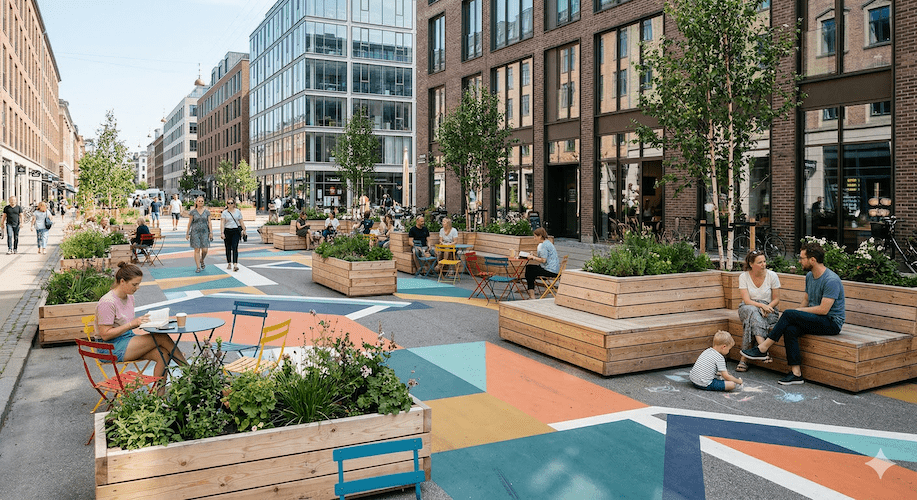
The slogan "Lighter, Quicker, Cheaper," advocated by groups such as Project for Public Spaces (PPS), perfectly captures the essence of this approach, which includes turning road space into temporary plazas, setting up food trucks, and painting temporary bicycle lanes.
At first glance, this may seem to go against Burnham's teaching, "Don't make small plans." However, this is not the case. If what Burnham sought was "magic that moves the hearts of citizens," then perhaps this process, in which citizens themselves participate and change their town little by little with their own hands, could be said to be a modern-day form of "magic."
Big Plans/Macro
Features:Government-led, long-term perspective, infrastructure development, irreversible.
role:Protecting the city's "skeleton" and ensuring values such as the landscape and natural environment that must not be changed for 100 years.
Small Practices/Micro
Features:Citizen-led, short-term perspective, social experiment, reversible.
role:Creating the "blood flow" of the city, creating a lively atmosphere that responds to the changing times and fostering community interaction.
5. Local practice: "Toyako Model" adapted to Toyako Town, Hokkaido
Based on the discussion so far, we will propose a new model of urban development for the specific region of Toyako Town, Hokkaido, that combines Burnham's ideas with modern tactics.
5.1 [Lakeside Area] Burnham-style "Sanctuary" Strategy
The legal principle that Montgomery Ward and others advocated for protecting the Chicago lakeshore, "Forever Open, Clear, and Free," should be applied as a guiding principle to Lake Toya today, given its overwhelming natural assets.
-
Full public access to the lakefront:
Currently, in some areas, accommodation facilities are built right up to the lakeshore, but in the future, we will encourage them to set back and develop a continuous "lakeside promenade" that anyone can walk along freely. This is a "grand plan" that prioritizes the public good, rather than the profits of any particular company. -
Establishment of "view rights" and removal of abandoned buildings:
The local government will take strong leadership in removing the abandoned hotels (Blight) that are obstructing the view and promoting greening. Ensuring a view of the lake (Vista) is an absolute rule for protecting the dignity of the city.
5.2 [Hot Spring Towns and Streets] Creating a Japanese-style "tactical" lively atmosphere
On the other hand, on the main streets of hot spring resorts where tourists and residents come and go, Japanese-style flexibility that allows for change is needed rather than strict regulations.
-
Street "living" experiment:
We will conduct a social experiment by temporarily turning the roadway into a pedestrian zone and installing kotatsu tables and terrace seating on the street. Unconstrained by existing zoning, we will draw out the potential of the area by using an agile approach of "try it, and if it doesn't work, fix it." -
Turning winter's negatives into positives:
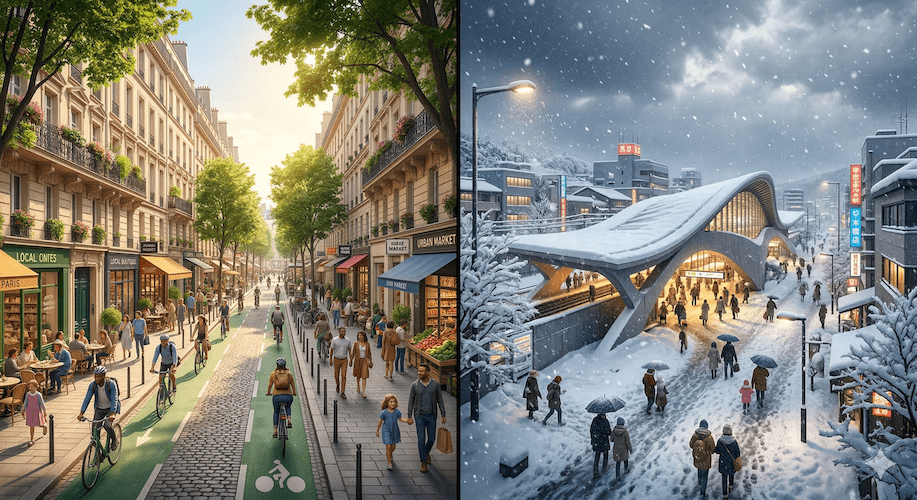
A winter challenge in Hokkaido is the "snow mountains caused by snow removal." Rather than treating them as mere obstacles, they are incorporated into the design as snow candle corridors and play areas for children. This is an extremely advanced example of tactical urbanism that makes use of the region's unique climate and geography.
Conclusion: The intersection of 100-year plans and daily activities
Burnham's call to "make big plans" was to give pride and direction to a city that had lost hope for the future. His message resonates particularly strongly in modern Japan, where a sense of stagnation pervades.
What we should aim for is a flexible approach that applies a "strict Burnham gaze" to natural structures such as lakes and mountains that must not be changed, while incorporating "tactical practices by citizens" to daily life and the bustle of the streets.
"Logical blueprints" and "practices that bring human touch." Where these two intersect, we can be sure that we will create a town that will continue to be loved for 100 years to come. While accumulating small actions, we must always continue to draw a big map in our hearts. This is the responsibility of those of us living today, and it will be our greatest gift to the future.
Related Links
- Chicago Architecture Center: The Plan of Chicago (1909) – A comprehensive look at the historic plan
- Ministry of Land, Infrastructure, Transport and Tourism: Overview of the Urban Planning System – Land Use Regulations and Zoning in Japan
- Sotonoba: Domestic examples of tactical urbanism and the use of public spaces
Inquiries and requests
We help solve local issues.
Please feel free to contact us even if it is a small matter.