〜A decision made 350 years ago that was torn between property rights and public safety〜
*This article is based on the latest research and historical documents (such as Parentalia) as of January 2026.
"Reader, if you want a monument, look around you."
St. Paul's Cathedral towers over the City of London, London's financial district. In its crypt, a Latin inscription praising its designer, Sir Christopher Wren, is quietly engraved. However, when we consider these words from the perspective of urban planning history, we become aware of one "enormous absence."
If the gears of history had turned just a little differently, the "monuments" we see in London would not have been just cathedrals, but rather a "perfectly planned city" composed of magnificent geometric grids and radial roads that would surpass even Paris and Washington DC.
In 1666, the Great Fire of London burned to the ground. Immediately afterwards, Wren presented King Charles II with a master plan for reconstruction, which envisioned a break with the chaos of the Middle Ages and a leap towards a modern city that combined disaster prevention, sanitation, and beauty. However, this innovative proposal was deemed "unworkable" and was forgotten in the darkness of history.
Why on earth was such an ideal plan, which should have been logically correct, rejected by the citizens? And what insightful implications does this history of "failure" offer for the urban structure of Sapporo, Hokkaido, far away in Japan, and for the modern-day urban development of Toyako Town, which is facing population decline and volcanic risk?
In this article, we will decipher the unfinished blueprints from 350 years ago from a modern perspective, and thoroughly delve into the eternal dilemma between urban "hard" (foundation) and "soft" (rights) aspects, and the lessons that can be drawn from this for the future, based on detailed data and facts.
1. Proposal from the Ashes: Ren's "Baroque Dream" and its Numerical Basis
1666: The disappearance of the city and the "tabula rasa"
First, we need to accurately understand the situation at the time. Until the mid-17th century, London was a dark, unsanitary medieval city, with wooden houses packed tightly together within Roman walls and "jetties" with upper floors jutting out into the street and obscuring the sky. The urban environment was reaching its limits, with a major plague outbreak in 1665 killing approximately 70,000 people.
Then, in the early hours of September 2, 1666, a fire broke out at a bakery on Pudding Lane, fanned by strong winds and razed approximately 801 tp3t in the city. However, for intellectuals of the time, particularly Christopher Wren, a member of the Royal Society, this tragedy was also a "golden opportunity."
On September 11, just a few days after the fire had been extinguished, Len submitted a master plan to the King. It was an extremely mathematical and rational one, completely ignoring the existing property boundaries and maze-like alleyways, and drawing new lines as if the land were a vacant lot (tabula rasa).
Three core features of the Ren Project
Wren's proposal went beyond simply widening the roads. Drawing on the Baroque urban planning of Rome, which he had studied in books and had visited Paris the previous year, he sought to bring three principles to London:
- ●Hierarchical road network:
All roads have been strictly standardized into three levels based on traffic volume: 90 feet (major arteries), 60 feet (core roads), and 30 feet (residential roads). - ●Focal Points:
The Royal Exchange was placed at the center, creating a star-shaped plaza with roads radiating out from it, and the layout was calculated so that churches and public buildings were always visible at the eye stop (the line of sight). - ●Open waterfront (Quays):
The plan was to canalise the River Fleet and build extensive quays along the Thames in an attempt to dramatically improve logistics efficiency and the landscape.
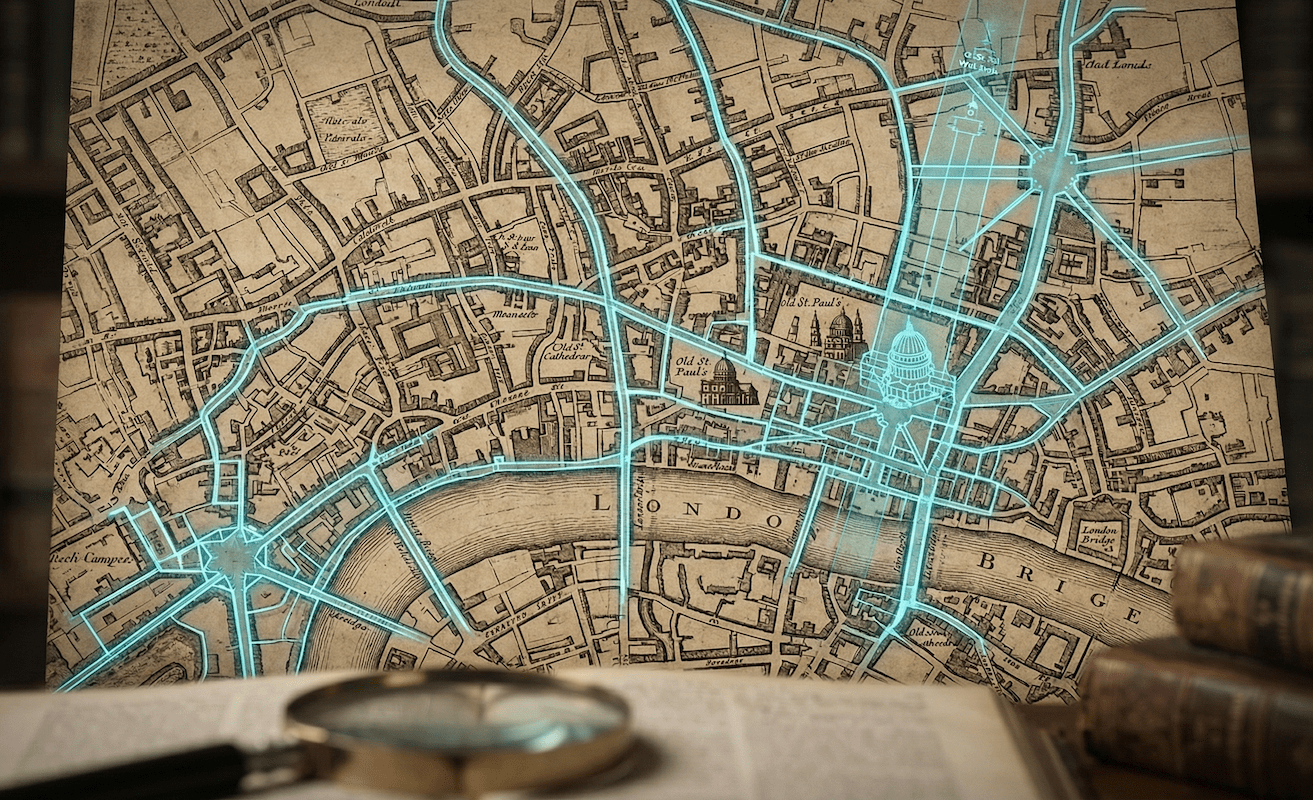
[Map] The area around St. Paul's Cathedral (now the City of London), which Wren focused on for his reconstruction
*The complex street layout on the map shows that Wren's grid plan was not realized and the medieval land division was maintained.
[Comparative Analysis] Revolutionary Road Width
This visual comparison shows how insanely huge Ren's proposed 90 feet (approximately 27.4 meters) figure was at the time, and how closely it resembles modern cities.
📊 Comparison of road widths (common sense at the time vs. Len's ideals vs. modern times)
*In an era when horse-drawn carriages could barely pass each other, this proposed road would be equivalent to a modern two-lane road.
(← You can scroll horizontally →)
As this graph makes clear, Wren's plan was not simply a restoration project, but a revolution that would fundamentally change the scale of the city. The 90-foot road not only served as a firebreak in the event of a fire, but also represented an infrastructure investment in anticipation of future increases in traffic volume.
2. Why the plan was deemed "unfeasible": Rights and time barriers
The despair of "impossible to measure"
Why was such a rational, forward-looking plan rejected? Commonly cited reasons include a lack of funding and a lack of leadership on the part of the King, but modern research (such as that by T.F. Reddaway) has revealed that the true cause was a more structural issue: complex property rights.
Before the Great Fire, London had extremely complex land boundaries due to centuries of additions and alterations. Furthermore, there were multiple layers of rights for each parcel of land, including "freeholders" and "leaseholders," as well as sub-leases.
To realize Wren's plan, all land rights had to be reset to zero and the land redistributed to fit the new road sections, a process known as "replotting."
This method is equivalent to modern land readjustment projects, but at the time, accurate surveying techniques and the registration system to legally guarantee them were underdeveloped, making it difficult to even determine who owned what land.
Merchants argued that time was money. If surveying and adjusting rights took years, London's port functions would be paralyzed and it would lose dominance to rival cities such as Amsterdam.
"I want to rebuild my store immediately on the ruins of my burnt store." This urgent and powerful economic motivation overwhelmed geometric idealism.
The Fire Court's Struggle
In the end, Charles II abandoned Wren's master plan and decided to rebuild based on the existing street network. However, it is important to note that he did not allow for "disorderly rebuilding."
In order to expedite the reconstruction, the government established a special court called the Fire Court. This was a groundbreaking system that bypassed normal court procedures and adjudicated disputes between landlords and tenants, such as who should bear the cost of reconstruction and how rent should be reduced, through summary trials. This legal mechanism was the hidden driving force behind London's rapid recovery.
3. The foundation of modern building regulations left behind by compromise
Wren's "Road Plan" has disappeared, but his "Philosophy of Disaster Prevention" has survived in another form."Rebuilding Act 1667"is.
This law adopted an approach that changed the quality of buildings instead of changing the shape of the city. Specifically, the following strict regulations were imposed:
| Regulation items | Specific details | Modern-day impact and significance |
|---|---|---|
| Nonflammability obligation | All new construction is restricted to brick or stone construction. Wooden construction is prohibited. | The origin of the modern Building Standards Act (fire prevention area designation). Enforced fireproofing of cities. |
| Building restrictions by floor | Buildings are classified into four classes based on the importance of the road, and their height and number of floors are restricted. | A pioneer of zoning and floor area ratio restrictions. A logic to ensure street views and sunlight. |
| Jetty Ban | Protruding upper floors are prohibited, vertical facades are required, and the installation of storm drains is also mandatory. | Improved hygiene and breathability, and improved fire prevention in the event of a fire. |
(← You can scroll horizontally →)
In this way, London has transformed into a rare hybrid city, with modern, fireproof buildings built on a medieval floor plan. This was a practical solution that abandoned hard reforms (zoning) and opted for soft improvements (legal regulations).
4. To the Northern Lands: Wren Genes Seen in Sapporo and Lake Toya
Sapporo: Ren's dream of becoming a "firebreak city"
Moving forward to 19th century Japan, the city of Sapporo, built by the Hokkaido Development Commission, embodies in a surprisingly pure form the ideals that Wren was unable to realize in London.
Odori Park is particularly symbolic. This huge green space, approximately 105 meters wide and stretching 1.5 km from east to west, was originally planned as a "firebreak" dividing the city into north and south. It can be said to be an example of Ren's idea of "blocking the spread of fire with wide roads" being implemented on an even larger scale and in a more planned manner.
[Map] Odori Park, Sapporo (an example of a huge firebreak created by modern urban planning)
Toyako Town: Reverse Urban Planning in an Era of Population Decline
Now, in contrast to the present day, regional cities like Toyako Town in Hokkaido are facing the exact opposite challenges of London: a declining population and an increase in vacant land. However, here too, there are lessons to be learned from Wren's unfinished plan.
Toyako Town is a tourist destination that coexists with the active volcano Mount Usu. With the aging rate exceeding 44.0% (as of 2024), securing routes that allow the elderly to evacuate quickly in the event of a disaster is vital. If the Ren-style "90-foot road" concept were applied here, it would not be new development, but rather "ensuring ample evacuation routes by utilizing vacant land that has become a sponge."
Rather than leaving vacant lots resulting from population decline in an unregulated manner, they will be systematically connected as "green spaces" and "plazas." These will serve as places of relaxation for tourists in normal times, and as buffer zones to prevent the spread of fires and aid evacuation in emergencies. This is urban planning based on a reversed idea: "By reducing the number of buildings, we can raise the scale of the city."
5. Future Outlook: Digital Twins Open Up the Future of Adjustment
Technology can solve the cost of consensus building
The "rights adjustment" hurdle that Ren faced may be overcome by modern technology: the "Digital Twin."
By integrating not only the physical shape of a city, but also complex rights relationships, underground utilities, and disaster simulations in virtual space, it will be possible to instantly visualize "what would be the benefits and losses to each individual if this area were rezoned?" This will dramatically shorten the consensus-building process, which previously took years, and will enable "pre-reconstruction" with the consent of residents.
Conclusion: Cities are made by agreements, not by blueprints
Christopher Wren's plan for rebuilding London was perfect on paper, but a city is more than just a physical arrangement of buildings and roads; it is a living thing, a complex web of the lives, memories, and rights of the people who live there.
The rejection of Wren's plan was in some ways a victory for "democratic urbanism." Londoners chose to prioritize protecting their own infrastructure over top-down ideals, and in return accepted strict building regulations.
What we can learn from this today is the difficulty of "tearing everything down and rebuilding (revolution)" and the value of "doing the best we can within existing constraints (improvement)." Toyako Town, located amidst Hokkaido's magnificent natural scenery, also needs more than just massive infrastructure development. With Ren's goals of "safety" and "beauty" in mind, the town will update the rules one step at a time through dialogue with local residents. This steady process is the only way to create a "strong town" that will remain for 100 years to come.
Related Links
- Museum of London: History of the Great Fire and Reconstruction
- Ministry of Land, Infrastructure, Transport and Tourism: Case studies of urban reconstruction
- Sapporo City Archives: Sapporo's urban planning and infrastructure development
Inquiries and requests
We help solve local issues.
Please feel free to contact us even if it is a small matter.