〜Unraveling the genealogy of two squares: the "Dialogue Agora" of Ancient Greece and the "Majestic Form" of Rome〜
*This article is based on survey data and historical documents as of December 2025.
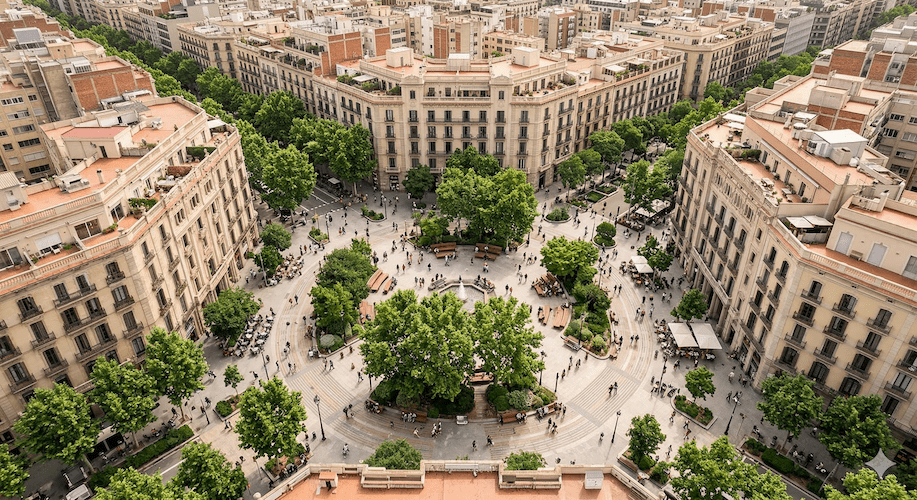
A city is not simply a physical collection of buildings and roads. It is a "total of relationships" woven by the people who live, gather, and move around there, and at the center of these cities has always been the "square," a mirror that reflects the spirit of the times.
Many regional cities in Japan, including Toyako Town in Hokkaido, where we are based, are currently at a crossroads when it comes to "revitalization." They face population decline, deserted streets, and intensifying competition as tourist destinations. Are there sustainable solutions to these issues that go beyond the hasty construction of new buildings?
The key lies in the resume of an ancient city dating back thousands of years.
In the Mediterranean world, two concepts of squares once functioned as the engines of cities: the ancient Greek"Agora"and ancient Roman"Forum"。
This paper unearths the dramatic transformation in the functions of these two plazas from the layers of history and compares them with contemporary urban data (GDP contribution rate and economic ripple effects). What emerges from this is a universal law that is relevant to the modern discussion of "walkable cities" and a concrete vision for the future of Toyako Town as a "public space that coexists with the volcano."
Let's bridge historical knowledge with modern data to unravel next-generation urban strategies.
1. Genealogy of the ancient square: "functional transformation" from agora to forum
The square has always been at the core of urban structure in Western civilization. However, the roles that squares played in the two great civilizations of Greece and Rome were similar yet different. We begin our discussion by understanding the crucial differences between them.
1.1 Agora, a space for horizontal participation
The "agora" was an ancient Greek public square, as exemplified by Athens in the pre-Christian era. The word "agora" comes from the meaning of "gathering." Agoras originally arose simply as places for citizens to meet, but eventually came to function as the "engine" of the city (polis), where political, commercial, religious, and social activities intermingled.
The Agora's distinctive feature is its"Horizontality" and "Openness"The space was not physically enclosed, but organically connected to the surrounding natural landscape of mountains and the sea. Although boundary stones (horoi) gently separated the sacred and profane realms, it was a "stage for public discourse" where citizens could debate on an equal footing, enact laws, and practice direct democracy.
Here, the voices of political debate, market calls, and philosophical dialogue resonated equally.
1.2 Forum, the space of vertical authority
However, when Rome assumed hegemony, the square's appearance changed dramatically. While the "Form" inherited the multifunctionality of the agora, its essence shifted to "visualizing authority."
The Roman Forum during the Imperial period in particular was a space lined with magnificent temples, triumphal arches, and gigantic basilicas (public halls) built on artificial land created by reclaiming marshland. Surrounded by colonnades and monumental buildings, the eye is naturally drawn to the central symbol of power.
While the Agora was a space that encouraged "civic participation," the Forum was a place where imperial triumphal arches and religious ceremonies were held."Passive spectator seating"The scale of the space itself functioned as a device to convey to citizens the power of the empire and the absoluteness of the legal order.
▼ Figure 1: Structural comparison of the Greek agora and the Roman forum
| Comparison items | [Greek Agora] (Democratic / Horizontal) |
[Roman Forum] (Imperial / Vertical) |
|---|---|---|
| The Essence of Space | A symbol of civil equality. The cradle of democracy. |
A symbol of imperial power and law and order. A showcase of national prestige. |
| The role of citizens | active participant (Discussion, voting, market transactions) |
Passive Spectator (listening to speeches, ceremonies, and parades) |
| spatial configuration | Harmonizing with the natural landscape and topography, The layout is open to the street. |
Geometric and closed. Giant buildings control the line of sight. |
| Implications for the present day | Marche, exchange events, A place where demonstrations are permitted. |
Ceremonies, parades, A good place to place symbols. |
*Created by the author based on historical documents
2. Data on Modern Cities: Economic Value Generated by Walking
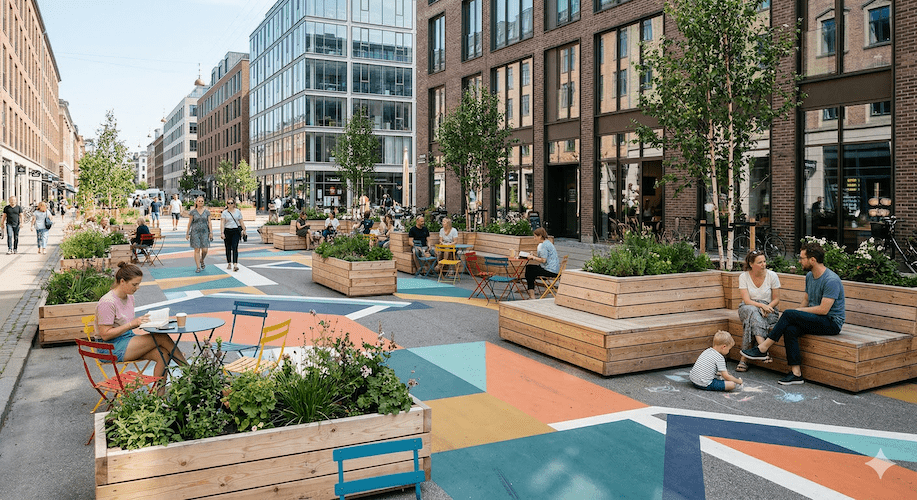
In the context of modern urban planning, especially the "walkable city," these ancient concepts of squares are no longer just a story in history textbooks.
The latest economic data proves that people-centered plazas and pedestrian spaces have far greater "capital efficiency" than car-centric urban designs.
2.1 Only 11 TP3T of land generates 201 TP3T of GDP
A study of 35 major US metropolitan areas (WalkUPs) revealed a surprising fact: only a small fraction of the total land area of a city is considered "walkable."1.2%However, this tiny area contains the entire United States.Approximately 20% of GDPis what is being produced.
This suggests that opportunities for innovation and consumption are concentrated in places where people walk, stay, and interact (plaza-like spaces), rather than in places where people drive through (roads).
▼ Graph: GDP productivity per area of walkable space (35 US metropolitan areas)
Walkable Area
Production Share
*Source: The George Washington University School of Business (WalkUPs survey)
2.2 Japanese Case: Economic Ripple Effects of "Akapla" in Sapporo
Looking at Japan, a good example is Sapporo's Kita 3-jo Plaza (commonly known as Akapla), a former roadway that has been converted into a permanent plaza and is managed by a public-private area management organization.
According to a 2019 survey, the direct economic ripple effect (production ripple effect) of holding events using this square is790 million yenThe income generation effect reached 450 million yen. The ripple effect multiplier for the investment is estimated to be 1.59 times.
By simply restructuring roads from a "passage function" to a "stay function," cities have the potential to generate this much wealth.
3. Shadows of Public Spaces: Gentrification and Noise Risk
■ Eyes on the Street
As Jacobs proposed, gathering people in a square creates a "natural surveillance eye" and improves public safety.
■ Accidental consumption
Impulse shopping and eating and drinking while strolling, rather than shopping for a specific purpose, broadens the base of the local economy.
■ Gentrification
As local areas become more branded, land prices soar, and there is a risk that original residents and the socially vulnerable will be excluded, as in the case of Miyashita Park.
■ The disconnect over sound
As in the case of the closure of a park in Nagano City, there are increasing cases where "children's voices" and "event sounds" become "noise" to local residents, leading to serious conflicts.
The most sensitive issue in modern plaza development is "sound." In the agora of the past, the hustle and bustle was a sign of democracy, but in modern Japan, where silence is a precious asset, especially in areas close to residential areas.
The government and tourism sector want to create a lively atmosphere, while the residents seek peace. Building infrastructure without achieving consensus building between these two interests will leave a legacy of problems in the future.
4. Proposal for Toyako Town: A "Modern Agora" Concept Using the Volcano as a Backdrop
So how should we implement these historical and economic insights in Toyako Town, Hokkaido, where we are based?
Toyako Town is a major tourist destination with annual tourism spending of approximately 45.3 billion yen (2024), but there is a need for further improvements in quality and sustainability. What I would like to propose here is a fusion of "formal landscape" and "agora-like functions."
4.1 "Form as Borrowed Landscape" and "Dispersed Agora"
The Romans demonstrated their authority with huge stone temples, but Lake Toya already has monuments that surpass them."Mount Usu" and "Mount Showa Shinzan"is.
We don't need to create a new gigantic structure (form). We can make the most of the overwhelming volcanic scenery as a "modern form (urban backdrop)," and dot the foreground with small, human-scale interaction hubs (agora).
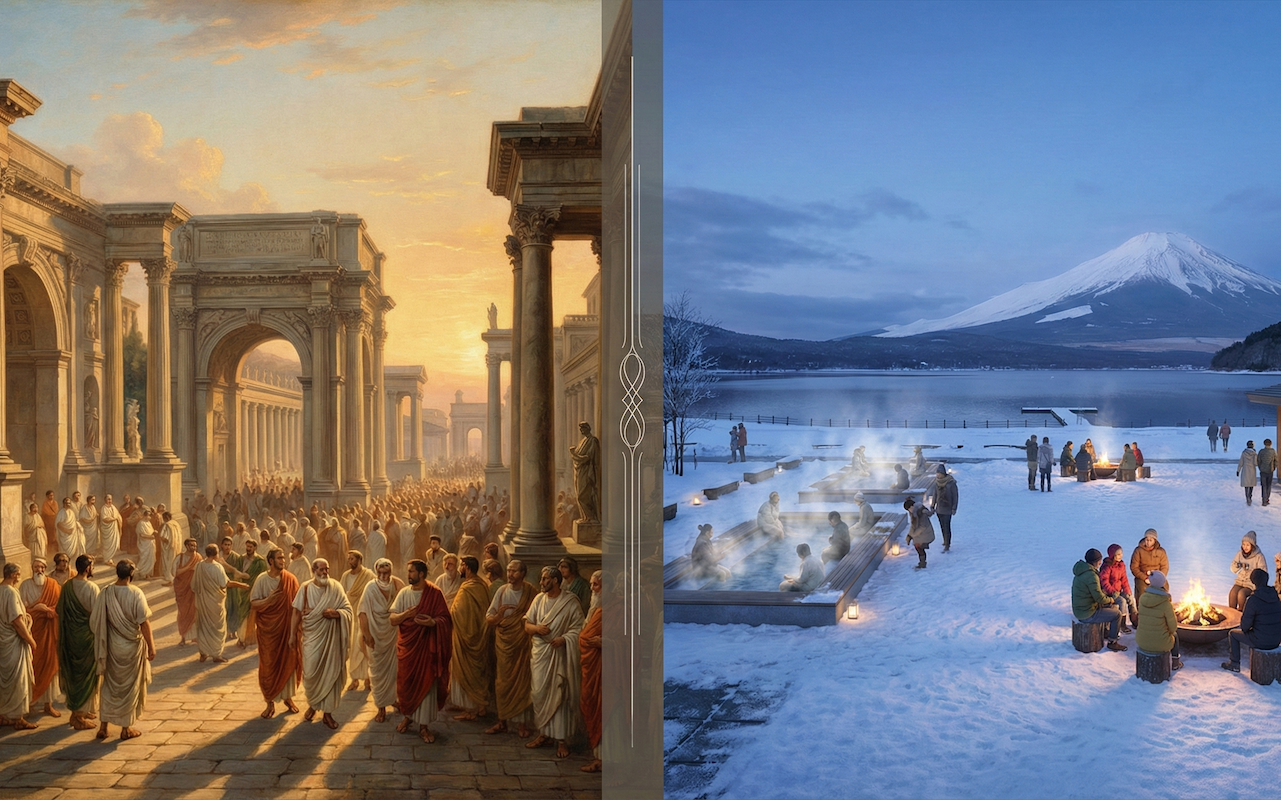
Specifically, the planned hand bath and foot bath will not just be used as a rest area,"Micro Agora (Small Square)"These are defined as places where tourists and local residents can exchange words spontaneously through the medium of hot water. By lining these spaces in a daisy-chain along the shopping street and connecting them with walkable routes, the entire town will be reorganized into "roofless architecture."
4.2 "Winter Placemaking" that adds value to winter
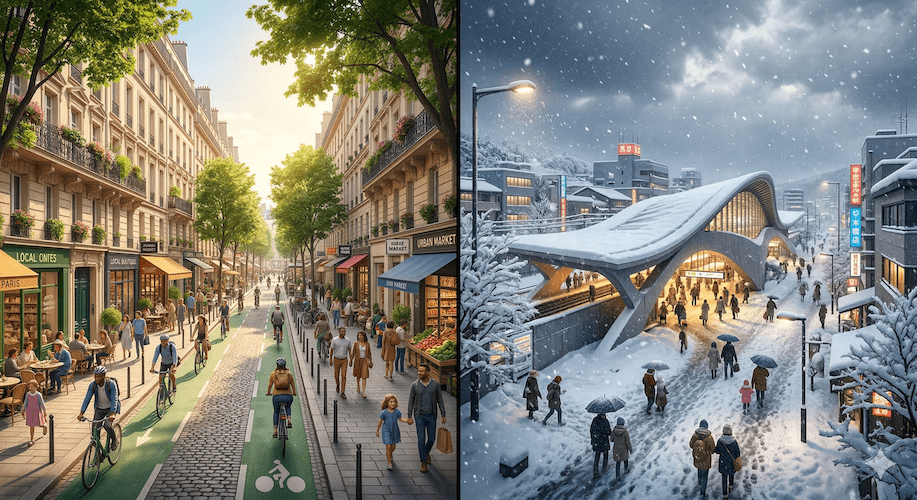
The biggest bottleneck in urban planning in Hokkaido is winter. Squares get buried in snow and become dead space. However, we need to think in reverse.
Adopting the concept of "Winter Placemaking," which is practiced in Scandinavia and Canada, the event will see snow as a "resource" rather than an "obstacle." It will feature a snow candle plaza made from cleared snow, heated benches powered by geothermal energy, and illuminations that stand out in the crisp, cool air.
Maintaining the plaza's functions year-round will be an important economic strategy for leveling out and raising tourism spending, which currently stands at 45.3 billion yen, even during the winter.
As a landscape translator
The urban planner Jan Gehl"First, people shape cities, and then cities shape people."He said.
The ancient agora gave voice to its citizens, the Roman forum gave form to its empire. Today, we need a balance between the two.
It is not just about carrying out large-scale development from the top down (formal approach), nor is it about leaving things in a state of disarray (agora-like chaos).
In Toyako Town, we carefully and strategically designed a small gathering place (agora) at the foot of the volcano, where people can sit side by side in a footbath and enjoy casual conversation, with the absolute natural majesty (form) of the volcano as a backdrop.
Economic activity and community building are not in conflict with each other, but can mutually enhance each other through appropriate spatial design.
"Capital maximization" and "relationship design."
Armed with historical wisdom and modern data, we will continue to translate the landscape of this land for future generations.
Related Links
- Ministry of Land, Infrastructure, Transport and Tourism: Comfortable and walkable city centers (walkable)
- Sapporo City: Sapporo Ekimae-dori Kita 3-jo Plaza (Akapla) official website
- Japan Tourism Agency: Japan Sustainable Tourism Guidelines
Inquiries and requests
We help solve local issues.
Please feel free to contact us even if it is a small matter.