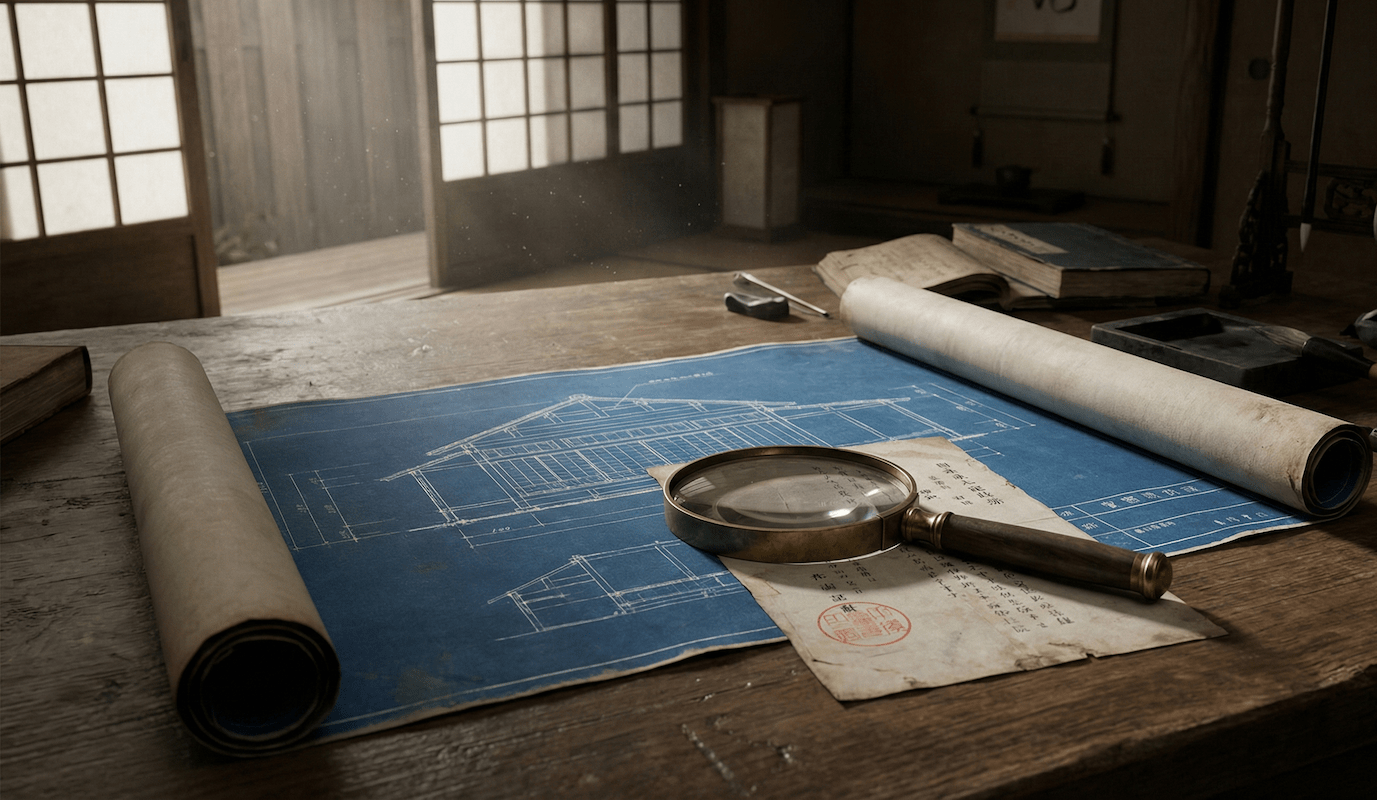
〜Why is the value of a property zero without these documents?〜
*This article is based on publicly available data and legal information as of December 2025.
"God is in the details"
These words, left behind by the master of modern architecture, Ludwig Mies van der Rohe, resonate with an extremely poignant meaning in Japan's modern real estate market, particularly in light of the ever-increasing problem of vacant houses.
Recently, the media has been buzzing with glamorous success stories such as "old house cafes" and "vacant house renovations," especially in regional cities. However, did you know that behind these stories, countless projects have stalled for certain reasons, or that the purchasers are faced with fatal risks?
The reason for this is not the appearance or location of the building, but the absence of documents hidden within the walls or deep within the drawers.
Currently, the total number of vacant houses in Japan is increasing at a rate approaching 9 million, but the biggest obstacle preventing them from circulating on the market is the lack of "as-built drawings," which serve as a building's "resume," and an "inspection certificate," which serves as a "certificate" of legality. Just as in human society, without identification and past medical records one cannot participate in social activities or receive appropriate medical surgery, in the same way, without documents that prove the "origin" and "soundness" of a building, one cannot renovate it, change its use, or even obtain a loan from a bank.
This article focuses on these two documents, which play a crucial role in the life cycle management of buildings. They are not just pieces of paper, but the only currency that can transform a vacant building, which could become a liability, into an asset that generates wealth.
1. Building "ID" and "medical records": The cost of lost records
First, to understand the essence of the problem we are facing, we need to clarify what these two documents specifically mean in the professional fields of construction and real estate transactions. Many owners and prospective buyers have a fatal misconception that "it must be okay because there is a confirmation certificate."
The crucial difference between a "Confirmed Certificate" and an "Inspected Certificate"
The process of building a building involves strict checkpoints set up by the government and designated inspection agencies, and confusing these is like trying to leave a country without a passport.
First document: Building confirmation certificate (Kakuninzumisho)
This is a document issued before construction begins. It is a sort of "planning permit" that acknowledges that "the plans to be built comply with the laws and regulations on the drawings." However, this is merely a "plan." At this point, there is no guarantee that the building will actually be built exactly as planned.
Second document: Inspection certificate (Kensazumisho)
This is the most important document in this case. After the construction is completed, a final inspection is conducted and it is issued after on-site confirmation that the completed building has been built according to the plans and in accordance with the law. It is a "certificate of completion," so to speak. In real estate transactions, loans, and future extensions and renovations, the presence or absence of this document is the only legal basis for determining whether a building is "legal" or "illegal."
Third document: As-Built Drawings
Apart from legal documents, as-built drawings show the actual physical state of the building. Drawings at the design stage (final design drawings) are merely ideal images, and changes often occur on-site due to ground conditions and construction circumstances. As-built drawings are the "anatomy of the final building" that reflect all of these on-site changes.
The table below compares the difference in asset value between having and not having each document.
| Document name and role | [If you have documents] Value and benefits as an asset |
[If you do not have the documents] Risks and disadvantages of debt |
|---|---|---|
| Building confirmation certificate (Planning Permit) |
This is an important clue to identifying the legal standards (old earthquake resistance, new earthquake resistance, etc.) at the time of construction. | Since it cannot be proven that the completed building is as planned, this alone does not prove legality and only serves as a temporary relief. |
| Inspection certificate (Certificate of Completion) |
[Strongest proof of legality] Extensions and changes of use (such as cafes or private lodgings) will proceed smoothly, and it will be easier to pass loan screening from financial institutions. |
[Suspicion of illegal construction] As a general rule, extensions and changes of use are not permitted, and investigations to prove legality after the fact can cost hundreds of thousands of yen. |
| As-built drawings (Final drawing) |
The location of braces and piping can be accurately determined without tearing down walls, allowing for highly accurate renovation designs and estimates. | [Risks of surgical procedures] Because the inside of the walls is a black box, excessive demolition and investigation is required, which significantly reduces the accuracy of planning for insulation renovations and seismic reinforcement. |
2. Historical Background: Why are there so many "houses without documents" in Japan?
First of all, why are so many buildings in modern Japan left without inspection certificates? To find the reason, we need to look back at the history of Japanese architecture after the war. This was not simply due to negligence, but was a structural problem born out of the demands of the times.
"Scrap and build" during the period of rapid economic growth
When the Building Standards Act was enacted in 1950, Japan was in the midst of a post-war reconstruction period. Providing a large number of homes to protect people from the elements, in other words, "quantity over quality," was the top priority of national policy.
Subsequently, with the introduction of new earthquake resistance standards in 1981, legal frameworks for building safety were put in place. However, in practice, the practice of "neglecting completion inspections" continued for a long time. Specifically, it is estimated that until the late 1990s, the national average completion inspection rate (the rate at which inspection certificates were issued) was only around 30% to 40%.
Behind this was a complex interplay of factors, including:
-
●
Lending practices of financial institutions:
In the past, banks accepted a "certificate of confirmation (permission before construction begins)" as a condition for granting a home loan, and did not require the submission of an "inspection certificate" after completion. -
●
Construction time reduction and site changes:
Many builders chose not to undergo inspections because they did not want to be ordered to make corrections for minor changes made on site (such as misaligning windows or adding storage space).
The 2005 "Aneha Incident" Paradigm Shift
This sloppy management system underwent a dramatic change following the revelation in 2005 of the "Structural Calculation Document Falsification Problem (commonly known as the Aneha Incident)." This incident fundamentally shook the public's trust in architecture, and in response, the Building Standards Act was tightened in 2007. At the same time, financial institutions also strengthened their compliance, and changed course to a policy of not providing loans without an inspection certificate.
The graph below conceptually shows the trend in completion inspection rates. It shows that the situation changed dramatically after the turn of the millennium, but at the same time, it also highlights the fact that a large amount of "pre-date buildings" remain as stock.
[Estimate] Trends in the rate of completion inspections for building confirmation
(Disregard for testing)
(Tighter rules)
(Required in principle)
*Illustration based on materials from the Ministry of Land, Infrastructure, Transport and Tourism, etc.
3. Deviation from global standards: Comparison with Western "Home File" culture
Let's broaden our perspective and compare it with housing markets overseas. The reason why the used home market is so active in Europe and the US, especially in the US and the UK, is that information transparency is guaranteed.
The culture of "Home File" is deeply rooted in their society. This is a system in which documents such as new construction drawings, past repair records, equipment instruction manuals, and legal permits are managed as a single file or data, and handed over to the next owner when the property is sold.
Meanwhile, Japan's housing market has long been dominated by a "new construction supremacy" approach. The asset value of a wooden house is generally assessed as nearly zero (land value only) after 20 to 25 years of construction. This resignation that "the value will be zero anyway" is perhaps the biggest factor that has reduced the incentive to preserve documentation. As a result, vacant houses in Japan are treated like "used cars with unknown history," and are inevitably valued far below their true potential.
4. The reality of utilizing vacant houses: The turning point between benefits and risks
So, what practical impact does the presence or absence of documentation have when trying to utilize a vacant house? We will analyze this from the perspectives of both the "business promoting the project" and the "individual owner."
(Legalization and cost reduction)
For government officials, architects, and real estate developers, complete documentation acts as a "safety net" that ensures the success of a project.
- ● Accelerating change of use:
For example, if you are converting a vacant house with a total floor area of over 200m² into a cafe, private lodging facility, or group home, you must apply for building confirmation. If you have an inspection certificate, the existing part is considered legal (Article 87 of the law), and the procedure will proceed smoothly. Conversely, if you do not have the necessary documents, a process called a "legal compliance survey" will be required, which can take several months and cost several million yen, and it is not uncommon for this alone to take place. - ● Renovation cost optimization:
As-built drawings (especially plan drawings and floor plans) clarify the location of the braces in the walls and the reinforcement specifications for the foundation. This makes it possible to avoid unnecessary demolition surveys and excessive reinforcement work that overestimates safety factors, resulting in a reduction in total costs of 500,000 to 1,000,000 yen. - ● Receiving public support:
Subsidies and low-interest loans such as those offered by the "Long-Term Quality Housing Renovation Promotion Project" strictly require compliance with the law. Having all the necessary documents is your ticket to enjoying these economic benefits.
(Pandora's Box risk)
On the other hand, for owners, there is a risk that scrutinizing the documents will end up "waking a sleeping dog" and opening a so-called Pandora's box.
- ● Disclosure of violations:
When detailed as-built drawings are discovered and compared with the current situation, violations such as "the area that was applied for as a garage has been remodeled into a living space without permission" or "the building coverage ratio and floor area ratio are exceeded" may come to light. Once this is discovered, sales and financing will be suspended unless corrective work (such as reduction in floor area) is carried out, leaving the owner in a serious dilemma: "I should have just sold the property without knowing." - ● Cost burden for restoring drawings:
If you don't have the necessary documents, you'll need to hire an architect to create a current survey map and restoration drawings. This will cost around 300,000 to 500,000 yen. For vacant houses in rural areas that can only be sold for a few million yen, making this upfront investment is often economically unreasonable, which is one of the reasons why abandoned vacant houses are created. - ● Privacy Risks:
Detailed as-built drawings contain extremely sensitive information, such as the location of safes, the layout of bedrooms, security wiring, etc. It is only natural that owners would be strongly opposed to digitizing this information and making it widely available for public viewing on sites such as "vacant house banks."
5. Regional Issues: "Records for Survival" in the Toyako Area of Hokkaido
The difficulty and risks of utilizing vacant homes vary greatly depending on the region. Hokkaido, which was the subject of this report, and particularly the area around Lake Toya, a famous tourist destination, are unique in that the presence or absence of documentation is directly linked not only to legal compliance but also to the physical viability and success or failure of the business.
1. "Invisible" insulation performance history
Hokkaido's housing technology has evolved in a unique way as it battles the harsh cold. Since the 1970s, construction methods such as block insulation and additional insulation have become widespread, but these cannot be seen from the outside.
Even for 40-year-old houses that look the same on the outside, the cost of heating oil in winter can vary by tens of thousands of yen per month depending on whether the insulation inside the walls is "50mm of glass wool, which was the standard at the time," or "100mm of high-performance urethane added at the owner's request." Furthermore, inadequate insulation construction directly leads to the risk of the structure rotting due to internal condensation.
If there are as-built drawings (plans and specifications), it is possible to estimate the performance (UA value) of the walls without removing them, and it becomes possible to accurately determine how much to spend on insulation renovations when planning a renovation. Without drawings, it becomes a gamble where you don't know until you open it up.
2. Roofs and solar panels in heavy snow areas
In recent years, with growing environmental awareness, there has been a movement to utilize vacant houses to install solar panels and turn them into ZEH (Net Zero Energy Houses).However, in areas with particularly heavy snowfall, including parts of Toyako Town, several tons of snow accumulate on the roofs.
In addition, detailed structural calculations are essential to support the weight of solar panels (approximately 15-20 kg/m²). If you have structural drawings, you can calculate whether the panels will support the roof without reinforcement based on the size and pitch of the rafters and the thickness of the beams. However, without drawings, you may need to take a safety factor into account and have to re-roof the entire roof or reinforce the beams, which can increase costs and cause the project to stall.
3. Tourism and Airbnb demand and fire safety issues
Lake Toya is an area with strong inbound tourism demand, and there is an extremely high demand for revitalizing vacant lakeside houses as "villas for rent" or "private lodgings." However, there are obstacles to overcome: the Inns and Hotels Act and the Fire Service Act.
In order to obtain a business license to operate as a lodging facility, the safety of the building must be proven. Particularly problematic are the presence of sunrooms or wooden decks that have been added on in the past without permission. If these are "illegal additions" that are not on the blueprints, or if there is no inspection certificate and legality cannot be proven, a business license will not be issued unless corrective work is carried out. The current situation is that there is no end to investors who purchase properties simply because they have a "good view," only to later realize this fact and be at a loss as to what to do.
Conclusion: Document management as a "baton" to the future
What has become clear from the above analysis is that the completion drawings and inspection certificates are not relics of the past, but rather a "currency" that can open up new possibilities for utilizing vacant houses in the future.
The way construction information is handled is predicted to change dramatically over the next few years to ten years. With the spread of 3D city models such as "PLATEAU" promoted by the Ministry of Land, Infrastructure, Transport and Tourism, and BIM (Building Information Modeling), construction information will likely be managed as a digital twin on the cloud. At that time, the presence or absence of analog paper drawings and certificates will determine asset value in the digital world.
The real estate market will become clearly polarized in the future. There are properties with complete inspection certificates, completion drawings, and repair history (= assets), and properties without these (= liabilities below the land value).
If you are currently a homeowner, please look for those old blueprints and inspection certificates that are sleeping in the back of your dresser. They are important "instructions" for passing the baton to the next resident, and are an asset that could be worth several million yen when you sell.
And for prospective buyers, don't choose an old house based on its atmosphere alone. If you're dreaming of renovating it or turning it into a private lodging, first check whether it has an inspection certificate and completion drawings. If they don't, you need to understand that revitalizing it will involve additional costs and risks, and be wise enough to use them as leverage in price negotiations.
Vacant houses are not just old boxes. When properly recorded and managed, they can be transformed into irreplaceable "resources" that carry on the history of the region and create new economic value.
Related Links
- Ministry of Land, Infrastructure, Transport and Tourism: Initiatives to revitalize the existing housing and renovation market
- Statistics Bureau, Ministry of Internal Affairs and Communications: 2018 Housing and Land Survey
- General Incorporated Foundation Building Administration Information Center: Overview of the Building Confirmation and Inspection System
Inquiries and requests
We help solve local issues.
Please feel free to contact us even if it is a small matter.