〜Riken Yamamoto's "local community sphere" and the current issue of vacant houses and its connection to energy issues〜
*This article is based on statistics and research information as of December 2025.
Urban civilization in the 21st century is currently in the midst of an unprecedented paradox.
On the one hand, digital technology has maximized connectivity, and the term "smart city" has been talked about with great fanfare in conjunction with the Sustainable Development Goals (SDGs).However, at the same time, the reality is that "individual isolation" in our physical living spaces is becoming increasingly serious.
In particular, the number of single-person households is increasing rapidly in Japan, and the aging of the population is progressing rapidly. It is no exaggeration to say that the safety nets of local ties and blood ties that once supported local communities are no longer functioning properly. In particular, in rural areas such as Hokkaido, where our activities are based, the hollowing out of communities due to population decline is beginning to threaten the very foundations of life, such as disaster prevention, snow removal, and energy efficiency.
But did you know that in response to this modern-day situation of stagnation, a "utopian" architectural concept proposed in France in the early 19th century still offers astonishing modern insights, even after 200 years?
Its name is,François Marie Charles FourierThe communal living entity envisioned by"Phalanstère"is.
Fourier's ideas have long been relegated to the footnotes of history as the bizarre dream of "utopian socialism." However, the perspectives at the heart of his ideas—"liberation of passion through architecture," "integration of work, residence, and leisure," and "guaranteeing livelihood through economies of scale"—are visionary and could even serve as the prototypes for cutting-edge urban theories such as modern concepts like "living close to work" and the "sharing economy," as well as the "local community sphere" proposed by 2024 Pritzker Prize winner Riken Yamamoto.
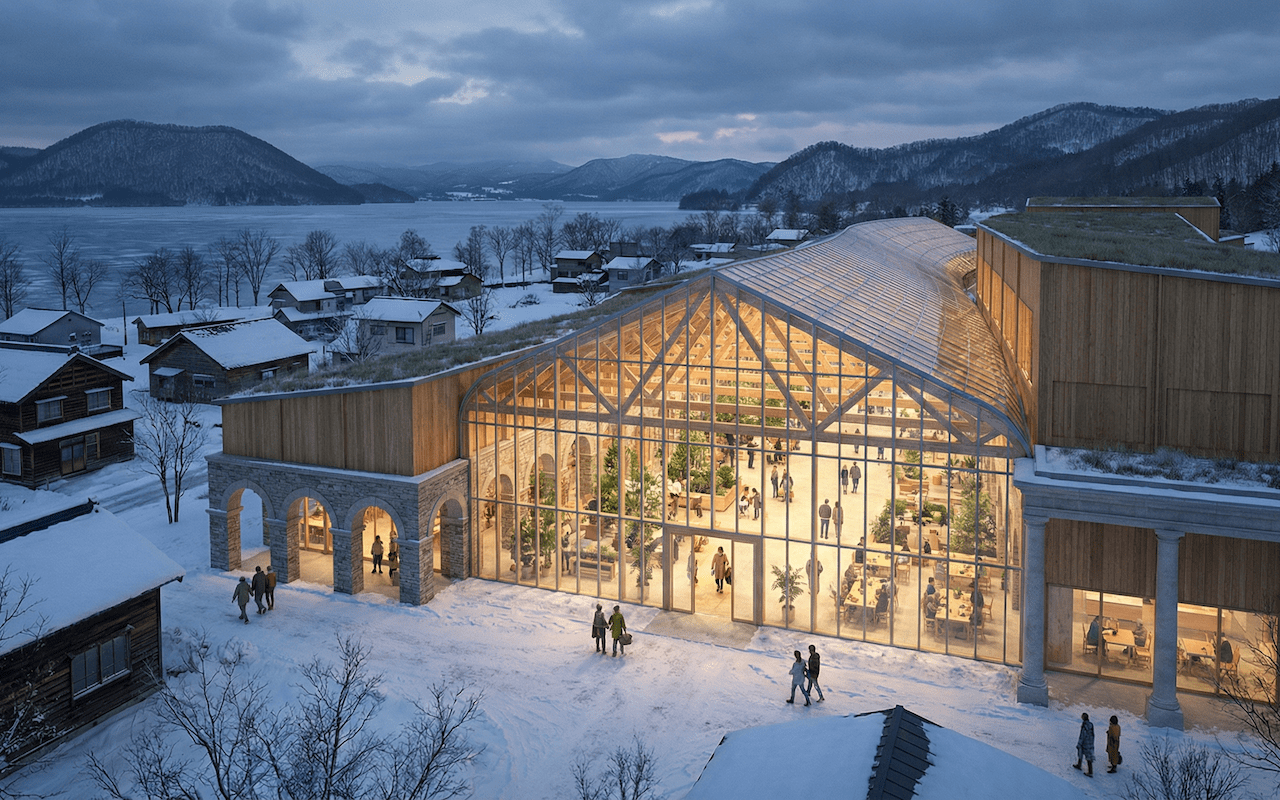
In this paper, we redefine Fourier's phalanstere not simply as a historical relic, but as a valid "reference model" for modern urban development, and thoroughly examine the possibility of implementing it in the specific field of Toyako Town, Hokkaido.
1. Charles Fourier and the definition and structure of the "phalanstere"
1.1 Ideological background: Criticism of civilization and the discovery of "passionate attraction"
First, let's look at the background of his ideas. Charles Fourier was born in Besançon, France in 1772. He witnessed firsthand the social turmoil that followed the French Revolution and the poverty and deception that came with early industrial capitalism.
He called the social system of the time "civilization" and harshly criticized it for suppressing human nature and creating disharmony. At the core of Fourier's thought was the conviction that there exists a universal force that moves humans in the social world, just as Isaac Newton discovered "universal gravitation" in the physical world. He called this“Attraction passionnée”We named it ``.''
According to Fourier, God intended a specific social order for human beings, which could only be achieved through the liberation of passion, not through the suppression of reason. He classified human passions into 12 basic passions (five sensual passions, four collective passions, and three regulating passions), and argued that a society in which these passions could be freely expressed without being suppressed would bring about universal harmony.
1.2 Mathematics and definitions of phalansteres
Fourier's social design is characterized by its highly mathematical and architectural approach. He believed that by pairing men and women with 810 different personalities (temperaments), all combinations of human passions could be covered.
Therefore, the minimum population required to form a perfectly harmonious social unit (phalanx) is defined as follows:
This is the smallest unit of a community.
This huge single building where 1,620 people live, work, and play together is called "Phalanstere." It is not just an apartment complex. It is a "megastructure" that incorporates all the functions of production, consumption, education, and entertainment.
■ Architectural features: invention of the internal street (rue interiour)
The most innovative architectural element of the Phalanstere is"Interior Street (Rue Intérieure)"is.
This refers to an all-weather corridor covered with a glass roof that runs through the second or third floor of a building. The wide gallery was air-conditioned (though at the time it was assumed to have been a fireplace or ventilation system), allowing residents to move from their living space to their workshops, dining room, or theater without being exposed to rain, snow, cold, or heat.
Fourier contrasted these internal streets with the filthy, muddy streets of Paris at the time, and considered them to be devices that physically guaranteed "social cohesion." This concept has something in common with modern shopping malls, underground pedestrian spaces in cold regions, and the concept of thresholds in Riken Yamamoto's "social community sphere."
2. Historical Development and Realization
The phalanstere that Fourier proposed was never realized during his lifetime, but after his death, his students and influenced businessmen built experimental communities around the world.
2.1 Success story: Jean-Baptiste André Godin's "Familiar Tale"
The most successful and architecturally sophisticated embodiment of these experiments is known as the Guise, France,"Familistère"is.
▲ The "Familistaire" in Guise, France, now preserved as a museum and apartment complex
Its founder was Jean-Baptiste André Godin, a successful businessman who manufactured cast iron stoves. He stripped away metaphysical elements such as the "liberation of the passions" and radical elements such as "free love" from Fourier's theory, and revised it into a more realistic model of a cooperative "union of capital and labor."
It is noteworthy that the three main residential buildings are connected, each with a large glass-roofed courtyard (kuur). These courtyards not only provide light and ventilation, but also serve as a place for social interaction, a play area for children on rainy days, and a space for celebrations. This is a development of Fourier's "internal streets" into a "covered square."
3. Comparative analysis from a global perspective and contemporary significance
The core concepts of the phalanstere - "cohabitation," "close proximity of work and home," "shared childcare," and "economies of scale" - continue to influence housing models around the world in various forms. Here, we will conduct a comparative analysis with representative modern forms of cohabitation to highlight its contemporary significance.
| item | Phalanster (Fourier/19th century) |
kibbutz (Israel/20th century) |
Cohousing (Europe and America/Modern/21st century) |
|---|---|---|---|
| Main purpose | Harmony of Passions and Criticism of Civilization | Founding of the nation, agriculture, and self-defense | Community Regeneration and Mutual Aid |
| scale | 1,620 people (capacity) | Hundreds to thousands of people | Approximately 20 to 40 households |
| spatial configuration | Large single building (palace) | Settlements (dispersed) | Individual house + common house |
| privacy | Low (emphasis on interaction) | Once non-existent, now increasing | Expensive (each unit is independent) |
| contemporary challenges | The limits of idealism | Privatization and inequality | Affordability |
*You can view the table by scrolling horizontally.
In this comparison, the phalanstere stands out in its size and functional integration. Modern cohousing can be described as a democratically scaled-down, realistically adapted version of this.
4. Contemporary Developments in Japan – Yamamoto Riken and the “Local Community Sphere”
What about the situation in Japan? Restoring the phalansteric "community" is an especially pressing issue in Japan today. This is because the "home ownership" and "nuclear family" model promoted by postwar housing policy is reaching its limits amid a declining and aging population.
4.1 Yamamoto Riken's "Local Community Area"
The "local community sphere" proposed by architect Riken Yamamoto, who will receive the Pritzker Prize, known as the Nobel Prize of architecture in 2024, is extremely important as a reinterpretation of the phalanxtere in modern Japan.
Yamamoto proposes a residential model in which units are composed of several hundred people (e.g., 400-500 people). This is an attempt to dismantle the traditional closed unit of "one house = one family" and socialize some of the functions of daily life. Specifically, the home will be reorganized into the following two elements:
This glass-walled space is open to the outside (local community). It can function as a SOHO, gallery, cafe, or simply a veranda. It is a private space, yet also has a social role.
A closed private space (such as a bedroom). A place where a high degree of privacy is ensured and where people can rest. A purely residential unit that separates the social aspects from the traditional function of housing.
Furthermore, by freeing up toilets, showers, kitchens and other water-related facilities from individual homes and making them shared or distributed, it becomes possible to use highly efficient, high-quality facilities.With this spatial configuration, the aim is to make watching over elderly people living alone and mutual support for child-rearing a natural activity among residents, rather than a government service.
5. Case Study — "Local Phalanster" in Toyako Town, Hokkaido
Based on the above theoretical background, we will now consider the possibility of implementing this in a specific local government. Our target is Toyako Town, Hokkaido, where we are based.
5.1 Lake Toya's challenges and "energy pressure"
Toyako Town is a scenic tourist destination, but it also epitomizes the challenges facing rural Japan, particularly the harsh winters that directly affect the cost of living there.
According to a survey summary on the residential sector in Hokkaido, annual kerosene consumption is approximately 1,540 liters for detached houses (owner-occupied homes) and approximately 582 liters for apartment buildings, showing a large difference depending on housing type.
[Comparison of annual kerosene consumption in Hokkaido]
Source: Created based on the FY2021 Hokkaido Household Energy Consumption Survey (Summary) etc.
In this way, apartment buildings are more cost-effective than detached houses.Annual kerosene consumption reduced by approximately 40% (approximately 60% reduction)This is an important difference that affects the right to economic survival for elderly people living on pensions.
5.2 Proposal: "Toyako Linkage" decentralized network
It would be financially and socially unrealistic to build a huge, single palace (phalanstere) in Toyako Town, as Fourier once dreamed of. However, a "distributed network" model that utilizes existing stock would be a different story.
We have two approaches:"Modern Local Phalanstère"We advocate the following.
A. Networking "shops" that utilize vacant houses
Using subsidies, the first floors of vacant houses scattered throughout the town will be renovated into "shops" (community spaces) that will serve as co-working spaces, shared dining halls, salons for tourists, etc. By connecting these spaces with key routes in the snow removal plan (snow corridors), rather than isolating them, the entire town will function as a single, easily accessible facility.
B. "Winter Phalanstere" Seasonal Settlements
This is a model in which elderly people move into managed apartment complexes or former hotels and resorts that have been renovated and insulated just during the winter. Taking advantage of the reduction in kerosene consumption (about 60%) that comes from converting to apartment complexes, the savings can be used to enhance care services and community activities. "Freedom from snow removal" could be Hokkaido's most powerful attraction.
Fourier advocated the "charm of labor." He affirmed the "fickle passions" and argued that humans cannot tolerate being engaged in a single task for long periods of time.
This idea is directly linked to the modern concepts of "related population" and "multi-work." Residents use their special "passions" (skills and hobbies) to provide tour guide services, farm work, cooking classes, and more in their "shops." Tourists are not simply consumers, but participate in the exchange as temporary "phalanstere residents." This cycle may be the only solution to keeping shrinking local communities alive.
Conclusion: Aiming for a 21st century "social palace"
The phalanstere dreamed of by Charles Fourier was considered a "premature utopia" in the 19th century. However, in modern Japan, which is suffering from the triple burden of population decline, environmental crisis, and social isolation, especially in cold regions like Hokkaido, the time has come to reevaluate its rationality and social value.
The possibilities in Toyako Town are not to build a huge monumental building."Integration of work, housing and leisure," "Freedom from the climate," and "Mutual aid through the community"The idea is to re-edit this software using existing stock (vacant houses, hot springs, landscapes).
As advocated by Riken Yamamoto, we need to open the closed doors of our "personal homes" and reimagine the entire community as one large "dwelling." This will be a new definition of wealth in a shrinking society. The phalanstere is no longer a fantasy; it is a highly pragmatic and passionate prescription for sustainable urban development.
“The extension of privileges to women is the fundamental cause of all social progress.”
— Charles Fourier
Related Links
- Ministry of Land, Infrastructure, Transport and Tourism: Sustainable urban development (compact city)
- The Pritzker Architecture Prize: Riken Yamamoto's Award-winning Achievement (2024)
- Toyako Town, Hokkaido: Comprehensive Strategy for Revitalizing Towns, People, and Jobs
Inquiries and requests
We help solve local issues.
Please feel free to contact us even if it is a small matter.