〜The history of a city that was born and then disappeared for a national project, and hints for sustainable urban development〜
*This article is based on the latest archaeological knowledge and statistical information as of December 2025.
"The ground plan is a generator. Without order there can be no freedom of the mind."
These words, left by the master of modern architecture, Le Corbusier, emphasize the importance of "planning" in cities, but 4,000 years before he was born, in the desert on the banks of the Nile, there existed a city that embodied this philosophy to the fullest extent.
The name of the city is "Kahun."
This city, which suddenly appeared during the Middle Kingdom of Egypt in the 19th century BC, was one of the oldest "fully planned cities" in human history, setting itself apart from any naturally occurring settlement. With its ruler-drawn orthogonal grid, strict zoning, and thorough state management, it was as if it had already foretold all of the challenges and possibilities of the "compact cities" and "company towns" we face today.
Why did people 4,000 years ago build a geometric city in the desert? And why was this perfect city abandoned? This article unravels the full story of Kahun based on archaeological evidence, and explores its profound implications for the sustainability issues facing Hokkaido's pioneering cities and modern-day local governments.
1. The full picture of the "managed utopia" that emerged in the desert
The first Pharaoh "grid design"
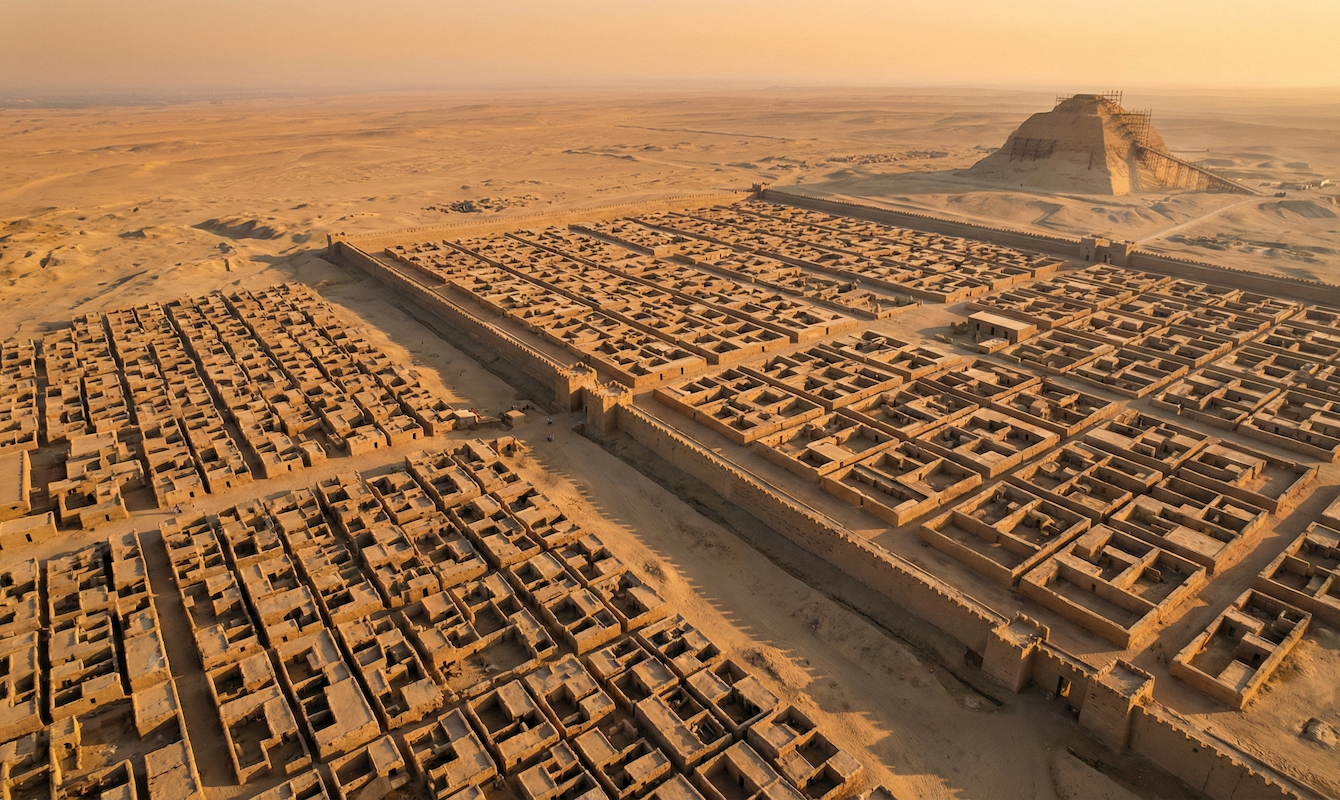
Kahun (official name: Hetep Senusret / Senusret Was Satisfied) was built by the 12th Dynasty pharaoh Senusret II primarily to house the workers, artisans, and priests who would be building his own pyramid.
In modern urban planning terms, Kahun is a complex city that combines the following elements:
- Company Town (company town):A system in which the state (Pharaoh) was the sole employer, providing housing, food, and tools and monopolizing the labor force.
- Gated communities:The entire city is surrounded by a strong wall, creating a secure space that is physically cut off from the outside world.
- Cartesian grid city:A geometric street structure facing north, south, east and west, introduced more than 1,000 years before Hippodamos in Greece.
The table below compares Kafun's urban specifications with those of the Hokkaido Tondenhei villages of the Meiji period, which also had the context of "planned settlement by the state."
| Comparison items | [Ancient] Kahun (Egypt) | [Modern times] Tondenhei Village (Hokkaido) |
|---|---|---|
| Motivation for construction (Core Mission) |
Pyramid construction and ritual maintenance (National project for the afterlife of the king) |
Northern Security and Agricultural Development (National projects for national defense and industrial development) |
| urban structure (Hardware) |
A strict orthogonal grid and The "wall" that divides classes |
Strict orthogonal grid (joint blocks) Windbreak division |
| Type of residence (Zoning) |
Extreme class differences (Elite 860m² vs. Worker 60m²) |
Standardized barracks (Standard homogeneous design of approximately 58 m2) |
| social function (Software) |
Monopolistic control and rationing of labor | Discipline and mutual aid through communal living |
2. The Wall Reveals Class Society and Advanced Civilization
Kahun's grid structure was a very "high visibility" management system for the state.
The excavated Kahun Papyrus reveals that this city was not merely a prison camp, but a highly civilized city.
- ● Kahun Gynecological Papyrus:One of the world's oldest medical documents, it specializes in women's health care, including contraception and pregnancy tests.
- ● Veterinary Papyrus:The treatment of cattle and livestock, which powered the construction site, was systematized.
- ● Legal contract:Residents were exercising their legal rights to make wills and transfer property.
In this way, by concentrating specialized knowledge (priests, doctors, and scribes) in one place, the highest level of living infrastructure at the time was maintained.
On the other hand, overly rigid planning has robbed cities of their flexibility and accelerated social division.
A wall was built through the center of the city, physically separating the vast "elite district" on the east side from the small "workers' district" on the west side.
The overwhelming disparity in living space
- ● Lack of scalability:Because the walled city was unable to expand as the population grew, serious overcrowding occurred in the workers' quarters.
- ● Surveillance socialization:The straight roads may have also served as a means for administrators to keep a close eye on residents, creating a suffocating surveillance society.
3. A warning to the modern world: The fate of cities that have lost their purpose
When the pyramids disappear, so do the cities.
Kahun was rapidly abandoned during the 13th Dynasty after the death of Senusret II, with the inhabitants reportedly leaving many of their belongings behind.
Why? Because the city's existence depended on a single project: the construction of the pyramids. The moment the king died and the construction project ended, the city's economic engine stopped, and the people lost their livelihood.
This is a typical death pattern of a "single-industry dependent city," and it is the very challenge facing modern Japan, particularly regional cities in Hokkaido.
What is the "modern pyramid" in Toyako Town?
For example, in a tourist city like Toyako Town, tourism is like building a modern-day pyramid. It has a powerful unifying force, but if the project is halted due to external factors such as a pandemic or natural disaster, it is vulnerable to paralyzing the entire city's functions.
A comparative model of risk of dependence on a single industry
- Depends on: Pyramid construction
- Risk: Business closure/King's death
- Result: urban abandonment and desertification
- Depends on: Tourism industry
- Risks: infectious diseases, volcanic eruptions, population decline
- countermeasure: ???
Toyako Town is expected to receive approximately 640,000 tourists in 2024, but its economic base is dependent on an influx of people from outside. Kahun's lessons suggest that cities cannot survive by simply building infrastructure (grids), and that soft power, which involves constantly updating the "next purpose," is crucial.
Conclusion: Design "variability (white space)" into the grid
The ruins of Kahun are a grand experimental site left behind by rulers 4,000 years ago in their quest for efficiency. They offer hope that with a clear purpose (mission) and rational design (hardware), it is possible to create a sophisticated urban system even in the barren desert.
But at the same time,"A city with a fixed purpose is fragile"It also points out the cold hard fact that...
What is needed in future urban development in Japan, especially in areas struggling with population decline, is not a "solid, complete plan" like Kahun's. Rather, what is needed is a pre-determined grid that intentionally leaves "space" and "escape routes" that allow residents to redefine the meaning of their city.
The framework of a city is made up of hardware, but it is the "soft" aspects (activities) that keep the city alive and well, constantly changing with the times. Kahun's silence, spanning 4,000 years, quietly speaks to us living in the modern age about the importance of "adaptation" over "planning."
Related Links
- Ministry of Land, Infrastructure, Transport and Tourism: Compact city formation
- Hokkaido: History and Culture of Hokkaido (Tondenhei)
- UNESCO World Heritage Center: Ancient Thebes with its Necropolis
Inquiries and requests
We help solve local issues.
Please feel free to contact us even if it is a small matter.