〜How did huge new towns like Senri and Tama come into being, and how are they aging now?〜
*This article is based on publicly available data as of February 2026.
"A house is a machine for living in"
These cold, rational words from Le Corbusier, one of the most representative architects of the 20th century, functioned as a kind of prophecy in Japan's postwar urban policy. Reconstruction from the ruins and rapid economic growth followed. Japan in the Showa era was dominated by the "logic of numbers" - how to efficiently accommodate the wave of population that was flooding from rural areas to cities.
The strongest trump card the government has come up with to address this national issue of the "housing crisis" is the"New Housing and Urban Development Act (hereinafter referred to as the New Housing Act)"Since its enactment in 1963, this law has completely transformed the suburban landscape of Japan. It has cut down mountains, filled in valleys, and given rise to geometric roads and huge housing complexes. It was truly a grand engineering undertaking, like the construction of a gigantic "living machine" on the land of the country.
However, more than half a century has passed, and what was once a "dream new town" is now known as an "old new town," facing the double hardships of a rapid aging population and aging buildings. Why has a town built with dreams of the future become so rigid in modern times? And what happens to the regional cities (such as Toyako) where people came from after leaving the new towns of major cities?
This article provides a thorough comparison of Japan's first large-scale new town, Senri, its largest, Tama, and the marginal northern village of Momijidai. It also looks at the issue of vacant houses in rural areas and delves into how cities should be closed down and how to handle end-of-life real estate in a society with a declining population.
1. The Drastic New Housing Law: An Artificial City Created by Complete Acquisition
First, we need to understand the legal mechanisms by which the "new towns" we see every day were created. There are two major trends in urban planning in Japan.
The Limitations of the Land Readjustment Act and the Impact of "Tabula Rasa"
In the late 1950s, sprawl (piecemeal development) caused by disorderly development was becoming a serious problem in the outskirts of Tokyo and Osaka. Apartment buildings were built in the middle of fields, and people settled in these areas without roads or sewers. The Land Readjustment Act, the mainstream urban planning method at the time, was powerless to address this situation.
Land readjustment projects are a democratic method in which landowners pool their land little by little (reduction of land area) to build roads and parks. However, it takes an enormous amount of time to reach consensus among all landowners, and it was far from keeping up with the explosive demand for "hundreds of thousands of homes needed right now."
So in 1963 (Showa 38), the government made a decision. The New Housing and Urban Development Law was enacted. The biggest feature and most shocking aspect of this law was that it required project implementers to acquire land within the target area."Full acquisition method"The advantage is that it can be obtained at
The government started with a completely blank slate (tabula rasa) of all existing rights and interests, and used the vast land as a single canvas to draw out the ideal layout of roads, parks, schools, shopping centers, and housing in one go. This was a powerful, state-led urban redevelopment project that stood out from conventional urban development, which proceeded while carefully checking the approval of landowners.
[Comparative Analysis] New Housing Law vs. Land Readjustment Law
The difference between these two approaches has created a decisive difference in the city's DNA. Check out the structural differences in the table below.
*Please scroll horizontally to view the table.
| Comparison items | New Residential and Urban Development Act (New Housing Act) |
Land Readjustment Act (Land readjustment) |
|---|---|---|
| Basic philosophy | by public authority"Creating a new city" (Full acquisition method) |
Landowner-led"Urban development" (Land exchange method) |
| Land rights | Full acquisition (liquidation of rights) Previous landowners will sell their land and either buy it back after development is complete (priority sale) or move out to other locations. |
Exchange of land (transfer of rights) Your rights will be maintained, and you will only be transferred to a new location (exchange of land), allowing you to continue living in the same place. |
| urban design | A functional and orderly streetscape will be formed based on a unified master plan. *Usage regulations are extremely strict |
Landowners have a high degree of freedom and individual building renovations are carried out, resulting in diversity (variation) in the streetscape. *It is easy for uses to be mixed |
| Infrastructure development | Public facilities are developed in one go by the contractor. The costs are passed on to the sale price. |
The development costs will be covered by landowners pooling their land in a "reduction" scheme and profits from the sale of reserved land. |
| Population composition risk | For simultaneous occupancy,Age and income groups are becoming more homogenousEasy to do. (The main cause of the later "Old New Town Problem") |
Because there is a mix of new and old residents, it is relatively easy to maintain a balance between generations. |
| Typical example | Senri NT, Tama NT (Shinjuku Ward), Kozoji NT, Momijidai Housing Complex | Tama NT (land readjustment area), Kohoku NT, part of Chiba NT |
Here's some interesting data. Statistically speaking, roughly 60% of new town development areas across Japan are the result of land readjustment projects, while development under the New Housing Law accounts for less than 10%. However, the New Housing Law (or its spirit) is at the core of some of the biggest projects in Japanese urban planning history, such as Senri and Tama, and its impact is even greater than the numbers suggest.
[Reference data] Proportion of new town development methods (area basis)
*Estimated figures taken from the Ministry of Land, Infrastructure, Transport and Tourism's "Efforts to Revitalize New Towns" document.
2. British Ideals and Japanese Reality: The Shift to High Density
When discussing Japan's new town policy, it is impossible to avoid comparing it with the British "Garden City" concept that served as its model.
At the end of the 19th century, Ebenezer Howard proposed the idea of a "garden city" to alleviate overcrowding in London.
Subsequent cities such as the New Towns Act of 1946 and Milton Keynes, designated in 1967, were based on spacious designs, with rows of low-rise housing with ample gardens surrounded by lush green belts. They also promoted the proximity of work and life, and aimed to create self-sustaining economic zones by attracting factories and offices within the city.
On the other hand, Japan, with approximately 731 TP3T of its land area being mountainous (611 TP3T + 121 TP3T of hills), had an extreme lack of flat land. As a result, the process of importing British ideas caused a decisive change.
"Low-rise and spacious" was rewritten as "medium-rise and high-density," and "living close to work" was put on the back burner. As a result, Japan's new towns are now huge developments for office workers commuting to their offices in the city center on crowded trains."A town where you go to sleep (bedroom town)"It was decided to function as such.
Side effects of "purifying applications"
Another feature of the new Housing Act, strict zoning (use restrictions), also casts a unique shadow over Japan's new towns.
In order to protect the living environment, the mixing of stores and offices into residential areas has been thoroughly prevented, resulting in the loss of "diversity" and "chaotic vitality" from the city. For example, even if a city wants to build a convenience store for aging residents, there are many cases where this cannot be realized because of the high hurdles to changing the use of the building. Ironically, planned urban development has created a "rigid city" that cannot adapt to the changing times.
3. Case Study A: Senri New Town (Osaka) — The Road to Regeneration
Let's take a look at some specific examples. First, there's Senri, Japan's first large-scale new town, where residents began moving in in 1962 (Showa 37).
Japan's first large-scale experimental city
Senri New Town (development area: approximately 1,160 hectares), located in the Hokusetsu region of Osaka Prefecture, is made up of 12 residential districts. The New Housing Act itself was enacted in 1963, but Senri began accepting residents the year before. It started out as a "housing complex" in terms of business methodology, and later came under the New Housing Act, making it truly an experimental city built in tandem with Japan's legal system.
Breaking away from the "old" and restoring population
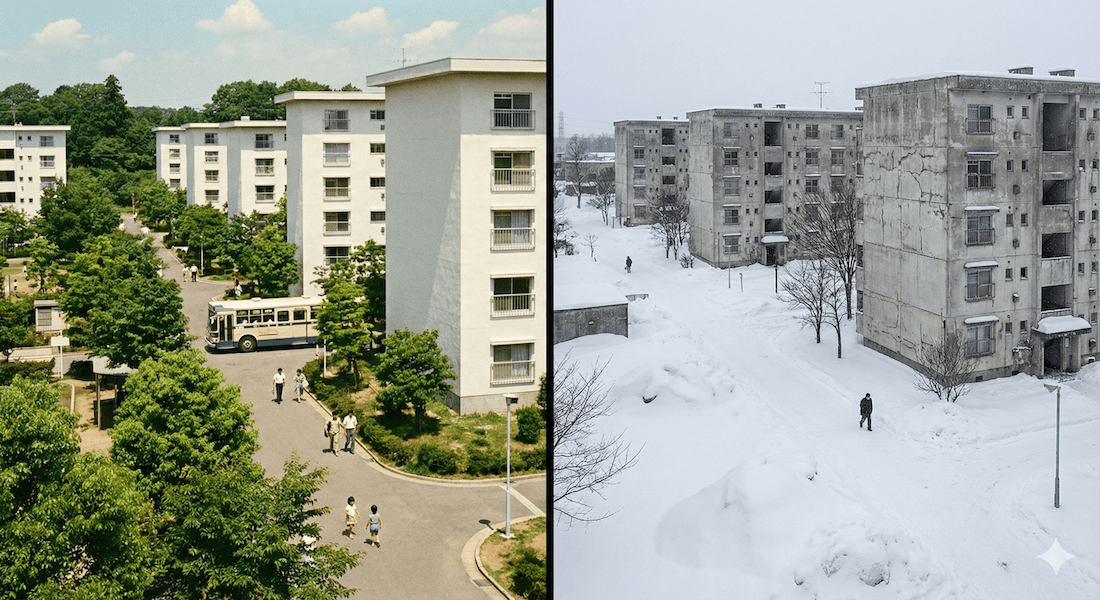
One notable feature of Senri is that it is currently undergoing a dramatic regeneration. The five-story stairwell-style apartment complexes (without elevators) built at the beginning of development no longer meet modern needs, but by taking advantage of relaxed floor area ratio regulations, a series of successful projects have been undertaken to convert these into high-rise apartment buildings.
The population had been declining since peaking at around 129,000 in 1975, but according to Suita City's Basic Resident Register, it has been increasing slightly since 2015, remaining at around 100,000 in 2020. The factors behind its success are its overwhelmingly convenient location, just 20 minutes by train from Osaka Umeda, and the fact that the spacious site plan at the time of development allowed for room for population growth through high-rise construction. Senri is a rare example of a town that has successfully broken out of its old shell and attracted a new generation.
4. Case Study B: Tama New Town (Tokyo) — The Conundrum of Size
Next is Tama New Town, Japan's largest city. This megacity, which spans the Tokyo cities of Tama, Hachioji, Inagi, and Machida, has an overwhelming scale of approximately 2,962 hectares of land area, but it faces different challenges than Senri.
World-class "pedestrian and vehicle separation" system
The greatest feature of Tama New Town's urban design is its thorough"Pedestrian and vehicle separation (Radburn system)"A network of pedestrian decks was spread throughout the city, allowing residents to access stations, schools, parks, and shopping centers without ever crossing a car. This design, which prevented traffic accidents and created a comfortable pedestrian space, was an extremely advanced attempt even by global standards.
"Simultaneous aging" in early development areas
However, this advanced infrastructure is facing a serious problem: aging. Tama New Town took a long time to develop, and in areas such as Suwa and Nagayama, which were first settled in the area (from 1971 onwards), the young families who lived there at the time are now aging, with the aging rate approaching 40% to 50% per block.
Particularly problematic are mid-rise housing complexes built in the early days that lack elevators. The stairs where children once ran around have now become a barrier that prevents elderly people from going out. Even if efforts are made to make these complexes barrier-free, many of the residents are elderly people living on pensions, and there are many buildings that cannot be rebuilt due to a lack of repair reserve funds and difficulties in reaching consensus.
5. Case Study C: Momijidai (Sapporo) — The Northern Limit and Snow Lessons
The Momijidai housing complex in Atsubetsu Ward, Sapporo, is a clear example of how Japan's new town plans are based on Tokyo and Osaka standards and disregard the climate and environment of each region.
The tragedy of a winter pedestrian deck
Like Tama and Senri, Momijidai has also been equipped with walking paths and pedestrian decks that take advantage of the undulating terrain. In the lush green season, this creates a beautiful landscape. However, in winter, the situation changes completely.
Walkways that are not properly cleared of snow freeze over and become dangerous areas where elderly people can fall. Furthermore, slopes that were once considered beautiful become fatal obstacles on snowy roads. Momijidai brutally highlights the fact that the "separation of pedestrians and vehicles" and the "aesthetics of curved roads" that are praised in Honshu can become cages that confine residents to their homes in cold, snowy regions.
An isolated island without a railway and expectations for autonomous driving
Even more serious is the problem of transportation access. There are not enough train stations to match the planned population size, so residents must take a bus (approximately 16 minutes) to get to the nearest JR Shin-Sapporo Station or subway station. According to a Sapporo City survey, the aging rate in Momijidai has reached approximately 50.1% (2020), and with more and more people turning down their driver's licenses, maintaining bus routes is a matter of life and death.
Currently, Sapporo is conducting demonstration experiments of "self-driving buses" in the Jozankei district and other areas. The Momijidai district is also considering introducing this type of next-generation mobility, as well as "land use reorganization" to consolidate dispersed residences near convenient facilities, but the maintenance costs of the overly extensive infrastructure are high, and no fundamental solution has been found.
6. The reality of local cities: Toyako Town and "end-of-life real estate"
So far we have looked at new towns in metropolitan areas, but let's shift our perspective to regional areas. Regional cities like Toyako Town in Hokkaido have traditionally been the ones "supplying" population to new towns.
The thread of "inheritance" that connects new towns and rural areas
The baby boomers who once moved to the dream new towns are now over 75 years old and approaching the late elderly stage. Many of them are originally from rural areas, which has led to problems for those who have left their family homes behind in rural areas.
For the younger generation whose lives are based in new towns, their old family homes in rural areas are not "places to return to" but merely places that require maintenance costs and property taxes."Negative assets"The increase in vacant houses (Akiya), which people inherit but have no plans to live in, not only deteriorates the landscape and puts them at risk of collapse, but also directly leads to reduced tax revenues and increased administrative costs for local governments.
A paradigm shift from "expansion" to "contraction"
Municipalities like Toyako Town no longer require "new development" as per the new Housing Act. What is needed is a "retreat strategy" for how to reduce and manage the excessive housing stock.
In the context of the web column, the keyword that connects Toyako Town and the new town is"End of Life Real Estate"How will the first generation, who have decided to make the new town their final home, dispose of and organize their assets in their original hometown? This goes beyond a personal issue; it is a national challenge that will reorganize Japan's land use.
Conclusion: From Growth Engineering to Shrinkage Wisdom
The New Housing and Urban Development Law was Japan's "engineering for growth" in the 20th century. It certainly created living spaces for millions of people in a short space of time and supported postwar economic growth, but at the same time it embedded the vulnerability of "homogeneity" deep into the urban fabric.
Now in 2026, we are facing a shift from an era where new towns are forcibly built by law to a time when we need to figure out how to use existing towns and how to beautifully fold them down."The Age of Wisdom"It is a shift to.
The hope seen in the regeneration of Senri, the reality seen in the struggles of Tama, the battle against the snow in Momijidai, and the quiet maintenance of Lake Toya - these are by no means separate events. They are all phases of a grand cycle born out of Japan's 70 years since the end of the war.
Perhaps we are now being called upon to change course from urban planning, which has been focused solely on expansion, and to define a new meaning for prosperity, one that finds value in "repairing" rather than "creating," and in "folding" rather than "expanding."
Related Links
- Ministry of Land, Infrastructure, Transport and Tourism: Initiatives for the revitalization of new towns
- Urban Renaissance Agency: Housing complex revitalization project
- Sapporo City: Urban development in the Momijidai area
Inquiries and requests
We help solve local issues.
Please feel free to contact us even if it is a small matter.