〜How have Frederick Gibbard's "Green Wedge" and "Sculpture City" ideas become assets to the city over the past 70 years?〜
*This article is based on information as of February 2026.
A city is not a static structure that is completed once and then finished. It is a gigantic living organism that breathes with the times and repeats its metabolism like cells are replaced.
Harlow New Town, a symbol of Britain's post-war reconstruction, is currently undergoing a dramatic metabolic process. Designed in 1947 as a means to absorb overcrowded London, the town was deeply ingrained in the city's DNA by the strong aesthetic vision of a single architect, Frederick Gibberd, who imprinted greenery and art on the town.
Once known as "Plum Town" and overflowing with young families, the town fell into a period of stagnation with the decline of manufacturing. However, Harlow is now reviving. The decision to relocate the UK Health Security Agency (UKHSA) and the rebranding as "the world's first sculpture town" mean that it is no longer just a commuter town.
This article delves into the historical changes in Harlow and the latest trends in the 2020s, and explores concrete solutions to the challenges of population decline and infrastructure maintenance faced by Japan's urban regeneration, particularly in regional cities such as Hokkaido.
1. Frederick Gibbard's Urban Philosophy: The "Green Wedge" and the Practice of Modernism
When talking about Harrow New Town, it is essential to mention the architect who drew up the master plan, Sir Frederick Gibberd. His urban planning was revolutionary in that it brought a uniquely British "picturesque" aesthetic to modern urban planning, which tends to be dominated by functionalism.
Starting as the flagship of "Mark One"
In 1946, immediately after World War II, the British government enacted the New Towns Act. Based on this, the first generation of new towns designated around London from 1946 to 1950 were called "Mark One."
Of these, Harrow was officially designated on March 25, 1947, and positioned as the most ambitious and experimental city. At the time, London had been devastated by war, and overcrowding had become a serious social problem. Gibbard's mission was not simply to provide housing, but to create from scratch a "self-contained community" where people could live decent lives.
The initial planned population was 60,000, but in response to the tight housing demand in London, it was raised to 80,000 in the revised plan of 1952. Gibbard's ideas are reflected in this flexible expansion plan.
Landscape First: How the "Green Wedge" Works
Gibbard's greatest planning innovation was the creation of urban structures called "Green Wedges," which are radically different from mere parks or green spaces.
Usually, green spaces in cities are placed to fill in the gaps between buildings, but in Harlow, they did the opposite. First, they respected the natural topography, existing valleys, and old tree-lined streets, preserving them as the skeleton of the city. Then they fitted the neighborhoods into that green skeleton.
This "wedge" radiates from the city center and serves three important functions:
- Physical Separation and Coupling:Each residential area will be clearly demarcated by green spaces, while being organically connected by pedestrian and bicycle paths.
- Access to nature:No matter which house you live in, you can access an authentic natural environment within a few minutes' walk.
- Historical Preservation:By preserving the old village of "Old Harrow" that existed before development and the existing trees, the "inhumanity" that is typical of emerging cities will be alleviated.
Even more remarkable is Gibbard's integration of waterscapes and architecture, as seen in "The Water Gardens." The map below shows the Town Center area, where Gibbard's design ideas remain prominent.
Gibbard designed the Water Gardens, which combines commercial facilities with aquatic spaces.
"Great art on every street corner"
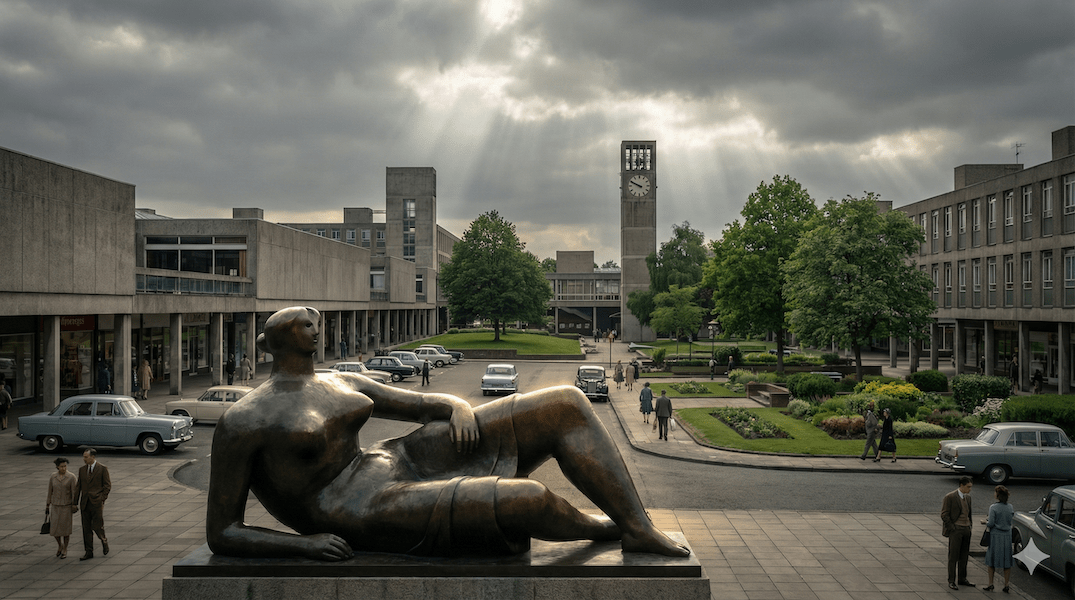
Another side of Harrow is its role as a "sculpture town."
"I want people who don't go to museums to be able to experience first-class art in their daily lives," said Gibbard, whose belief led to the systematic installation of public art starting in the 1950s. The collection now numbers over 100 pieces (reports from the Harlow Art Trust and others state that there are over 90), including works by masters such as Henry Moore, Barbara Hepworth, Auguste Rodin, and Elisabeth Frink, whose works are often featured in art textbooks.
What is particularly noteworthy is that these were not placed in heavily guarded areas, but rather in places where children play, such as the courtyards of housing complexes or the plazas of shopping streets. This was an extremely democratic attempt to elevate art from a "highly-appreciated object" to the "shared property (commons) of the citizens."
2. From Prosperity to Stagnation: Lessons from "Newtown Blues"
The 1950s and 1960s saw Harrow's golden age. Young couples flocked to the area from London, attracted by its modern homes, excellent infrastructure, and abundant green space. In 1951, "The Lawn," one of Britain's first tower blocks after the war, was built and became a symbol of modernism. The birth rate was three times the national average, earning the area the nickname "Plum Town."
However, this glory did not last long, and in the late 1970s and 1980s the city entered a period of serious stagnation.
| period classification | Major events and urban conditions | Social factors and issues behind the issue |
|---|---|---|
| 1947–1960s (Dawn/growth period) |
● Master plan formulated (revised in 1952 with a target population of 80,000) Construction of "The Lawn," one of the UK's earliest high-rise residential buildings ● Formation of a vibrant shopping district and community |
Post-war reconstruction and the baby boom. Public funds were poured in under the ideal of building a welfare state. The residents were highly homogeneous, making it easy to form communities. |
| 1980s – 2000s (Stagnation/decline period) |
●Dissolution of Harrow Development Corporation (1980) ●Private sale of town center ● Simultaneous deterioration of concrete buildings |
The Thatcher administration introduced a "small government." The decline of manufacturing led to an increase in unemployment. Social isolation and feelings of psychological stagnation, known as the "Newtown Blues," became apparent. |
| Since 2010 (Regeneration and transition period) |
●"Sculpture Town" Declaration ●The decision to relocate the UKHSA and the development of a science city ● Garden Town (HGGT) concept launched |
Urban regeneration centered on cultural capital and science and technology (life sciences). Stimulating reinvestment through the acquisition of leveling-up funds, etc. |
Why did the city lose its vitality?
The challenges faced by Harlow are very similar to those currently facing new towns in Japan.
First, infrastructure is destined to collapse at the same time, as "things built at the same time" do. Concrete houses, which were constructed in large numbers in a short period of time, all needed to be replaced after 50 years. The buildings at the time had poor insulation performance, and maintenance costs put a strain on the household budgets of residents.
Second, the dissolution of the development corporation and the dissipation of its assets. When the development corporation was dissolved in 1980, profitable assets such as commercial facilities were sold to the private sector. This has been pointed out as having weakened the city's ability to manage the entire town in a unified manner.
3. A dramatic turning point in the 2020s: a scientific and cultural reboot
But Harlow isn't finished. As we enter the 2020s, the city is embarking on a wave of unprecedented investment and transformation, driven by science and culture.
Relocating the UK Health Security Agency (UKHSA): Attracting a national project
On 17 July 2025, a historic decision was made for Harrow, when the UK Government formally confirmed that the UK Health Security Agency (UKHSA) Science Campus Hub would be relocated to Harrow.
This is not just a government office relocation. It is a huge project to consolidate research facilities that were previously scattered around the country and build a world-leading infectious disease research center. The specific impacts are as follows:
- Investing in UKHSA:The initial investment alone is more than 250 million pounds (£250m).
- Job creation:Approximately 1,600 highly skilled professionals are expected to be stationed during the construction phase, and approximately 2,750 once operations begin.
- Investing in urban regeneration:Separately, the city has received 20 million pounds (£20 million: approximately 3.8 billion yen) from the government's Levelling Up Fund, which will be used to redevelop the arts and culture district.
This project positions Harrow as one of the key hubs in the UK Innovation Corridor linking Cambridge and London, transforming the former working town into a city for scientists.
Harlow & Gilston Garden Town (HGGT) Scheme
Furthermore, the redefinition of Harrow as a "garden town" is also progressing in residential development. In the wider area including Harrow and its surrounding areas (such as the Gilston district), plans are in place to supply approximately 16,000 new homes by 2033, with a total of over 23,000 homes planned in the future.
On January 9, 2025, plans for a 10,000-home development in the Gilston area were officially approved. This is a large-scale community development consisting of seven "villages," and rather than simply expanding residential areas, it is a next-generation development that prioritizes sustainability and the preservation of green spaces.
4. Data on the transformation of Harlow and a comparison of Japan and the UK
Here, we use objective data to visualize the transformation of Harlow and the differences between it and new towns in Japan.
Demographic trends and forecasts: Signs of a V-shaped recovery
The graph below shows the population trends in Harlow. Between 2011 and 2021, the population increased by 13.91 TP3T. In terms of future projections, the ONS (Office for National Statistics) base scenario predicts a flat population, but if large-scale housing supply by HGGT is realized, it is planned to reach 100,000.
Harrow New Town population trends and forecasts
Source: ONS Census Data (2011/2021) & HGGT Vision
Japan and the UK: The crucial difference between new towns
What makes Harlow different from Japan's Tama New Town and the housing complexes in Hokkaido?
| Comparison items | UK: Harrow New Town | Japan: Tama and Hokkaido (cannabis, etc.) |
|---|---|---|
| The relationship between work and home | Aiming for complete self-containment, the city will incorporate industrial parks and research facilities. The city will have a high rate of workplaces and homes being close to each other, and will have a large daytime population. | It was designed as a "bedroom town" where people go to sleep, with the assumption that they would commute to the city center. The daytime population is extremely low, and the local economic circulation is weak. |
| Functions of green spaces | "Green Wedge": Designed as part of the city's functionality, it is integrated as a landscape, travel route and environmental conservation asset. | The parks are primarily designed to function in accordance with the Parks Act. In Hokkaido, they must function as snow removal spaces in the winter, but the cost of snow removal can be a heavy burden in some cases. |
| Cultural capital (art) | Over 100 outdoor sculptures are scattered throughout the living space. They have become a source of pride for the residents and have been successfully turned into a tourist attraction. | The mainstream is concentrated in box-like facilities (museums and halls). There are attempts at outdoor sculpture in some areas, such as Lake Toya, but it is still in the process of becoming part of everyday life. |
| Trends in revitalization funds | Strategic, focused investment at the national level, such as through the Levelling Up Fund (£20m) and UKHSA (£250m). | The main focus is on rebuilding and renovation projects, but the rights involved, such as the Condominium Act, are complex, and it takes a long time to reach an agreement. |
5. Proposal for Toyako Town, Hokkaido: "Design of Relationships"
The Harlow case is by no means a fantasy from a faraway country. It contains extremely practical hints for regional cities in Hokkaido, such as Toyako Town, which are facing population decline, an aging population, and a harsh natural environment.
How to understand the dual management costs of "snow" and "green"
Harlow's "Green Wedge" is a successful example, but to apply it directly to Hokkaido, the variable of "snow" must be taken into consideration. As examples such as the Oasa Danchi complex in Ebetsu City show, excessively large green spaces directly lead to increased snow removal and disposal burdens in winter.
But what if we change our perspective? In Toyako Town, it is possible to redefine green spaces not simply as a landscape, but as "variable infrastructure" that functions both as a snow dump in winter and as a tourist and recreational facility from spring to autumn. Just as Harlow incorporated "valleys" into the urban structure, Hokkaido needs to incorporate "snow" as part of its urban structure at the design level.
Shifting art from "tourism" to "lifestyle": Creating a connected population
Lake Toya already has a wonderful asset called the "Lake Toya Sculpture Park," which is a row of 58 sculptures. Harlow's lesson is not to make this just for tourists, but to make it a "part of life" that local residents come into contact with on a daily basis.
Specifically, the following measures can be considered to incorporate the "related population."
When renovating vacant houses or former resorts, rather than simply making them new, they reevaluate the modernist (or Showa retro) context of Harlow as added value. They package "life with art" and repurpose these properties as workcation facilities or satellite offices to attract urban creatives.
In Harrow, a citizens' organization called the Art Trust is working to preserve the sculptures. In Toyako, a system has been created in which citizen volunteers and children clean the sculptures and provide guided tours, helping to reaffirm the importance of art as a source of pride for the town and strengthening community unity.
Conclusion: Cultural capital is the most powerful infrastructure
The 70-year history of Harrow New Town offers us one clear lesson.
Physical infrastructure such as roads, water pipes, and concrete boxes begin to deteriorate the moment they are built, and eventually the cost of maintenance becomes a burden. However, excellent "landscape" and "culture (art)" are different. Over time, they become imbued with stories, become a source of pride for the community, and grow into "vintage" assets that increase in value.
The reason Harlow is now able to attract cutting-edge science such as the UKHSA is not simply because of the land it has, but also because the lush greenery and cultural richness left behind by Gibbard has made it an attractive place to attract creative talent.
Rejecting "completion" and allowing industrial structure and resident composition to metabolize in line with the times. And placing unwavering "cultural capital" at the core of this change. This is the optimal solution for modern urban management, which aims to maximize capital and design relationships, and should serve as a guidepost for Japan's regional cities.
Related Links
- Harlow & Gilston Garden Town (HGGT) – Official website
- Harlow Art Trust – Sculpture Town Official
- UK Government – Leveling Up Fund Case Study – UK government regeneration case study
Inquiries and requests
We help solve local issues.
Please feel free to contact us even if it is a small matter.