〜What is the true value of "universal design" that goes beyond simply eliminating steps and uneven surfaces?〜
*This article is based on information as of March 2026.
"We shape our buildings, and afterwards our buildings shape us." This speech by former Prime Minister Winston Churchill to the British Parliament on October 28, 1943, accurately expresses how urban environments and physical spatial design profoundly influence human behavior, mentality, and ultimately, the very nature of society. Turning to contemporary urban development, the most important issue that has emerged is the social implementation of the concept of "Universal Design (UD)."
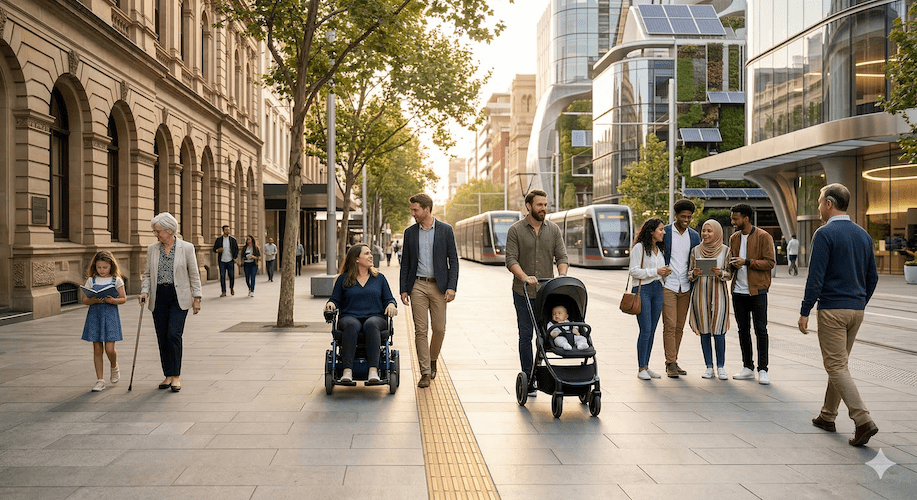
In short, universal design is a comprehensive design concept that aims to design urban environments, buildings, products, information, and services in a way that makes them easily accessible to everyone from the outset, regardless of age, gender, culture, or physical condition (such as disability). In other words, it is not about retrospectively modifying the environment as a "special consideration" for specific groups (such as people with disabilities or the elderly), but rather about eliminating all kinds of "barriers" that may be present in daily life—such as temporary injuries, the use of strollers, language barriers, and age-related decline in physical function—from the initial design stages, thereby creating a fair living environment.
However, translating this noble ideal into actual urban development involves numerous dilemmas between ideal and reality, as well as physical and economic bottlenecks based on regional characteristics. Based on the latest data, this article will comprehensively examine the historical background of universal design, its essential differences from the overlapping concept of barrier-free design, and the challenges unique to snowy and cold regions, including the record-breaking inbound tourism demand. It will unravel how next-generation urban infrastructure should balance "maximizing capital" and "designing relationships."
1. Historical lineage and establishment of the concept: The theoretical foundation of universal design
A comprehensive design philosophy outlined in "7 principles" and "8 goals"
The concept of universal design has evolved beyond mere "the pursuit of ease of use" into a solid academic and social movement with a firm theoretical foundation, thanks to the existence of clear guidelines. Specifically, the "seven principles of universal design," compiled and proposed in 1997 by a group led by Ronald Mace of North Carolina State University, form its strong foundation.
Firstly, "Equitable Use." This refers to a design that does not isolate or stigmatize any particular user. Secondly, "Flexibility in Use." This means a design that adapts to individual abilities, such as accommodating both right-handed and left-handed users. Thirdly, "Simple and Intuitive Use." Fourthly, "Perceptible Information." Fifthly, "Tolerance for Error." Sixthly, "Low Physical Effort." And seventhly, "Size and Space for Approach and Use."
What is particularly noteworthy is that the IDeA Center (Center for Inclusive Design and Environmental Access) at the University of Buffalo has extended this concept beyond physical fit to encompass health and social participation. They formulated "8 Goals": Body Fit, Comfort, Awareness, Understanding, Wellness, Social Integration, Personalization, and Cultural Appropriateness. As a result, universal design has moved beyond the phase of simply eliminating physical barriers and has been elevated to a highly sophisticated urban policy that promotes improved well-being and social participation where diverse people can co-create.
Barrier-free design and Universal Design: Not opposing concepts, but "overlapping and complementary concepts"
In urban development, the term "barrier-free" is frequently used for comparison. In the context of public institutions, universal design (UD) is generally defined as an approach that "considers how to make things easy for diverse people to use from the outset," while barrier-free design (BF) is defined as an approach that "removes existing barriers."
However, in practical applications, it is difficult and inappropriate to clearly separate these two concepts. For example, "multifunctional toilets" and "audio guidance systems" in train stations possess both barrier-free (BF) elements that remove barriers for people with disabilities and universal design (UD) elements that make them easy to use for able-bodied people, including the elderly and those with infants. In other words, these should not be seen as opposing concepts, but rather as "overlapping concepts that complement each other in enhancing urban resilience." The following table summarizes the starting points and characteristics of each design.
| Comparison items | Universal Design (UD) | Barrier-free (BF) |
|---|---|---|
| Direction in one word | Creating an environment that is easy for everyone to use from the start. | Improving the environment by removing existing barriers. |
| How to perceive the target audience | All people (without discrimination based on age, gender, culture, disability, etc.) | People experiencing specific problems or inconveniences (e.g., people with disabilities, the elderly) |
| Approach stages | Planning and designInitial stage (zero base)Therefore, we incorporate it while anticipating diverse needs. | Barriers in the existing environmentRetrospectively (from negative to zero)Remove or take measures |
| Overlap in practical work | Multifunctional restrooms, elevators, and voice guidance displays serve as BF (Benefits) to support specific vulnerable groups, while simultaneously fulfilling the role of Universal Design (UD) to enhance convenience for all. (Both roles are seamlessly integrated on-site.) | |
2. The Light and Shadow of Urban Development: Maximizing Capital and Risk
Promoting universal design in urban planning and community development is not merely a matter of social contribution or ethical obligation; it also has strategic significance in maximizing the return on investment (ROI) of the resources invested (time, money, and effort). However, there are also clear disadvantages and concerns that cannot be avoided when promoting its implementation. Here, we will structure and explain the "light and shadow" aspects for each stakeholder.
Maximizing the target customer base (market expansion and increased customer acquisition):
Because Universal Design (UD) targets "all people," it includes not only able-bodied individuals but also the elderly, families with young children (stroller users), people with temporary injuries, and foreign tourists unfamiliar with the language—a remarkably diverse range of customers and facility users. As a result, a dramatic increase in visitor numbers and utilization rates can be expected, bringing long-term and stable economic benefits to the community.
Long-term cost reduction and avoidance of renovation risks:
Because the building is constructed with a diverse range of users in mind from the initial design stages, there are no additional costs for constructing dedicated ramps or custom elevators for specific groups of people later on. Looking at the building's entire lifecycle (LCC), renovation costs are kept low, significantly reducing financial risk.
Social integration and enhanced brand value:
Creating an inclusive society that respects diversity directly leads to improved attractiveness of local governments for residents and enhanced ESG ratings for companies. Developing an environment where everyone can be themselves and utilize their abilities promotes innovation throughout society and enables sophisticated urban branding.
"Lack of safety due to overgeneralization (risk of exclusion of specific vulnerable groups)":
This is the biggest dilemma in Universal Design (UD). Flat sidewalks with no steps or uneven surfaces, designed to be easy for everyone to walk on, are ideal for wheelchair users, but for visually impaired people, they lose the ability to perceive the boundary between the road and the sidewalk, severely compromising safety. Therefore, there is a concern that if the incomplete aspects of UD are not supplemented with after-market barrier-free features (such as tactile paving), it could lead to fatal accidents.
Increased initial investment (initial cost) and spatial constraints:
Ensuring sufficient size and space for access (Principle 7) inevitably requires wide passageways and gentle slopes. Standardizing these within the limited site area of urban areas creates significant design constraints and greatly increases initial construction and development costs.
The hollowing out of institutions and moral hazard due to "barriers of consciousness":
No matter how excellent the physical universal design may be, it will not function without the morality and understanding of the people who use it. Problems such as able-bodied people occupying multi-purpose restrooms are frequent, and if the ethical awareness and education of each citizen do not keep pace, facilities that have been built with large amounts of taxpayer money will not reach those who truly need them.
3. Regionally specific bottlenecks: The challenges of Hokkaido, a snowy and cold region.
Caught between physical barriers and historical landscape
One of the factors that makes it extremely difficult to apply nationwide universal design standards to urban development is the "unique natural environment and topography of each region." In particular, promoting UD in Hokkaido presents unique environmental challenges that are fundamentally different from those in other regions of Japan.
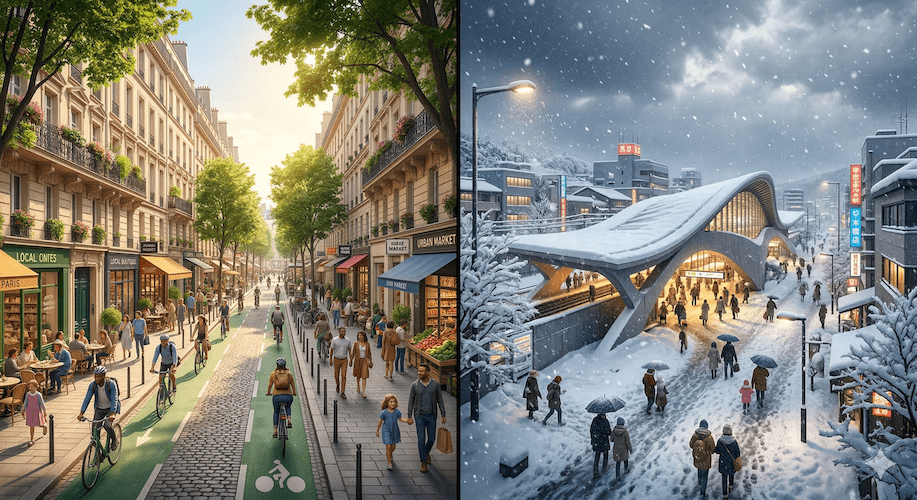
The first obstacle is the formidable physical barrier of "snowfall and a cold climate." Even if sidewalk steps are eliminated and ramps are installed in urban planning, the universal design function is completely rendered useless in winter by tens of centimeters of snow and ice. Wheelchair and stroller users are often deprived of means of transportation, and infrastructure development that involves enormous costs, such as the installation of road heating specific to snowy and cold regions and the expansion of underground pedestrian spaces, is required as a set.
Let's look specifically at the status of universal design implementation in major cities within Hokkaido, based on data from the Ministry of Land, Infrastructure, Transport and Tourism (reference values as of the end of March 2018). The graph clearly shows that there are significant differences in progress between regions.
[Graph] Comparison of Universal Design Status in Major Cities in Hokkaido
*This data is a reference value based on a survey conducted at the end of March 2018.
1. Development rate of roads around stations that should be converted to Universal Design (UD).
2. Reach rate from train stations to essential living facilities
*While Sapporo City maintains a relatively high level, Otaru City's facility access rate has dropped significantly to 42%. This is because Otaru's unique "hilly terrain" and "urban structure with a high concentration of historical buildings" are major obstacles to physical universal design.oneIt is presumed that this is the case.
Record surge in inbound tourism and "Universal Design for Information and Services"
The second challenge is to simultaneously address two conflicting factors facing major tourist destinations in Hokkaido: the rapid aging of local residents and the surge in multinational inbound tourists. According to the Japan National Tourism Organization (JNTO), the number of foreign visitors to Japan in 2024 reached 36,870,148 (final figure), and the annual total for 2025 is projected to reach 42,683,600, continuing to break previous records at an overwhelming pace. This massive wave of inbound demand is undoubtedly impacting Hokkaido's natural and hot spring resources.
For example, in a region like Toyako Town, which boasts abundant nature and hot springs, it is not easy to perfectly balance the preservation of old buildings and historical landscapes with physical universal design. However, this is precisely why investing in "universal design in terms of information" yields extremely high cost-effectiveness (leverage). Thorough multilingual support, the development of intuitively understandable pictograms, and the provision of services that ensure cultural appropriateness dramatically improve the quality of stay for tourists from diverse cultural backgrounds. As a result, this leads to attracting repeat visitors, boosting tourism spending, and ultimately contributing to a definite increase in tax revenue for the local economy.
4. Quantifying the transformation of mindset: Indicators for a truly inclusive society
Local government initiatives to overcome "barriers of awareness"
No matter how much capital is invested to build physical infrastructure and digital systems, a truly inclusive society cannot be realized unless the "attitude barriers" of the citizens who operate and use them are removed. To address this internal challenge, advanced municipalities are setting clear numerical targets and working to improve the situation.
According to Sapporo City's 2024 performance data, the percentage of citizens who feel that the city is becoming more barrier-free remains at only 55.61 TP3T, and the city has set a target of raising this to 75.01 TP3T by 2031. Furthermore, the indicator of the percentage of people who understand and act in accordance with the needs of the elderly, people with disabilities, etc., which forms the foundation of urban development, highlights the current situation of only 40.41 TP3T in 2024. The city is strengthening its awareness-raising and educational approaches to citizens in order to reach 70.01 TP3T by 2031. These data clearly show that removing the barriers of misunderstanding and prejudice in people's hearts, rather than removing physical barriers, is the most difficult challenge in next-generation urban infrastructure.
Conclusion: Building an endless ecosystem is true Universal Design.
In the near future, within a few years, universal design in urban planning is expected to move beyond the phase of "standardizing physical spatial design" and evolve into "smart city-type universal design" linked with IoT and AI technologies. Personalization, where environmental adjustments (such as extending the opening and closing time of automatic doors or automatically adjusting lighting contrast) are seamlessly provided through a sensor network in urban spaces in conjunction with wearable devices such as smartphones, according to the user's individual physical characteristics such as language, eyesight, and walking speed, has the potential to become the new standard.
However, no matter how advanced technology becomes, the most important perspective we should base our thinking on is the undeniable fact that "universal design is not a panacea that instantly solves all social problems, but only shows its true value through continuous coexistence with barrier-free design." Flat and sophisticated designs that cater to all people always contain the dilemma that they may sometimes deprive people who need specific support of the "barriers necessary for perceiving environmental information."
Therefore, truly inclusive and leveraged urban development is nothing less than a flexible approach that, while firmly establishing the principles of universal design—which pursue the ideal—as infrastructure, diligently provides support for the diverse individual needs that inevitably fall through the cracks, using the after-the-fact perspective of barrier-free design. Realizing a "society where everyone can live comfortably" is not something that is completed once the blueprints are drawn and construction is finished. It is an endless, gritty process of constantly gathering feedback from on-site users, learning from operational mistakes, and continuously updating while removing systemic distortions and "barriers of consciousness" within people. A truly universal urban environment can only be established when the government, businesses, and all citizens who use the space are aware of their respective responsibilities and build an ecosystem of mutually beneficial relationships.
Related Links
- Ministry of Land, Infrastructure, Transport and Tourism: Barrier-Free and Universal Design Policies
- Cabinet Office: Promoting Universal Design for the Realization of an Inclusive Society
- Japan National Tourism Organization (JNTO): Statistics on the number of foreign visitors to Japan
Inquiries and requests
We help solve local issues.
Please feel free to contact us even if it is a small matter.