〜Motorization has brought prosperity to cities, but the vulnerability it has exposed as population declines〜
*This article was compiled and written based on information as of February 2026.
"Cities are mankind's greatest invention," said economist Edward Glaser in his book, "Cities: The Greatest Invention of Mankind." Cities have functioned as devices that bring people together, exchange knowledge, and generate innovation.
However, another invention that became widespread in the mid-20th century, the automobile, dramatically and irreversibly transformed the shape of cities."Motorization (car-oriented society)"is.
Motorization, once a symbol of Japan's rapid economic growth, is now a huge and unsustainable social cost in a country with a declining and aging population. This issue is becoming particularly serious in vast areas like Hokkaido, where people are losing their means of transportation.
This paper examines the positive and negative aspects of motorization in urban structure from a historical and structural perspective, and closely examines the future of sustainable urban development based on data from a demonstration experiment of "regional public transportation" conducted in Toyako Town, Hokkaido.
▼Area analyzed: Toyako Town, Hokkaido
1. Definition of motorization and its impact on urban structure
Irreversible system restructuring: "car society"
First, let's confirm the definition that will serve as the premise for this discussion. Motorization does not simply refer to an increase in the number of cars owned. As the National Institute for Japanese Language and Linguistics has proposed rephrasing it as "car-oriented society," it refers to socio-economic activities, the physical structure of cities, and people's lifestyles themselves.The phenomenon of being reconfigured into a "system that assumes the use of automobiles"refers to.
From an urban planning perspective, this phenomenon has simultaneously brought about two powerful and contradictory vectors for urban structure:
The increased speed and distance of automobile travel has expanded the "outskirts" of cities indefinitely. The habitable area, once limited to within walking distance of train and bus stations, has expanded uncontrollably into suburban farmland and forests (urban sprawl), promoting the formation of low-density urban areas.
As a result, since the 1990s, large shopping centers (roadside stores) with huge parking lots have sprung up along suburban bypasses in regional cities.
On the other hand, automobile traffic facilitates the influx of people into urban centers, causing chronic congestion in metropolitan areas and paralyzing urban functions.
This paradox—"Though it was supposed to be convenient, it actually becomes inconvenient when everyone uses cars"—has resulted in pedestrians being excluded from city centers and historic streetscapes being destroyed to widen roads.
Historical transition: From the dawn to the "degenerate" phase
Japan's motorization has undergone dramatic changes from the postwar period of rapid economic growth to the present day. Looking back at this transition also helps us understand the root causes of current issues.
-
Phase 1: Explosive growth and the "transport wars" (1960s onwards)
In 1967 (Showa 42), the number of cars owned in Japan exceeded 10 million. However, the development of infrastructure such as traffic lights and sidewalks was unable to keep up, and in 1970 (Showa 45), the number of traffic accident fatalities reached a record high of 16,765. This became a social problem known as the "traffic war."
-
Phase 2: Maturity and the trend toward one device per person (1980s onwards)
After the bubble economy, the trend in regional areas shifted from "one car per household" to "one car per person." It was also during this period that suburban shopping centers rapidly increased due to the relaxation of the Large Retail Store Law, and the hollowing out of city centers (the doughnut phenomenon) became decisive.
-
Phase 3: Saturation and Degeneration (2010s to present)
Japan is currently in a "degenerate" phase. According to data from the Automobile Inspection and Registration Information Association, the number of private passenger cars per household will be 1.009 by the end of March 2025, marking the 12th consecutive year of decline.
[Illustration] Image of the progress of motorization in Japan
dawn
maturity period
saturation
Degeneration/reduction
*Conceptual diagram showing trends for each generation
2. The "negative spiral" and structural issues affecting regional cities
The collapse of public transport
The biggest problem facing modern regional cities is the collapse of public transportation caused by excessive reliance on private cars and the resulting decline of local communities.
This process is a classic example of the "fallacy of composition," which occurs when everyone acts rationally without malicious intent.
[Negative spiral]
- Popularization of private cars:Residents are using their convenient personal cars to move to large suburban stores with a better selection of products.
- Decrease in public transport users:Bus and railway profits are declining, leading to reduced service and line closures.
- Reduced convenience:Buses will become inconvenient and the number of passengers will decrease even further.
- Decline of local commerce:People with limited mobility (elderly people and students) will no longer be able to go to local stores, and local stores will close.
- Loss of daily functions:Ultimately, this will result in the creation of "inhospitable areas" where residents without cars cannot survive.
Japan's uniqueness revealed through international comparison
To understand the current situation in Japan's regional cities, let's compare it with international data.
According to 2023 data from the Japan Automobile Manufacturers Association (JAMA), the global four-wheel vehicle penetration rate is approximately 206 vehicles per 1,000 people (one vehicle for every five people), but in Japan,639 unitsIt is at an exceptionally high level.
However, what is particularly noteworthy is the treatment of motorcycles. In Asian countries, scooters and other motorcycles are the main form of mobility, but in Japan, due to the winter climate (especially in Hokkaido) and safety considerations, transportation is heavily dependent on four-wheeled vehicles that can withstand the elements.
This structure leads to increased maintenance costs. According to JAMA's calculations, the taxes and maintenance costs borne by Japanese car users over the 13 years from vehicle purchase amount to approximately 1.9 million yen (approximate tax only), an extremely heavy burden compared to Europe and the United States. With road-specific revenues increasingly being converted into general revenues, infrastructure maintenance costs are becoming a heavy burden.
| Comparison items | Regional cities in Japan | Europe (major EU cities) |
|---|---|---|
| urban structure | Suburban sprawl (disorderly) Regulations on conversion to agricultural land are lax, leading to increased sprawl. |
Concentrated (compact) The city boundaries are clearly defined and suburban development is strictly regulated. |
| Public Transportation Management | Independent accounting system The principle is that private businesses must operate in the black. If they are in the red, they will withdraw. |
Public-private operation and vertical separation The infrastructure is provided by the government, while operation is by the private sector. There is ample government support. |
| road funding | Gasoline taxes and other taxes will be included in general revenue. A lot of tax money goes into maintaining roads. |
Fuel taxes and other taxes are high, but they are also used for environmental measures and public transportation. |
3. Empirical Analysis: The Challenge of Toyako Town, Hokkaido
Now, let's look at some specific data from the field. The situation in Toyako Town, one of Hokkaido's leading tourist destinations, can be seen as a microcosm of the limitations of motorization that rural Japan faces and the struggle to break away from them.
Demographic changes and the "migration crisis"
The population of Toyako Town is8,442 people(Values listed in a report by the Ministry of Land, Infrastructure, Transport and Tourism). According to population estimates, although the total population is on a downward trend, the aging rate continues to rise. Particularly serious is the increase in the elderly (75 years old and over).
Furthermore, as the risk of dementia and mild cognitive impairment (MCI) is increasing nationwide, there are many people who are considering giving up their driver's licenses, and it is inevitable that the number of people who have difficulty getting around on their own will rapidly increase in the future.
Some of the routes of the privately run bus service (Donan Bus) that once ran through the town were discontinued due to declining profitability, leaving residents living in the northern area of the town facing the risk of losing their means of transportation to the city center, where the town hall and hospital are located.
How "Touya Connect Taxi" works
In response to this crisis, Toyako Town collaborated with Panasonic ITS Corporation and others to conduct a trial run of the demand-based transportation service "Toya Connect Taxi" (October 1, 2024 - February 28, 2025).
- System design:We operate a reservation-based shared taxi service using a wagon as a "private paid passenger transport (municipal paid transport)" based on Article 78, Paragraph 2 of the Road Transport Act.
- Digital Utilization:Reservations can be made via both the town's official LINE account and by phone.
- Regional currency collaboration:By utilizing "Toya Coins (town points)," prices are differentiated between town residents (200 yen) and non-town residents (500 yen).
The shock of "1.6%" revealed by income and expenditure data
The data from this experiment clearly shows the reality that local public transportation cannot be a viable business. Below is a graph showing the estimated income and expenditures during the experiment period.
[Demonstration experiment income and expenditure data] Fare revenue vs. running costs
*Comparison of running costs only, excluding initial costs (approximately 60 million yen).
*Figures are estimates based on the demonstration experiment report.
Cost recovery rate through fare revenue is minimalApproximately 1.6%This is a figure that would cause a normal private business to immediately withdraw.
However, it would be premature to conclude that these figures were a failure. During the period, the number of people using the Connect Taxi itself was 1,144 (433 trips), and the average monthly number of people using all public transport in the town was 830, so the program has been successful to some extent in providing transportation for residents.
4. Conclusions and Outlook: A Paradigm Shift in Urban Management
Redefining "mobility" as social infrastructure
The Toyako Town case suggests that public transportation in rural areas is no longer a business that aims to make a profit, but rather a business that is run by the same means as roads, waterworks, and police."Social Infrastructure"It is a fact that needs to be seen as such.
The following three perspectives are essential for future urban management.
-
Cross-sector funding
It is impossible to cover the costs from fare revenue alone. A system in which hospitals, commercial facilities, tourist associations, and other entities that benefit from travel share part of the costs, as well as the use of taxes (general revenue), should be justified. -
Visualization of social ROI (return on investment)
In addition to the deficit amount, we need indicators that quantify the "reduced nursing care benefits costs due to elderly people going out" and "amount of consumption at local stores," and prove that investment in transportation is a "profit" for the entire region. -
Autonomous driving and digital technology implementation
The majority of running costs are labor costs. Demonstration tests of self-driving buses being conducted in Chitose City, Hokkaido, and other areas show the possibility of reducing costs through future unmanned operation.
▼ Autonomous driving demonstration test area (example): Around the roadside station in Chitose City, Hokkaido
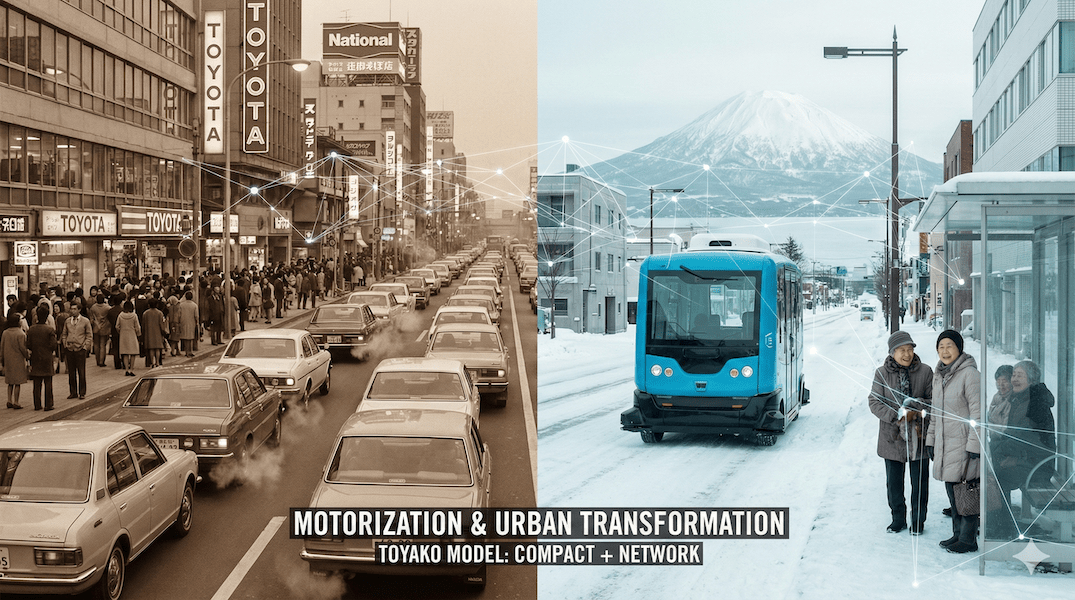
Transforming urban structures into "compact plus networks"
It is not just traffic measures that are necessary; the very shape of the city itself needs to be revised over the long term.
It is not realistic to gather everything in the center. We should form "small bases" that gather clinics, shops, and community centers in the center of old towns and villages, and connect them with local transportation in a multi-polar network-type town development, that is,"Compact Plus Network"This is the vision we should aim for.
Editor's Note: Return from the Sprawl
Motorization has given us unlimited freedom of movement, but at the cost of this, we have lost cities that are walkable and left huge maintenance costs for future generations.
At first glance, Toyako Town's efforts may seem like a small local news story, but they encompass a larger theme that all local governments in Japan face: "returning from sprawl."
Reweaving dispersed cities back together so that human warmth can once again reach each other—this may be the way to reconstruct true "prosperity" in a society with a declining population.
Related Links
- Ministry of Land, Infrastructure, Transport and Tourism: Revitalization and revitalization of local public transportation
- Ministry of Economy, Trade and Industry: Autonomous Driving Business Review Committee
- Japan Automobile Manufacturers Association: Japan's Automobile Statistics
Inquiries and requests
We help solve local issues.
Please feel free to contact us even if it is a small matter.