〜The true value of a walkable city in a declining population society〜
*This article is based on the latest information as of December 2025.
Ever since humans invented the device known as the "city," we have always struggled to reconcile "convenience" and "livability." In particular, motorization in the 20th century dramatically expanded our living space, but it also had the side effect of weakening pedestrian safety and community ties.
Now, it is being re-evaluated all over the world.Neighborhood Unit Theory" is a classic theory proposed in the United States about 100 years ago. However, the idea of "living within walking distance" that this theory embodies has been revived with surprising freshness in the modern context of "15-minute cities" and "carbon neutrality."
This paper traces this intellectual transition and, in conjunction with a wide range of data, explores how regional cities like Toyako Town in Hokkaido, which are facing population decline and financial constraints, can utilize this theory as a "survival strategy." Over five chapters, the paper argues that cities are not simply a collection of buildings, but a collection of our wills.
1. The origins of neighborhood theory: Clarence Perry's utopia
■ The impact of motorization and "children's rights"
In 1920s New York, the spread of the Model T Ford led to a rapid shift from the era of horse-drawn carriages to the era of the internal combustion engine. However, this shift came at a cost: urban planning at the time could not keep up with the speed of the automobile, and the streets were transformed from playgrounds for children into dangerous, life-threatening spaces.
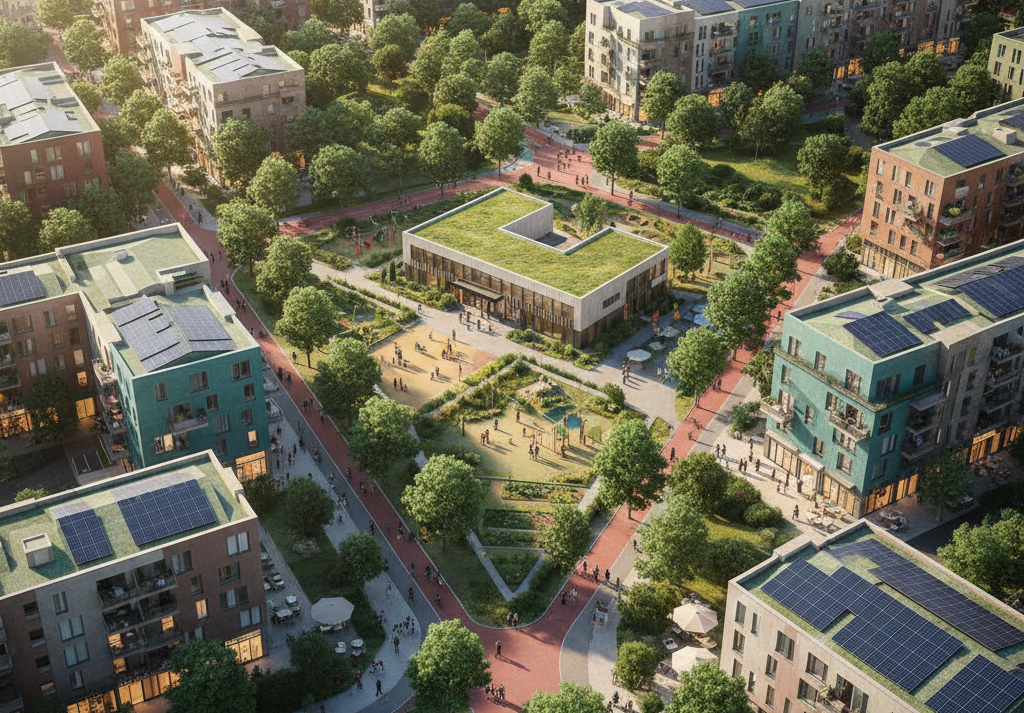
The "Neighborhood Theory" published by Clarence Perry as part of his 1929 Regional Plan of New York was a brilliant response to this confusion. Perry defined the size of a neighborhood as "a population large enough to support one elementary school (approximately 5,000 to 6,000 people)." This idea of "centering on elementary schools" has become the foundation of modern community design.
■ Six basic principles and their philosophy
Perry's principles can be summarized as follows:
- scale:A population large enough to support one elementary school (approximately 1,000 to 1,200 households).
- boundary:The residential area is surrounded by a main road, preventing passing traffic from entering the area.
- Parks and Recreation:Arrangement of squares and parks that are easily accessible to residents.
- Public facilities:The layout is centered around the school, allowing residents to gather by walking.
- Nearby stores:They will be located at the four corners of the residential area (at the intersections with major roads) to ensure convenience.
- Internal road network:Vehicle traffic will be restricted, and pedestrian safety will be given top priority.
These were not just rules for physical layout. By reducing physical distance, Perry hoped to restore the spirit of "mutual aid" among city residents, which had been gradually fading away.
2. Evolution to the "15-minute city": A paradigm shift due to the climate crisis and pandemic
■ Carlos Moreno and the "Ecology of Time"
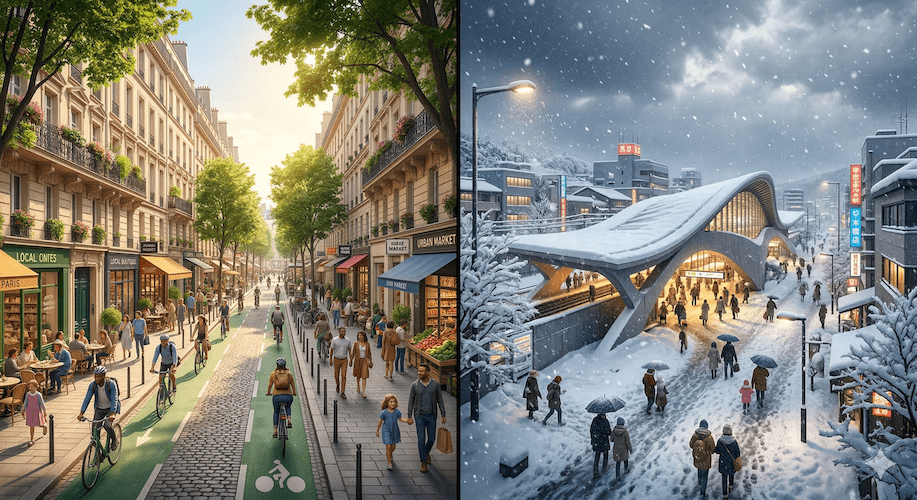
Fast forward to the 2020s, and the "15-Minute City" (La Ville du Quart d'Heure), a policy initiative promoted by Paris Mayor Anne Hidalgo, is a modern update of Perry's theory. Its proponent, Professor Carlos Moreno, advocated for freeing urban life from the "drudgery of travel."
While traditional urban planning separates land use (zoning) and assumes long-distance travel, the 15-minute city emphasizes "multi-functionality." A single building can function as an office during the day, a community center at night, and a cultural facility on weekends. This concept of "chronotopia" (utilizing time) is the key to dramatically reducing a city's carbon emissions.
| comparison dimension | Neighborhood Planning (1920s-) | 15 minutes city (2020s-) |
|---|---|---|
| Main driver | Ensuring safety from traffic accidents and childcare environment | Climate change, well-being, and pandemic resilience |
| Central Facility | Primary School (Education and Social Hub) | Multi-functional base (work, living, medical care, leisure) |
| Philosophy of Movement | Pedestrian and vehicle separation (safety by eliminating vehicles) | Active mobility (reducing dependency on cars) |
| Digital Technology | Assuming analog face-to-face interaction | The integration of remote work, IoT, and online medical care |
*Table 1: Comparison of the concepts of neighborhood districts and 15-minute cities (created by the author)
3. The "silent emergency" facing Japan's regional cities
■ The costs of sprawl and fiscal rigidity
After the war, many regional cities in Japan were planned on the premise of expansion. Residential areas spread to the suburbs and further out in the city, and roads, water supply and sewerage systems, and public facilities were built to accommodate them. However, what we are seeing today is the reality that the maintenance costs of these systems are eating away at local government finances.
As population density declines, infrastructure maintenance costs per person increase exponentially. This phenomenon is also known as "negative agglomeration economies." Many local governments have been putting off repairs to aging bridges and tunnels, and it is predicted that these will reach their physical limits in the 2030s.
■ Case study of Toyako Town, Hokkaido
Looking at Toyako Town as an example, the dilemma between declining tax revenues due to a declining population and maintaining the hot spring town and public infrastructure that are tourism resources becomes clear. The town's budget for fiscal year 2023 is approximately 8.2 billion yen. Of this, the amount of "discretionary expenses" that can truly be used to invest in the future is surprisingly limited.
Toyako Town: Predicted correlation between population trends and infrastructure maintenance costs
*Graph explanation: The blue line shows the working-age population trend, and the red line shows the predicted renewal costs for public infrastructure (bridges, water supply and sewerage, etc.). While the population is declining, the "crocodile's mouth" phenomenon, where facilities built before the bubble period are due for renewal, is becoming more pronounced.
4. Critical Reflection: Why Some People Rebel Against the 15-Minute City
While the theory is beautiful, we cannot ignore the fact that there are protests against the "15-minute city" around the world (especially in Europe and the United States). This is the biggest hint when it comes to introducing this theory to regional cities.
In Oxford and other places, there was a backlash that bordered on conspiracy theories, with residents fearing that they would be restricted from leaving their residential areas. This is an example of how the lack of transparency when digital management and urban planning are combined has triggered a psychological defensive instinct among residents.
Branding "convenience within 15 minutes" risks driving up land prices and driving low-income earners out of the area. This is a warning that urban planning must not become "comfortable encapsulation for the wealthy."
5. Proposals for the future: Digital neighborhoods and mutual assistance digital transformation
■ One-minute city (street-level transformation)
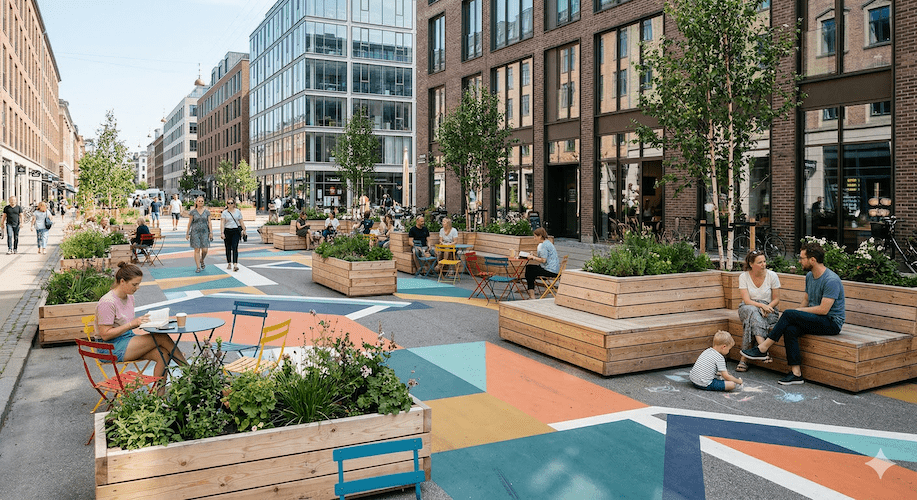
The Swedish initiative, "1-minute city (Street Moves)," is a micro-redesign of the street just outside a house, even more microscopic than 15 minutes. By converting parking spaces into parks and benches, the frequency of interaction between residents is dramatically increased.
■ "Digital Wand" in Regional Cities
In areas like Toyako Town, where physical concentration is difficult, technology is needed to neutralize distance.
- Metaverse City Hall:Even elderly people who have difficulty moving around physically can complete administrative procedures from their homes as if they were in person.
- Automatic vertical and horizontal movement:On-demand transportation maintains the "15-minute psychological distance."
- Drone logistics network:Reduce logistics costs while maintaining the convenience of shopping.
Conclusion: What we put into that 15 minutes
Cities are the result of the will of the people who live there. The true goal of the terms "neighborhood theory" and "15-minute city" is not efficient transportation or orderly urban planning. It is the most precious resource in our lives."time"It's about reclaiming freedom for our family, friends, and ourselves, without it being taken away by traffic jams and the immobility of travel.
Jane Jacobs' insight that "planning a city begins with knowing the life people want" remains relevant even now, 100 years later, and here in Toyako. Where should we invest our 8.2 billion yen budget? This is our own answer to the question, "What kind of society do we love, and what do we want to leave to the next generation?"
Redefining neighborhood theory is not simply a matter of redrawing a map, but a deeply human and creative process in which we reclaim the "richness of our lives" with our own hands.
Related Links
- Ministry of Land, Infrastructure, Transport and Tourism: Overview of the Location Optimization Plan System
- C40 Cities: 15-Minute City Global Hub
- Toyako Town: Second Toyako Town Public Facilities Comprehensive Management Plan
Inquiries and requests
We help solve local issues.
Please feel free to contact us even if it is a small matter.