〜The reality of urban regeneration towards 2030〜
*This article is based on information as of February 2026.
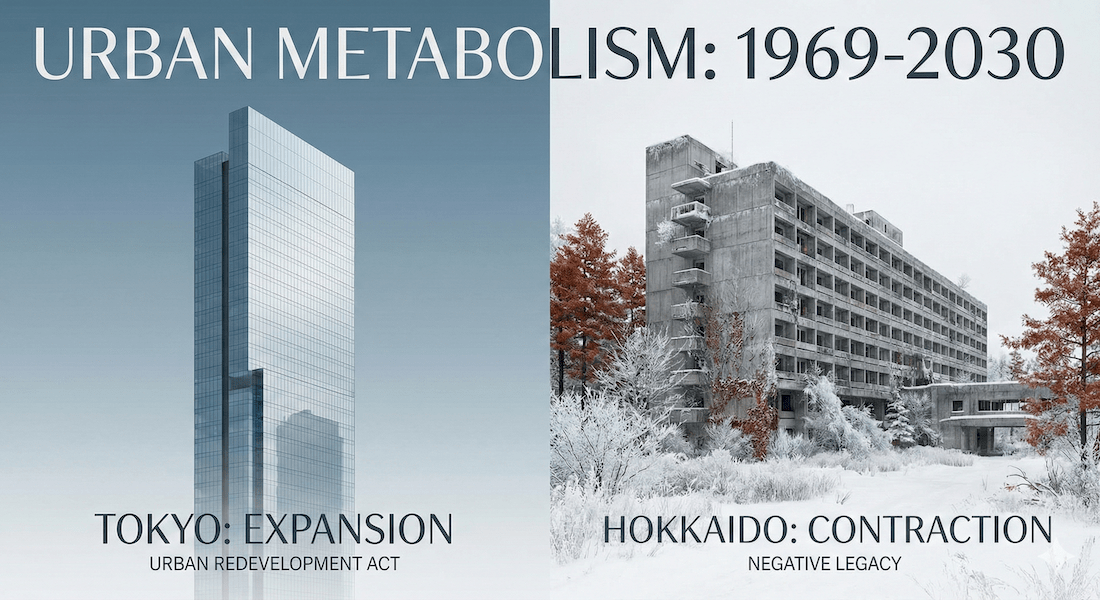
The tower apartment buildings and glass-walled commercial complexes in front of train stations that we casually look up at every day did not emerge spontaneously, but were driven by a powerful "legal engine": the Urban Redevelopment Act, enacted in 1969.
This law has "magically" consolidated fragmented land rights and stretched the city skyward. As a result, Tokyo has maintained a level of affordability (livability) through an "oversupply of housing" that is unparalleled in the world. However, this powerful mechanism also carries the risk of creating a huge "negative legacy" in regional cities and hot spring resorts where populations are declining.
Furthermore, recent soaring construction material prices and labor shortages are fundamentally undermining the foundations of this successful model. Furthermore, the unique characteristics of the Japanese system have been brought into sharp focus by comparing it with the latest trends overseas, such as the "City of Yes" initiative underway in New York City.
This article will explore in detail the mechanism of "rights conversion" that lies at the core of the Urban Redevelopment Act, compare it with the latest developments in New York and London, and explore the practical challenges facing regional cities such as Toyako Town in Hokkaido, in order to explore the perspective of "urban development" that will be necessary for Japan in the future.
1. The Alchemy of "Rights Conversion": The True Nature of the Urban Redevelopment Act
A system in which land becomes a "floor" with consent and approval
Before we get to the heart of this law, we need to understand the historical background of Japanese cities. After Japan rebuilt from the ruins of postwar Japan experienced rapid economic growth and population concentration in urban areas. However, this resulted in dangerous urban areas with densely packed wooden apartment buildings, narrow roads, and areas that even fire trucks could not access.
The Urban Redevelopment Act (Type 1 Urban Redevelopment Project) can be most succinctly described as follows:"A system that reconstructs (converts) complex rights relationships such as land and leasehold rights into "divided ownership rights (floor)" of buildings."is.
Normally, buying or selling land requires the consent of all owners. If just one person objects, the project will be derailed. However, under this law, if certain requirements are met (such as the consent of more than two-thirds of the owners and the area), and approval procedures are completed by the prefectural governor or other relevant authority, it becomes possible to replace the land with a "floor right" for a new building through legal procedures, including the rights of opposing landowners. This is an extremely powerful legal technique that strikes a delicate balance between the protection of private property rights and the public welfare (making cities fireproof and promoting intensive use).
"Floor Area Ratio Bonus" is combined with another system
It is often misunderstood, but the Urban Redevelopment Act itself does not automatically increase the "floor area ratio (the ratio of the total floor area of a building to the site).""Comprehensive Design System"や"Specific block"By skillfully combining special provisions under the City Planning Act and Building Standards Act, the huge floor space has been created.
Specifically, on the condition that "public open space (a plaza that anyone can access)" and "cultural facilities" are developed, the government can grant a relaxation (bonus) in the floor area ratio, and the additional floor space can be sold to raise funds for the project. In other words, the Redevelopment Act can be said to be a "vessel that brings together rights," and the floor area ratio bonus is the "fuel that makes the project happen."
Case study: The power of redevelopment as seen in Roppongi Hills
The power of this law is exemplified by Roppongi Hills in Tokyo's Minato Ward. Once a maze of wooden houses, TV Asahi, and narrow, sloping streets, the area has been transformed into a vast cultural center through a 17-year redevelopment project.
▲ Roppongi Hills is a symbol of redevelopment. It is a three-dimensional city development that takes advantage of the differences in elevation of the terrain.
Winston Churchill once said:
“We shape our buildings; thereafter they shape us.”
(We shape our buildings, but then our buildings shape us.)
For Japan, which rose from the ruins of post-war Japan, eliminating densely populated wooden areas and creating fireproof cities (concrete skyscrapers) was precisely the "shaping" required to protect the lives of its citizens. This law has functioned as the most powerful tool for achieving this national goal.
2. Why is Tokyo "cheap"?: A comparison with New York and London
Tokyo's "metabolism" astonishes the world
Tokyo is known as a "mysterious city" among urban planners around the world because rents and housing prices are kept (relatively) low compared to the size of its economy. Why is it that Tokyo is the only city that can maintain an abundant supply while New York and London suffer from chronic housing shortages and skyrocketing prices?
Part of the answer lies in the "tolerance" of Japan's legal system, including the Urban Redevelopment Act. The graph below gives an idea of the annual number of housing units supplied in major cities.
Annual housing supply in major cities (comparison of estimated values)
*Tokyo housing construction start statistics (average for 2019-2023)
*Based on number of completed units (average for recent years)
*Based on the number of permitted/completed units (average for recent years)
*Statistical definitions (construction starts, completions, net increases, etc.) differ from city to city, so care should be taken when making simple comparisons.
*If you are viewing this on a smartphone, you can scroll horizontally.
Ideological differences in system design
This huge difference in supply stems from fundamental differences in urban planning. Let's take a closer look at the differences in the table below.
| Comparison items | Tokyo | New York (NYC) |
|---|---|---|
| The philosophy behind development control |
[Permissive/Additive] In principle, construction is permitted as long as the requirements are met. "Rights conversion" makes it easy to update existing non-compliant buildings, and mixing of land use zones is also flexibly permitted. |
[Restrictive/discretionary] There are strict zoning regulations, and each project requires tough negotiations with the community board and local government, and it is not uncommon for approval to take several years. |
| Housing Supply Mechanism |
[Scrap and Build] Taking advantage of the redevelopment law, aging properties are being rebuilt into high-rise apartment buildings one after another, and the excess supply acts as a pressure to suppress prices. |
[Stock emphasis] There are strict regulations for preserving historical buildings, and new supply cannot keep up with demand. As a result, vacancy rates are extremely low and rents continue to rise. |
| Latest Trends |
[Walkable City] The floor area ratio will be relaxed by developing plazas that emphasize a comfortable stay. Greenery and the creation of pedestrian spaces will be conditions for receiving the bonus. |
[City of Yes] Creating affordable housing (for low-income people) would enable the Universal Affordability Preference (UAP) to provide at least 20% of additional housing. |
As can be seen from the table, Tokyo has systematically encouraged the practice of "tear down and rebuild higher." This has created a certain amount of "slack" in the market, maintaining price competitiveness.
Meanwhile, New York City will“City of Yes for Housing Opportunity”The city has embarked on a bold zoning reform called the "Capacity Reform." This allows for an increase in the floor space available for housing construction, provided that "affordable housing (income-restricted housing)" is provided. While Japan's redevelopment law has traditionally given bonuses in exchange for "public open space (plaza)," NYC's more direct payment of "residential rights" offers important insights into the future design of Japanese systems.
3. The tricks and risks of "free new construction"
The double-edged sword of "reserved beds"
The biggest incentive of the Urban Redevelopment Act is the scheme that allows landowners to acquire floor space in new buildings without paying any money (equivalent exchange)."Reserved floor"is.
Here's how it works: First, a building with a much larger floor area than the original building is planned, using a relaxation (bonus) of the floor area ratio. The landowner is given a floor area (right of floor) that corresponds to the original asset value. Then, the remaining "extra floors (reserved floors)" are sold to developers or new residents, and the profits from the sale are used to cover the enormous construction costs.
However, this "alchemy" can easily be disrupted by changes in the economic environment. Let's look at the following two scenarios.
Prime location in the city center/in front of the station
This model works in areas with high land prices, such as Minato Ward and Shibuya Ward. Because the "reserved floors" sell like hotcakes at high prices, it pays off even if construction costs soar.
- Landowners can acquire newly built condominiums with increased asset value at no cost.
- Disaster-resistant plazas and roads will be built in the area.
- The government can expect to see an increase in property tax revenue.
➔ A win-win-win relationship is established
Local cities/suburbs
This is a risk that frequently occurs in central urban areas in regional areas. If demand for apartments and tenants is weak and there are no buyers for the "reserved floor space," or if they can only be sold at low prices, the business's balance sheet will collapse.
- The rising construction costs could not be covered, resulting in large additional costs for landowners.
- After completion, the commercial floors were left unfilled, leaving management costs to bear.
- This will turn the area into a "shuttered building," accelerating the city's decline.
➔ The birth of a negative legacy
In her classic book, The Death and Life of Great American Cities, urban scholar Jane Jacobs points out that a city's diversity is born precisely because its "old buildings" remain. This is because old buildings have low rent and are easy for young people, artists, and small businesses to move into. Uniform redevelopment that pursues only economic rationality can erase a city's original "bustling streets" and "community warmth," and can also have the side effect of causing gentrification (replacement of residents).
4. The Local Blues: A Warning from Toyako Town, Hokkaido
Where redevelopment laws don't apply
Hokkaido's hot spring resorts are a prime example of a region where Tokyo's logic doesn't apply. In Toyako Town, Teshikaga Town (Kawayu Onsen), Lake Akan, and other areas, large hotels that were expanded during the bubble period have closed down, leaving these areas abandoned as huge ruins, a serious problem.
"Why not use the Urban Redevelopment Act to rebuild it beautifully?"
It would be premature to think so, because hereThe "construction cost" is far higher than the "market value" (below cost)That's why.
▲ Aerial photo of Lake Toya hot springs. The area faces the problem of dilapidated accommodation facilities scattered across the beautiful lakeside landscape.
The history of "preservation and collection" rather than "land readjustment"
Toyako Town (formerly Abuta Town) suffered extensive damage from the eruption of Mount Usu in 2000. At that time, rather than the usual land readjustment project, the town decided to implement the following measures to restore the area."Disaster Prevention Group Relocation Promotion Project (Boushu)"There is a reason why this was adopted.
The Nishiyama foothills area rose by more than 70 meters, dramatically changing the topography. It is impossible to restore the land to its original shape in such an area. Therefore, the most rational option was for the local government to purchase land in the danger zone, develop housing complexes on safer, higher ground (such as the Senboku area), and relocate people en masse through "prevention and collection."
[Case study: High cost structure of hot spring resorts]
The construction of public facilities and hotels in Hokkaido's hot spring resorts involves battling harsh conditions that differ from those found in ordinary areas.
-
● Sulfur and cold weather walls
The sulfur gases that are unique to hot spring areas corrode metals rapidly. This makes it necessary to use expensive corrosion-resistant materials for the roof, sashes, and even piping. Furthermore, insulation performance is required to withstand the harsh winters, when temperatures can reach minus 20 degrees Celsius, so the construction cost per square meter is significantly higher than in other areas. If this were to be done for a reinforced concrete hotel, the construction costs would be enormous. -
● Lack of profitability
Tower apartments in Tokyo sell like hotcakes at over 5 million yen per tsubo. However, in regional resort areas, the number of people willing to buy at that price range is extremely limited. The structure is such that "the more you build, the more you incur losses," so private redevelopment companies cannot get involved.
In such areas, the traditional urban redevelopment law aimed at "high-use (making it bigger)" is powerless. Instead, what is needed is a new interpretation of the law and the injection of public funds to "reduce (make it smaller)" and "publicize (make it into a plaza)." By removing abandoned buildings and developing the sites as parks, the value of the entire area can be increased -- in other words."Redevelopment by Subtraction"This is the key to regional revitalization.
Conclusion: Redevelopment within our means by 2030
The Urban Redevelopment Law was a great invention that supported Japan's rapid economic growth. The role that this law played in the process of building modern cities from ruins is immeasurable.
However, in the second half of the 2020s, with the population declining and material prices rising simultaneously, this role is being forced to undergo a major transformation.
In large cities, a qualitative shift is needed, like NYC's "City of Yes," where development profits are returned to solving social issues such as "affordable housing" and "environmental performance.""Who is the floor for?"This is an era in which this is being questioned.
Meanwhile, regional cities need the wisdom to use this law and related bills as a "tool for retreat" to avoid unreasonable high-rise construction and to shrink their cities into small, beautiful cities. How can we break away from the Showa-era success story that "the construction of tall buildings equals success" and design sustainable landscapes that suit the local climate and size?
The time has come for each of us to take the initiative in charting the future of our cities, rather than leaving it up to the government and experts.
Related Links
- Ministry of Land, Infrastructure, Transport and Tourism: Urban Redevelopment Projects
- Urban Renaissance Agency: Urban Renaissance Initiatives
- Tokyo Metropolitan Government Bureau of Urban Development: Urban Redevelopment Project Structure
Inquiries and requests
We help solve local issues.
Please feel free to contact us even if it is a small matter.