〜The concepts of "valley section" and "region" proposed by Patrick Geddes provide an essential perspective in today's world, where we are facing climate change and population decline.〜
*This article is based on publicly available information and various statistical data as of January 2026.
"A city is more than a place in space, it is a drama in time."
These are the words of Sir Patrick Geddes (1854-1932), a Scottish biologist and sociologist who is considered one of the fathers of modern urban planning.
These days, terms like SDGs (Sustainable Development Goals) and sustainability are commonly discussed in business and government. However, how much do we realize is that more than 100 years before these concepts became commonplace, there was a thinker who tried to view the environment, economy, and people's lives as if they were a single "organism"?
Geddes witnessed the cities that were becoming polluted and diseased due to the rapid industrialization of his time, and he advocated that urban planners should be urban surgeons. The process of "Survey-Analysis-Plan" that he advocated, and the concept of "Valley Section," which views a region from a topographical cross section, are not simply historical relics.
Rather, in modern Japan, where we face increasingly severe disasters due to climate change and a shrinking social function due to population decline, and particularly in Hokkaido, where abundant natural capital and severe disaster risk coexist, his ideas shine with unprecedented brilliance and offer us the "wisdom for survival."
This article explores how Geddes's theory can be applied to modern urban development in Toyako Town, Hokkaido, and its surrounding area (Toyako-Usu UNESCO Global Geopark). The enormous caldera formed approximately 110,000 years ago, the repeated eruptions every few decades, and the people who live there—reevaluating these through Geddes's eyes should help us see a path to true regional revitalization that goes beyond the traditional frameworks of tourism promotion and disaster prevention planning.
1. Return to the organic entity known as the "region"
Beyond the "illusion" of administrative divisions
First, let's think about the "addresses" and "administrative districts" that we use every day and take for granted. We tend to recognize our residential areas as "City X" or "Town X," artificial boundaries drawn on a map. However, for Patrick Geddes, a city was not just a collection of such inorganic divisions.
For him, cities were like organs that existed within a larger, vast living organism known as a "region." Just as the human body is a collection of organs connected by blood vessels and nerves, he believed that cities could not exist apart from their surrounding natural environment and rural areas. Rather than separating cities in isolation, he repositioned them within the geographical and ecological context that surrounded them.
Geddes was strongly influenced by the French sociologist Frederic Le Play's formula "Place - Labor - Family," and he proposed his own theory of the Trinity, which he developed biologically and sociologically."Place," "Work," and "Folk"is.
The Modern Revival of Trinitarianism (Place-Work-Folk)
These three elements do not simply exist in parallel. Geddes argued that the substance of society is the process by which these elements influence each other and evolve in a spiral fashion.
In other words, the characteristics of a geographical "place" determine the "labor" of industries and other activities carried out there, and through that labor the social structure and mentality of the "people" are formed. Then, as people mature, they again work on the place, improving its environment for the better - a state in which this cycle is functioning normally is what he considered a "healthy region."
Now, if we apply this to the modern-day context of the Toyako-Usu Geopark area, these three elements come together in a very dramatic way.
The Toya Caldera was formed by a massive eruption about 110,000 years ago, and the still-active Mount Usu and Mount Showa-Shinzan. The abundant forests and lakes, as well as the geothermal heat and hot springs generated by volcanic activity, are not human-made, but are a given condition of "destiny."
The cultivation of fruit trees and vegetables takes advantage of the excellent drainage of the volcanic ash soil, scallop farming takes advantage of the topography of Funka Bay, and tourism that takes advantage of the hot spring resources and scenery. All of these are "natural occupations" that are inevitably derived from the characteristics of the "place."
The unique disaster culture of "living with the changing earth" that has been cultivated through experiencing eruptions every few decades, and the awareness of local residents, such as "volcano masters," that has been fostered through geopark activities, are the results of adapting to a harsh environment.
Geddes astutely pointed out that the failure of many urban plans stems from attempting to solve only the problems of "labor (economic efficiency)" or "people (social systems)" without a deep understanding of "place (environment)." For example, there are countless examples today of residential areas built without regard for the natural topography that are vulnerable to disasters, or redevelopment that ignores the local historical context destroying communities.
In that sense, the Toyako-Usuzan UNESCO Global Geopark, which is jointly operated by one city and three towns (Date City, Toyoura Town, Sobetsu Town, and Toyako Town), including Toyako Town, can be said to be a very Geddes-esque practice that transcends administrative silos and attempts to manage the area as a "natural area" that is a geological and ecological entity.
| Comparative Perspective | Traditional modern urban planning | Geddes-style regional planning |
|---|---|---|
| Basic unit of planning | Artificial divisions based on administrative boundaries (Division at the municipal level) |
"Natural areas" based on topography and watersheds (bioregion) |
| Attitude towards nature | Overcome, control, and develop (Overemphasis on hard infrastructure such as dam construction and embankment construction) |
Adaptation, coexistence, and utilization (Land use in accordance with the laws of nature, Eco-DRR) |
| Problem-solving approach | Top-down infrastructure development (Maximizing functional efficiency) |
Research-based "conservative surgery" (Therapeutic use of existing resources) |
| Vision of society | Pursuit of economic rationality (Maximizing Work) |
Harmony of Place, Work and Folk (Evolution of life and quality of life) |
2. Understanding the structure of Lake Toya through the "Valley Section"
From the mountains to the sea, a chain of occupations and spirits
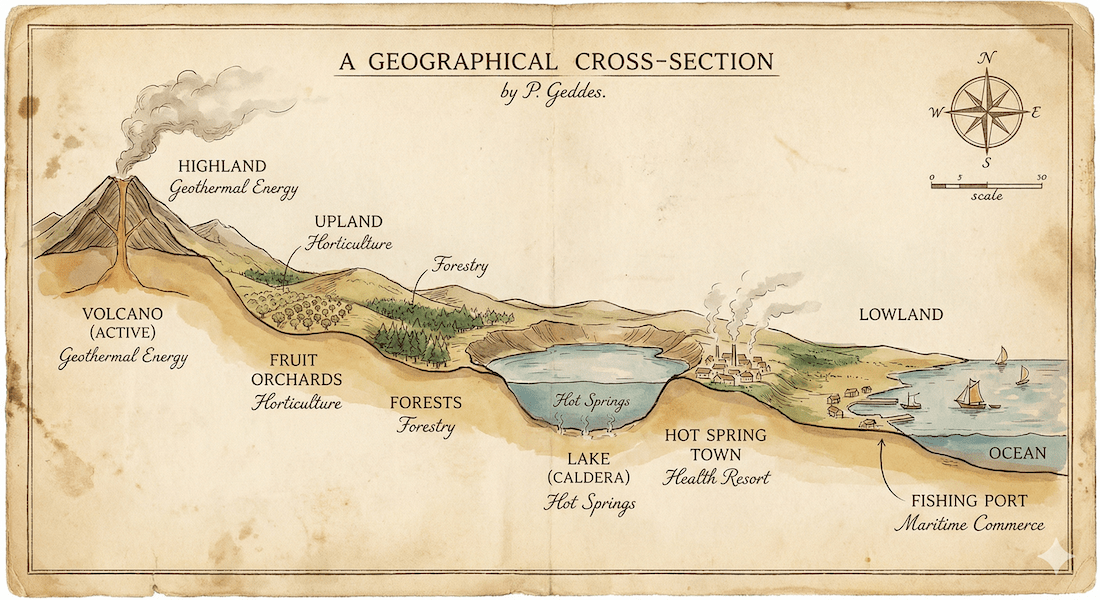
The most visually powerful tool in Geddes's theory is known as the "Valley Section," a model that uses a cross-section of a river basin, stretching from the mountains through the plains to the coast, to show how topographical conditions determine human occupations and social structures.
While urban planning typically uses flat (two-dimensional) maps, Geddes adopted a vertical (cross-sectional) perspective to visualize the flow of materials and energy from upstream to downstream, as well as the continuity of people's activities. He believed that each place gave rise to its own unique work ethic and spirituality, from the "miners and hunters" at the source of the river, to the "shepherds" on the plateau, the "farmers" on the plains, and the "merchants and fishermen" at the mouth of the river.
So, what happens when we superimpose this classical model on the modern-day Lake Toya/Mount Usu area? Surprisingly, we find a textbook-quality, vivid "modern valley section."
[Illustration: Volleyball section in the Toyako area]
(Highlands)
(Uplands)
(Lowlands/City)
(Estuary/Sea)
- ●Highlands (miners): A source of earth energy. Geothermal heat, steam, and awe. The source of the risks and benefits that active volcanoes bring.
- ●High ground (farmers and shepherds): The blessings of volcanic ash soil. Natural management and cultivation through orchards. Agriculture on well-drained plateaus.
- ●Lowland (city): A hub for interaction and consumption. A place where tourists and residents can mingle. Utilizing the hot spring resource.
- ●Sea (fisherman): A connection with the open sea. A scallop farming site that receives minerals from the mountains. A point of contact with the global economy.
The risk of climate change breaking the chain
On further analysis, the perspective of this valley section highlights the essence of the current climate change issue. In recent years, Funka Bay (Uchiura Bay) has been facing issues such as poor growth and mass mortality of young scallops, which are cultivated as a major industry in the region.
Research is currently being conducted into the causes of this, which are not a single factor, but rather a complex range of changes in the marine environment, including high water temperatures, the development of ocean stratification, and changes in the food environment. From Geddes's comprehensive perspective, this is not an issue that can be resolved solely by the ocean. We must also consider the possibility that weather changes and changes in watershed recharge functions in the "mountains (place)" are affecting the fishing environment, which is "work at sea (sea)," through the river, as a chain reaction throughout the entire river basin.
In the traditional vertically divided government, forest damage was handled by separate departments, such as the Forestry Agency or the Hokkaido Prefectural Government's Forestry Division, and fisheries resource issues by the Fisheries Agency or the Fisheries Division. However, the idea conceived by Geddes 100 years ago of "planning the entire watershed as a single unit" provides an essential framework for understanding these issues in an integrated manner and seeking solutions.
3. "Research, analysis, and planning" - Creating a regional medical record
"There can be no treatment without diagnosis." For Geddes, urban planning was the same process as a doctor examining a patient. He severely criticized development based on intuition or political considerations,"Survey - Analysis - Plan"A scientific procedure was established.
It is important to note that the "survey" that Geddes referred to goes beyond mere demographic statistics and surveying. He advocated a "synoptic survey," which described all the elements that make up a region, from its geology, weather, and vegetation to its history, folklore, and the emotions of its people.
The current state and challenges of "Folk" as seen through data
So what is the current state of the "Folk" (people) in Toyako Town today? Looking at the published statistical data, we can see that the "disease" of population decline is progressing silently but surely.
[Chart: Comparison of Toyako Town's population trends and number of tourists]
On the other hand, the number of tourists visiting Toyako Town alone is as follows:
Source: Created by the author based on the Hokkaido Prefectural Government's "Hokkaido Tourist Visitor Survey (by Municipality)" annual editions
The evacuation of the entire town following the eruption of Mount Usu in 2000 left a deep scar on the town's demographics, and the population has continued to decline due to a declining birthrate and aging population. However, the number of tourists visiting the town remains at over 2 million per year, and they are an important pillar supporting the local economy.
How can we bridge the gap between the declining resident population and the increasing number of visitors (tourists)? From Geddes's perspective, simply increasing the number of tourists and encouraging them to spend is not enough. How can we get tourists (temporary folk) to become deeply involved in the local "place" and "work" and play a part in maintaining the region as a related population? Geoparks' educational programs and experiential tours can be seen as important attempts to design exactly this point of contact.
4. Disaster Remains as "Conservative Surgery"
Preserving what was destroyed as a storage device
Geddes disliked drastic methods such as slum clearance, which involved destroying and rebuilding existing towns. Instead, he advocated"Conservative Surgery"This is an extremely delicate approach that respects the city's history and existing community to the fullest extent possible, carefully removing only the diseased parts and restoring healthy functions.
It is no exaggeration to say that Toyako Town's preservation and utilization of "disaster remains" embodies this spirit of "conservative surgery" in the present day. Normally, buildings that collapse in disasters tend to be quickly removed as they are seen as "dangerous" or "tragic memories." However, Toyako Town has chosen to preserve the hospital that collapsed in the 1977 eruption, the roads that were submerged in the 2000 eruption, and the damaged apartment buildings "as is."
At first glance, these may appear to be "negative heritage," but in Geddes's context, they have been transformed into essential "organs" for conveying the history of the region and the ferocity of nature to future generations. Rather than remaking everything, even the scars are incorporated as part of the region's identity (folk memory), and new value is given to them in the form of disaster prevention education and tourism (work).
This initiative, which transforms the "memory of destruction" into "wisdom for living," is like surgery by a master surgeon, restoring the city's memory without erasing it.
Civic Education: The Role of Volcano Meisters
Another essential element of Geddes's theory of surveys is that they should not be conducted solely by experts, but by citizens themselves. He believed that "investigating and understanding the area in which one lives (civic survey)" was what fostered true citizenship.
The "Lake Toya and Mount Usu Volcano Meister" program, which began in 2008, is the embodiment of this ideal. Local residents study the mechanisms of volcanoes and the history of the region together with scientists, and are then certified after passing an exam. This system goes beyond simply training tourist guides. It is a process in which the local residents themselves become "observers" of the region, and then "educators" who translate and pass on that knowledge to the next generation and visitors.
As of 2024, many Meisters are active in the fields of school education, disaster prevention drills, and tourist guides. They are no longer passive entities that are unilaterally given plans by the government, but have evolved into active people who autonomously promote the value of their region.
5. Towards a "Neotechnics" Future
Moving away from paleotechnics
Geddes derided the technological system of the early Industrial Revolution, which relied on coal and steam engines and produced black smoke and slums, calling it "paleotechnics." He predicted a coming age of "neotechnics," a society that would restore humanity through electricity and clean technology.
This prediction coincides surprisingly well with the current shift to a carbon-neutral society. Toyako Town's "Zero Carbon City Declaration" announced in January 2023 (Reiwa 5) can be seen as a declaration of a transition to a modern version of neotechnics.
| Policy Areas | Specific initiatives |
|---|---|
| Renewable Energy (Local production for local consumption) |
We are considering the introduction of a snow cooling system that utilizes the abundant geothermal resources, such as hot spring heat and heat pumps, and snow, a winter nuisance, as a cooling energy source. |
| Architecture and Living Environment (Improvement of quality of life) |
Support for improving insulation performance (ZEH), which is unique to cold regions. This not only reduces energy costs but also directly affects the health of residents (protection of the Folk) by preventing heat shock. |
| Transportation/Movement (Clean arteries) |
Development of EV (electric vehicle) charging infrastructure. Securing emission-free transportation by introducing secondary transportation (green slow mobility, etc.) as a tourist destination. |
What is particularly noteworthy is the attempt to utilize resources specific to the place, such as geothermal energy and snow, as energy sources. This breaks away from an economic structure that continues to purchase fossil fuels from outside, and instead circulates resources at the site. This is exactly what Geddes envisioned as the "circulation of energy and materials within the region."
Conclusion: "Think Global, Act Local" resonates across 100 years
One aphorism strongly associated with the thought of Patrick Geddes is "Think Global, Act Local." There are various theories about the exact origin of this phrase itself, and it is often attributed to later thinkers such as René Dubos, but there is no doubt that Geddes's regional planning ideas are one of its spiritual origins.
The practices at Lake Toya-Usuzan Geopark are re-examining the original meaning of this word. We must understand the 110,000-year history of the Earth (Global/Place) and, based on that, design our lives and tourism for today and tomorrow (Local/Work). We must also inherit the memory of disasters and live as wise citizens (Folk).
The prescriptions that Geddes gave us as an "urban physician" from Scotland 100 years ago are not just something found in old books. In today's Japan, where we are struggling with the twin storms of climate change and population decline, they are an extremely practical compass for restoring the "health" of our communities.
"Investigate and you will see." Geddes' voice still reverberates beneath our feet, like the fumes of Mount Usu.
Related Links
- Lake Toya and Mount Usu Geopark Official Website
- Ministry of the Environment: Regional Circulation and Coexistence Zone Portal Site
- Toyako Town Declares Itself a Zero Carbon City
Inquiries and requests
We help solve local issues.
Please feel free to contact us even if it is a small matter.