〜The true value of Ebenezer Howard's "garden city" was not its lush landscape, but its economic system that returned land value to the community.〜
*This article is based on information as of January 2026.
When we hear the term "garden city," what image comes to mind for those of us living in modern Japan?
Perhaps it is the beautiful residential areas surrounded by hedges that lie just a few minutes away by train from the city center, or the former newly developed residential areas known as "new towns." However, would you be surprised if I told you that these are merely superficial imitations of the grand idea of the "garden city"?
The fact that its origin, Letchworth Garden City in the UK, is not simply a green commuter town, but a "huge economic machine" with its own revenue streams that continues to autonomously reinvest in the region, is little known in Japan outside of urban planning experts.
This urban model, conceived by social reformer Ebenezer Howard at the end of the 19th century, was a historic experiment that challenged the foundation of capitalism, "private ownership of land," and implemented a system of "publicizing wealth." Surprisingly, far from failing, the experiment continues to evolve even today in the 21st century, run by a non-profit organization with net assets of approximately 50 billion yen.
This article examines the Letchworth Heritage Foundation's latest financial report (2024 edition) and historical changes in detail, while dissecting the secrets of its sustainable urban management. Furthermore, in a time when Japan is facing an "era of shrinkage" due to population decline and fiscal contraction, how can tourist destinations such as Toyako Town in Hokkaido apply this model to achieve both "relationship design" and "capital maximization"? We will thoroughly examine specific strategies.
1. Ebenezer Howard's Thoughts and the True Meaning of the "Three Magnets"
The Shadow of the Industrial Revolution and the Third Way
Let's turn the clock back to 1898. Britain was at the height of its industrial revolution, but behind the light was a dark shadow.
Big cities like London were overflowing with workers looking for work, resulting in extreme overcrowding, unsanitary conditions, and soaring rents, creating slums. Meanwhile, rural areas were suffering from depopulation and economic stagnation due to the outflow of young people. "Overcrowded cities" and "declining rural areas." In response to this deadlocked dichotomy, Ebenezer Howard, a court stenographer and self-taught social thinker, proposed a completely new third way.
In his book Tomorrow: A Peaceful Path to True Reform (later renamed Garden Cities of Tomorrow), he presented an illustration of the "Three Magnets," which has become extremely famous in the history of urban planning.
- First magnet: Town There are social opportunities, high wages, and entertainment, but also high rents, polluted air, and isolation from nature.
- Second magnet: Country There's natural beauty, fresh air, and low rent, but also social isolation, low wages, and a lack of entertainment.
- Third Magnet: Town-Country A utopia that combines the vitality of the city with the nature of the countryside, eliminating the drawbacks of both.
However, Howard's true innovation was not simply in his vision of a "green city." The core of his vision was his redesign of the "profit stream" generated by urban development.
Returning money to society through "Unearned Increment"
As cities develop and people gather, the value of land inevitably rises. In economic terms, this is called the "unearned increment." While this profit usually goes into the pockets of individual landowners, Howard defined it as "community-created value."
"Land prices rise because people gather there. So shouldn't the profits from that rise be used for the benefit of the people?"
Howard's answer to this question was the "public ownership (or trust holding) of the land" in Garden City. Rather than selling off the land piece by piece, the city management body would own it all in one lump sum and collect "rate-rent" from residents. As the city developed, the rent income increased and was reinvested in the city's infrastructure and welfare. This "system of value circulation" was the blueprint for Letchworth.
2. 120 Years of Letchworth: A Chronicle of Ideals and Crisis
▼ Location of Letchworth Garden City (approximately 50km north of London)
In 1903, construction of the world's first garden city began to realize Howard's vision. However, the road to its completion was not an easy one.
The hostile takeover crisis of the 1960s
When the town was first established, a company called "First Garden City Ltd" led the development, but its articles of incorporation limited dividends to 5%, with any surplus profits to be used for the town. In the early days, infrastructure investment was heavy and management was extremely difficult, but after half a century, as the town matured, the company began to accumulate huge unrealized gains.
This is where things began. In the early 1960s, a company called Hotel York set its sights on this unrealized profit and launched a hostile buyout of First Garden City Ltd's shares. Their goal was to abolish Howard's philosophy of "unitary land management" and sell off the land piece by piece to make short-term profits.
This meant the death of Garden City. However, residents and the local government reacted strongly and petitioned Parliament. As a result, in 1962 the publicly-held Letchworth Garden City Corporation was established, and the assets were forcibly transferred, resulting in a dramatic outcome. After further legislation in 1995, the site was succeeded by the current Letchworth Garden City Heritage Foundation.
This historical fact teaches us that noble ideals alone cannot protect a city, and that legal ``breakwaters'' are necessary.
3. Astonishing Financial Data: "Second Finance" Generated by Assets of 50 Billion Yen
So, what is Letchworth's current economic situation? We will analyze its strong financial foundation based on the "LGCHF Report & Accounts to 31 December 2024."
Analysis of asset and revenue structure for fiscal year 2024
| Financial items (end of 2024) | Amount (pounds) | Japanese Yen Equivalent (approximate) | Remarks and details |
|---|---|---|---|
| Investment property valuation | £ 224,844,000 | Approximately 42.7 billion yen | Commercial, industrial, residential, agricultural, etc. |
| Other investments/cash | £ 29,653,000 | Approximately 5.6 billion yen | Other investments £13.7m + cash £15.9m |
| Net Assets (Net Assets / Funds) | £ 267,749,000 | Approximately 50.8 billion yen | City's total net assets (funds) |
| Total Income | £ 14,420,000 | Approximately 2.7 billion yen | Mainly real estate rental income |
| Charitable expenditures and grants | £ 7,071,000 | Approximately 1.3 billion yen | Activity expenditure £6.5m + grants £0.5m |
*The exchange rate is calculated as £1 = 190 yen (estimated as of January 2025).
*You can view the table by scrolling horizontally.
It is worth noting that while its main source of funding is income from investment property, its total annual income reaches approximately 2.7 billion yen (£14.4m).
The foundation will use this income as its source of funds in 2024.Approximately 1.3 billion yen (over £7 million)on charitable activities and grants for the community, which is entirely separate from Council tax revenue.
Many local governments in Japan are forced to close community centers and cultural facilities because they cannot even raise the maintenance costs, but Letchworth uses its own financial resources to maintain its historic Broadway Cinema & Theatre, operate an educational farm, and provide grants to residents. Although it also makes use of external grants receivable, it has fundamentally achieved financial resilience by supporting local services with revenue generated from its own assets.
4. Japan-UK Comparison: Why are Japan's new towns becoming "old towns"?
In Japan, there were many projects influenced by Howard, such as the development of Denenchofu by Eiichi Shibusawa and Tama New Town during the period of rapid economic growth. However, after 100 years, the two have clearly differed in their pros and cons.
While many new towns in Japan are facing the problems of becoming "old towns" due to aging infrastructure, an aging population, and a lack of funds to renovate, Letchworth continues to increase its asset value. What is the decisive difference?
The limitations of the "one-time sale model"
The biggest difference is where the development profits (capital gains) are attributed.
Developers develop land, sell it to individuals, lock in profits, and then withdraw from the town. Even if the town develops and land prices rise, the profits simply become the assets of the individual landowners, and there is no system in place to pool them as infrastructure renewal costs for the entire town.
Result: Infrastructure renewal relies on tax revenue, and financial resources are depleted due to population decline.
The foundation will not give up the freehold of the land, but will instead "lease" or "hold under management." If the town becomes more attractive and land rents and tenant fees increase, this will become income for the foundation and become a source of funds for future investments.
Result: A perpetual cycle is created in which the growth of the city directly leads to increased financial resources.
In other words, Japan's new towns were slash-and-burn agriculture-style businesses that "sold the products and that was it," while Letchworth was a stock-utilization business that "cultivated orchards and continued to harvest fruit." This structural flaw can be said to be one of the fundamental causes of the problems currently plaguing Japanese local governments.
5. Strategic Recommendation: Implementation of "Modern Land Rent" in Toyako Town, Hokkaido
Based on the analysis so far, let's shift our focus to modern Japan, specifically the town of Toyako in Hokkaido, which is the subject of our research. In Japan, where the legal system is different, it is impossible to publicize all land at this point. However, it is entirely possible to apply Letchworth's "mechanism."
▼ Toyako Town, Hokkaido (tourist hub within the national park)
Shrinking population and "commoning tourism resources"
According to Toyako Town's population vision, the population, which was approximately 10,000 in 2015, is predicted to plummet to approximately 5,300 in 2040 and approximately 3,000 in 2060. With taxpayers halving, it will be physically impossible to maintain the current infrastructure.
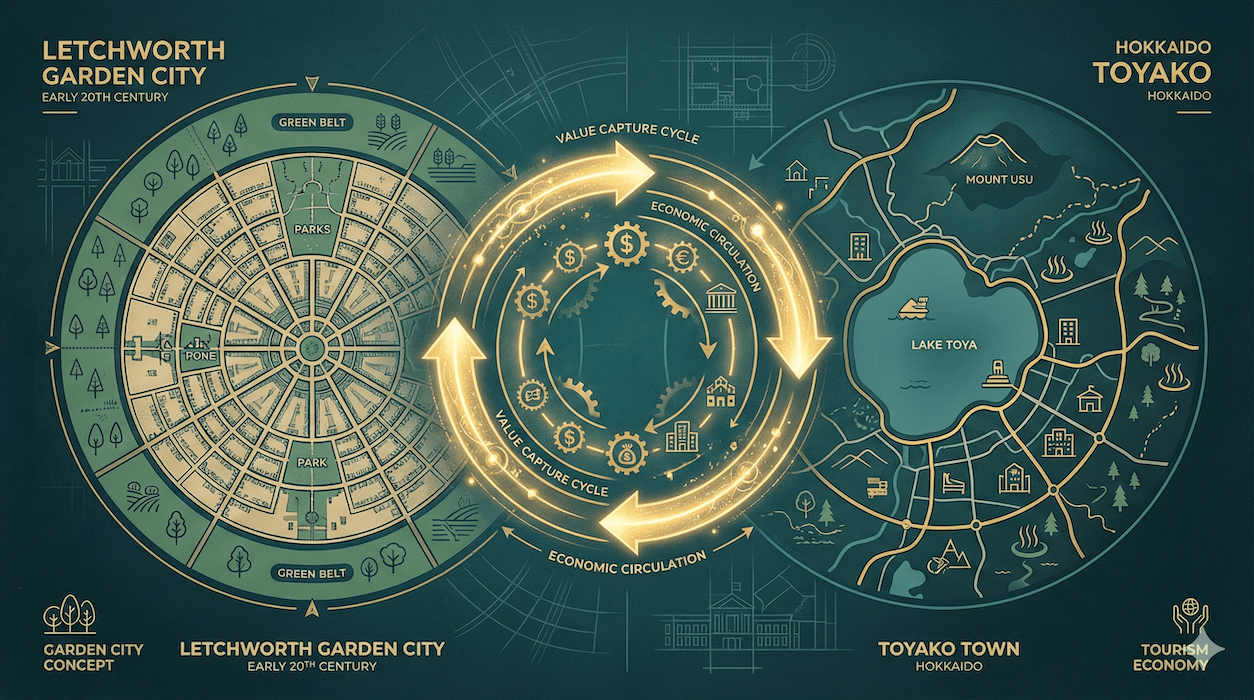
The key to this is the "accommodation tax" that is scheduled to be introduced from April 2026 (Reiwa 8). There has been much discussion about this, but in this article, we will look at this accommodation tax not as a simple tax, but in the context of Letchworth."Modern Rate-Rent"I propose to redefine it as
[Diagram] Value circulation model in Toyako Town (proposal)
Consuming the "value" of Lake Toya
Separating it from the general account and limiting its use (ring-fencing)
(Green belt)
(Increasing asset value)
*You can view the image by scrolling horizontally.
Transition to "Stewardship"
One of the reasons for Letchworth's success is that it has "not buried its revenue in general administrative expenses (black holes such as road repairs) but instead focused on investments that increase the town's appeal."
Toyako Town should also clearly redirect the estimated annual accommodation tax revenue of approximately 150 million yen to investment in the future, rather than using it to cover existing deficits. Specifically, a semi-public, semi-private DMO (Destination Management Organization) like the Letchworth Heritage Foundation should manage this money and strategically invest it in "removing abandoned hotels and turning them into green spaces" and "developing high-value-added experiential content."
This will increase the landscape value (brand) of the town as a whole, attracting more tourists and higher-paying guests. Creating this virtuous cycle is the very essence of "maximizing capital" in a time of population decline, and is the greatest lesson we can learn from Letchworth.
Conclusion: From ownership to stewardship
The Garden City that Ebenezer Howard dreamed of 120 years ago was not just an idyllic utopia. It was an extremely cool-headed and rational economic system in which the finite resource of land was managed by the community and the resulting wealth was circulated fairly.
With Japan's steady economic growth coming to an end and a declining population certain to come, what we should aim for is not the disorderly expansion of cities, but rather the redefinition of our current assets - beautiful nature, hot springs, and the relationships between people - as "commons" (shared assets) and the careful stewardship that goes into maintaining them.
The reason why black squirrels can still roam Letchworth Wood is because the "profit-making system" for protecting the forest is solid. In order to talk about romance, we must do the math (maximize capital). Toyako Town, and other regional cities in Japan, still has plenty of potential.
Related Links
- Letchworth Garden City Heritage Foundation (official website and annual report)
- Cabinet Office: Digital Garden City-State Initiative
- Toyako Town Population Vision and Comprehensive Strategy
Inquiries and requests
We help solve local issues.
Please feel free to contact us even if it is a small matter.